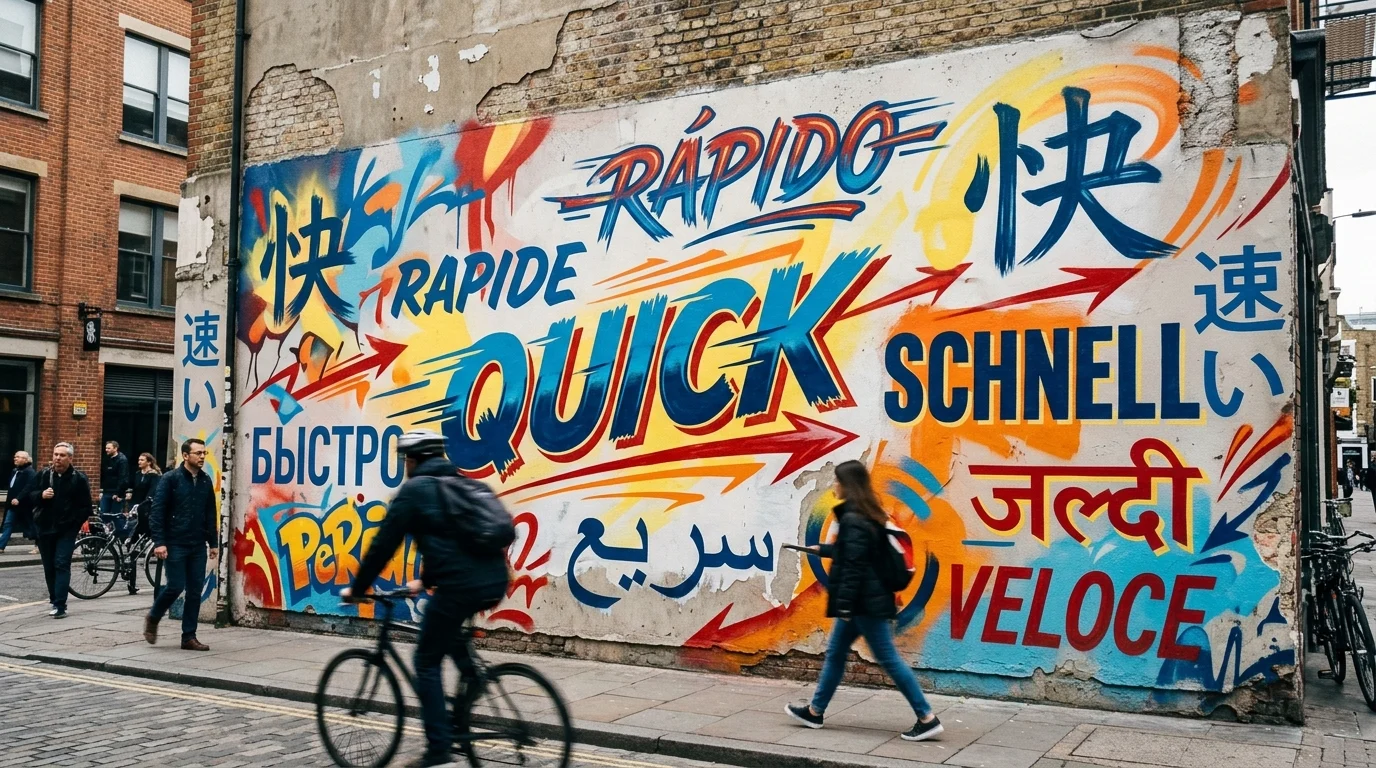
The word “quick” is useful in everyday conversations, whether you want someone to hurry, describe a fast action, or explain that something takes very little time. Although English speakers use “quick” in many situations, other languages express the same idea with different words depending on context.
Learning how to say quick in different languages helps you communicate while traveling, understand foreign films, learn new vocabulary, and connect with people from different cultures.
In this guide, you will discover quick translations in 70 languages, including native phrases, easy English pronunciations, and practical example sentences with English meanings. Whether you are looking for quick in all languages for language learning, writing, or general knowledge, this list makes it easier to find the right expression.
One important detail: “quick” can mean fast, rapid, or taking little time. Some languages use different words depending on whether you describe a person, an action, or a task. The translations below focus mainly on the common meaning of “fast” or “quickly,” with examples that show natural usage.
How to Say “Quick” in Different Languages: 70 Translations
The table below covers common ways to express “quick” and “quickly” across Europe, Asia, Africa, the Middle East, and other regions. Pronunciations are approximate guides for English speakers; regional accents may differ.
1. European Languages (1–10)
| No. | Language | Native Phrase | Pronunciation | Example Sentence | English Meaning |
|---|---|---|---|---|---|
| 1 | Spanish | Rápido | RAH-pee-doh | ¡Date prisa, rápido! | Hurry up, quickly! |
| 2 | French | Rapide | rah-PEED | C’est un travail rapide. | It is a quick job. |
| 3 | German | Schnell | shnel | Mach schnell! | Be quick! |
| 4 | Italian | Veloce | veh-LOH-cheh | È una soluzione veloce. | It is a quick solution. |
| 5 | Portuguese | Rápido | HAH-pee-doo | Foi um processo rápido. | It was a quick process. |
| 6 | Dutch | Snel | snel | Kom snel! | Come quickly! |
| 7 | Swedish | Snabb | snahb | Det går snabbt. | It goes quickly. |
| 8 | Norwegian | Rask | rahsk | Det var en rask beslutning. | It was a quick decision. |
| 9 | Danish | Hurtig | HOOR-tee | Det var en hurtig løsning. | It was a quick solution. |
| 10 | Finnish | Nopea | NOH-peh-ah | Se oli nopea vastaus. | It was a quick answer. |
2. European Languages (11–20)
| No. | Language | Native Phrase | Pronunciation | Example Sentence | English Meaning |
|---|---|---|---|---|---|
| 11 | Icelandic | Fljótur | FLYOH-tur | Hann er fljótur. | He is quick. |
| 12 | Irish | Tapaidh | TOP-ee | Bí tapaidh! | Be quick! |
| 13 | Welsh | Cyflym | kuh-VLIM | Mae hi’n gyflym. | She is quick. |
| 14 | Polish | Szybki | SHIB-kee | To szybka odpowiedź. | This is a quick answer. |
| 15 | Czech | Rychlý | RIKH-lee | To bylo rychlé. | That was quick. |
| 16 | Slovak | Rýchly | REEKH-lee | To bola rýchla odpoveď. | That was a quick answer. |
| 17 | Slovenian | Hiter | HEE-ter | To je hiter način. | This is a quick method. |
| 18 | Croatian | Brz | brzh | To je brz odgovor. | That is a quick answer. |
| 19 | Serbian | Брз (Brz) | brzh | То је брз одговор. | That is a quick answer. |
| 20 | Bulgarian | Бърз (Bǎrz) | burz | Това беше бързо. | That was quick. |
3. European and Middle Eastern Languages (21–30)
| No. | Language | Native Phrase | Pronunciation | Example Sentence | English Meaning |
|---|---|---|---|---|---|
| 21 | Russian | Быстрый (Bystryy) | BIS-triy | Это быстрый способ. | This is a quick method. |
| 22 | Ukrainian | Швидкий (Shvydkyi) | shvid-KEE | Це швидка відповідь. | This is a quick answer. |
| 23 | Greek | Γρήγορος (Grígoros) | GREE-go-ros | Είναι γρήγορος. | He is quick. |
| 24 | Romanian | Rapid | rah-PEED | A fost un răspuns rapid. | It was a quick answer. |
| 25 | Hungarian | Gyors | dyorsh | Ez gyors megoldás. | This is a quick solution. |
| 26 | Albanian | I shpejtë | ee SHPEY-tuh | Ai është i shpejtë. | He is quick. |
| 27 | Turkish | Hızlı | huhz-luh | Bu hızlı bir çözüm. | This is a quick solution. |
| 28 | Arabic | سريع (Sarīʿ) | sah-REE | هذا حل سريع. | This is a quick solution. |
| 29 | Hebrew | מהיר (Mahir) | mah-HEER | זה פתרון מהיר. | This is a quick solution. |
| 30 | Persian | سریع (Sari’) | sah-REE | این یک راه سریع است. | This is a quick way. |
4. South Asian Languages (31–40)
| No. | Language | Native Phrase | Pronunciation | Example Sentence | English Meaning |
|---|---|---|---|---|---|
| 31 | Urdu | جلدی (Jaldi) | JUL-dee | جلدی آؤ۔ | Come quickly. |
| 32 | Hindi | तेज़ (Tez) | tayz | यह एक तेज़ तरीका है। | This is a quick method. |
| 33 | Bengali | দ্রুত (Druto) | DROO-toh | দ্রুত এসো। | Come quickly. |
| 34 | Punjabi | ਤੇਜ਼ (Tez) | tayz | ਜਲਦੀ ਆਓ। | Come quickly. |
| 35 | Gujarati | ઝડપી (Jhadpi) | JHUHD-pee | ઝડપથી આવો. | Come quickly. |
| 36 | Marathi | जलद (Jalad) | juh-LUHD | लवकर या. | Come quickly. |
| 37 | Nepali | छिटो (Chhito) | CHHEE-toh | छिटो आउनुहोस्। | Please come quickly. |
| 38 | Sinhala | ඉක්මන් (Ikman) | ICK-mun | ඉක්මනින් එන්න. | Come quickly. |
| 39 | Tamil | விரைவான (Viraivāna) | vee-ry-vah-nah | விரைவாக வாருங்கள். | Please come quickly. |
| 40 | Telugu | వేగంగా (Vēgaṅgā) | VAY-gun-gah | త్వరగా రండి. | Please come quickly. |
5. Asian Languages (41–50)
| No. | Language | Native Phrase | Pronunciation | Example Sentence | English Meaning |
|---|---|---|---|---|---|
| 41 | Kannada | ವೇಗವಾಗಿ (Vēgavāgi) | VAY-guh-vah-gee | ಬೇಗ ಬನ್ನಿ. | Come quickly. |
| 42 | Malayalam | വേഗത്തിൽ (Vēgathil) | VAY-guh-thil | വേഗം വരൂ. | Come quickly. |
| 43 | Mandarin Chinese | 快 (Kuài) | kwye | 快一点! | Hurry up! |
| 44 | Cantonese | 快 (Faai3) | faai | 快啲! | Hurry up! |
| 45 | Japanese | 速い (Hayai) | hah-yah-ee | 返事が速いです。 | The reply is quick. |
| 46 | Korean | 빠른 (Ppareun) | ppah-reun | 빠른 답변이에요. | It is a quick reply. |
| 47 | Vietnamese | Nhanh | nyahn | Làm nhanh lên! | Hurry up! |
| 48 | Thai | เร็ว (Reo) | reow | เร็วหน่อย! | Hurry up! |
| 49 | Indonesian | Cepat | chuh-paht | Cepatlah datang! | Come quickly! |
| 50 | Malay | Cepat | chuh-paht | Datang cepat! | Come quickly! |
6. Asian and African Languages (51–60)
| No. | Language | Native Phrase | Pronunciation | Example Sentence | English Meaning |
|---|---|---|---|---|---|
| 51 | Filipino (Tagalog) | Mabilis | mah-BEE-lis | Mabilis siyang sumagot. | He or she answered quickly. |
| 52 | Burmese | မြန် (Myan) | myahn | မြန်မြန်လာပါ။ | Please come quickly. |
| 53 | Khmer | លឿន (Loeun) | luhn | មកឱ្យលឿន។ | Come quickly. |
| 54 | Lao | ໄວ (Vai) | vai | ມາໄວໆ. | Come quickly. |
| 55 | Mongolian | Хурдан (Hurdan) | hoor-dahn | Хурдан ирээрэй. | Please come quickly. |
| 56 | Kazakh | Жылдам (Jyldam) | zhuhl-dahm | Жылдам кел! | Come quickly! |
| 57 | Uzbek | Tez | tez | Tez kel! | Come quickly! |
| 58 | Swahili | Haraka | hah-RAH-kah | Njoo haraka! | Come quickly! |
| 59 | Amharic | ፈጣን (Fetan) | fuh-TAHN | በፍጥነት ና። | Come quickly. |
| 60 | Somali | Degdeg | deg-deg | Si degdeg ah u kaalay. | Come quickly. |
7. African and Other Languages (61–70)
| No. | Language | Native Phrase | Pronunciation | Example Sentence | English Meaning |
|---|---|---|---|---|---|
| 61 | Hausa | Da sauri | dah sow-ree | Zo da sauri. | Come quickly. |
| 62 | Yoruba | Yára | YAH-rah | Wá yára! | Come quickly! |
| 63 | Igbo | Ngwa ngwa | ngwah ngwah | Bịa ngwa ngwa. | Come quickly. |
| 64 | Zulu | Ngokushesha | ngoh-koo-SHEH-shah | Woza ngokushesha. | Come quickly. |
| 65 | Xhosa | Ngokukhawuleza | ngoh-koo-khah-LEH-zah | Yiza ngokukhawuleza. | Come quickly. |
| 66 | Afrikaans | Vinnig | FIN-ikh | Kom vinnig! | Come quickly! |
| 67 | Malagasy | Haingana | high-NGAH-nah | Avia haingana! | Come quickly! |
| 68 | Haitian Creole | Vit | veet | Vini vit! | Come quickly! |
| 69 | Esperanto | Rapida | rah-PEE-dah | Ĝi estas rapida solvo. | It is a quick solution. |
| 70 | Latin | Celer | KAY-ler | Responsum celer est. | The answer is quick. |
Publishing tip: For better readability on mobile, keep each table under its own H2 heading, as shown above. Before publishing, verify individual translations and example sentences with a reliable native-language source, especially where the phrase changes according to grammar or context.
Translation note: These examples illustrate common expressions rather than claiming that one word works in every grammatical situation. Some entries use an adjective meaning “quick,” while others use an adverb or a natural expression meaning “quickly” or “hurry up.”
What Does “Quick” Mean in Different Languages?
The English word “quick” generally describes something that happens fast or takes little time. Depending on the sentence, it can describe a person, an action, a response, or a process.
For example:
- A quick answer: A response given without much delay.
- A quick person: Someone who moves or reacts fast.
- Do it quickly: Complete an action without wasting time.
- A quick break: A short period of rest.
When learning quick translations, it helps to distinguish between an adjective, such as “quick,” and an adverb, such as “quickly.” Many languages change the word’s form or use a different expression to communicate these meanings naturally.
Why Does the Word “Quick” Change Across Languages?
Languages have different grammar rules, pronunciation systems, and cultural conventions. A direct word-for-word translation may therefore sound unnatural in everyday conversation.
- In Spanish, for example, rápido can describe something fast, while rápidamente means “quickly.” In French, rapide is an adjective, whereas rapidement is an adverb. In Mandarin Chinese, 快 (kuài) can convey speed, and the surrounding words help establish the intended meaning.
These differences are important when searching for “quick in all languages.” The best translation depends on how the word is being used.
How to Say “Quick” in Different Languages in Everyday Conversations
If you want to use quick translations naturally, start with short expressions that you can remember easily. These phrases are especially useful when traveling, talking with friends, or learning a new language.
Here are five practical examples:
- Spanish: ¡Rápido! — Quickly!
- French: Dépêche-toi ! — Hurry up!
- German: Beeil dich! — Hurry up!
- Japanese: 早く! (Hayaku!) — Quickly!
- Urdu: جلدی کرو! (Jaldi karo!) — Hurry up!
Notice that these expressions do not always translate word for word into English. Instead, they communicate the intended message naturally.
Easy Tips for Memorizing “Quick” Translations
Learning 70 translations at once can feel challenging. These simple techniques can help you remember them more effectively.
1. Learn five words at a time. Choose a small group of languages and practice their translations before moving on.
2. Practice with complete sentences. Remembering a word in context is often easier than memorizing a translation alone.
3. Say each word aloud. Pronunciation practice helps you recognize unfamiliar sounds and become more comfortable speaking.
4. Compare related languages. Spanish, Italian, and Portuguese share some similar vocabulary, although their pronunciation and grammar differ.
5. Review regularly. Revisit the words after one day, three days, and one week to reinforce your memory.
When Should You Use “Quick” or “Quickly”?
Although these words are closely related, they serve different grammatical purposes in English.
| Word | Usage | Example |
|---|---|---|
| Quick | Describes a noun | We need a quick answer. |
| Quickly | Describes an action | Please answer quickly. |
| Fast | Describes speed | She is a fast runner. |
| Hurry up | Tells someone to act faster | Hurry up or we’ll be late! |
Understanding these distinctions makes it easier to choose accurate quick translations in other languages. It also helps you avoid mistakes when creating sentences for travel, school, work, or everyday conversation.
Frequently Asked Questions
1. How do you say “quick” in different languages?
The word varies by language. Examples include rápido in Spanish, rapide in French, schnell in German, veloce in Italian, and 快 (kuài) in Mandarin Chinese.
2. What is the most common word for “quick” around the world?
There is no single word used worldwide. Each language has its own vocabulary and grammar. Words such as rápido, schnell, cepat, and 快 are common ways to express speed in their respective languages.
3. How do you say “quickly” in 70 languages?
The table above provides 70 language translations and practical examples. Some entries use words that directly mean “quickly,” while others use natural commands such as “Come quickly!” or “Hurry up!” because the most appropriate form depends on the context.
4. What is the difference between “quick” and “fast” in other languages?
Both words can describe speed, and some languages use the same word for both meanings. In other languages, the choice depends on whether you describe a person, an action, a response, or a process.
5. What is the easiest way to learn quick in all languages?
Start with languages you encounter most often, practice the pronunciation, and use each translation in a short sentence. Reviewing a few words daily is generally more manageable than trying to memorize all 70 at once.
Conclusion
Learning how to say quick in different languages is a simple way to expand your vocabulary and improve cross-cultural communication. From rápido in Spanish to schnell in German and kuài in Mandarin Chinese, every language offers its own way to express speed and urgency.
Use this list of 70 translations as a practical reference, practice the example sentences, and pay attention to the differences between “quick,” “quickly,” and “hurry up.” With regular practice, these useful expressions can become part of your everyday vocabulary.

I am Ricardo Hunter, Administrator at LingoBuz, passionate about languages, translations, and global communication. I help create useful, clear content that makes exploring different languages simple, enjoyable, and accessible.