Knowing how to ask “what time is it?” in different languages is a useful skill for travelers, language learners, students, and anyone who enjoys communicating with people from different cultures. A simple question about the time can help you start conversations, navigate unfamiliar places, and understand everyday expressions.
In this guide, you will find what time is it in all languages represented below, with the original phrase, an easy English pronunciation, and a practical example sentence. These “what time is it” translations cover 70 languages from different regions, making it easy to compare how people ask about the time around the world.
What Time Is It in Different Languages?
The English phrase “What time is it?” is commonly used to ask someone for the current time. Although the meaning is the same, languages differ in sentence structure, vocabulary, and pronunciation.
Here are 70 ways to ask “What time is it?” in different languages:
| # | Language | Native Phrase | Easy English Pronunciation | Example Sentence | English Meaning |
|---|---|---|---|---|---|
| 1 | English | What time is it? | Wut time iz it? | What time is it now? | What is the current time now? |
| 2 | Spanish | ¿Qué hora es? | Keh OR-ah ess? | ¿Qué hora es ahora? | What time is it now? |
| 3 | French | Quelle heure est-il ? | Kel uhr eh-TEEL? | Quelle heure est-il maintenant ? | What time is it now? |
| 4 | German | Wie spät ist es? | Vee shpayt ist ess? | Wie spät ist es jetzt? | What time is it now? |
| 5 | Italian | Che ore sono? | Kay OR-eh SOH-noh? | Che ore sono adesso? | What time is it now? |
| 6 | Portuguese | Que horas são? | Kay OR-as sow? | Que horas são agora? | What time is it now? |
| 7 | Dutch | Hoe laat is het? | Hoo laat iz het? | Hoe laat is het nu? | What time is it now? |
| 8 | Swedish | Vad är klockan? | Vah air KLOK-an? | Vad är klockan nu? | What time is it now? |
| 9 | Norwegian | Hva er klokka? | Vah air KLOK-ah? | Hva er klokka nå? | What time is it now? |
| 10 | Danish | Hvad er klokken? | Vah air KLOK-en? | Hvad er klokken nu? | What time is it now? |
| 11 | Finnish | Paljonko kello on? | PAL-yon-koh KEL-loh on? | Paljonko kello on nyt? | What time is it now? |
| 12 | Icelandic | Hvað er klukkan? | Kvath air KLOO-kan? | Hvað er klukkan núna? | What time is it now? |
| 13 | Irish | Cén t-am é? | Kane tom ay? | Cén t-am é anois? | What time is it now? |
| 14 | Welsh | Faint o’r gloch ydy hi? | Faint or gloch uh-dee hee? | Faint o’r gloch ydy hi nawr? | What time is it now? |
| 15 | Scottish Gaelic | Dè an uair a tha e? | Jay an oo-ar a ha eh? | Dè an uair a tha e a-nis? | What time is it now? |
| 16 | Polish | Która jest godzina? | KTOO-rah yest goh-JEE-nah? | Która jest teraz godzina? | What time is it now? |
| 17 | Czech | Kolik je hodin? | KOH-lik yeh HO-din? | Kolik je teď hodin? | What time is it now? |
| 18 | Slovak | Koľko je hodín? | KOL-koh yeh HO-deen? | Koľko je teraz hodín? | What time is it now? |
| 19 | Slovenian | Koliko je ura? | KOH-lee-koh yeh OO-rah? | Koliko je ura zdaj? | What time is it now? |
| 20 | Croatian | Koliko je sati? | KOH-lee-koh yeh SAH-tee? | Koliko je sada sati? | What time is it now? |
| 21 | Serbian | Колико је сати? | KOH-lee-koh yeh SAH-tee? | Колико је сада сати? | What time is it now? |
| 22 | Bosnian | Koliko je sati? | KOH-lee-koh yeh SAH-tee? | Koliko je sada sati? | What time is it now? |
| 23 | Macedonian | Колку е часот? | KOL-koo eh CHA-sot? | Колку е часот сега? | What time is it now? |
| 24 | Bulgarian | Колко е часът? | KOL-koh eh cha-SUT? | Колко е часът сега? | What time is it now? |
| 25 | Russian | Который час? | Kah-TOR-ee chas? | Который сейчас час? | What time is it now? |
| 26 | Ukrainian | Котра година? | KOH-trah ho-DY-nah? | Котра зараз година? | What time is it now? |
| 27 | Belarusian | Колькі гадзін? | KOL-kee gah-DZEEN? | Колькі зараз гадзін? | What time is it now? |
| 28 | Lithuanian | Kiek dabar valandų? | Kyek DA-bar vah-LAN-doo? | Kiek dabar valandų? | What time is it now? |
| 29 | Latvian | Cik ir pulkstenis? | Tsik ir POOLK-stay-nis? | Cik tagad ir pulkstenis? | What time is it now? |
| 30 | Estonian | Mis kell on? | Mis kell on? | Mis kell praegu on? | What time is it now? |
| 31 | Hungarian | Hány óra van? | Haan-Y OR-ah van? | Hány óra van most? | What time is it now? |
| 32 | Romanian | Cât este ceasul? | Kut YES-teh CHAS-ool? | Cât este ceasul acum? | What time is it now? |
| 33 | Greek | Τι ώρα είναι; | Tee OR-ah EE-nay? | Τι ώρα είναι τώρα; | What time is it now? |
| 34 | Albanian | Sa është ora? | Sah UH-sht OR-ah? | Sa është ora tani? | What time is it now? |
| 35 | Turkish | Saat kaç? | SAH-at kach? | Saat kaç şimdi? | What time is it now? |
| 36 | Maltese | X’ħin hu? | Shin hoo? | X’ħin hu issa? | What time is it now? |
| 37 | Arabic | كم الساعة؟ | Kam as-SAA-ah? | كم الساعة الآن؟ | What time is it now? |
| 38 | Hebrew | מה השעה? | Mah ha-SHA-ah? | מה השעה עכשיו? | What time is it now? |
| 39 | Persian | ساعت چند است؟ | Saa-at chand ast? | ساعت الان چند است؟ | What time is it now? |
| 40 | Urdu | ابھی کتنے بجے ہیں؟ | Ab-hee kit-nay bajay hain? | ابھی کتنے بجے ہیں؟ | What time is it now? |
| 41 | Hindi | अभी कितने बजे हैं? | Ab-hee kit-nay bajay hain? | अभी कितने बजे हैं? | What time is it now? |
| 42 | Bengali | এখন কয়টা বাজে? | Ekhon koy-ta ba-je? | এখন কয়টা বাজে? | What time is it now? |
| 43 | Punjabi | ਹੁਣ ਕਿੰਨੇ ਵਜੇ ਹਨ? | Hun kinne vajay han? | ਹੁਣ ਕਿੰਨੇ ਵਜੇ ਹਨ? | What time is it now? |
| 44 | Gujarati | અત્યારે કેટલા વાગ્યા છે? | At-yar-ay ket-la vag-ya chhay? | અત્યારે કેટલા વાગ્યા છે? | What time is it now? |
| 45 | Marathi | आत्ता किती वाजले आहेत? | Aat-ta kit-ee vaj-lay aa-het? | आत्ता किती वाजले आहेत? | What time is it now? |
| 46 | Nepali | अहिले कति बज्यो? | Ah-hi-lay ka-tee ba-jyo? | अहिले कति बज्यो? | What time is it now? |
| 47 | Sinhala | දැන් වෙලාව කීයද? | Dan wel-a-wa kee-ya-da? | දැන් වෙලාව කීයද? | What time is it now? |
| 48 | Tamil | இப்போது மணி என்ன? | I-po-thu ma-ni en-na? | இப்போது மணி என்ன? | What time is it now? |
| 49 | Telugu | ఇప్పుడు సమయం ఎంత? | I-ppoo-du sa-ma-yam en-tha? | ఇప్పుడు సమయం ఎంత? | What time is it now? |
| 50 | Kannada | ಈಗ ಸಮಯ ಎಷ್ಟು? | Eega sa-ma-ya esh-tu? | ಈಗ ಸಮಯ ಎಷ್ಟು? | What time is it now? |
| 51 | Malayalam | ഇപ്പോൾ സമയം എത്രയാണ്? | I-p-pol sa-ma-yam eth-ra-ya-nu? | ഇപ്പോൾ സമയം എത്രയാണ്? | What time is it now? |
| 52 | Mandarin Chinese | 现在几点? | Shyen-zai jee-en dian? | 现在几点? | What time is it now? |
| 53 | Japanese | 今何時ですか? | Ee-ma nan-jee dess-ka? | 今何時ですか? | What time is it now? |
| 54 | Korean | 지금 몇 시예요? | Jee-geum myut shee-ye-yo? | 지금 몇 시예요? | What time is it now? |
| 55 | Vietnamese | Mấy giờ rồi? | May zuh roy? | Bây giờ là mấy giờ? | What time is it now? |
| 56 | Thai | ตอนนี้กี่โมง? | Dton-nee gee mohng? | ตอนนี้กี่โมง? | What time is it now? |
| 57 | Indonesian | Sekarang jam berapa? | Seh-KAH-rang jam beh-RAH-pah? | Sekarang jam berapa? | What time is it now? |
| 58 | Malay | Pukul berapa sekarang? | Poo-kool beh-RAH-pah seh-KAH-rang? | Pukul berapa sekarang? | What time is it now? |
| 59 | Filipino | Anong oras na? | Ah-nong OH-ras na? | Anong oras na ngayon? | What time is it now? |
| 60 | Burmese | အခု ဘယ်နှနာရီရှိပြီလဲ? | Ah-koo beh nah-yee shee bee leh? | အခု ဘယ်နှနာရီရှိပြီလဲ? | What time is it now? |
| 61 | Khmer | ឥឡូវម៉ោងប៉ុន្មាន? | E-loh mong pon-man? | ឥឡូវម៉ោងប៉ុន្មាន? | What time is it now? |
| 62 | Mongolian | Одоо хэдэн цаг болж байна вэ? | O-doh khe-den tsag bolj bai-na veh? | Одоо хэдэн цаг болж байна вэ? | What time is it now? |
| 63 | Georgian | რომელი საათია? | Ro-me-li saa-ti-a? | ახლა რომელი საათია? | What time is it now? |
| 64 | Armenian | Ժամը քանիսն է։ | Zham-uh ka-NEESN eh? | Հիմա ժամը քանիսն է։ | What time is it now? |
| 65 | Azerbaijani | Saat neçədir? | Saa-at neh-cheh-dir? | İndi saat neçədir? | What time is it now? |
| 66 | Kazakh | Сағат неше? | Sa-ghat neh-sheh? | Қазір сағат неше? | What time is it now? |
| 67 | Swahili | Ni saa ngapi? | Nee sah ahn-GAH-pee? | Ni saa ngapi sasa? | What time is it now? |
| 68 | Afrikaans | Hoe laat is dit? | Hoo laat iz dit? | Hoe laat is dit nou? | What time is it now? |
| 69 | Zulu | Isikhathi sini? | Ee-see-kah-tee see-nee? | Isikhathi sini manje? | What time is it now? |
| 70 | Xhosa | Ngubani ixesha? | Ngoo-bah-nee ee-KEH-sha? | Ngubani ixesha ngoku? | What time is it now? |
How to Say “What Time Is It?” in Different Languages
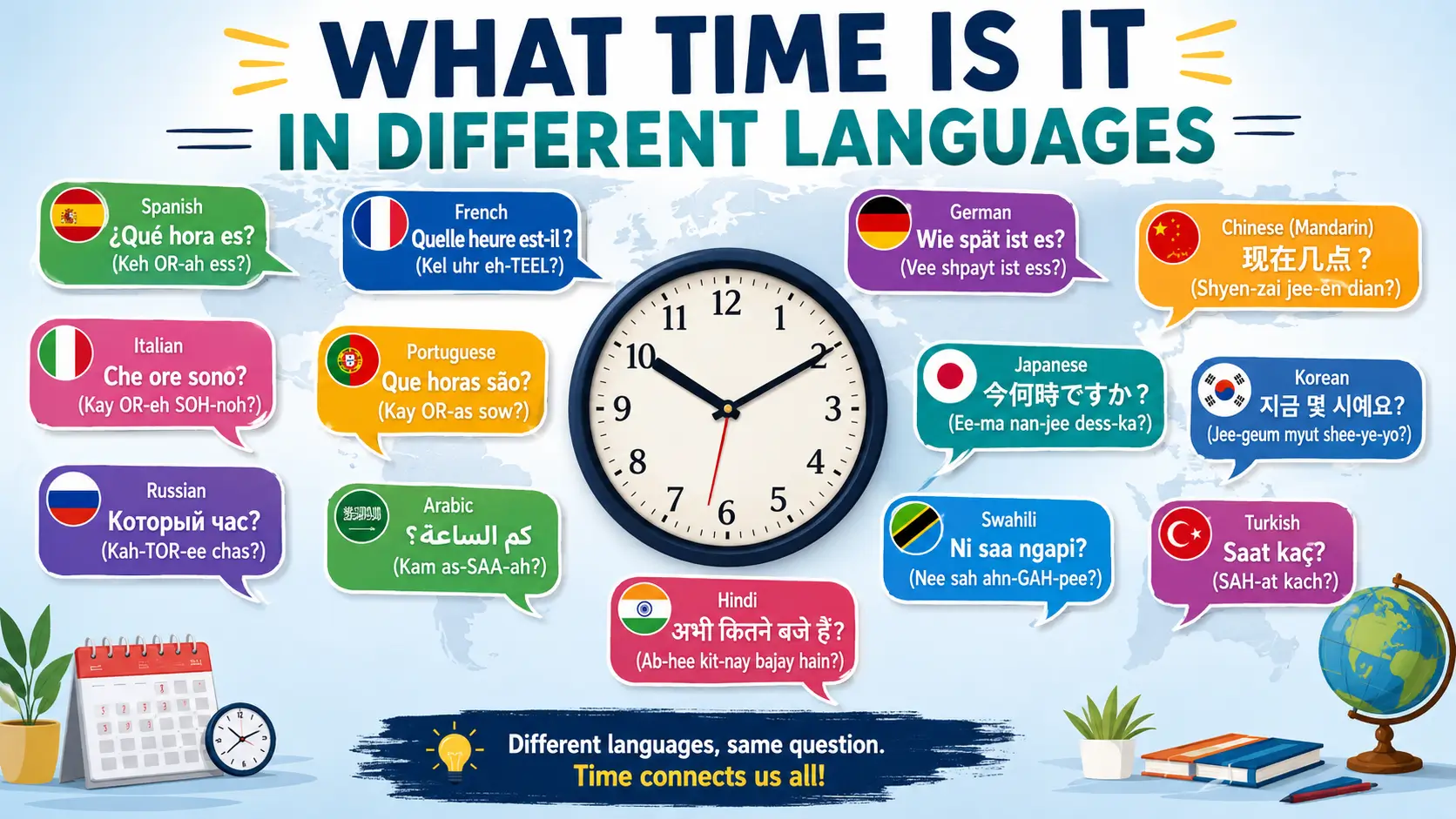
The phrase changes considerably from one language to another. In Spanish, for example, “¿Qué hora es?” literally asks what hour it is. French uses “Quelle heure est-il ?”, while German uses “Wie spät ist es?”, which is closer to asking how late it is.
Asian languages often use structures based on “what hour,” “how many o’clock,” or “what time.” For example, Mandarin Chinese uses “现在几点?”, Japanese uses “今何時ですか?”, and Korean uses “지금 몇 시예요?”
Learning these differences can make vocabulary easier to remember because you are not simply memorizing individual words—you are learning how each language naturally talks about time.
What Time Is It in European Languages?
European languages offer many interesting variations.
Romance languages such as Spanish, French, Italian, Portuguese, and Romanian commonly use words connected with hour or hours. Germanic languages such as German, Dutch, Swedish, Norwegian, and Danish often use expressions connected with being late or referring to the clock.
Slavic languages also have their own patterns. Russian commonly uses “Который час?”, while Polish uses “Która jest godzina?”
These differences show why direct word-for-word translation does not always produce the most natural phrase.
What Time Is It in Asian Languages?
Asia contains thousands of languages and a wide variety of ways to discuss time.
In Hindi and Urdu, people commonly ask about how many o’clock it is, while Mandarin Chinese uses an expression involving the current time and hour. Japanese and Korean also have specific everyday structures for asking the time.
For travelers, learning the local phrase is particularly useful because it can be easier to understand a response when you know the vocabulary used for hours, minutes, morning, afternoon, and evening.
What Time Is It in Arabic, Persian, and Other Middle Eastern Languages?
Arabic uses “كم الساعة؟”, meaning “How much is the hour?” or naturally, “What time is it?” Persian uses “ساعت چند است؟”
Hebrew uses “מה השעה?”, another common everyday expression for asking the time.
When learning these languages, remember that written forms may look very different from English. Practicing the pronunciation alongside the native spelling can make the phrases much easier to use in conversation.
What Time Is It in African Languages?
Africa is home to an enormous range of languages. Swahili, Afrikaans, Zulu, and Xhosa are among the languages represented in this list.
Swahili uses “Ni saa ngapi?”, while Afrikaans uses “Hoe laat is dit?” The Zulu phrase “Isikhathi sini?” and Xhosa “Ngubani ixesha?” demonstrate how differently languages can structure a simple question about time.
Learning even one local phrase can make everyday communication more welcoming when traveling or meeting speakers of these languages.
Why Learn “What Time Is It?” in Different Languages?
There are several practical reasons to learn this phrase.
For travel: Asking the time can help when catching trains, buses, flights, or meeting people.
For language learning: Time-related vocabulary appears frequently in everyday conversations.
For cultural understanding: Different languages organize ideas about time in different ways.
For conversation: Asking the time is one of the easiest ways to begin a simple interaction.
For multilingual communication: Knowing common phrases gives you confidence when speaking with international friends, classmates, or colleagues.
Useful Time Vocabulary to Learn
Once you know how to ask “what time is it?”, learning a few related words can make conversations much easier.
- Hour — a unit of time lasting 60 minutes
- Minute — a unit of time lasting 60 seconds
- Now — the present moment
- Today — the current day
- Morning — the early part of the day
- Afternoon — the period after midday
- Evening — the later part of the day
- Midnight — 12:00 at night
- Noon — 12:00 in the daytime
- Clock — a device or system used to measure time
Learning these related words alongside the main phrase helps you build useful conversational vocabulary rather than memorizing a single sentence.
Tips for Pronouncing Time Questions Correctly
Pronunciation can be challenging when you encounter an unfamiliar language. Start by listening to native speakers whenever possible and repeat the phrase slowly.
The English pronunciation column above is designed as a simple guide rather than a precise phonetic transcription. Sounds can vary by region, accent, and speaking style.
Pay particular attention to syllable stress. In some languages, changing the stress can make your pronunciation sound unnatural even when the individual sounds are correct.
“What Time Is It?” Translations Around the World
The 70 phrases above demonstrate that a simple English question can have many different forms around the world.
Some languages use a structure similar to “What hour is it?” Others ask “How late is it?”, “How many o’clock is it?”, or use another grammatical pattern that sounds natural to native speakers.
This is why learning “what time is it in different languages” is more useful than relying on literal translations. The goal is to learn the phrase people actually use in everyday conversation.
Frequently Asked Questions
1. How do you say “what time is it?” in different languages?
You can say it in many ways depending on the language. For example, Spanish is “¿Qué hora es?”, French is “Quelle heure est-il ?”, German is “Wie spät ist es?”, and Japanese is “今何時ですか?”
2. What is the most common way to ask for the time?
In English, the most common everyday phrase is “What time is it?” Other languages have their own natural expressions, so it is best to learn the phrase used by native speakers rather than translate each word individually.
3. How do you say “what time is it?” in Spanish?
In Spanish, you say “¿Qué hora es?” This is the standard everyday way to ask someone for the time.
4. How do you say “what time is it?” in French?
In French, you can say “Quelle heure est-il ?” This is a standard expression used to ask what time it is.
5. Why should I learn “what time is it” in other languages?
Learning this phrase is useful for travel, language practice, cultural communication, and everyday conversations. It is also an easy way to begin learning practical vocabulary about clocks, hours, minutes, and daily schedules.
Conclusion
Learning “what time is it?” in different languages gives you a practical phrase that can be used almost anywhere. From Spanish and French to Hindi, Japanese, Arabic, Swahili, and Korean, each language expresses the same basic idea in its own natural way.
Use the 70-language table as a quick reference, practice the pronunciation, and try using one new phrase in a real conversation. Understanding how people ask about time around the world is a small but useful step toward becoming a more confident multilingual speaker.

I am Ricardo Hunter, Administrator at LingoBuz, passionate about languages, translations, and global communication. I help create useful, clear content that makes exploring different languages simple, enjoyable, and accessible.