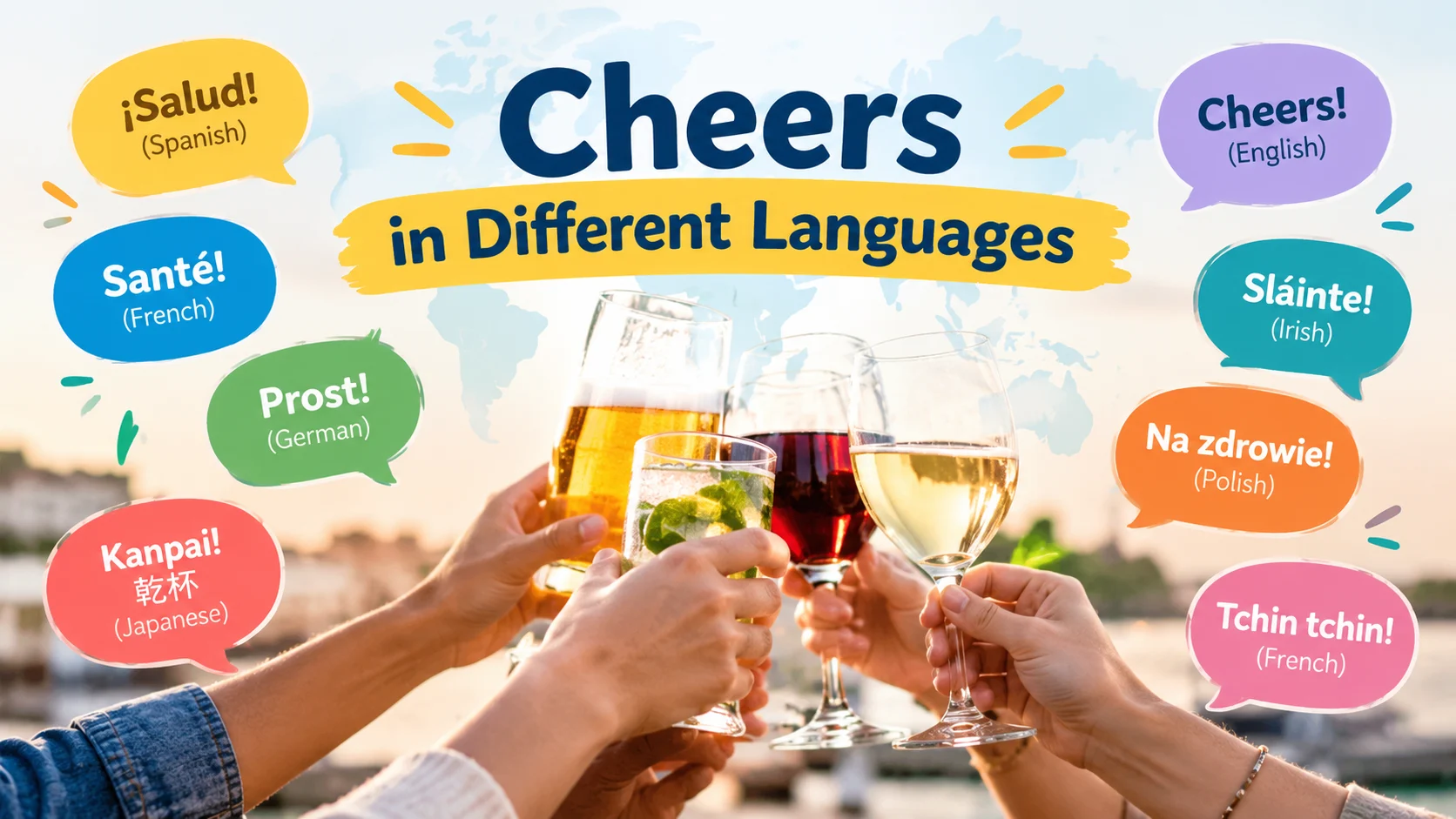
Cheers in different languages is a useful phrase to learn when celebrating with friends, sharing a meal, traveling abroad, or making a special toast. Although English speakers often say “Cheers” before taking a drink, other languages use expressions that reflect local customs, good wishes, and celebration. Some phrases are also used to say thank you or goodbye, depending on the context.
In this guide, you will discover 70 ways to say cheers around the world, with native phrases, easy English pronunciations, practical example sentences, and their English meanings. You will also learn which expressions are commonly used for toasts, which have different meanings, and how to use them naturally in everyday conversations.
How Do You Say Cheers in Different Languages?
The word “Cheers” does not have one universal translation. Many languages have a traditional expression used when people raise their glasses, while others use a phrase that wishes everyone good health or happiness.
Here are eight common ways to say cheers in different languages.
| Language | Native Phrase | Easy Pronunciation | Example Sentence | English Meaning |
|---|---|---|---|---|
| Spanish | ¡Salud! | sah-LOOD | ¡Salud por nuestra amistad! | Cheers to our friendship! |
| French | Santé ! | sahn-TAY | Santé à notre réussite ! | Cheers to our success! |
| German | Prost! | prohst | Prost, auf unser neues Zuhause! | Cheers to our new home! |
| Italian | Cin cin! | chin chin | Cin cin, amici! | Cheers, friends! |
| Portuguese | Saúde! | sah-OO-jee | Saúde a todos nós! | Cheers to all of us! |
| Japanese | 乾杯! | kahn-pie | 乾杯、みんな! | Cheers, everyone! |
| Korean | 건배! | geon-bae | 우리 모두를 위해 건배! | Cheers to all of us! |
| Mandarin Chinese | 干杯! | gahn-bye | 为我们的友谊干杯! | Cheers to our friendship! |
These examples are common toast expressions, but the most natural choice can depend on the language, region, and social setting.
Cheers in South Asian Languages
South Asian languages offer several ways to express good wishes during celebrations. In casual conversations, speakers may also use the English word “Cheers,” especially in multilingual settings.
| Language | Native Phrase | Easy Pronunciation | Example Sentence | English Meaning |
|---|---|---|---|---|
| Hindi | आपकी सेहत के लिए! | aap-kee seh-hut kay lee-ay | आपकी सेहत के लिए! | To your health! |
| Urdu | آپ کی صحت کے نام! | aap kee seh-hut kay naam | آپ کی صحت کے نام! | To your health! |
| Bengali | সুস্বাস্থ্যের জন্য! | shush-shas-thyer jon-no | সুস্বাস্থ্যের জন্য! | To good health! |
| Punjabi | ਚੜ੍ਹਦੀ ਕਲਾ! | charh-dee ka-laa | ਸਾਰਿਆਂ ਦੀ ਚੜ੍ਹਦੀ ਕਲਾ ਲਈ! | To everyone’s well-being and rising spirits! |
| Gujarati | તમારા સ્વાસ્થ્ય માટે! | tum-aa-raa swaasth-ya maa-tay | તમારા સ્વાસ્થ્ય માટે! | To your health! |
| Marathi | तुमच्या आरोग्यासाठी! | tum-chyaa aa-ro-gyaa-saa-thee | तुमच्या आरोग्यासाठी! | To your health! |
| Nepali | स्वास्थ्यको लागि! | swaas-thya-ko laa-gi | सबैको स्वास्थ्यको लागि! | To everyone’s health! |
Cheers in East Asian Languages
East Asian languages have recognizable toast expressions. The Japanese and Korean phrases below are commonly used when people raise their glasses, while Chinese has a widely recognized expression for making a toast.
| Language | Native Phrase | Easy Pronunciation | Example Sentence | English Meaning |
|---|---|---|---|---|
| Cantonese | 乾杯! | goon-bui | 為我們的友誼乾杯! | Cheers to our friendship! |
| Taiwanese Hokkien | 乾杯! | kan-pue | 咱來乾杯! | Let’s raise a toast! |
| Mongolian | Эрүүл энхийн төлөө! | eh-rüül en-khiin tö-löö | Эрүүл энхийн төлөө! | To health and peace! |
| Tibetan | བདེ་ཐང་གི་ཆེད་དུ། | de-tang gi che-du | བདེ་ཐང་གི་ཆེད་དུ། | To good health! |
| Manchu | ᠰᠠᠶᠢᠨ ᠡᠷᠡᠭᠦᠯ ᠤᠨ ᠲᠥᠯᠥᠭᠡ | sai-in er-gu-lun tu-lu-ge | ᠰᠠᠶᠢᠨ ᠡᠷᠡᠭᠦᠯ ᠤᠨ ᠲᠥᠯᠥᠭᠡ | To good health! |
| Japanese | 乾杯! | kahn-pie | みんなの成功を祝って、乾杯! | Cheers to everyone’s success! |
| Korean | 건배! | geon-bae | 우리의 우정을 위해 건배! | Cheers to our friendship! |
Cheers in Southeast Asian Languages
In Southeast Asia, toast expressions can include wishes for good fortune, health, or a shared celebration. Usage differs by country and language, so the phrases below are not interchangeable in every situation.
| Language | Native Phrase | Easy Pronunciation | Example Sentence | English Meaning |
|---|---|---|---|---|
| Indonesian | Bersulang! | ber-soo-lang | Bersulang untuk persahabatan kita! | Cheers to our friendship! |
| Malay | Minum untuk kesihatan! | mee-noom oon-took kuh-see-ha-tan | Minum untuk kesihatan kita! | A toast to our health! |
| Filipino (Tagalog) | Tagay! | tah-guy | Tagay para sa ating pagkakaibigan! | Cheers to our friendship! |
| Thai | ชนแก้ว! | chon gaew | ชนแก้วเพื่อมิตรภาพของเรา! | Let’s toast to our friendship! |
| Vietnamese | Một, hai, ba, dô! | moat, hai, ba, yo | Một, hai, ba, dô, chúc mừng tình bạn! | One, two, three, cheers to friendship! |
| Burmese | ကျန်းမာရေးအတွက် | chan-ma-yay a-twet | ကျွန်တော်တို့ရဲ့ ကျန်းမာရေးအတွက်။ | To our health. |
| Khmer | ជល់កែវ! | chol kaev | ជល់កែវដើម្បីមិត្តភាពរបស់យើង! | Let’s toast to our friendship! |
Cheers in Middle Eastern Languages
Many expressions in this region refer to health, life, or well-being. Some are more appropriate for particular communities or settings, so consider the audience before using them.
| Language | Native Phrase | Easy Pronunciation | Example Sentence | English Meaning |
|---|---|---|---|---|
| Arabic | في صحتكم! | fee seh-het-kom | في صحتكم يا أصدقاء! | To your health, friends! |
| Persian (Farsi) | به سلامتی! | beh sa-la-ma-tee | به سلامتی دوستی ما! | Cheers to our friendship! |
| Hebrew | לחיים! | leh-kha-YEEM | לחיים ולחברות שלנו! | To life and our friendship! |
| Turkish | Şerefe! | sheh-reh-feh | Şerefe, dostluğumuza! | Cheers to our friendship! |
| Kurdish (Kurmanji) | Serkeftin! | ser-kef-tin | Serkeftina me ya hevpar! | To our shared success! |
| Pashto | ستاسو روغتیا ته! | staa-so ro-ghtee-aa ta | ستاسو روغتیا ته، ملګرو! | To your health, friends! |
| Armenian | Կենաց! | keh-nats | Կենաց մեր ընկերությանը։ | Cheers to our friendship! |
Cheers in Western European Languages
Western Europe has many familiar toast expressions, from the French Santé to the German Prost. Several phrases refer directly to health or well-being.
| Language | Native Phrase | Easy Pronunciation | Example Sentence | English Meaning |
|---|---|---|---|---|
| Dutch | Proost! | prohst | Proost op onze vriendschap! | Cheers to our friendship! |
| Luxembourgish | Prost! | prohst | Prost op eis Frëndschaft! | Cheers to our friendship! |
| Frisian | Tsjoch! | tsohkh | Tsjoch op ús freonskip! | Cheers to our friendship! |
| Breton | Yec’hed mat! | yeh-het maht | Yec’hed mat d’an holl! | Good health to everyone! |
| Basque | Topa! | toh-pah | Topa gure adiskidetasunagatik! | Cheers to our friendship! |
| Catalan | Salut! | sah-loot | Salut a la nostra amistat! | Cheers to our friendship! |
| Galician | Saúde! | sow-oo-deh | Saúde pola nosa amizade! | Cheers to our friendship! |
Cheers in Northern European Languages
In northern Europe, short expressions are common when raising a glass. Some related languages share similar words, but pronunciation and local customs can vary.
| Language | Native Phrase | Easy Pronunciation | Example Sentence | English Meaning |
|---|---|---|---|---|
| Swedish | Skål! | skohl | Skål för vår vänskap! | Cheers to our friendship! |
| Norwegian | Skål! | skohl | Skål for vennskapet vårt! | Cheers to our friendship! |
| Danish | Skål! | skohl | Skål for vores venskab! | Cheers to our friendship! |
| Icelandic | Skál! | skowl | Skál fyrir vináttu okkar! | Cheers to our friendship! |
| Finnish | Kippis! | kip-piss | Kippis ystävyydellemme! | Cheers to our friendship! |
| Estonian | Terviseks! | ter-vee-seks | Terviseks meie sõprusele! | Cheers to our friendship! |
| Latvian | Priekā! | pree-eh-kaa | Priekā mūsu draudzībai! | Cheers to our friendship! |
Cheers in Southern European Languages
Southern European toast expressions often refer to health, happiness, or celebration. These phrases are useful at friendly dinners, family gatherings, and festive occasions.
| Language | Native Phrase | Easy Pronunciation | Example Sentence | English Meaning |
|---|---|---|---|---|
| Italian | Cin cin! | chin chin | Cin cin alla nostra amicizia! | Cheers to our friendship! |
| Portuguese | Saúde! | sow-oo-deh | Saúde à nossa amizade! | Cheers to our friendship! |
| Romanian | Noroc! | no-rok | Noroc pentru prietenia noastră! | Cheers to our friendship! |
| Greek | Στην υγειά μας! | steen yee-YAH mahs | Στην υγειά μας και στη φιλία μας! | To our health and friendship! |
| Albanian | Gëzuar! | guh-zoo-ar | Gëzuar për miqësinë tonë! | Cheers to our friendship! |
| Maltese | Saħħa! | sah-hah | Saħħa għall-ħbiberija tagħna! | Cheers to our friendship! |
| Sardinian | A kent’annos! | ah ken-tan-nos | A kent’annos, amigus! | May we celebrate for a hundred years, friends! |
Cheers in Slavic and Eastern European Languages
Slavic languages have several recognizable expressions for toasting. Some wish people good health, while others express celebration or the hope for a long life.
| Language | Native Phrase | Easy Pronunciation | Example Sentence | English Meaning |
|---|---|---|---|---|
| Russian | За здоровье! | za zda-ROV-ye | За здоровье и дружбу! | To health and friendship! |
| Ukrainian | Будьмо! | bood-mo | Будьмо за нашу дружбу! | Cheers to our friendship! |
| Polish | Na zdrowie! | nah zdroh-vyeh | Na zdrowie, przyjaciele! | Cheers, friends! |
| Czech | Na zdraví! | nah zdrah-vee | Na zdraví našemu přátelství! | Cheers to our friendship! |
| Slovak | Na zdravie! | nah zdrah-vyeh | Na zdravie nášmu priateľstvu! | Cheers to our friendship! |
| Slovenian | Na zdravje! | nah zdrahv-yeh | Na zdravje našemu prijateljstvu! | Cheers to our friendship! |
| Bulgarian | Наздраве! | naz-drah-veh | Наздраве за приятелството ни! | Cheers to our friendship! |
Cheers in Central European and Balkan Languages
The following expressions are useful in parts of Central and Southeastern Europe. Similar phrases may occur across neighboring languages, but each entry represents a distinct language.
| Language | Native Phrase | Easy Pronunciation | Example Sentence | English Meaning |
|---|---|---|---|---|
| Serbian | Живели! | zhee-veh-lee | Живели за наше пријатељство! | Cheers to our friendship! |
| Croatian | Živjeli! | zhee-vyeh-lee | Živjeli za naše prijateljstvo! | Cheers to our friendship! |
| Bosnian | Živjeli! | zhee-vyeh-lee | Živjeli za naše prijateljstvo! | Cheers to our friendship! |
| Montenegrin | Živjeli! | zhee-vyeh-lee | Živjeli za naše prijateljstvo! | Cheers to our friendship! |
| Macedonian | На здравје! | nah zdrahv-yeh | На здравје за нашето пријателство! | Cheers to our friendship! |
| Hungarian | Egészségedre! | eh-gaysh-shay-ged-reh | Egészségedre, barátaim! | Cheers, my friends! |
| Lithuanian | Į sveikatą! | ee svay-kah-tah | Į sveikatą ir draugystę! | To health and friendship! |
Cheers in African Languages
Across Africa, toast expressions can wish people good health, happiness, or good fortune. The phrases below represent different languages and should be used with attention to local pronunciation.
| Language | Native Phrase | Easy Pronunciation | Example Sentence | English Meaning |
|---|---|---|---|---|
| Afrikaans | Gesondheid! | guh-soont-hate | Gesondheid op ons vriendskap! | Cheers to our friendship! |
| Swahili | Afya njema! | ah-fyah njeh-mah | Afya njema kwa marafiki wote! | Good health to all our friends! |
| Zulu | Impilo enhle! | eem-pee-lo en-hleh | Impilo enhle kithi sonke! | Good health to all of us! |
| Xhosa | Impilo entle! | eem-pee-lo en-tleh | Impilo entle kuthi sonke! | Good health to all of us! |
| Yoruba | Àlàáfíà! | ah-laa-fee-ah | Àlàáfíà fún gbogbo wa! | Peace and well-being for all of us! |
| Amharic | ለጤናችን! | leh-teh-nah-chin | ለጤናችን እና ለወዳጅነታችን! | To our health and friendship! |
| Somali | Caafimaad! | aa-fee-maad | Caafimaad iyo saaxiibtinimo! | To health and friendship! |
Cheers in Other World Languages
These additional languages show how toast expressions vary beyond the regions already covered. Some expressions are traditional toasts, while others are more general wishes for health or happiness.
| Language | Native Phrase | Easy Pronunciation | Example Sentence | English Meaning |
|---|---|---|---|---|
| Irish | Sláinte! | slawn-cha | Sláinte lenár gcairdeas! | Cheers to our friendship! |
| Welsh | Iechyd da! | yeh-khid dah | Iechyd da i’n cyfeillgarwch! | Cheers to our friendship! |
| Scottish Gaelic | Slàinte mhath! | slan-cha vah | Slàinte mhath dhuinn uile! | Good health to all of us! |
| Hawaiian | ʻŌkole maluna! | oh-koh-leh mah-loo-nah | ʻŌkole maluna i ko kākou hoaloha! | A toast to our friends! |
| Esperanto | Je via sano! | yeh vee-ah sah-noh | Je nia amikeco! | To our friendship! |
| Latin | Prosit! | proh-sit | Prosit omnibus amicis! | Cheers to all our friends! |
| Yiddish | לחיים! | luh-KHA-yim | לחיים און פריינדשאַפט! | To life and friendship! |
How to Use Cheers in Everyday Conversations
Knowing the local expression for cheers can make a toast feel more natural and welcoming. The best phrase depends on whether you are celebrating a friendship, congratulating someone, or sharing a meal.
Here are some practical examples:
- At a birthday party: Say ¡Salud! in Spanish or Santé! in French when raising a glass to the birthday person.
- At a wedding: Use Cin cin! in Italian to celebrate the couple and their future together.
- At a dinner with German speakers: Say Prost! when joining a group toast.
- When celebrating with Japanese speakers: Say 乾杯 (Kanpai!) as the group raises its glasses.
- When congratulating friends: Use a phrase that expresses good wishes, such as Na zdrowie! in Polish.
Remember that some expressions are associated specifically with drinking, while others can be used more broadly to wish someone well.
Formal vs. Informal Ways to Say Cheers
The relationship between speakers and the setting can affect which expression sounds appropriate.
| Situation | Useful Expression | Language |
|---|---|---|
| Casual gathering | Prost! | German |
| Friendly dinner | Cin cin! | Italian |
| Formal toast | À votre santé ! | French |
| Celebrating friendship | ¡Salud por nuestra amistad! | Spanish |
| Traditional Irish toast | Sláinte! | Irish |
| Japanese group celebration | 乾杯! | Japanese |
In French, À votre santé ! is a polite way to wish good health, while À ta santé ! addresses someone informally. In German, Zum Wohl! is another common toast that means roughly “to your well-being.”
The most natural choice depends on the occasion and the people present.
Common Mistakes When Saying Cheers in Different Languages
Learning the translation is only the first step. Avoid these common mistakes to make your toast more accurate.
- Confusing similar expressions: Spanish ¡Salud! and Italian Salute! look similar, but they belong to different languages.
- Using literal translations everywhere: A direct translation of “cheers” may not sound natural in another language. Learn the expression actually used for toasts.
- Ignoring pronunciation: Accents and unfamiliar sounds can change how a phrase is understood. Listen to native speakers when possible.
- Assuming every phrase means the same thing: Some expressions mean “to your health,” while others refer to life, happiness, or good fortune.
- Forgetting the setting: A phrase used among close friends might not be the most suitable choice for a formal gathering.
How to Pronounce Cheers in Different Languages
Pronunciation guides in English letters are approximations. They help beginners get started, but they cannot always represent every sound in the original language.
Try these simple techniques:
- Break the phrase into syllables. For example, Spanish Salud can be practiced as sah-LOOD.
- Pay attention to stress. In Italian Salute, the final syllable receives the main stress.
- Practice unfamiliar sounds slowly. German Prost ends with a consonant cluster that may take practice.
- Listen and repeat. Compare your pronunciation with recordings from native speakers.
- Practice the complete expression. Saying a phrase in a short sentence helps you learn its rhythm and natural usage.
For the most reliable pronunciation, use a native-speaker recording or a reputable language-learning dictionary.
Cultural Etiquette When Making a Toast
A toast is more than a translation. It is also a social gesture, and customs can differ between communities and occasions.
- Follow the host’s lead. If you are attending a celebration abroad, observe how others make a toast before joining in.
- Respect personal preferences. Not everyone drinks alcohol, and nobody should feel pressured to participate.
- Choose an appropriate expression. A friendly one-word toast is often enough for an informal gathering.
- Consider cultural and religious practices. Some people and communities avoid alcohol or do not use traditional drinking toasts.
- Keep the message sincere. A short wish for friendship, happiness, or good health can be more meaningful than a long speech.
You can also use these expressions at suitable nonalcoholic celebrations, such as a gathering with sparkling water, juice, or another preferred drink.
How to Remember Cheers in Different Languages
You do not need to memorize all 70 expressions at once. Start with a few languages that interest you or that you expect to encounter.
- Learn by region. Practice European expressions together, then move on to Asian or African languages.
- Connect phrases with occasions. Remember Sláinte! for an Irish toast and Kanpai! for a Japanese toast.
- Use flashcards. Put the language on one side and the native phrase with its pronunciation on the other.
- Practice aloud. Repeating a phrase several times can make it easier to recall during a real conversation.
- Review example sentences. Learning a phrase in context is usually more useful than memorizing a translation alone.
Focus on using a handful of expressions correctly before trying to learn the entire collection.
Frequently Asked Questions
What is the most common way to say cheers around the world?
- There is no single expression used everywhere. Common examples include ¡Salud! in Spanish, Prost! in German, Santé! in French, Skål! in several Scandinavian languages, and Kanpai! in Japanese.
How do you say cheers in 70 different languages?
- Each language has its own toast expressions. Examples include Saúde! in Portuguese, Kippis! in Finnish, Na zdrowie! in Polish, Şerefe! in Turkish, and Sláinte! in Irish. The regional tables above provide additional phrases, pronunciations, and example sentences.
Does cheers mean good health in every language?
No. Some expressions explicitly wish people good health, while others refer to life, happiness, friendship, or celebration. The intended meaning depends on the particular expression and language.
How do you say cheers without drinking alcohol?
You can use a suitable toast expression with any drink or during a nonalcoholic celebration. If a traditional drinking toast is not appropriate, simply offer a sincere wish for health, friendship, happiness, or success.
Is cheers the same as thank you in other languages?
Not always. In British English, “cheers” can mean “thank you” in casual conversation. In many other languages, the expression used for a toast does not automatically have that meaning, so the context matters.
Conclusion
Learning cheers in different languages is a simple yet meaningful way to make international conversations, cultural experiences, and special celebrations more welcoming and memorable. Whether you are enjoying a meal with friends, attending a wedding, celebrating a birthday, traveling abroad, or raising a glass at a family gathering, knowing how to say “Cheers!” around the world can help you connect with people from different backgrounds. From the popular Spanish expression ¡Salud! and the French Santé! to the German Prost! and the Japanese 乾杯! (Kanpai!), every phrase offers a unique way to share good wishes, express friendship, and celebrate a special moment.
Exploring how to say cheers in different languages also gives you a glimpse into local traditions, social customs, and the cultural meaning behind a toast. Some expressions are associated with good health, while others are used to wish people happiness, success, prosperity, or good fortune. Learning the correct pronunciation, understanding the meaning of each phrase, and knowing when to use it can make your interactions feel more natural and respectful. Whether you want to impress your international friends, prepare for an upcoming trip, learn useful foreign-language phrases, or add a cultural touch to your next celebration, these cheers translations from around the world will help you choose the right expression for the occasion. Practice a few phrases, learn their native pronunciation, and raise your glass with confidence!

I am Scarlett Wilson, a passionate language writer who loves exploring different languages, words, meanings, translations, and useful phrases. I enjoy making language learning simple, clear, and interesting for everyone.