Learning how to say “I am fine” in different languages is a simple way to build confidence in everyday conversations. Whether you are traveling, learning a new language, chatting with international friends, or simply exploring world languages, knowing this useful phrase can help you respond naturally when someone asks how you are.
The phrase “I am fine” can have slightly different forms depending on the language, culture, level of formality, and even the speaker’s gender. In some languages, a direct translation sounds natural, while in others, people commonly use an expression closer to “I’m well” or “Everything is good.”
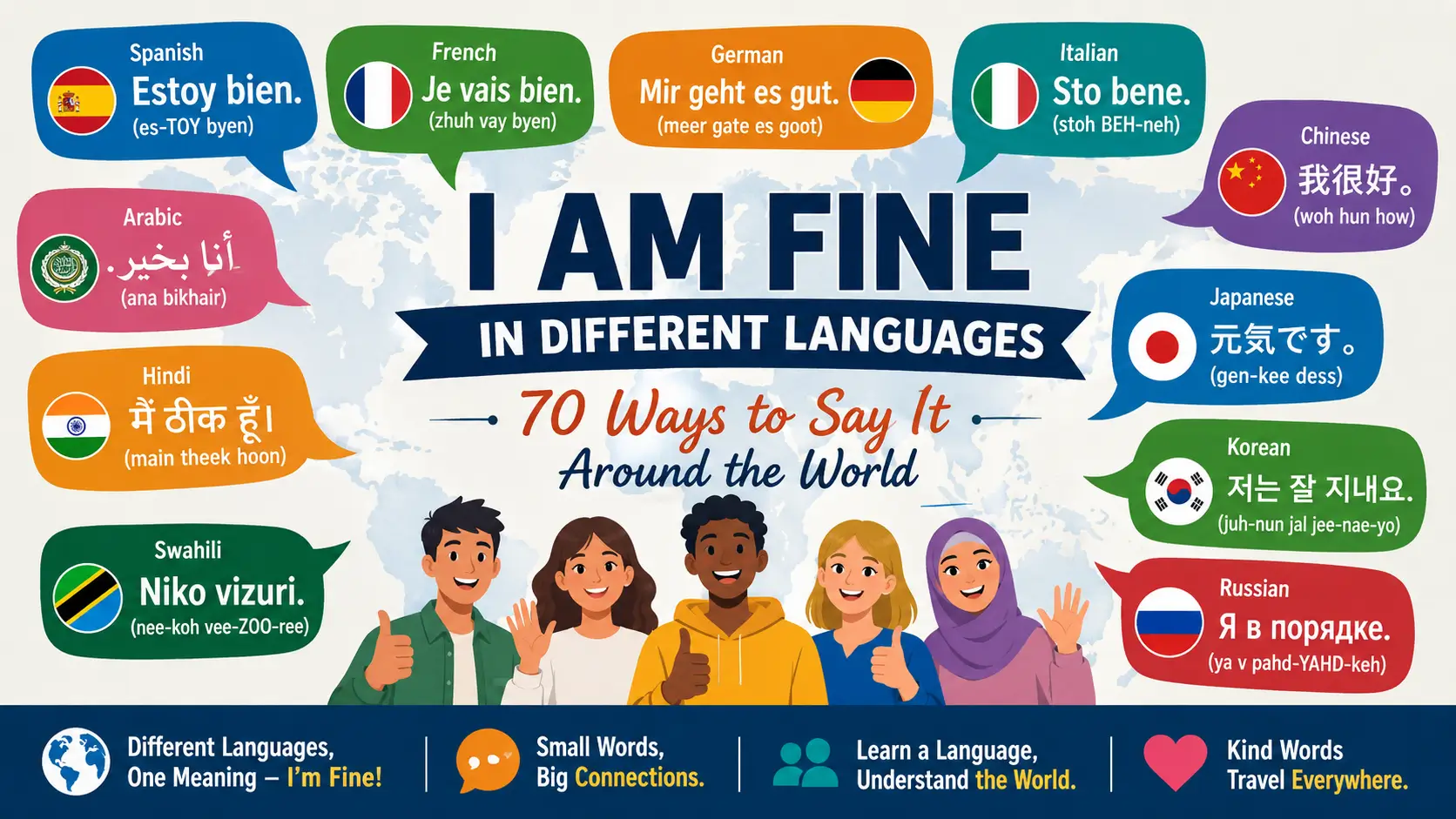
Below, you will find 70 translations of “I am fine”, including the native phrase, an easy English pronunciation, and a short example sentence with its English meaning.
I Am Fine in Different Languages: 70 Translations
| # | Language | Native Phrase | Easy English Pronunciation | Example Sentence | English Meaning |
|---|---|---|---|---|---|
| 1 | English | I am fine. | eye am fine | I am fine, thank you. | I am fine, thank you. |
| 2 | Spanish | Estoy bien. | es-TOY byen | Estoy bien, gracias. | I am fine, thank you. |
| 3 | French | Je vais bien. | zhuh vay byen | Je vais bien, merci. | I am fine, thank you. |
| 4 | German | Mir geht es gut. | meer gate ess goot | Mir geht es gut, danke. | I am fine, thank you. |
| 5 | Italian | Sto bene. | stoh BEH-neh | Sto bene, grazie. | I am fine, thank you. |
| 6 | Portuguese | Estou bem. | es-TOH baym | Estou bem, obrigado. | I am fine, thank you. |
| 7 | Dutch | Het gaat goed met me. | het gaht khoot met muh | Het gaat goed met me, dank je. | I am fine, thank you. |
| 8 | Swedish | Jag mår bra. | yahg mor brah | Jag mår bra, tack. | I am fine, thank you. |
| 9 | Norwegian | Jeg har det bra. | yay har deh brah | Jeg har det bra, takk. | I am fine, thank you. |
| 10 | Danish | Jeg har det godt. | yay har deh got | Jeg har det godt, tak. | I am fine, thank you. |
| 11 | Finnish | Voin hyvin. | voyn HOO-vin | Voin hyvin, kiitos. | I am fine, thank you. |
| 12 | Icelandic | Mér líður vel. | myair LEE-thur vel | Mér líður vel, takk. | I am fine, thank you. |
| 13 | Irish | Tá mé go maith. | taw may guh mah | Tá mé go maith, go raibh maith agat. | I am fine, thank you. |
| 14 | Welsh | Dw i’n iawn. | doo een YOWN | Dw i’n iawn, diolch. | I am fine, thank you. |
| 15 | Scottish Gaelic | Tha mi gu math. | ha mee goo mah | Tha mi gu math, tapadh leat. | I am fine, thank you. |
| 16 | Latin | Bene sum. | BEH-neh soom | Bene sum, gratias tibi ago. | I am fine, thank you. |
| 17 | Esperanto | Mi fartas bone. | mee FAR-tas BOH-neh | Mi fartas bone, dankon. | I am fine, thank you. |
| 18 | Polish | Mam się dobrze. | mam shye DOB-zheh | Mam się dobrze, dziękuję. | I am fine, thank you. |
| 19 | Czech | Mám se dobře. | maam seh DOB-zheh | Mám se dobře, děkuji. | I am fine, thank you. |
| 20 | Slovak | Mám sa dobre. | maam sah DOH-breh | Mám sa dobre, ďakujem. | I am fine, thank you. |
| 21 | Slovenian | Dobro sem. | DOH-broh sem | Dobro sem, hvala. | I am fine, thank you. |
| 22 | Croatian | Dobro sam. | DOH-broh sahm | Dobro sam, hvala. | I am fine, thank you. |
| 23 | Serbian | Добро сам. | DOH-broh sahm | Добро сам, хвала. | I am fine, thank you. |
| 24 | Bosnian | Dobro sam. | DOH-broh sahm | Dobro sam, hvala. | I am fine, thank you. |
| 25 | Macedonian | Добро сум. | DOH-broh soom | Добро сум, благодарам. | I am fine, thank you. |
| 26 | Bulgarian | Добре съм. | doh-BREH sum | Добре съм, благодаря. | I am fine, thank you. |
| 27 | Russian | Я в порядке. | ya v pahd-YAHD-keh | Я в порядке, спасибо. | I am fine, thank you. |
| 28 | Ukrainian | Я в порядку. | ya v poh-RYAD-koo | Я в порядку, дякую. | I am fine, thank you. |
| 29 | Belarusian | У мяне ўсё добра. | oo myah-NEH fsyoh DOH-brah | У мяне ўсё добра, дзякуй. | I am fine, thank you. |
| 30 | Lithuanian | Man viskas gerai. | man VIS-kas geh-RY | Man viskas gerai, ačiū. | I am fine, thank you. |
| 31 | Latvian | Man viss ir labi. | man viss eer LAH-bee | Man viss ir labi, paldies. | I am fine, thank you. |
| 32 | Estonian | Mul läheb hästi. | mool lah-eb HAS-tee | Mul läheb hästi, aitäh. | I am fine, thank you. |
| 33 | Hungarian | Jól vagyok. | yohl VAH-yok | Jól vagyok, köszönöm. | I am fine, thank you. |
| 34 | Romanian | Sunt bine. | soont BEE-neh | Sunt bine, mulțumesc. | I am fine, thank you. |
| 35 | Albanian | Jam mirë. | yam meer | Jam mirë, faleminderit. | I am fine, thank you. |
| 36 | Greek | Είμαι καλά. | EE-meh ka-LA | Είμαι καλά, ευχαριστώ. | I am fine, thank you. |
| 37 | Armenian | Ես լավ եմ։ | yes lav em | Ես լավ եմ, շնորհակալություն։ | I am fine, thank you. |
| 38 | Georgian | კარგად ვარ. | kahr-GAHD var | კარგად ვარ, მადლობა. | I am fine, thank you. |
| 39 | Turkish | İyiyim. | ee-YEE-yim | İyiyim, teşekkür ederim. | I am fine, thank you. |
| 40 | Azerbaijani | Mən yaxşıyam. | men yah-shuh-YAM | Mən yaxşıyam, təşəkkür edirəm. | I am fine, thank you. |
| 41 | Persian | من خوبم. | man KHOOb-am | من خوبم، ممنون. | I am fine, thank you. |
| 42 | Arabic | أنا بخير. | ana bikhair | أنا بخير، شكرًا. | I am fine, thank you. |
| 43 | Hebrew | אני בסדר. | ah-NEE beh-SEH-der | אני בסדר, תודה. | I am fine, thank you. |
| 44 | Hindi | मैं ठीक हूँ। | main theek hoon | मैं ठीक हूँ, धन्यवाद। | I am fine, thank you. |
| 45 | Urdu | میں ٹھیک ہوں۔ | main theek hoon | میں ٹھیک ہوں، شکریہ۔ | I am fine, thank you. |
| 46 | Bengali | আমি ভালো আছি। | ami bhalo achhi | আমি ভালো আছি, ধন্যবাদ। | I am fine, thank you. |
| 47 | Punjabi | ਮੈਂ ਠੀਕ ਹਾਂ। | main theek haan | ਮੈਂ ਠੀਕ ਹਾਂ, ਧੰਨਵਾਦ। | I am fine, thank you. |
| 48 | Gujarati | હું મજામાં છું. | hoon maja-maa chhoon | હું મજામાં છું, આભાર. | I am fine, thank you. |
| 49 | Marathi | मी ठीक आहे. | mee theek aa-heh | मी ठीक आहे, धन्यवाद. | I am fine, thank you. |
| 50 | Nepali | म ठिक छु। | ma thik chhu | म ठिक छु, धन्यवाद। | I am fine, thank you. |
| 51 | Sinhala | මම හොඳින්. | mama hondin | මම හොඳින්, ස්තුතියි. | I am fine, thank you. |
| 52 | Tamil | நான் நன்றாக இருக்கிறேன். | naan nan-RAA-gah iruk-KI-ren | நான் நன்றாக இருக்கிறேன், நன்றி. | I am fine, thank you. |
| 53 | Telugu | నేను బాగున్నాను. | nenu baa-gun-NAH-nu | నేను బాగున్నాను, ధన్యవాదాలు. | I am fine, thank you. |
| 54 | Kannada | ನಾನು ಚೆನ್ನಾಗಿದ್ದೇನೆ. | naanu chen-NAH-gid-DAY-neh | ನಾನು ಚೆನ್ನಾಗಿದ್ದೇನೆ, ಧನ್ಯವಾದಗಳು. | I am fine, thank you. |
| 55 | Malayalam | എനിക്ക് സുഖമാണ്. | en-ikk SUKH-a-maan | എനിക്ക് സുഖമാണ്, നന്ദി. | I am fine, thank you. |
| 56 | Thai | ฉันสบายดี | chan sa-bai dee | ฉันสบายดี ขอบคุณ | I am fine, thank you. |
| 57 | Vietnamese | Tôi khỏe. | toy kweh | Tôi khỏe, cảm ơn. | I am fine, thank you. |
| 58 | Indonesian | Saya baik-baik saja. | sah-yah bye-kbye sah-jah | Saya baik-baik saja, terima kasih. | I am fine, thank you. |
| 59 | Malay | Saya baik-baik sahaja. | sah-yah bye-kbye sah-hah-jah | Saya baik-baik sahaja, terima kasih. | I am fine, thank you. |
| 60 | Filipino | Mabuti ako. | mah-boo-tee ah-koh | Mabuti ako, salamat. | I am fine, thank you. |
| 61 | Chinese (Mandarin) | 我很好。 | woh hun how | 我很好,谢谢。 | I am fine, thank you. |
| 62 | Japanese | 元気です。 | gen-kee dess | 元気です、ありがとう。 | I am fine, thank you. |
| 63 | Korean | 저는 잘 지내요. | juh-nun jal jee-nae-yo | 저는 잘 지내요, 감사합니다. | I am doing well, thank you. |
| 64 | Mongolian | Би сайн байна. | bee sain bai-na | Би сайн байна, баярлалаа. | I am fine, thank you. |
| 65 | Swahili | Niko vizuri. | nee-koh vee-ZOO-ree | Niko vizuri, asante. | I am fine, thank you. |
| 66 | Afrikaans | Dit gaan goed met my. | dit khahn khoot met may | Dit gaan goed met my, dankie. | I am fine, thank you. |
| 67 | Zulu | Ngiyaphila. | ngee-yah-PEE-lah | Ngiyaphila, ngiyabonga. | I am fine, thank you. |
| 68 | Xhosa | Ndiphilile. | ndee-pee-LEE-leh | Ndiphilile, enkosi. | I am fine, thank you. |
| 69 | Yoruba | Mo wà dáadáa. | moh wah dah-dah | Mo wà dáadáa, o ṣeun. | I am fine, thank you. |
| 70 | Hausa | Ina lafiya. | ee-nah lah-FEE-yah | Ina lafiya, na gode. | I am fine, thank you. |
How to Say “I Am Fine” in Different Languages
The most useful translation depends on the situation. In English, “I am fine” is a common response to “How are you?” Other languages may use an expression that literally means “I am well,” “I am doing well,” or “I am in good condition.”
For example:
- Spanish: Estoy bien.
- French: Je vais bien.
- German: Mir geht es gut.
- Italian: Sto bene.
- Arabic: أنا بخير.
- Hindi: मैं ठीक हूँ।
- Urdu: میں ٹھیک ہوں۔
- Japanese: 元気です。
- Mandarin Chinese: 我很好。
These expressions are useful for casual conversations, travel, language practice, and friendly introductions.
“I Am Fine” in All Languages: What Changes?
There is no single universal translation because languages express well-being differently.
Some languages use a direct equivalent of “fine.” Others use phrases closer to “I am well” or “I am doing well.” Cultural habits also influence how people answer questions about their health or mood.
In many situations, adding “thank you” makes the response sound more complete and polite.
For example:
English: I am fine, thank you.
Spanish: Estoy bien, gracias.
French: Je vais bien, merci.
German: Mir geht es gut, danke.
Urdu: میں ٹھیک ہوں، شکریہ۔
“I Am Fine” Translations for Everyday Conversations
When learning a new language, it is helpful to learn the phrase together with a practical response.
If someone asks “How are you?”, you can usually answer with the local equivalent of “I am fine” and then ask how they are.
For example:
“I am fine, thank you. How are you?”
This simple exchange is useful because it turns a vocabulary word into a complete conversation pattern.
“I Am Fine” Around the World
The idea of saying that you are fine is universal, but the wording varies widely around the world.
European languages include forms such as Sto bene in Italian, Jól vagyok in Hungarian, and Sunt bine in Romanian. Across Asia, you can find expressions such as میں ٹھیک ہوں in Urdu, 我很好 in Mandarin, and 元気です in Japanese.
African languages also have their own natural ways to express well-being, including Niko vizuri in Swahili and Ngiyaphila in Zulu.
Learning these expressions gives you more than a translation. It helps you understand how different languages naturally communicate everyday feelings and social responses.
Formal and Casual Ways to Say “I Am Fine”
The appropriate expression can depend on who you are speaking with.
With friends, short expressions are often enough. In more formal situations, you may want to add a polite word such as “thank you.”
For example:
- Casual: Estoy bien.
- Polite: Estoy bien, gracias.
- Casual: Sto bene.
- Polite: Sto bene, grazie.
The same principle applies to many other languages. When traveling or speaking with someone for the first time, using the polite form is generally a safe choice.
Why Learn “I Am Fine” in Different Languages?
“I am fine” is one of the most practical phrases for beginners because it can appear in everyday conversations.
Learning this phrase can help you:
- Respond to greetings naturally.
- Practice pronunciation.
- Start conversations with native speakers.
- Communicate while traveling.
- Understand basic conversational questions.
- Build a useful everyday vocabulary.
- Become more comfortable speaking another language.
It is also an easy phrase to practice because you can use it immediately after learning how to ask “How are you?”
Tips for Pronouncing “I Am Fine” in Other Languages
Pronunciation can be more difficult than memorizing the written translation. The pronunciation guides in the table are simplified for English speakers, so they are designed as a starting point rather than a complete phonetic transcription.
For better pronunciation, listen carefully to native speakers and pay attention to:
- Vowel sounds: They may differ from English.
- Word stress: Some languages emphasize particular syllables.
- Consonants: Certain sounds may not exist in English.
- Rhythm: Languages have different natural speaking patterns.
- Context: A phrase can sound different when spoken quickly in a real conversation.
Repeated listening and speaking practice will usually improve pronunciation faster than memorizing spelling alone.
Frequently Asked Questions About “I Am Fine” in Different Languages
1. How do you say “I am fine” in different languages?
“I am fine” has many translations. Examples include Estoy bien in Spanish, Je vais bien in French, Sto bene in Italian, Ich bin gut is not the natural German equivalent, while Mir geht es gut is natural German, and میں ٹھیک ہوں in Urdu.
2. What is the easiest language to say “I am fine” in?
For English speakers, languages using familiar sounds and simple sentence structures may feel easier. Spanish Estoy bien, Italian Sto bene, and Indonesian Saya baik-baik saja are examples of commonly approachable expressions.
3. How do you say “I am fine, thank you” in another language?
You can combine the local expression for “I am fine” with the local word for “thank you.” For example, Spanish is Estoy bien, gracias, while French is Je vais bien, merci.
4. Is “I am fine” the same as “I am well”?
They can communicate essentially the same idea in everyday conversation, but the grammar and natural expression differ between languages. Some languages commonly use a phrase equivalent to “I am well” rather than a literal translation of “I am fine.”
5. Why are there different translations for “I am fine”?
Languages have different grammar, vocabulary, cultural conventions, and ways of expressing personal well-being. As a result, the most natural translation may not be a word-for-word equivalent of the English phrase.
Conclusion
Learning how to say “I am fine in different languages” is a useful first step toward everyday multilingual communication. From Estoy bien in Spanish and Je vais bien in French to میں ٹھیک ہوں in Urdu and 我很好 in Mandarin, each language has its own natural way to express the same basic idea.
Use the 70 translations above to practice greetings, improve pronunciation, and make simple conversations more comfortable. The best way to remember a new phrase is to use it regularly in realistic situations.

I am Ricardo Hunter, Administrator at LingoBuz, passionate about languages, translations, and global communication. I help create useful, clear content that makes exploring different languages simple, enjoyable, and accessible.