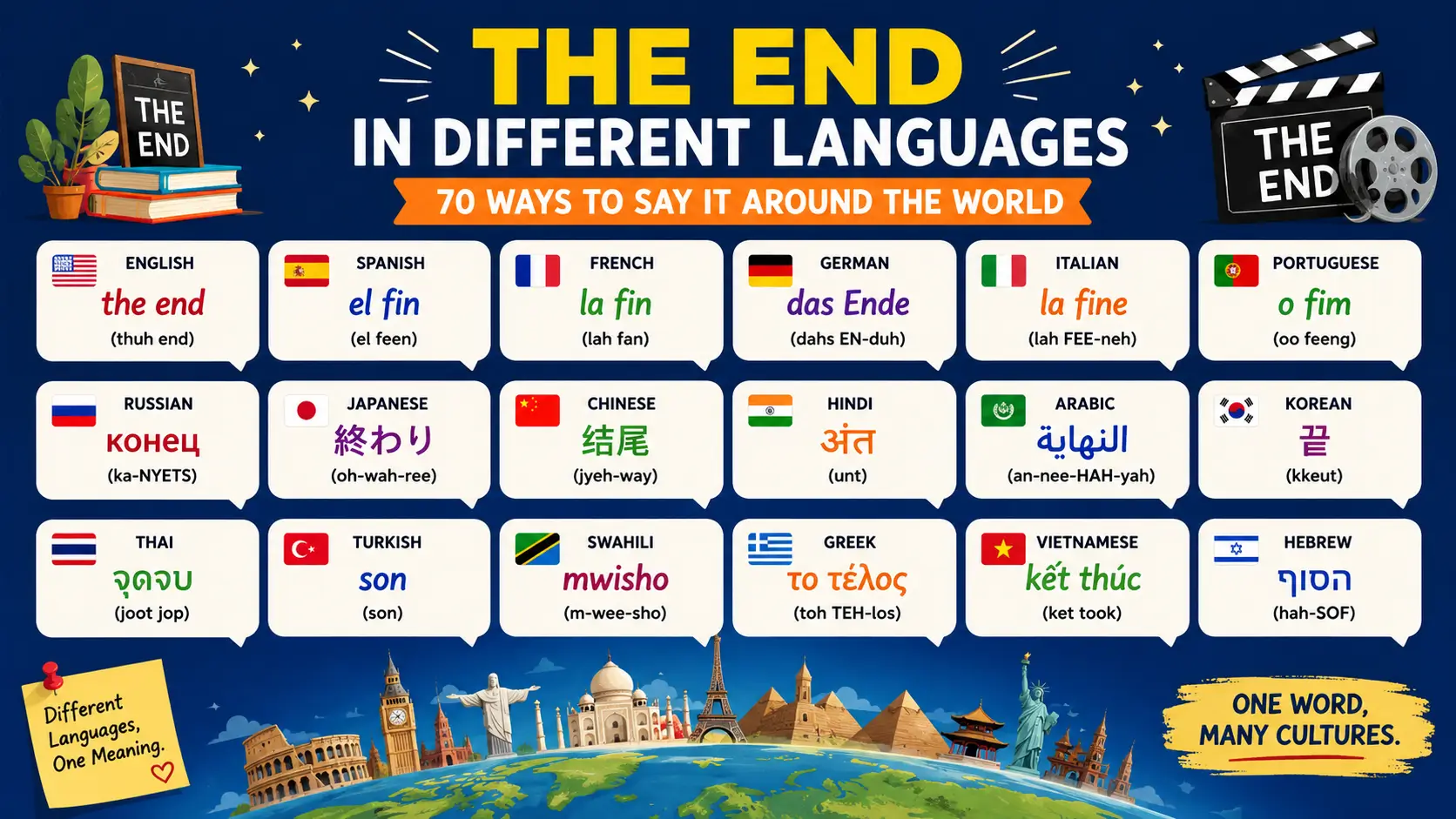
The phrase “the end” appears everywhere—from books and films to conversations about journeys, relationships, events, and important life moments. Learning how to say the end in different languages is a simple way to explore vocabulary, culture, and everyday communication around the world.
Whether you are looking for the end translations, researching how to say the end in different languages, or simply curious about how people express endings around the world, this guide gives you 70 useful examples. Each entry includes the native phrase, an easy English pronunciation, a natural sentence, and its English meaning.
The End in All Languages: 70 Translations
| # | Language | Native phrase | Easy English pronunciation | Real-life example sentence | English meaning |
|---|---|---|---|---|---|
| 1 | English | the end | thuh end | This is the end. | This is the end. |
| 2 | Spanish | el fin | el feen | Este es el fin. | This is the end. |
| 3 | French | la fin | lah fan | C’est la fin. | This is the end. |
| 4 | German | das Ende | dahs EN-duh | Das ist das Ende. | This is the end. |
| 5 | Italian | la fine | lah FEE-neh | Questa è la fine. | This is the end. |
| 6 | Portuguese | o fim | oo feeng | Este é o fim. | This is the end. |
| 7 | Dutch | het einde | hut EYN-duh | Dit is het einde. | This is the end. |
| 8 | Afrikaans | die einde | dee EYN-duh | Dit is die einde. | This is the end. |
| 9 | Swedish | slutet | SLOO-tet | Det här är slutet. | This is the end. |
| 10 | Danish | slutningen | SLOOT-ning-en | Dette er slutningen. | This is the end. |
| 11 | Norwegian | slutten | SLOOT-en | Dette er slutten. | This is the end. |
| 12 | Finnish | loppu | LOP-poo | Tämä on loppu. | This is the end. |
| 13 | Icelandic | endirinn | EN-di-rin | Þetta er endirinn. | This is the end. |
| 14 | Irish | an deireadh | un JER-iv | Seo an deireadh. | This is the end. |
| 15 | Welsh | y diwedd | uh DYE-eth | Dyma’r diwedd. | This is the end. |
| 16 | Basque | amaiera | ah-my-EH-rah | Hau da amaiera. | This is the end. |
| 17 | Catalan | el final | el fee-NAL | Aquest és el final. | This is the end. |
| 18 | Romanian | sfârșitul | sfur-SHEET-ool | Acesta este sfârșitul. | This is the end. |
| 19 | Albanian | fundi | FOON-dee | Ky është fundi. | This is the end. |
| 20 | Greek | το τέλος | toh TEH-los | Αυτό είναι το τέλος. | This is the end. |
| 21 | Bulgarian | краят | kray-AT | Това е краят. | This is the end. |
| 22 | Macedonian | крајот | KRAY-ot | Ова е крајот. | This is the end. |
| 23 | Serbian | крај | kray | Ово је крај. | This is the end. |
| 24 | Croatian | kraj | kray | Ovo je kraj. | This is the end. |
| 25 | Slovenian | konec | KOH-nets | To je konec. | This is the end. |
| 26 | Czech | konec | KOH-nets | To je konec. | This is the end. |
| 27 | Slovak | koniec | KOH-nyets | Toto je koniec. | This is the end. |
| 28 | Polish | koniec | KOH-nyets | To jest koniec. | This is the end. |
| 29 | Russian | конец | ka-NYETS | Это конец. | This is the end. |
| 30 | Ukrainian | кінець | kee-NYETS | Це кінець. | This is the end. |
| 31 | Lithuanian | pabaiga | pah-BYE-gah | Tai pabaiga. | This is the end. |
| 32 | Latvian | beigas | BAY-gahs | Šīs ir beigas. | This is the end. |
| 33 | Estonian | lõpp | lup | See on lõpp. | This is the end. |
| 34 | Hungarian | a vég | ah vayg | Ez a vég. | This is the end. |
| 35 | Turkish | son | son | Bu son. | This is the end. |
| 36 | Azerbaijani | son | son | Bu sondur. | This is the end. |
| 37 | Armenian | վերջը | ver-JUH | Սա վերջն է։ | This is the end. |
| 38 | Georgian | დასასრული | dah-sah-soo-lee | ეს დასასრულია. | This is the end. |
| 39 | Hebrew | הסוף | hah-SOF | זה הסוף. | This is the end. |
| 40 | Arabic | النهاية | an-nee-HAH-yah | هذه هي النهاية. | This is the end. |
| 41 | Persian | پایان | pay-YAAN | این پایان است. | This is the end. |
| 42 | Urdu | اختتام | ikh-ti-TAAM | یہ اختتام ہے۔ | This is the end. |
| 43 | Hindi | अंत | unt | यह अंत है। | This is the end. |
| 44 | Bengali | শেষ | shesh | এটাই শেষ। | This is the end. |
| 45 | Punjabi | ਅੰਤ | ant | ਇਹ ਅੰਤ ਹੈ। | This is the end. |
| 46 | Gujarati | અંત | ant | આ અંત છે. | This is the end. |
| 47 | Marathi | शेवट | sheh-VUT | हा शेवट आहे. | This is the end. |
| 48 | Nepali | अन्त्य | un-tya | यो अन्त्य हो। | This is the end. |
| 49 | Sinhala | අවසානය | ah-wah-SAA-nah-yah | මෙය අවසානයයි. | This is the end. |
| 50 | Tamil | முடிவு | moo-dee-voo | இதுதான் முடிவு. | This is the end. |
| 51 | Telugu | ముగింపు | moo-gim-poo | ఇదే ముగింపు. | This is the end. |
| 52 | Kannada | ಅಂತ್ಯ | un-tya | ಇದು ಅಂತ್ಯ. | This is the end. |
| 53 | Malayalam | അവസാനം | ah-va-SAA-nam | ഇതാണ് അവസാനം. | This is the end. |
| 54 | Thai | จุดจบ | joot jop | นี่คือจุดจบ | This is the end. |
| 55 | Vietnamese | kết thúc | ket took | Đây là kết thúc. | This is the end. |
| 56 | Indonesian | akhir | ah-kheer | Ini adalah akhir. | This is the end. |
| 57 | Filipino | ang wakas | ang wah-kas | Ito ang wakas. | This is the end. |
| 58 | Swahili | mwisho | m-wee-sho | Huu ni mwisho. | This is the end. |
| 59 | Zulu | isiphetho | ee-see-PHEH-tho | Lesi yisiphetho. | This is the end. |
| 60 | Xhosa | isiphelo | ee-see-PHEH-lo | Esi sisiphelo. | This is the end. |
| 61 | Yoruba | opin | oh-PEEN | Eyi ni opin. | This is the end. |
| 62 | Hausa | ƙarshe | KAR-sheh | Wannan shi ne ƙarshe. | This is the end. |
| 63 | Somali | dhammaadka | dham-MAAD-kah | Kani waa dhammaadka. | This is the end. |
| 64 | Amharic | መጨረሻ | meh-cheh-REH-sha | ይህ መጨረሻ ነው። | This is the end. |
| 65 | Chinese | 结尾 | jyeh-way | 这是结尾。 | This is the end. |
| 66 | Japanese | 終わり | oh-wah-ree | これが終わりです。 | This is the end. |
| 67 | Korean | 끝 | kkeut | 이것이 끝입니다. | This is the end. |
| 68 | Mongolian | төгсгөл | tugs-gul | Энэ бол төгсгөл. | This is the end. |
| 69 | Kazakh | соңы | sohng-uh | Бұл соңы. | This is the end. |
| 70 | Uzbek | oxiri | oh-khee-ree | Bu oxiri. | This is the end. |
What Does “The End” Mean?
“The end” refers to the final point of something. It can describe the conclusion of a story, movie, journey, event, activity, period, or situation.
For example:
- The end of the movie means the final part of the movie.
- At the end of the road refers to the final point of a road.
- This is the end means something has reached its conclusion.
- The end of the journey describes the point where a journey finishes.
The exact translation can change depending on context. Some languages use different words for a physical ending, a conclusion, a final moment, or the end of a story.
How to Say “The End” in Different Languages
If you are searching for how to say the end in different languages, the table above provides 70 common translations.
The phrase may be short in one language and slightly longer in another. Grammar can also affect the form of the word. For example, some languages use an article or grammatical ending to express the specific idea of “the end,” rather than simply saying “end.”
This is why direct word-for-word translation is not always enough. A phrase that looks correct in a dictionary may need to change when it appears in a complete sentence.
“The End” Translations Around the World
The concept of an ending is universal, but languages express it in different ways.
European languages often have closely related words because many belong to the same language families. For example, words such as fin, fine, fim, konec, koniec, and koniec appear across several European languages, although pronunciation and grammar differ.
Asian languages provide another interesting range of expressions. Hindi uses अंत, Japanese uses 終わり, Korean uses 끝, Chinese uses 结尾, and Thai uses จุดจบ.
In South Asian languages, the word for an ending can also vary according to context. A word may refer to a conclusion, final moment, or completion rather than simply a physical endpoint.
The End Around the World: Why Translations Differ
Translation is more than replacing one word with another. Native speakers choose words based on context, grammar, and common usage.
For example, “the end” can refer to:
- The conclusion of a story — the final part of a book or movie.
- The completion of an activity — when something has finished.
- The final point of a place — such as the end of a road.
- A final period of time — such as the end of a year.
- A figurative ending — such as the end of an era.
Because these meanings can differ, the most natural the end translations may not always be identical in every situation.
Common Uses of “The End”
“The end” is one of those English phrases that appears in many everyday expressions.
The End of a Story
When a book, movie, or story finishes, English speakers often refer to its final section as the end.
Example:
I loved the story, especially the end.
The End of a Journey
The phrase can also describe reaching the final destination of a trip.
Example:
We finally reached the end of our journey.
The End of an Event
It can describe the moment when an event or activity finishes.
Example:
Everyone left at the end of the concert.
The End of a Period
“The end” can describe the final part of a particular period.
Example:
We will review the results at the end of the month.
How to Use These Translations Correctly
When learning the end in all languages, remember that pronunciation guides are approximate. They are designed to help English speakers get close to the native pronunciation, not to replace listening to a native speaker.
It is also useful to learn the phrase inside a sentence rather than memorizing the word alone. The examples in the table show how the expression can work naturally in context.
For writing, travel, language learning, or cultural research, always consider the situation before choosing a translation. A word meaning “end” may not be the best choice for every expression containing the English word “end.”
Frequently Asked Questions
1. How do you say “the end” in different languages?
There are many ways to say “the end” around the world. Examples include el fin in Spanish, la fin in French, das Ende in German, la fine in Italian, the end in English, 终尾/结尾 in Chinese contexts, 終わり in Japanese, and 끝 in Korean.
2. What is “the end” in Spanish?
“The end” in Spanish is el fin. A simple sentence is “Este es el fin,” which means “This is the end.”
3. What is the word for “the end” in French?
“The end” in French is la fin. The phrase is pronounced approximately “lah fan.”
4. Why can translations for “the end” vary by language?
Languages have different grammar, vocabulary, and ways of expressing concepts. Some languages use a specific noun for an ending, while others may choose different words depending on whether they mean the conclusion of a story, the completion of an activity, or a final location.
5. What is the best way to learn “the end” in another language?
Learn the phrase together with a short example sentence and pronunciation. This helps you understand not only the translation but also how native speakers naturally use it.
Conclusion
Learning how to say the end in different languages is a quick and interesting way to explore vocabulary across cultures. While the basic idea is universal, every language has its own pronunciation, grammar, and preferred expressions.
Whether you are studying languages, writing creatively, traveling, or researching the end around the world, these 70 translations provide a useful starting point for understanding how different cultures express the idea of completion and finality.

I am Ricardo Hunter, Administrator at LingoBuz, passionate about languages, translations, and global communication. I help create useful, clear content that makes exploring different languages simple, enjoyable, and accessible.