The word “woman” is one of the most widely used words in everyday communication. Whether you are learning a new language, traveling, studying cultures, or simply curious about world languages, knowing how to say “woman” can be a useful starting point.
In this guide, you will discover woman in different languages, including the native word, an easy English pronunciation, and a short example sentence. The table includes 70 languages from different regions, making it easy to compare woman translations around the world.
Woman in All Languages: 70 Translations
If you are searching for how to say woman in different languages, the table below provides a quick reference. Pronunciations are simplified for English speakers, while the example sentences show how each word can be used naturally.
| # | Language | Native Phrase | Easy English Pronunciation | Example Sentence | English Meaning |
|---|---|---|---|---|---|
| 1 | Spanish | mujer | moo-HEHR | La mujer está aquí. | The woman is here. |
| 2 | French | femme | fam | La femme est ici. | The woman is here. |
| 3 | German | Frau | frow | Die Frau ist freundlich. | The woman is friendly. |
| 4 | Italian | donna | DON-nah | La donna è felice. | The woman is happy. |
| 5 | Portuguese | mulher | moo-LYEHR | A mulher está aqui. | The woman is here. |
| 6 | Dutch | vrouw | frow | De vrouw is vriendelijk. | The woman is friendly. |
| 7 | Afrikaans | vrou | frow | Die vrou is vriendelik. | The woman is friendly. |
| 8 | Swedish | kvinna | KVIHN-nah | Kvinnan är här. | The woman is here. |
| 9 | Norwegian | kvinne | KVIHN-neh | Kvinnen er her. | The woman is here. |
| 10 | Danish | kvinde | KVIHN-deh | Kvinden er her. | The woman is here. |
| 11 | Finnish | nainen | NAI-nen | Nainen on täällä. | The woman is here. |
| 12 | Icelandic | kona | KOH-nah | Konan er hér. | The woman is here. |
| 13 | Irish | bean | ban | Tá an bhean anseo. | The woman is here. |
| 14 | Welsh | menyw | MEN-oo | Mae’r menyw yma. | The woman is here. |
| 15 | Scottish Gaelic | boireannach | BOR-yuh-nakh | Tha am boireannach an seo. | The woman is here. |
| 16 | Polish | kobieta | koh-BYE-tah | Kobieta jest tutaj. | The woman is here. |
| 17 | Czech | žena | ZHEH-nah | Žena je tady. | The woman is here. |
| 18 | Slovak | žena | ZHEH-nah | Žena je tu. | The woman is here. |
| 19 | Slovenian | ženska | ZHEN-skah | Ženska je tukaj. | The woman is here. |
| 20 | Croatian | žena | ZHEH-nah | Žena je ovdje. | The woman is here. |
| 21 | Serbian | žena | ZHEH-nah | Žena je ovde. | The woman is here. |
| 22 | Bosnian | žena | ZHEH-nah | Žena je ovdje. | The woman is here. |
| 23 | Bulgarian | жена | zheh-NAH | Жената е тук. | The woman is here. |
| 24 | Macedonian | жена | ZHEH-nah | Жената е тука. | The woman is here. |
| 25 | Russian | женщина | ZHEN-shchee-nah | Женщина здесь. | The woman is here. |
| 26 | Ukrainian | жінка | ZHEEN-kah | Жінка тут. | The woman is here. |
| 27 | Belarusian | жанчына | zhan-CHUH-nah | Жанчына тут. | The woman is here. |
| 28 | Lithuanian | moteris | moh-teh-RIS | Moteris yra čia. | The woman is here. |
| 29 | Latvian | sieviete | SYEH-vee-eh-teh | Sieviete ir šeit. | The woman is here. |
| 30 | Estonian | naine | NAI-neh | Naine on siin. | The woman is here. |
| 31 | Hungarian | nő | nuh | A nő itt van. | The woman is here. |
| 32 | Romanian | femeie | feh-MAY-eh | Femeia este aici. | The woman is here. |
| 33 | Greek | γυναίκα | yi-NEH-kah | Η γυναίκα είναι εδώ. | The woman is here. |
| 34 | Albanian | grua | GROO-ah | Gruaja është këtu. | The woman is here. |
| 35 | Armenian | կին | keen | Կինը այստեղ է։ | The woman is here. |
| 36 | Georgian | ქალი | kah-lee | ქალი აქ არის. | The woman is here. |
| 37 | Turkish | kadın | kah-DUHN | Kadın burada. | The woman is here. |
| 38 | Azerbaijani | qadın | gah-DUHN | Qadın buradadır. | The woman is here. |
| 39 | Persian | زن | zan | زن اینجاست. | The woman is here. |
| 40 | Arabic | امرأة | im-RAH-ah | المرأة هنا. | The woman is here. |
| 41 | Hebrew | אישה | ee-SHAH | האישה כאן. | The woman is here. |
| 42 | Hindi | महिला | muh-HEE-lah | महिला यहाँ है। | The woman is here. |
| 43 | Urdu | عورت | AW-rat | عورت یہاں ہے۔ | The woman is here. |
| 44 | Bengali | মহিলা | moh-HEE-lah | মহিলা এখানে আছেন। | The woman is here. |
| 45 | Punjabi | ਔਰਤ | OR-at | ਔਰਤ ਇੱਥੇ ਹੈ। | The woman is here. |
| 46 | Gujarati | સ્ત્રી | STREE | સ્ત્રી અહીં છે. | The woman is here. |
| 47 | Marathi | स्त्री | STREE | स्त्री इथे आहे. | The woman is here. |
| 48 | Nepali | महिला | muh-HEE-lah | महिला यहाँ छिन्। | The woman is here. |
| 49 | Sinhala | කාන්තාව | KAAN-tah-wah | කාන්තාව මෙහි සිටී. | The woman is here. |
| 50 | Tamil | பெண் | pen | பெண் இங்கே இருக்கிறார். | The woman is here. |
| 51 | Telugu | మహిళ | muh-HEE-lah | మహిళ ఇక్కడ ఉంది. | The woman is here. |
| 52 | Kannada | ಮಹಿಳೆ | muh-LEE-eh | ಮಹಿಳೆ ಇಲ್ಲಿ ಇದ್ದಾಳೆ. | The woman is here. |
| 53 | Malayalam | സ്ത്രീ | STREE | സ്ത്രീ ഇവിടെ ഉണ്ട്. | The woman is here. |
| 54 | Odia | ମହିଳା | moh-hee-LAH | ମହିଳା ଏଠାରେ ଅଛନ୍ତି। | The woman is here. |
| 55 | Assamese | মহিলা | moh-HEE-lah | মহিলা ইয়াত আছে। | The woman is here. |
| 56 | Chinese (Mandarin) | 女人 | NÜ-ren | 那个女人在这里。 | That woman is here. |
| 57 | Japanese | 女性 | JO-sei | 女性がここにいます。 | A woman is here. |
| 58 | Korean | 여성 | YEO-seong | 여성이 여기 있습니다. | A woman is here. |
| 59 | Vietnamese | phụ nữ | foo NOO | Người phụ nữ ở đây. | The woman is here. |
| 60 | Thai | ผู้หญิง | poo-YING | ผู้หญิงอยู่ที่นี่ | The woman is here. |
| 61 | Indonesian | perempuan | peh-REHM-poo-ahn | Perempuan itu ada di sini. | That woman is here. |
| 62 | Malay | wanita | wah-NEE-tah | Wanita itu ada di sini. | That woman is here. |
| 63 | Filipino | babae | bah-BAH-eh | Ang babae ay narito. | The woman is here. |
| 64 | Swahili | mwanamke | mwah-NAHM-keh | Mwanamke yuko hapa. | The woman is here. |
| 65 | Zulu | owesifazane | oh-weh-see-fah-ZAH-neh | Owesifazane ukhona. | The woman is present. |
| 66 | Xhosa | umfazi | oom-FAH-zee | Umfazi ukhona. | The woman is present. |
| 67 | Yoruba | obìnrin | oh-BEEN-reen | Obìnrin náà wà níbí. | The woman is here. |
| 68 | Igbo | nwanyị | wah-NYIN-yih | Nwanyị ahụ nọ ebe a. | The woman is here. |
| 69 | Hausa | mace | MAH-cheh | Matar tana nan. | The woman is here. |
| 70 | Somali | naag | nahg | Naagtu waa halkan. | The woman is here. |
How to Say “Woman” in Different Languages
The word for “woman” changes considerably from one language to another. Some languages use a single common noun, while others have different words depending on context, age, formality, or grammatical structure.
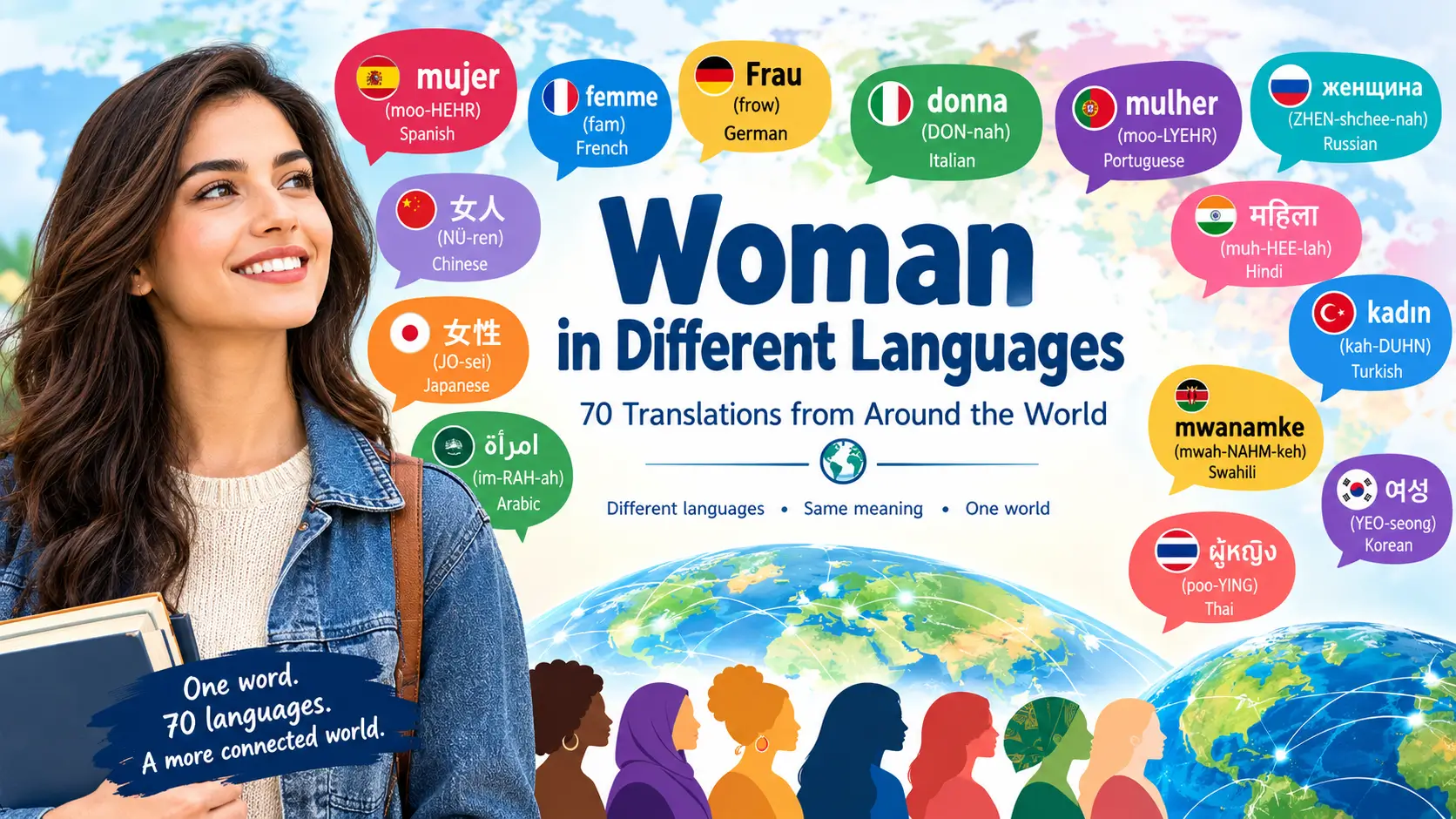
For example, mujer is the common Spanish word for woman, while French uses femme. German uses Frau, Italian uses donna, and Portuguese uses mulher.
In many languages, the grammatical form can also change when the word is used in a complete sentence. This is why a dictionary translation and a natural sentence may look slightly different.
Woman Translations Across Europe
European languages provide a wide range of forms for the word woman.
Romance languages such as Spanish, French, Italian, Portuguese, and Romanian have distinct words that developed from different historical forms. Germanic languages include forms such as Frau, vrouw, kvinna, and kvinne.
Slavic languages frequently use forms related to žena, although pronunciation and spelling differ between languages. Russian uses женщина, while Ukrainian uses жінка.
These differences make woman around the world an interesting example of how languages evolve while expressing the same basic idea.
Woman in Asian Languages
Asian languages often use completely different vocabulary and writing systems for the concept of woman.
In Hindi and several other South Asian languages, forms such as महिला are commonly used in formal contexts. Urdu commonly uses عورت, while Punjabi uses ਔਰਤ.
Mandarin Chinese uses 女人, Japanese commonly uses 女性 in formal or general contexts, and Korean uses 여성. Vietnamese uses phụ nữ, while Indonesian uses perempuan.
Learning both the native spelling and pronunciation can make these translations easier to recognize and use.
Woman in African Languages
Africa is home to thousands of languages, each with its own vocabulary and grammatical traditions.
In Swahili, mwanamke means woman. Zulu uses owesifazane, while Xhosa uses umfazi. Yoruba uses obìnrin, Igbo uses nwaanyị, and Hausa uses mace.
These examples demonstrate that woman in different languages is not simply a matter of changing letters. The structure, sounds, and grammatical patterns can vary significantly from language to language.
Formal and Everyday Uses of “Woman”
The most suitable translation can depend on context.
Some languages have words that are neutral and widely used in everyday conversation. Others have separate terms for formal writing, respectful speech, or specific social contexts.
For language learners, it is useful to learn the common dictionary form first and then study how native speakers use it in sentences.
When speaking or writing, context matters just as much as the basic translation.
Why Learn the Word “Woman” in Other Languages?
Learning simple vocabulary such as “woman” can help language learners build useful foundations.
It can help you:
- Understand basic conversations.
- Recognize common words while traveling.
- Expand your everyday vocabulary.
- Compare languages and cultures.
- Improve reading comprehension.
- Learn sentence structure through examples.
- Communicate more naturally with native speakers.
Simple words are often the building blocks for more advanced language learning.
Tips for Learning “Woman” in 70 Languages
Start with a few languages rather than trying to memorize all 70 at once. Choose languages connected to your travel plans, studies, family, or interests.
Pay attention to pronunciation because some sounds may not exist in English. Listening to native speakers is particularly useful for languages with unfamiliar sounds or tones.
It is also better to learn the word in a short sentence. For example, learning a noun together with “The woman is here” gives you a practical pattern that can be adapted to other vocabulary.
Frequently Asked Questions
1. What is the word for woman in Spanish?
The Spanish word for woman is mujer. It is commonly pronounced approximately like “moo-HEHR.”
2. How do you say woman in French?
In French, woman is femme. The pronunciation is approximately “fam.”
3. What is woman in Hindi?
The Hindi word commonly used for woman is महिला (mahila). It is especially common in formal or respectful contexts.
4. How do you say woman in Arabic?
The Arabic word for woman is امرأة (imra’ah). Arabic pronunciation can vary slightly by dialect, so the exact spoken form may differ between regions.
5. What is woman in Japanese?
A common formal or general Japanese term for woman is 女性 (josei). Japanese also has other terms depending on context and style.
Conclusion
The word “woman” has many different forms across the world’s languages. From Spanish mujer and French femme to Hindi महिला, Arabic امرأة, Mandarin 女人, and Swahili mwanamke, each language gives the concept its own pronunciation, spelling, and cultural context.
This list of 70 translations provides a practical starting point for anyone interested in woman in all languages, language learning, travel vocabulary, or global communication.

I am Ava Jones, a language enthusiast and author passionate about exploring different languages, sharing useful phrases, explaining meanings, and helping readers communicate confidently across cultures and countries.