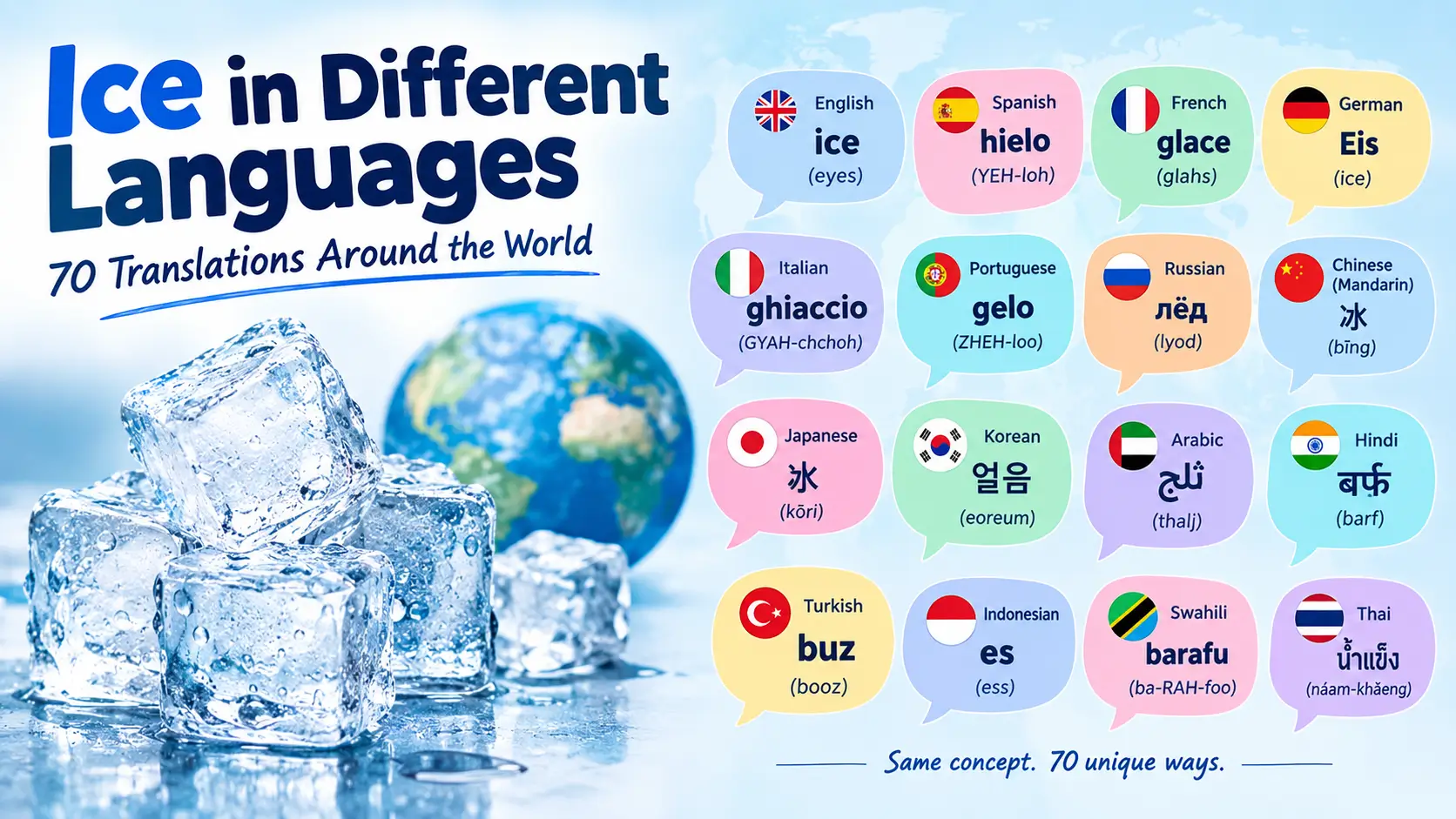
Ice is a simple everyday word, but it has fascinating translations across languages and cultures. Whether you are learning a new language, traveling, writing multilingual content, or simply curious about how people around the world refer to frozen water, learning the word for “ice” is a useful starting point.
In this guide, you will discover ice in different languages, including the native word, an easy English pronunciation, and a short real-life example. The table covers exactly 70 languages, making it easy to compare ice translations at a glance.
How to Say Ice in Different Languages
The word “ice” generally refers to water in its solid, frozen state. However, languages can use different words, grammatical forms, and writing systems to express the same idea.
Here is how to say ice in all languages included in this guide:
| # | Language | Native Word | Easy English Pronunciation | Example Sentence | English Meaning |
|---|---|---|---|---|---|
| 1 | English | ice | eyes | I put ice in my drink. | I put frozen water in my drink. |
| 2 | Spanish | hielo | YEH-loh | Necesito hielo para mi bebida. | I need ice for my drink. |
| 3 | French | glace | glahs | Je mets de la glace dans mon verre. | I put ice in my glass. |
| 4 | German | Eis | ice | Ich brauche Eis für mein Getränk. | I need ice for my drink. |
| 5 | Italian | ghiaccio | GYAH-chchoh | Metto il ghiaccio nella bevanda. | I put ice in the drink. |
| 6 | Portuguese | gelo | ZHEH-loo | Preciso de gelo para a bebida. | I need ice for the drink. |
| 7 | Dutch | ijs | eyes | Ik doe ijs in mijn drankje. | I put ice in my drink. |
| 8 | Afrikaans | ys | us | Ek sit ys in my drankie. | I put ice in my drink. |
| 9 | Swedish | is | ees | Jag vill ha is i min dryck. | I want ice in my drink. |
| 10 | Danish | is | ees | Jeg vil have is i min drink. | I want ice in my drink. |
| 11 | Norwegian | is | ees | Jeg vil ha is i drinken min. | I want ice in my drink. |
| 12 | Icelandic | ís | ees | Ég vil hafa ís í drykknum mínum. | I want ice in my drink. |
| 13 | Finnish | jää | yay | Laitan jäätä juomaan. | I put ice in the drink. |
| 14 | Estonian | jää | yay | Panen jääd joogi sisse. | I put ice in the drink. |
| 15 | Latvian | ledus | LEH-doos | Es ielieku ledu dzērienā. | I put ice in the drink. |
| 16 | Lithuanian | ledas | LEH-dahs | Įdedu ledo į gėrimą. | I put ice in the drink. |
| 17 | Polish | lód | lood | Dodaję lód do napoju. | I add ice to the drink. |
| 18 | Czech | led | led | Dám led do nápoje. | I put ice in the drink. |
| 19 | Slovak | ľad | lyat | Dám ľad do nápoja. | I put ice in the drink. |
| 20 | Slovenian | led | led | Dodam led v pijačo. | I add ice to the drink. |
| 21 | Croatian | led | led | Stavljam led u piće. | I put ice in the drink. |
| 22 | Serbian | лед | led | Стављам лед у пиће. | I put ice in the drink. |
| 23 | Bosnian | led | led | Stavljam led u piće. | I put ice in the drink. |
| 24 | Macedonian | мраз | mraz | Ставам мраз во пијалакот. | I put ice in the drink. |
| 25 | Bulgarian | лед | led | Слагам лед в напитката. | I put ice in the drink. |
| 26 | Romanian | gheață | GYATS-uh | Pun gheață în băutură. | I put ice in the drink. |
| 27 | Albanian | akull | AH-kool | Vendos akull në pije. | I put ice in the drink. |
| 28 | Greek | πάγος | PAH-ghos | Βάζω πάγο στο ποτό μου. | I put ice in my drink. |
| 29 | Russian | лёд | lyod | Я кладу лёд в напиток. | I put ice in the drink. |
| 30 | Ukrainian | лід | leed | Я додаю лід у напій. | I add ice to the drink. |
| 31 | Belarusian | лёд | lyod | Я дадаю лёд у напой. | I add ice to the drink. |
| 32 | Armenian | սառույց | sah-ROOYTS | Ես սառույց եմ դնում խմիչքի մեջ։ | I put ice in the drink. |
| 33 | Georgian | ყინული | q’inuli | სასმელში ყინულს ვამატებ. | I add ice to the drink. |
| 34 | Turkish | buz | booz | İçeceğime buz koyuyorum. | I put ice in my drink. |
| 35 | Azerbaijani | buz | booz | İçkimə buz əlavə edirəm. | I add ice to my drink. |
| 36 | Persian | یخ | yakh | من در نوشیدنیام یخ میریزم. | I put ice in my drink. |
| 37 | Arabic | ثلج | thalj | أضع الثلج في مشروبي. | I put ice in my drink. |
| 38 | Hebrew | קרח | KEH-rahkh | אני שם קרח במשקה שלי. | I put ice in my drink. |
| 39 | Hindi | बर्फ | barf | मैं अपने पेय में बर्फ डालता हूँ। | I put ice in my drink. |
| 40 | Urdu | برف | barf | میں اپنے مشروب میں برف ڈالتا ہوں۔ | I put ice in my drink. |
| 41 | Bengali | বরফ | bo-rof | আমি পানীয়তে বরফ দিই। | I put ice in the drink. |
| 42 | Punjabi | ਬਰਫ਼ | baraf | ਮੈਂ ਆਪਣੇ ਪੀਣ ਵਾਲੇ ਪਦਾਰਥ ਵਿੱਚ ਬਰਫ਼ ਪਾਉਂਦਾ ਹਾਂ। | I put ice in my drink. |
| 43 | Gujarati | બરફ | ba-raf | હું મારા પીણામાં બરફ નાખું છું. | I put ice in my drink. |
| 44 | Marathi | बर्फ | barf | मी माझ्या पेयात बर्फ घालतो. | I put ice in my drink. |
| 45 | Nepali | बरफ | ba-raf | म पेयमा बरफ हाल्छु। | I put ice in the drink. |
| 46 | Sinhala | අයිස් | ais | මම මගේ පානයට අයිස් දමමි. | I put ice in my drink. |
| 47 | Tamil | பனி | pa-nee | நான் என் பானத்தில் பனியை சேர்க்கிறேன். | I add ice to my drink. |
| 48 | Telugu | మంచు | man-chu | నేను నా పానీయంలో మంచు వేస్తాను. | I put ice in my drink. |
| 49 | Kannada | ಮಂಜುಗಡ್ಡೆ | man-ju-gad-de | ನಾನು ನನ್ನ ಪಾನೀಯಕ್ಕೆ ಮಂಜುಗಡ್ಡೆ ಹಾಕುತ್ತೇನೆ. | I put ice in my drink. |
| 50 | Malayalam | മഞ്ഞ് | manj | ഞാൻ എന്റെ പാനീയത്തിൽ മഞ്ഞ് ഇടുന്നു. | I put ice in my drink. |
| 51 | Chinese (Mandarin) | 冰 | bīng | 我在饮料里加冰。 | I add ice to the drink. |
| 52 | Cantonese | 冰 | bing1 | 我喺飲品入面加冰。 | I add ice to the drink. |
| 53 | Japanese | 氷 | kōri | 飲み物に氷を入れます。 | I put ice in the drink. |
| 54 | Korean | 얼음 | eoreum | 음료에 얼음을 넣어요. | I put ice in the drink. |
| 55 | Vietnamese | đá | da | Tôi cho đá vào đồ uống. | I put ice in the drink. |
| 56 | Thai | น้ำแข็ง | náam-khǎeng | ฉันใส่น้ำแข็งในเครื่องดื่ม | I put ice in the drink. |
| 57 | Lao | ນ້ຳກ້ອນ | nam kon | ຂ້ອຍໃສ່ນ້ຳກ້ອນໃນເຄື່ອງດື່ມ. | I put ice in the drink. |
| 58 | Khmer | ទឹកកក | tœ̆k-kɑk | ខ្ញុំដាក់ទឹកកកក្នុងភេសជ្ជៈ។ | I put ice in the drink. |
| 59 | Burmese | ရေခဲ | yay-kheh | အချိုရည်ထဲ ရေခဲထည့်တယ်။ | I put ice in the drink. |
| 60 | Indonesian | es | ess | Saya menambahkan es ke minuman. | I add ice to the drink. |
| 61 | Malay | ais | eyes | Saya masukkan ais ke dalam minuman. | I put ice in the drink. |
| 62 | Filipino | yelo | YEH-loh | Naglalagay ako ng yelo sa inumin. | I put ice in the drink. |
| 63 | Javanese | es | ess | Aku nyelehake es ing ombenan. | I put ice in the drink. |
| 64 | Swahili | barafu | ba-RAH-foo | Ninaweka barafu kwenye kinywaji. | I put ice in the drink. |
| 65 | Zulu | iqhwa | ee-KHWA | Ngifaka iqhwa esiphuzweni sami. | I put ice in my drink. |
| 66 | Xhosa | umkhenkce | oom-KHEN-kheh | Ndifaka umkhenkce kwisiselo sam. | I put ice in my drink. |
| 67 | Somali | baraf | ba-RAF | Waxaan cabitaanka ku daraa baraf. | I add ice to the drink. |
| 68 | Amharic | በረዶ | beh-REH-doh | በመጠጤ ውስጥ በረዶ እጨምራለሁ። | I add ice to my drink. |
| 69 | Malagasy | ranomandry | ra-no-MAN-dree | Mametraka ranomandry ao amin’ny zava-pisotro aho. | I put ice in the drink. |
| 70 | Māori | huka | HOO-kah | Ka tāpirihia e au te huka ki taku inu. | I add ice to my drink. |
Ice Translations Around the World
The translations above show that there is no single pattern for the word “ice.” Some languages have very short words, such as buz in Turkish, es in Indonesian, and led in several Slavic languages.
Other languages use words with different structures and sounds. For example, Mandarin Chinese uses 冰, Japanese uses 氷, Korean uses 얼음, and Arabic uses ثلج.
These differences make vocabulary comparisons useful for language learners because a familiar concept can reveal how different languages organize and express everyday ideas.
How to Say Ice in European Languages
European languages offer many interesting variations. Spanish uses hielo, French uses glace, Italian uses ghiaccio, and Portuguese uses gelo.
Several northern and eastern European languages have especially short forms. Swedish, Danish, and Norwegian use is, while Polish uses lód and Czech uses led.
Learning these small vocabulary differences can be helpful when traveling, ordering drinks, or understanding menus in another country.
How to Say Ice in Asian Languages
Asian languages provide a wide range of scripts and vocabulary forms. In Mandarin Chinese, the word is 冰, while Japanese uses 氷 and Korean uses 얼음.
In South Asia, common translations include बर्फ in Hindi, برف in Urdu, বরফ in Bengali, and ਬਰਫ਼ in Punjabi.
In Southeast Asia, you can find forms such as đá in Vietnamese, น้ำแข็ง in Thai, es in Indonesian, and ais in Malay.
Ice in Different Languages for Travel
Knowing how to say “ice” can be surprisingly practical while traveling. It can help when ordering cold drinks, asking for extra ice, shopping for food, or communicating with hotel and restaurant staff.
A useful approach is to learn the word together with a simple sentence. Instead of memorizing only the translation, practice a phrase such as “I want ice in my drink.” This gives you vocabulary that can be used immediately in real situations.
Why Learn Ice in All Languages?
Searching for ice in all languages can be useful for students, translators, travelers, writers, and people interested in world languages. Comparing translations also makes it easier to recognize similarities between related languages.
For example, Swedish, Danish, and Norwegian all use forms of is, while Croatian, Serbian, Bosnian, Slovenian, Czech, and other Slavic languages contain closely related forms built around the idea of ice.
Quick Guide to Ice Translations
If you only need a few popular translations, these are useful ones to remember:
- English: ice
- Spanish: hielo
- French: glace
- German: Eis
- Italian: ghiaccio
- Portuguese: gelo
- Turkish: buz
- Arabic: ثلج
- Hindi: बर्फ
- Urdu: برف
- Chinese: 冰
- Japanese: 氷
- Korean: 얼음
- Vietnamese: đá
- Indonesian: es
- Swahili: barafu
Frequently Asked Questions
1. How do you say “ice” in different languages?
“Ice” has many translations. Some common examples are hielo in Spanish, glace in French, Eis in German, ghiaccio in Italian, buz in Turkish, برف in Urdu, 冰 in Chinese, 氷 in Japanese, and 얼음 in Korean.
2. What is the word for ice in Spanish?
The Spanish word for ice is hielo. It is commonly used when talking about ice in drinks, frozen water, or ice in everyday situations.
3. What is ice called in Hindi and Urdu?
In Hindi, ice is बर्फ (barf). In Urdu, it is برف (barf). The two words are closely related and are commonly used in everyday speech.
4. How do you say ice in Chinese and Japanese?
In Mandarin Chinese, ice is 冰 (bīng). In Japanese, ice is 氷 (kōri). Both languages have their own writing systems and pronunciation patterns.
5. What is the most common translation of ice around the world?
There is no single universal translation. Different languages use completely different words, although related languages often have similar forms. The exact word depends on the language and context.
Conclusion
Learning how to say ice in different languages is a simple way to explore vocabulary, pronunciation, scripts, and cultural differences. From hielo in Spanish and ghiaccio in Italian to 冰 in Chinese and બરફ in South Asian languages, the translations show how one everyday concept can be expressed in many fascinating ways.
Whether you are researching ice translations, learning a new language, or simply curious about ice around the world, these 70 translations provide a practical multilingual reference.

I am Ava Jones, a language enthusiast and author passionate about exploring different languages, sharing useful phrases, explaining meanings, and helping readers communicate confidently across cultures and countries.