Saying “good morning” is one of the simplest ways to start a conversation on a friendly note. Whether you are traveling, learning a language, chatting with international friends, or simply exploring world languages, knowing this everyday greeting can help you connect with people across cultures.
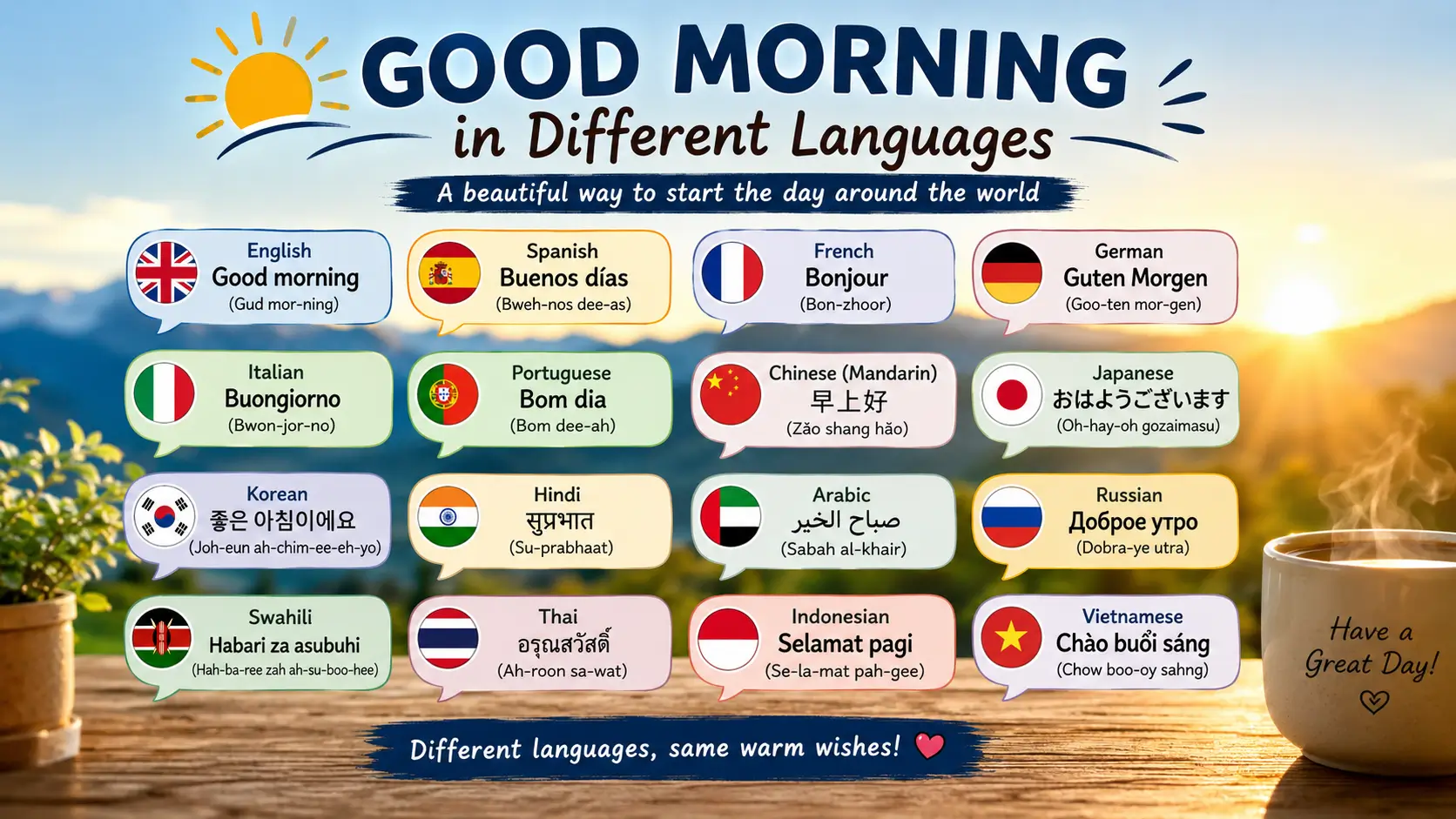
This guide shows good morning in different languages with the native phrase, an easy English pronunciation, and a practical example sentence. If you are looking for good morning in all languages, want to learn how to say good morning in different languages, or are comparing good morning translations, the table below provides 70 useful examples from around the world.
Good Morning in Different Languages: 70 Translations
The pronunciations below are simplified for English speakers. Actual pronunciation can vary by region, accent, and speaking style.
| # | Language | Native phrase | Easy English pronunciation | Example sentence | English meaning |
|---|---|---|---|---|---|
| 1 | English | Good morning | gud MOR-ning | Good morning, Sarah! | Good morning, Sarah! |
| 2 | Spanish | Buenos días | BWEH-nos DEE-as | Buenos días, señor. | Good morning, sir. |
| 3 | French | Bonjour | bohn-ZHOOR | Bonjour, Marie! | Good morning, Marie! |
| 4 | German | Guten Morgen | GOO-ten MOR-gen | Guten Morgen, Anna! | Good morning, Anna! |
| 5 | Italian | Buongiorno | bwohn-JOR-no | Buongiorno, Marco! | Good morning, Marco! |
| 6 | Portuguese | Bom dia | bohm DEE-ah | Bom dia, amigo! | Good morning, friend! |
| 7 | Dutch | Goedemorgen | KHOOD-uh-MOR-ghun | Goedemorgen, Lisa! | Good morning, Lisa! |
| 8 | Afrikaans | Goeiemôre | KHOY-uh-MOR-uh | Goeiemôre, vriend! | Good morning, friend! |
| 9 | Swedish | God morgon | goo MOR-ron | God morgon, Anna! | Good morning, Anna! |
| 10 | Norwegian | God morgen | goo MOR-gen | God morgen, Erik! | Good morning, Erik! |
| 11 | Danish | Godmorgen | goh-MOR-en | Godmorgen, Lars! | Good morning, Lars! |
| 12 | Icelandic | Góðan morgun | GO-thahn MOR-gun | Góðan morgun, vinur! | Good morning, friend! |
| 13 | Finnish | Hyvää huomenta | HOO-vah HWOH-men-tah | Hyvää huomenta, Anna! | Good morning, Anna! |
| 14 | Estonian | Tere hommikust | TEH-reh HOM-mee-kust | Tere hommikust, Mari! | Good morning, Mari! |
| 15 | Latvian | Labrīt | lah-BREET | Labrīt, Anna! | Good morning, Anna! |
| 16 | Lithuanian | Labas rytas | LAH-bahs REE-tahs | Labas rytas, drauge! | Good morning, friend! |
| 17 | Polish | Dzień dobry | jen DOH-bri | Dzień dobry, pani! | Good morning, ma’am! |
| 18 | Czech | Dobré ráno | DOH-breh RAH-no | Dobré ráno, Petře! | Good morning, Peter! |
| 19 | Slovak | Dobré ráno | DOH-breh RAH-no | Dobré ráno, Jana! | Good morning, Jana! |
| 20 | Slovenian | Dobro jutro | DOH-broh YOO-troh | Dobro jutro, prijatelj! | Good morning, friend! |
| 21 | Croatian | Dobro jutro | DOH-broh YOO-troh | Dobro jutro, Ana! | Good morning, Ana! |
| 22 | Serbian | Dobro jutro | DOH-broh YOO-troh | Dobro jutro, Marko! | Good morning, Marko! |
| 23 | Bosnian | Dobro jutro | DOH-broh YOO-troh | Dobro jutro, prijatelju! | Good morning, friend! |
| 24 | Bulgarian | Добро утро | DOH-broh OO-troh | Добро утро, Иван! | Good morning, Ivan! |
| 25 | Macedonian | Добро утро | DOH-broh OO-troh | Добро утро, Ана! | Good morning, Ana! |
| 26 | Russian | Доброе утро | DOH-brah-ye OO-trah | Доброе утро, Анна! | Good morning, Anna! |
| 27 | Ukrainian | Доброго ранку | DOH-bro-ho RAHN-koo | Доброго ранку, Олено! | Good morning, Olena! |
| 28 | Belarusian | Добрай раніцы | DOH-bry RAH-nee-tsuh | Добрай раніцы, сябра! | Good morning, friend! |
| 29 | Greek | Καλημέρα | kah-lee-MEH-rah | Καλημέρα, Μαρία! | Good morning, Maria! |
| 30 | Albanian | Mirëmëngjes | meer-uh-MUNG-yes | Mirëmëngjes, Ana! | Good morning, Ana! |
| 31 | Romanian | Bună dimineața | BOO-nuh dee-mee-NEH-ah-tsah | Bună dimineața, Maria! | Good morning, Maria! |
| 32 | Hungarian | Jó reggelt | yoh REG-gelt | Jó reggelt, Anna! | Good morning, Anna! |
| 33 | Turkish | Günaydın | goo-NIGH-dun | Günaydın, Ayşe! | Good morning, Ayşe! |
| 34 | Maltese | Bongu | BON-goo | Bongu, ħabib! | Good morning, friend! |
| 35 | Irish | Maidin mhaith | MAD-in wah | Maidin mhaith, a chara! | Good morning, friend! |
| 36 | Welsh | Bore da | BOR-eh dah | Bore da, Carys! | Good morning, Carys! |
| 37 | Basque | Egun on | EH-goon on | Egun on, lagun! | Good morning, friend! |
| 38 | Catalan | Bon dia | bon DEE-ah | Bon dia, Maria! | Good morning, Maria! |
| 39 | Galician | Bos días | bos DEE-as | Bos días, amigo! | Good morning, friend! |
| 40 | Esperanto | Bonan matenon | boh-NAHN mah-TEH-non | Bonan matenon, amiko! | Good morning, friend! |
| 41 | Latin | Bonum mane | BOH-noom MAH-neh | Bonum mane, amice! | Good morning, friend! |
| 42 | Arabic | صباح الخير | sah-BAH al-KHAIR | صباح الخير يا صديقي! | Good morning, my friend! |
| 43 | Hebrew | בוקר טוב | BOH-ker tov | בוקר טוב, דנה! | Good morning, Dana! |
| 44 | Persian | صبح بخیر | sobh bekh-EYR | صبح بخیر، دوست من! | Good morning, my friend! |
| 45 | Urdu | صبح بخیر | subah bakhair | صبح بخیر، دوست! | Good morning, friend! |
| 46 | Hindi | सुप्रभात | soo-pruh-BHAAT | सुप्रभात, मित्र! | Good morning, friend! |
| 47 | Bengali | সুপ্রভাত | shoo-pro-BHAAT | সুপ্রভাত, বন্ধু! | Good morning, friend! |
| 48 | Punjabi | ਸ਼ੁਭ ਸਵੇਰ | shubh SAV-air | ਸ਼ੁਭ ਸਵੇਰ, ਦੋਸਤ! | Good morning, friend! |
| 49 | Gujarati | સુપ્રભાત | soo-pruh-BHAAT | સુપ્રભાત, મિત્ર! | Good morning, friend! |
| 50 | Marathi | शुभ प्रभात | shubh pruh-BHAAT | शुभ प्रभात, मित्रा! | Good morning, friend! |
| 51 | Nepali | शुभ प्रभात | shubh pruh-BHAAT | शुभ प्रभात, साथी! | Good morning, friend! |
| 52 | Sinhala | සුභ උදෑසනක් | soo-bha oo-DAE-suh-nak | සුභ උදෑසනක්, මිතුරා! | Good morning, friend! |
| 53 | Tamil | காலை வணக்கம் | KAA-lai vah-NAK-kam | காலை வணக்கம், நண்பா! | Good morning, friend! |
| 54 | Telugu | శుభోదయం | shoo-bhoh-DA-yam | శుభోదయం, మిత్రమా! | Good morning, friend! |
| 55 | Kannada | ಶುಭೋದಯ | shoo-bhoh-DA-ya | ಶುಭೋದಯ, ಸ್ನೇಹಿತ! | Good morning, friend! |
| 56 | Malayalam | സുപ്രഭാതം | soo-pra-BHAH-tham | സുപ്രഭാതം, സുഹൃത്തേ! | Good morning, friend! |
| 57 | Odia | ସୁପ୍ରଭାତ | soo-pra-BHA-ta | ସୁପ୍ରଭାତ, ବନ୍ଧୁ! | Good morning, friend! |
| 58 | Assamese | সুপ্ৰভাত | soo-pro-BHAAT | সুপ্ৰভাত, বন্ধু! | Good morning, friend! |
| 59 | Mandarin Chinese | 早上好 | zǎo-shang hǎo | 早上好,朋友! | Good morning, friend! |
| 60 | Japanese | おはようございます | oh-hah-YOH goh-zah-ee-mahs | おはようございます、田中さん。 | Good morning, Mr. Tanaka. |
| 61 | Korean | 좋은 아침이에요 | JOH-eun ah-CHIM-ee-eh-yo | 좋은 아침이에요, 친구! | Good morning, friend! |
| 62 | Vietnamese | Chào buổi sáng | chow boo-oy SAHNG | Chào buổi sáng, bạn! | Good morning, friend! |
| 63 | Thai | อรุณสวัสดิ์ | ah-roon sah-WAT | อรุณสวัสดิ์ครับ เพื่อน! | Good morning, friend! |
| 64 | Indonesian | Selamat pagi | seh-LAH-maht PAH-gee | Selamat pagi, teman! | Good morning, friend! |
| 65 | Malay | Selamat pagi | seh-LAH-maht PAH-gee | Selamat pagi, kawan! | Good morning, friend! |
| 66 | Filipino | Magandang umaga | mah-gan-DAHNG oo-MAH-gah | Magandang umaga, kaibigan! | Good morning, friend! |
| 67 | Swahili | Habari za asubuhi | hah-BAH-ree zah ah-soo-BOO-hee | Habari za asubuhi, rafiki! | Good morning, friend! |
| 68 | Zulu | Sawubona ekuseni | sah-woo-BOH-nah eh-koo-SEH-nee | Sawubona ekuseni, mngane! | Good morning, friend! |
| 69 | Xhosa | Molo kusasa | MOH-loh koo-SAH-sah | Molo kusasa, mhlobo! | Good morning, friend! |
| 70 | Haitian Creole | Bonjou | bon-ZHOO | Bonjou, zanmi! | Good morning, friend! |
How to Say Good Morning in Different Languages
The phrase “good morning” does not always translate word-for-word between languages. Some languages use a specific morning greeting, while others use a broader greeting that is commonly used in the morning.
For example, Buenos días is the standard Spanish morning greeting, while Bonjour is the everyday French greeting used during the morning and much of the daytime. In Japanese, おはようございます is a polite morning greeting, particularly appropriate in formal or respectful situations.
This is why learning the natural expression is usually more useful than translating the English words separately.
Good Morning Around the World
Morning greetings can reveal interesting differences in language and culture.
In many European languages, the greeting directly refers to the morning or wishes someone a good morning. Romance languages such as Spanish, Portuguese, Italian, French, and Catalan have distinctive but related expressions.
Across South Asia, expressions such as صباح بخیر, صبح بخیر, শুভ্রভাত, and शुभ प्रभात reflect the linguistic diversity of the region.
In East and Southeast Asia, morning greetings can also depend on formality and social context. Japanese, Korean, Chinese, Vietnamese, Thai, Indonesian, and Malay all have their own natural ways to greet someone at the start of the day.
Good Morning Translations for Travel and Conversation
Learning a local morning greeting is particularly useful when traveling. Even a simple greeting can make everyday interactions feel warmer and more respectful.
You can use these translations when:
- Greeting someone at breakfast
- Starting a conversation with a local person
- Sending a morning text message
- Writing a multilingual social media post
- Practicing a new language
- Welcoming international customers or colleagues
- Creating language-learning materials
When speaking with native speakers, pronunciation and context matter as much as the written phrase. If you are unsure about formality, listen to how local speakers use the greeting and choose the polite form in professional situations.
Good Morning in All Languages: Quick Tips
There are thousands of languages spoken around the world, so no single list can literally include every language. This collection focuses on 70 widely recognized languages and regional languages that offer useful examples of how people greet one another in the morning.
A good way to remember new translations is to connect each phrase with a person, place, or daily routine. For example, practice Buenos días when learning Spanish, Guten Morgen when studying German, or Selamat pagi when practicing Indonesian or Malay.
Repeating a greeting aloud is also helpful because written pronunciation guides can only approximate the sounds of another language.
Why Learn Good Morning in Different Languages?
Knowing a simple greeting can be more than a vocabulary exercise. It can show curiosity about another culture and make communication more welcoming.
For language learners, morning greetings are also useful beginner vocabulary because they are short, practical, and easy to practice every day. You can build a larger vocabulary by learning related phrases such as “hello,” “good afternoon,” “good evening,” “how are you,” and “have a nice day.”
Frequently Asked Questions
1. What is “good morning” in the most popular languages?
Some common translations include Buenos días in Spanish, Bonjour in French, Guten Morgen in German, Buongiorno in Italian, Bom dia in Portuguese, 早上好 in Mandarin Chinese, おはようございます in Japanese, and Selamat pagi in Indonesian and Malay.
2. How do you say “good morning” in different languages?
You can use the 70-language table above to find the native phrase, an easy pronunciation guide, and an example sentence. The correct expression depends on the language and, in some cases, the level of formality.
3. What is the shortest way to say good morning in another language?
Several languages have short morning greetings. Examples include Bonjour in French, Bonjou in Haitian Creole, Bongu in Maltese, and Labrīt in Latvian.
4. Is “good morning” the same in every language?
No. Some languages have a phrase specifically associated with morning, while others use a general daytime greeting. Formality, region, and social relationship can also influence which expression sounds most natural.
5. Which good morning translation should I learn first?
Start with the language you are most likely to use. If you are traveling, learn the local greeting first. If you are studying a language, practice its standard morning expression along with its pronunciation and appropriate level of formality.
Conclusion
Learning good morning in different languages is a simple way to explore how people communicate around the world. From Buenos días and Bonjour to 早上好, おはようございます, and Selamat pagi, each greeting offers a small window into another language and culture.
Whether you need good morning in all languages for language learning, travel, communication, or curiosity, practicing these 70 phrases can help you start conversations with greater confidence and cultural awareness.

I am Ricardo Hunter, Administrator at LingoBuz, passionate about languages, translations, and global communication. I help create useful, clear content that makes exploring different languages simple, enjoyable, and accessible.