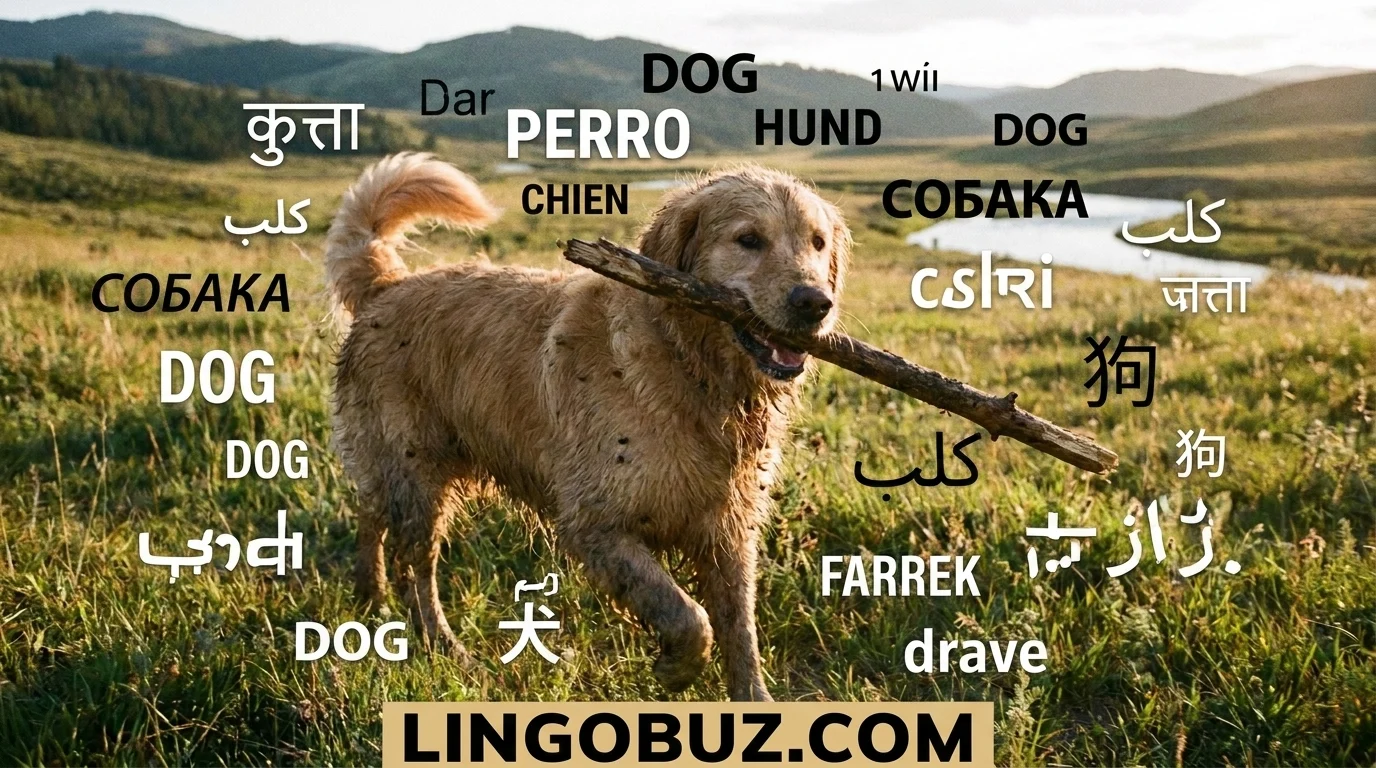
Dogs are loved around the world for their loyalty, intelligence, and playful personalities. But have you ever wondered how to say dog in different languages? From perro in Spanish to chien in French and Hund in German, every language has its own word for this popular animal.
Whether you are learning a new language, writing about pets, exploring animal names, or simply curious about different cultures, this guide will help you discover how people say dog in 70 languages. Each translation includes the native word, an easy pronunciation guide, and an example sentence with its English meaning.
How Do You Say Dog in Different Languages?
The word “dog” has different translations across the world. Here are eight common examples to help you get started.
| Language | Native Word | Easy Pronunciation | English Meaning |
|---|---|---|---|
| Spanish | Perro | PEH-rroh | Dog |
| French | Chien | shyeh(n) | Dog |
| German | Hund | hoont | Dog |
| Italian | Cane | KAH-neh | Dog |
| Portuguese | Cão | kowng | Dog |
| Hindi | कुत्ता | kut-ta | Dog |
| Urdu | کتا | kutta | Dog |
| Japanese | 犬 | ee-nu | Dog |
Example: In Spanish, El perro es amigable means “The dog is friendly.” In French, Le chien est gentil means “The dog is kind.”
Dog in South Asian Languages
South Asian languages have different words for dogs, with some languages also distinguishing between male and female dogs or using different words in formal and everyday speech.
| Language | Native Word | Easy Pronunciation | Example Sentence | English Meaning |
|---|---|---|---|---|
| Hindi | कुत्ता | kut-ta | कुत्ता बहुत प्यारा है। | The dog is very cute. |
| Urdu | کتا | kutta | کتا بہت پیارا ہے۔ | The dog is very cute. |
| Bengali | কুকুর | ku-kur | কুকুরটি খুব সুন্দর। | The dog is very cute. |
| Punjabi | ਕੁੱਤਾ | kut-ta | ਕੁੱਤਾ ਬਹੁਤ ਪਿਆਰਾ ਹੈ। | The dog is very cute. |
| Gujarati | કૂતરો | koo-tro | કૂતરો ખૂબ સુંદર છે. | The dog is very cute. |
| Marathi | कुत्रा | kut-raa | कुत्रा खूप गोड आहे. | The dog is very cute. |
| Nepali | कुकुर | ku-kur | कुकुर धेरै प्यारो छ। | The dog is very cute. |
Dog in East Asian Languages
East Asian languages use distinct words for dogs. These translations are useful for travelers, language learners, and anyone interested in animal vocabulary.
| Language | Native Word | Easy Pronunciation | Example Sentence | English Meaning |
|---|---|---|---|---|
| Mandarin Chinese | 狗 | gǒu | 这只狗很可爱。 | This dog is very cute. |
| Japanese | 犬 | inu | その犬はかわいいです。 | That dog is cute. |
| Korean | 개 | gae | 그 개는 귀여워요. | That dog is cute. |
| Mongolian | Нохой | no-khoi | Нохой хөөрхөн. | The dog is cute. |
| Tibetan | ཁྱི | khyi | ཁྱི་དེ་སྙིང་རྗེ་པོ་འདུག | That dog is cute. |
| Burmese | ခွေး | khway | ခွေးလေးက ချစ်စရာကောင်းတယ်။ | The dog is cute. |
| Cantonese | 狗 | gau2 | 呢隻狗好得意。 | This dog is cute. |
Dog in Southeast Asian Languages
Dogs are familiar animals in many Southeast Asian communities. These words can help you talk about pets and animals during everyday conversations.
| Language | Native Word | Easy Pronunciation | Example Sentence | English Meaning |
|---|---|---|---|---|
| Thai | สุนัข | su-nak | สุนัขตัวนี้น่ารัก | This dog is cute. |
| Vietnamese | Chó | chaw | Con chó rất dễ thương. | The dog is very cute. |
| Indonesian | Anjing | an-jing | Anjing itu sangat lucu. | That dog is very cute. |
| Malay | Anjing | an-jing | Anjing itu sangat comel. | That dog is very cute. |
| Filipino | Aso | ah-soh | Ang aso ay napakacute. | The dog is very cute. |
| Khmer | ឆ្កែ | ch-kay | ឆ្កែនេះគួរឱ្យស្រឡាញ់។ | This dog is adorable. |
| Lao | ໝາ | maa | ໝາໂຕນີ້ໜ້າຮັກ | This dog is cute. |
Dog in Middle Eastern and Nearby Languages
The following translations show how to say dog in several languages spoken across the Middle East and nearby regions.
| Language | Native Word | Easy Pronunciation | Example Sentence | English Meaning |
|---|---|---|---|---|
| Arabic | كلب | kalb | الكلب لطيف. | The dog is friendly. |
| Persian | سگ | sag | این سگ بامزه است. | This dog is cute. |
| Hebrew | כלב | keh-lev | הכלב חמוד. | The dog is cute. |
| Turkish | Köpek | kuh-pek | Köpek çok sevimli. | The dog is very cute. |
| Kurdish (Kurmanji) | Kûçik | koo-chik | Kûçik pir delal e. | The dog is very cute. |
| Pashto | سپی | spey | دا سپی ښکلی دی. | This dog is beautiful. |
| Armenian | Շուն | shoon | Շունը շատ սիրուն է։ | The dog is very cute. |
Dog in Western European Languages
Many Western European languages have short, commonly used words for dog. Learning them is a useful first step for anyone studying European vocabulary.
| Language | Native Word | Easy Pronunciation | Example Sentence | English Meaning |
|---|---|---|---|---|
| French | Chien | shyeh(n) | Le chien est gentil. | The dog is friendly. |
| Spanish | Perro | PEH-rroh | El perro es amigable. | The dog is friendly. |
| Portuguese | Cão | kowng | O cão é amigável. | The dog is friendly. |
| Italian | Cane | KAH-neh | Il cane è amichevole. | The dog is friendly. |
| German | Hund | hoont | Der Hund ist freundlich. | The dog is friendly. |
| Dutch | Hond | hond | De hond is vriendelijk. | The dog is friendly. |
| Catalan | Gos | goss | El gos és amable. | The dog is friendly. |
Dog in Northern European and Baltic Languages
These languages offer different names for dogs, from familiar Scandinavian words to Baltic vocabulary.
| Language | Native Word | Easy Pronunciation | Example Sentence | English Meaning |
|---|---|---|---|---|
| Swedish | Hund | hoond | Hunden är snäll. | The dog is kind. |
| Norwegian | Hund | hoon | Hunden er snill. | The dog is kind. |
| Danish | Hund | hoon | Hunden er venlig. | The dog is friendly. |
| Finnish | Koira | koy-rah | Koira on ystävällinen. | The dog is friendly. |
| Icelandic | Hundur | hoon-dur | Hundurinn er vingjarnlegur. | The dog is friendly. |
| Estonian | Koer | koh-ehr | Koer on sõbralik. | The dog is friendly. |
| Latvian | Suns | soons | Suns ir draudzīgs. | The dog is friendly. |
Dog in Slavic and Eastern European Languages
Slavic and Eastern European languages have distinctive words for dogs. Some words may look or sound similar because of historical relationships between languages.
| Language | Native Word | Easy Pronunciation | Example Sentence | English Meaning |
|---|---|---|---|---|
| Russian | Собака | sa-BA-ka | Собака очень добрая. | The dog is very kind. |
| Ukrainian | Собака | so-BA-ka | Собака дуже мила. | The dog is very cute. |
| Polish | Pies | pyes | Pies jest przyjazny. | The dog is friendly. |
| Czech | Pes | pes | Pes je přátelský. | The dog is friendly. |
| Slovak | Pes | pes | Pes je priateľský. | The dog is friendly. |
| Bulgarian | Куче | koo-cheh | Кучето е дружелюбно. | The dog is friendly. |
| Serbian | Пас | pas | Пас је пријатељски настројен. | The dog is friendly. |
Dog in Southern European and Balkan Languages
The following words are used in Southern Europe and the Balkans. They are useful for discussing pets, animals, and everyday life.
| Language | Native Word | Easy Pronunciation | Example Sentence | English Meaning |
|---|---|---|---|---|
| Greek | Σκύλος | SKEE-los | Ο σκύλος είναι φιλικός. | The dog is friendly. |
| Croatian | Pas | pas | Pas je prijateljski nastrojen. | The dog is friendly. |
| Bosnian | Pas | pas | Pas je umiljat. | The dog is affectionate. |
| Slovenian | Pes | pes | Pes je prijazen. | The dog is friendly. |
| Albanian | Qen | chen | Qeni është miqësor. | The dog is friendly. |
| Romanian | Câine | kuh-ee-neh | Câinele este prietenos. | The dog is friendly. |
| Hungarian | Kutya | koo-tyah | A kutya barátságos. | The dog is friendly. |
Dog in African Languages
Across Africa, many languages have their own words for dogs. These examples introduce several widely spoken African languages.
| Language | Native Word | Easy Pronunciation | Example Sentence | English Meaning |
|---|---|---|---|---|
| Swahili | Mbwa | mm-bwah | Mbwa ni rafiki mzuri. | The dog is a good friend. |
| Amharic | ውሻ | wu-sha | ውሻው ቆንጆ ነው። | The dog is cute. |
| Yoruba | Ajá | ah-jah | Ajá náà lẹ́wà. | The dog is beautiful. |
| Igbo | Nkịta | n-kee-tah | Nkịta ahụ mara mma. | That dog is beautiful. |
| Hausa | Kare | kah-reh | Karen yana da kyau. | The dog is beautiful. |
| Zulu | Inja | een-jah | Inja inobungane. | The dog is friendly. |
| Afrikaans | Hond | hond | Die hond is vriendelik. | The dog is friendly. |
Dog in Central Asian and Other World Languages
This final group includes languages from Central Asia, the Caucasus, the Baltic region, and Ireland.
| Language | Native Word | Easy Pronunciation | Example Sentence | English Meaning |
|---|---|---|---|---|
| Kazakh | Ит | eet | Ит өте сүйкімді. | The dog is very cute. |
| Uzbek | It | eet | It juda yoqimli. | The dog is very cute. |
| Kyrgyz | Ит | eet | Ит абдан сүйкүмдүү. | The dog is very cute. |
| Azerbaijani | İt | eet | İt çox şirindir. | The dog is very cute. |
| Georgian | ძაღლი | dzagh-lee | ძაღლი ძალიან საყვარელია. | The dog is very cute. |
| Lithuanian | Šuo | shoo-oh | Šuo yra draugiškas. | The dog is friendly. |
| Irish | Madra | mah-drah | Tá an madra cairdiúil. | The dog is friendly. |
Different Words for Dog, Puppy, and Pet
Although these words are related, they do not have exactly the same meaning.
- Dog: An adult or young member of the dog species.
- Puppy: A young dog.
- Pet: An animal kept for companionship.
- Stray dog: A dog living without a permanent home or owner.
- Guard dog: A dog trained to protect people or property.
For example, the Spanish word perro means dog, while cachorro commonly means puppy. In French, chien means dog and chiot means puppy.
Understanding these differences helps you choose the correct word when speaking or writing in another language.
Why Are Dogs Called Different Names Around the World?
Languages develop through different histories, cultures, and traditions. As a result, the word for dog varies widely.
- Historical development: Words evolve over generations and may change in pronunciation or spelling.
- Language families: Related languages sometimes share similar vocabulary.
- Local culture: Dogs may have different roles in communities, including companionship, herding, and guarding.
- Grammar: Some languages change the form of a word depending on its role in a sentence.
- Regional variation: Speakers may use different words or expressions depending on the region.
These differences make animal vocabulary an interesting way to explore languages and cultures.
How to Learn Dog in Different Languages
Use these simple methods to remember the translations more easily.
- Start with familiar languages: Learn the words in languages you already hear regularly.
- Practice pronunciation: Say each word aloud several times.
- Use pictures: Connect each word with a picture of a dog.
- Learn complete sentences: Practice phrases such as “The dog is friendly.”
- Listen to native speakers: Audio examples can help you understand sounds and accents.
- Review regularly: Revisit a few words each day instead of memorizing all 70 at once.
Small, regular practice sessions can help you remember new vocabulary and use it more naturally.
Frequently Asked Questions
How do you say dog in different languages?
Dog is perro in Spanish, chien in French, Hund in German, cane in Italian, कुत्ता in Hindi, and 犬 (inu) in Japanese. The exact word depends on the language.
What is dog called in Hindi?
Dog is commonly called कुत्ता (kutta) in Hindi. The feminine form commonly used for a female dog is कुतिया (kutiya).
What is dog called in Urdu?
Dog is called کتا (kutta) in Urdu. It is the common everyday word for a dog.
How do you say puppy in different languages?
A puppy is called cachorro in Spanish, chiot in French, Welpe in German, and 子犬 (koinu) in Japanese. These words refer specifically to a young dog.
Why do different languages have different words for dogs?
Languages develop through different historical and cultural influences. Their vocabulary changes over time, which is why the same animal can have many different names around the world.
Conclusion
Learning dog in different languages is a fun way to build vocabulary and explore cultures around the world. From perro in Spanish to chien in French and inu in Japanese, these translations show how languages describe one of the world’s most familiar animals.
Use the 70 words and example sentences in this guide to practice pronunciation, improve your language skills, and discover new ways to talk about dogs.

I am Ricardo Hunter, Administrator at LingoBuz, passionate about languages, translations, and global communication. I help create useful, clear content that makes exploring different languages simple, enjoyable, and accessible.