Saying “good afternoon” is a simple way to show politeness, warmth, and respect. While the exact expression changes from one language to another, the purpose is the same: greeting someone pleasantly during the afternoon.
If you are traveling, learning a new language, communicating with international friends, or simply exploring world languages, learning how to say good afternoon in different languages is a useful place to start.
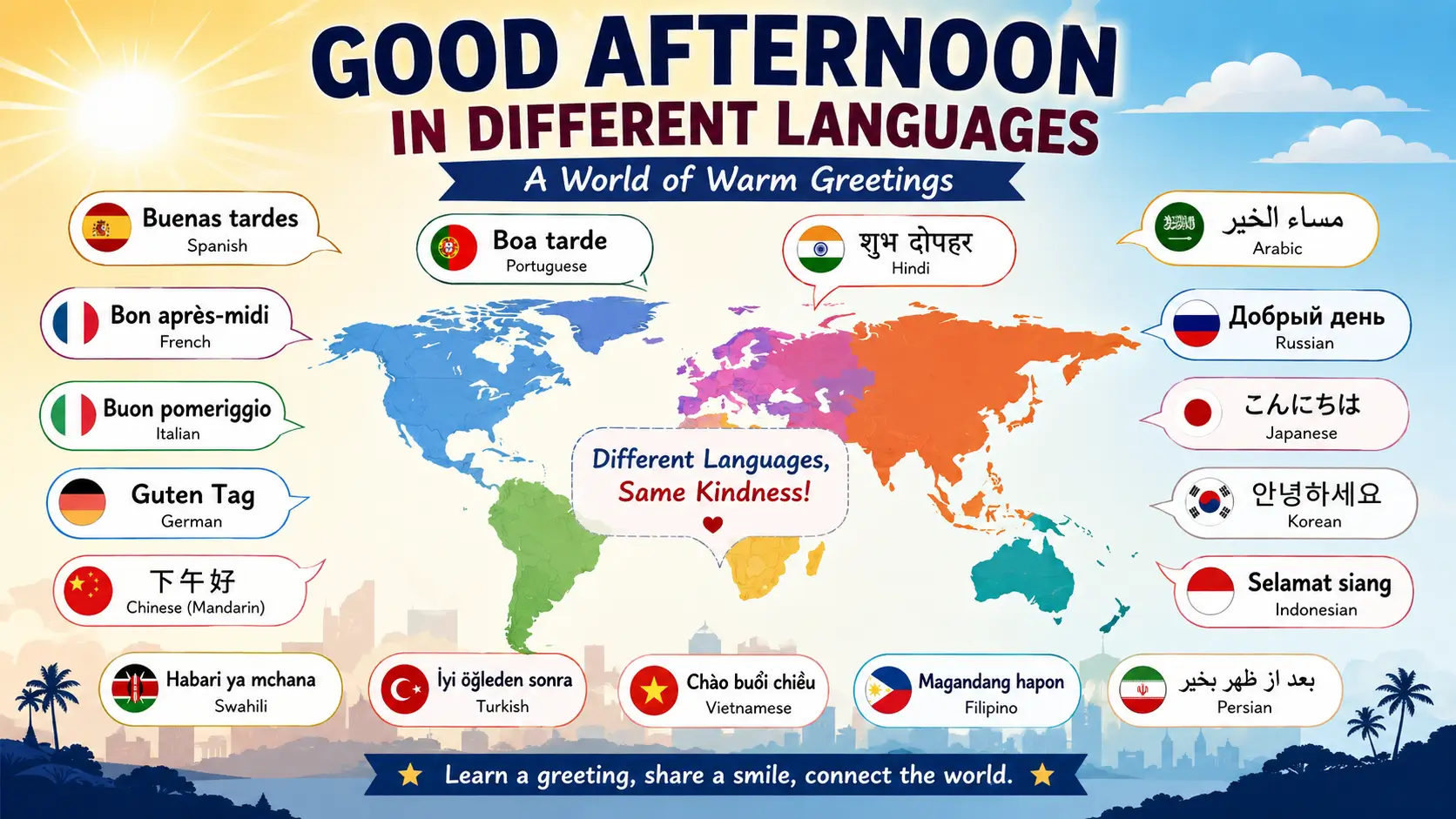
In this guide, you will discover 70 good afternoon translations, including the native phrase, an easy English pronunciation, a short real-life example, and the English meaning of each example. Some languages use a direct equivalent of “good afternoon,” while others commonly use a broader greeting that can naturally be used during the afternoon.
Good Afternoon in Different Languages
The table below provides good afternoon in all languages covered in this guide. Pronunciations are simplified for English speakers and are intended as practical pronunciation guides rather than formal phonetic transcriptions.
| # | Language | Native Phrase | Easy English Pronunciation | Real-Life Example | English Meaning |
|---|---|---|---|---|---|
| 1 | Spanish | Buenas tardes | BWEH-nas TAR-des | ¡Buenas tardes! ¿Cómo estás? | Good afternoon! How are you? |
| 2 | French | Bon après-midi | bohn ah-preh-mee-DEE | Bon après-midi, Marie ! | Good afternoon, Marie! |
| 3 | Italian | Buon pomeriggio | bwohn poh-meh-REE-joh | Buon pomeriggio, signora. | Good afternoon, ma’am. |
| 4 | Portuguese | Boa tarde | BOH-ah TAR-jee | Boa tarde, senhor. | Good afternoon, sir. |
| 5 | German | Guten Tag | GOO-ten tahk | Guten Tag, Herr Müller. | Good afternoon, Mr. Müller. |
| 6 | Dutch | Goedemiddag | KHOO-deh-MID-dakh | Goedemiddag, hoe gaat het? | Good afternoon, how are you? |
| 7 | Afrikaans | Goeie middag | KHOO-ee MID-dakh | Goeie middag, welkom! | Good afternoon, welcome! |
| 8 | Swedish | God eftermiddag | goo EF-ter-mee-dahg | God eftermiddag, Anna. | Good afternoon, Anna. |
| 9 | Norwegian | God ettermiddag | goo ET-ter-mee-dahg | God ettermiddag, alle sammen. | Good afternoon, everyone. |
| 10 | Danish | God eftermiddag | goh EF-ter-mee-dah | God eftermiddag, Jens. | Good afternoon, Jens. |
| 11 | Icelandic | Góðan daginn | GO-thahn DAH-yin | Góðan daginn, hvernig hefur þú það? | Good afternoon, how are you? |
| 12 | Finnish | Hyvää iltapäivää | HOO-vah EEL-tah-pie-vah | Hyvää iltapäivää kaikille. | Good afternoon, everyone. |
| 13 | Estonian | Tere päevast | TEH-reh PAY-vast | Tere päevast, proua! | Good afternoon, madam! |
| 14 | Latvian | Labdien | LAB-dee-en | Labdien, kā jums klājas? | Good afternoon, how are you? |
| 15 | Lithuanian | Laba diena | LAH-bah DEE-nah | Laba diena, mokytojau. | Good afternoon, teacher. |
| 16 | Polish | Dzień dobry | jen DOH-brih | Dzień dobry, pani Kowalska. | Good afternoon, Mrs. Kowalska. |
| 17 | Czech | Dobré odpoledne | DOH-breh OHD-poh-led-neh | Dobré odpoledne, pane Novák. | Good afternoon, Mr. Novák. |
| 18 | Slovak | Dobré popoludnie | DOH-breh POH-poh-lood-nyeh | Dobré popoludnie, priatelia. | Good afternoon, friends. |
| 19 | Slovenian | Dober dan | DOH-ber dahn | Dober dan, kako ste? | Good afternoon, how are you? |
| 20 | Croatian | Dobar dan | DOH-bar dahn | Dobar dan, gospodine. | Good afternoon, sir. |
| 21 | Serbian | Добар дан | DOH-bar dahn | Добар дан, како сте? | Good afternoon, how are you? |
| 22 | Bosnian | Dobar dan | DOH-bar dahn | Dobar dan, dobro došli. | Good afternoon, welcome. |
| 23 | Macedonian | Добар ден | DOH-bar den | Добар ден, пријатели. | Good afternoon, friends. |
| 24 | Bulgarian | Добър ден | DOH-bur den | Добър ден, господине. | Good afternoon, sir. |
| 25 | Russian | Добрый день | DOH-brih dyen | Добрый день, коллеги. | Good afternoon, colleagues. |
| 26 | Ukrainian | Добрий день | DOH-brih den | Добрий день, друзі. | Good afternoon, friends. |
| 27 | Belarusian | Добры дзень | DOH-brih dzyen | Добры дзень, сябры. | Good afternoon, friends. |
| 28 | Greek | Καλό απόγευμα | kah-LO ah-POH-yev-ma | Καλό απόγευμα, κύριε. | Good afternoon, sir. |
| 29 | Albanian | Mirëdita | mee-reh-DEE-tah | Mirëdita, si jeni? | Good afternoon, how are you? |
| 30 | Romanian | Bună ziua | BOO-nuh ZEE-wah | Bună ziua, doamnă Popescu. | Good afternoon, Mrs. Popescu. |
| 31 | Hungarian | Jó napot kívánok | yoh NA-pot KEE-vah-nok | Jó napot kívánok, tanár úr. | Good afternoon, teacher. |
| 32 | Turkish | İyi öğleden sonra | ee-YEE uh-LEH-den SON-rah | İyi öğleden sonra, arkadaşlar. | Good afternoon, friends. |
| 33 | Maltese | Il-waranofsin it-tajjeb | il-wah-rah-NOFS-in it-TAH-yeb | Il-waranofsin it-tajjeb, Sinjura. | Good afternoon, madam. |
| 34 | Irish | Tráthnóna maith | TRAW-noh-nah mah | Tráthnóna maith, a chairde. | Good afternoon/evening, friends. |
| 35 | Welsh | Prynhawn da | prin-HOWN dah | Prynhawn da, bawb. | Good afternoon, everyone. |
| 36 | Scottish Gaelic | Feasgar math | FESS-kar mah | Feasgar math, a chàirdean. | Good afternoon, friends. |
| 37 | Hindi | शुभ दोपहर | shubh DOH-pah-har | शुभ दोपहर, आपका दिन कैसा है? | Good afternoon, how is your day? |
| 38 | Urdu | دوپہر بخیر | do-PEH-r khair | دوپہر بخیر، آپ کیسے ہیں؟ | Good afternoon, how are you? |
| 39 | Bengali | শুভ অপরাহ্ণ | shub-hoh oh-po-RAHN | শুভ অপরাহ্ণ, সবাই কেমন আছেন? | Good afternoon, how is everyone? |
| 40 | Punjabi | ਸ਼ੁਭ ਦੁਪਹਿਰ | shubh doo-PEH-r | ਸ਼ੁਭ ਦੁਪਹਿਰ, ਤੁਸੀਂ ਕਿਵੇਂ ਹੋ? | Good afternoon, how are you? |
| 41 | Gujarati | શુભ બપોર | shubh ba-POHR | શુભ બપોર, તમે કેમ છો? | Good afternoon, how are you? |
| 42 | Marathi | शुभ दुपार | shubh doo-PAAR | शुभ दुपार, तुम्ही कसे आहात? | Good afternoon, how are you? |
| 43 | Nepali | शुभ दिउँसो | shubh dee-OO-soh | शुभ दिउँसो, तपाईंलाई कस्तो छ? | Good afternoon, how are you? |
| 44 | Sinhala | සුභ දහවලක් | soo-bha da-ha-WA-lak | සුභ දහවලක්, ඔබට කොහොමද? | Good afternoon, how are you? |
| 45 | Tamil | இனிய பிற்பகல் | ee-nee-yah PEER-pa-gal | இனிய பிற்பகல், அனைவருக்கும்! | Good afternoon, everyone! |
| 46 | Telugu | శుభ మధ్యాహ్నం | shoo-bha madh-YAH-nam | శుభ మధ్యాహ్నం, అందరికీ! | Good afternoon, everyone! |
| 47 | Kannada | ಶುಭ ಮಧ್ಯಾಹ್ನ | shoo-bha madh-YAH-na | ಶುಭ ಮಧ್ಯಾಹ್ನ, ಎಲ್ಲರಿಗೂ! | Good afternoon, everyone! |
| 48 | Malayalam | ശുഭ ഉച്ചതിരിഞ്ഞ് | shoo-bha ooch-cha-THI-rinj | ശുഭ ഉച്ചതിരിഞ്ഞ്, എല്ലാവർക്കും! | Good afternoon, everyone! |
| 49 | Odia | ଶୁଭ ଅପରାହ୍ନ | shoo-bha oh-pa-RAHN | ଶୁଭ ଅପରାହ୍ନ, ସମସ୍ତଙ୍କୁ! | Good afternoon, everyone! |
| 50 | Assamese | শুভ অপৰাহ্ন | shubho oh-po-RAHN | শুভ অপৰাহ্ন, সকলোকে! | Good afternoon, everyone! |
| 51 | Arabic | مساء الخير | ma-SAA al-KHAIR | مساء الخير، كيف حالك؟ | Good afternoon/evening, how are you? |
| 52 | Hebrew | אחר צהריים טובים | ah-KHAR tso-ho-RA-yim toh-VIM | אחר צהריים טובים, דנה. | Good afternoon, Dana. |
| 53 | Persian | بعد از ظهر بخیر | ba’d az ZOHR be-KHEYR | بعد از ظهر بخیر، حال شما چطور است؟ | Good afternoon, how are you? |
| 54 | Armenian | Բարի ցերեկ | bah-REE tseh-REK | Բարի ցերեկ, ընկերներ։ | Good afternoon, friends. |
| 55 | Georgian | კარგ შუადღეს გისურვებთ | karg shoo-ah-DGHES gee-SOOR-vebt | კარგ შუადღეს გისურვებთ, მეგობრებო. | Good afternoon, friends. |
| 56 | Azerbaijani | Günortanız xeyir | goo-nor-tah-NUZ khe-YEER | Günortanız xeyir, dostlar! | Good afternoon, friends! |
| 57 | Kazakh | Қайырлы күн | kah-YER-lih koon | Қайырлы күн, достар! | Good afternoon, friends! |
| 58 | Uzbek | Xayrli kun | khayr-LEE koon | Xayrli kun, do’stlar! | Good afternoon, friends! |
| 59 | Kyrgyz | Кайырдуу күн | kah-YER-doo koon | Кайырдуу күн, достор! | Good afternoon, friends! |
| 60 | Mongolian | Өдрийн мэнд | OOR-deen mend | Өдрийн мэнд, найзуудаа! | Good afternoon, friends! |
| 61 | Chinese (Mandarin) | 下午好 | shya-WOO how | 下午好,大家! | Good afternoon, everyone! |
| 62 | Japanese | こんにちは | kon-nee-chee-WAH | こんにちは、田中さん。 | Good afternoon, Mr. Tanaka. |
| 63 | Korean | 안녕하세요 | an-NYONG-ha-seh-YOH | 안녕하세요, 여러분. | Good afternoon, everyone. |
| 64 | Vietnamese | Chào buổi chiều | chow boo-OY chee-YEW | Chào buổi chiều, mọi người! | Good afternoon, everyone! |
| 65 | Thai | สวัสดีตอนบ่าย | sa-wat-DEE ton BAI | สวัสดีตอนบ่ายครับทุกคน | Good afternoon, everyone. |
| 66 | Indonesian | Selamat siang | seh-LAH-maht see-AHNG | Selamat siang, semuanya! | Good afternoon, everyone! |
| 67 | Malay | Selamat petang | seh-LAH-maht peh-TAHNG | Selamat petang, semua! | Good afternoon, everyone! |
| 68 | Filipino | Magandang hapon | mah-gan-DAHNG HAH-pon | Magandang hapon sa inyong lahat! | Good afternoon, everyone! |
| 69 | Swahili | Habari ya mchana | hah-BAH-ree yah m-CHA-na | Habari ya mchana, rafiki! | Good afternoon, friend! |
| 70 | Esperanto | Bonan posttagmezon | BOH-nahn post-tahg-MEH-zohn | Bonan posttagmezon, amikoj! | Good afternoon, friends! |
How to Say Good Afternoon in Different Languages
The most useful translation depends on the language and local customs.
For example, “Buenas tardes” is a standard afternoon greeting in Spanish-speaking communities. In Portuguese, “Boa tarde” is widely used. In Indonesian, “Selamat siang” is a natural daytime greeting, while “Selamat petang” is associated with the later afternoon or early evening in Malay.
Some languages do not rely on a greeting that precisely matches the English phrase “good afternoon.” Instead, speakers use a general daytime greeting. German “Guten Tag”, for example, literally means “good day” and is commonly appropriate during the afternoon.
This distinction is important when learning good afternoon translations because a literal translation is not always the expression native speakers would naturally choose.
Good Afternoon Around the World
The way people greet each other can reveal interesting differences in culture and daily communication.
In Spanish, French, Italian, and Portuguese, afternoon-specific greetings are common. In several European languages, however, a broader “good day” greeting may be more natural in ordinary conversation.
In South Asia, afternoon greetings can be expressed with phrases that specifically refer to the afternoon or midday. Hindi, Urdu, Punjabi, Bengali, Marathi, Gujarati, and other regional languages have their own expressions, although everyday usage can vary by region and situation.
Across East and Southeast Asia, local conventions are especially important. Mandarin Chinese has a direct afternoon greeting, while Japanese こんにちは (Konnichiwa) functions as a general daytime greeting rather than a strict literal equivalent of “good afternoon.” Korean 안녕하세요 (Annyeonghaseyo) is similarly a polite general greeting used during the day.
Formal and Casual Ways to Say Good Afternoon
The best greeting depends on who you are speaking to.
For a formal situation, use the standard polite greeting in the language. This is appropriate when speaking with a teacher, customer, colleague, official, or someone you have just met.
With friends and family, shorter or more casual greetings may be preferred. In some cultures, the exact phrase may also change depending on the time of day.
For example:
- Spanish: Buenas tardes
- Portuguese: Boa tarde
- Italian: Buon pomeriggio
- French: Bon après-midi
- Mandarin: 下午好
- Indonesian: Selamat siang
- Swahili: Habari ya mchana
When in doubt, using the commonly recognized polite greeting is usually the safest choice.
Why Learn Good Afternoon in Other Languages?
Learning a simple greeting can make communication feel more personal.
It can help you:
- Start conversations politely.
- Show respect for another culture.
- Make international friends feel welcome.
- Improve your vocabulary when studying languages.
- Communicate more confidently while traveling.
- Add variety to messages, cards, and social conversations.
- Understand how different cultures divide greetings by time of day.
You do not need to become fluent in a language to use a basic greeting correctly. Learning a few everyday expressions is often an enjoyable first step toward understanding another language and culture.
Common Mistakes When Using Good Afternoon Translations
A common mistake is assuming that every language has a direct, everyday equivalent of the English phrase “good afternoon.”
That is not always the case.
Some languages use a general greeting throughout much of the day. Others distinguish clearly between morning, afternoon, evening, and night. In still other languages, a phrase that translates literally as “good afternoon” may sound formal, unusual, or less natural in everyday conversation.
Pronunciation is another important consideration. A correct written translation can still sound unfamiliar if the pronunciation is significantly different from the English approximation.
The examples in this guide are therefore designed to provide both the native expression and a simple pronunciation guide.
Good Afternoon Translations for Travel and Everyday Conversation
If you are traveling internationally, a few greetings can make everyday interactions easier.
You might use an afternoon greeting when entering a shop, meeting a hotel employee, starting a conversation with a local person, or greeting a colleague.
For example:
Spanish: “Buenas tardes”
Portuguese: “Boa tarde”
Italian: “Buon pomeriggio”
French: “Bon après-midi”
German: “Guten Tag”
Indonesian: “Selamat siang”
Remember that context matters. A greeting that is perfectly understandable in a language-learning context may not always be the most natural expression in every region.
Good Afternoon in All Languages: Quick Reference
If you only need a few popular translations, these are useful starting points:
| Language | Good Afternoon |
|---|---|
| Spanish | Buenas tardes |
| French | Bon après-midi |
| Italian | Buon pomeriggio |
| Portuguese | Boa tarde |
| German | Guten Tag |
| Dutch | Goedemiddag |
| Polish | Dzień dobry |
| Russian | Добрый день |
| Hindi | शुभ दोपहर |
| Urdu | دوپہر بخیر |
| Arabic | مساء الخير |
| Persian | بعد از ظهر بخیر |
| Chinese | 下午好 |
| Japanese | こんにちは |
| Korean | 안녕하세요 |
| Vietnamese | Chào buổi chiều |
| Indonesian | Selamat siang |
| Filipino | Magandang hapon |
| Swahili | Habari ya mchana |
How to Choose the Right Afternoon Greeting
When choosing a phrase, consider three things: language, region, and situation.
First, make sure you are using the correct language. Many neighboring languages have similar expressions but different pronunciation and spelling.
Second, consider regional usage. A greeting can be grammatically correct but less common in a particular country or community.
Third, consider formality. A phrase used with friends may not be appropriate in a business meeting, while a formal greeting may sound unnecessarily stiff among close friends.
The safest approach for language learners is to begin with the standard polite greeting and then learn more casual alternatives as their familiarity with the language grows.
Frequently Asked Questions
1. What is “good afternoon” in different languages?
“Good afternoon” has different expressions around the world. Some common examples include “Buenas tardes” in Spanish, “Boa tarde” in Portuguese, “Buon pomeriggio” in Italian, “Goedemiddag” in Dutch, “下午好” in Mandarin Chinese, and “Magandang hapon” in Filipino.
2. What is the most common translation of good afternoon?
There is no single most common translation because each language has its own greeting conventions. In Spanish, “Buenas tardes” is a standard afternoon greeting, while German commonly uses “Guten Tag,” meaning “good day,” during the daytime.
3. How do you say good afternoon in Spanish?
In Spanish, “good afternoon” is “Buenas tardes.” A simple example is “¡Buenas tardes! ¿Cómo estás?” which means “Good afternoon! How are you?”
4. How do you say good afternoon in French?
In French, “Bon après-midi” translates directly as “good afternoon.” However, French speakers may use other greetings depending on the context and time of day, so local usage is worth considering.
5. Can I use these good afternoon translations while traveling?
Yes. Learning a basic local greeting is a useful way to begin conversations while traveling. For the most natural results, pay attention to the local time, level of formality, and regional customs surrounding greetings.
Conclusion
Learning good afternoon in different languages is a simple but meaningful way to explore communication around the world. From “Buenas tardes” in Spanish and “Boa tarde” in Portuguese to “下午好” in Mandarin and “Selamat siang” in Indonesian, each expression reflects the way a language handles everyday greetings.
Whether you are traveling, studying languages, communicating with international friends, or simply curious about good afternoon around the world, these 70 expressions give you a practical starting point.
The key is not only to memorize the translation but also to understand when and how native speakers naturally use it.

I am Ricardo Hunter, Administrator at LingoBuz, passionate about languages, translations, and global communication. I help create useful, clear content that makes exploring different languages simple, enjoyable, and accessible.