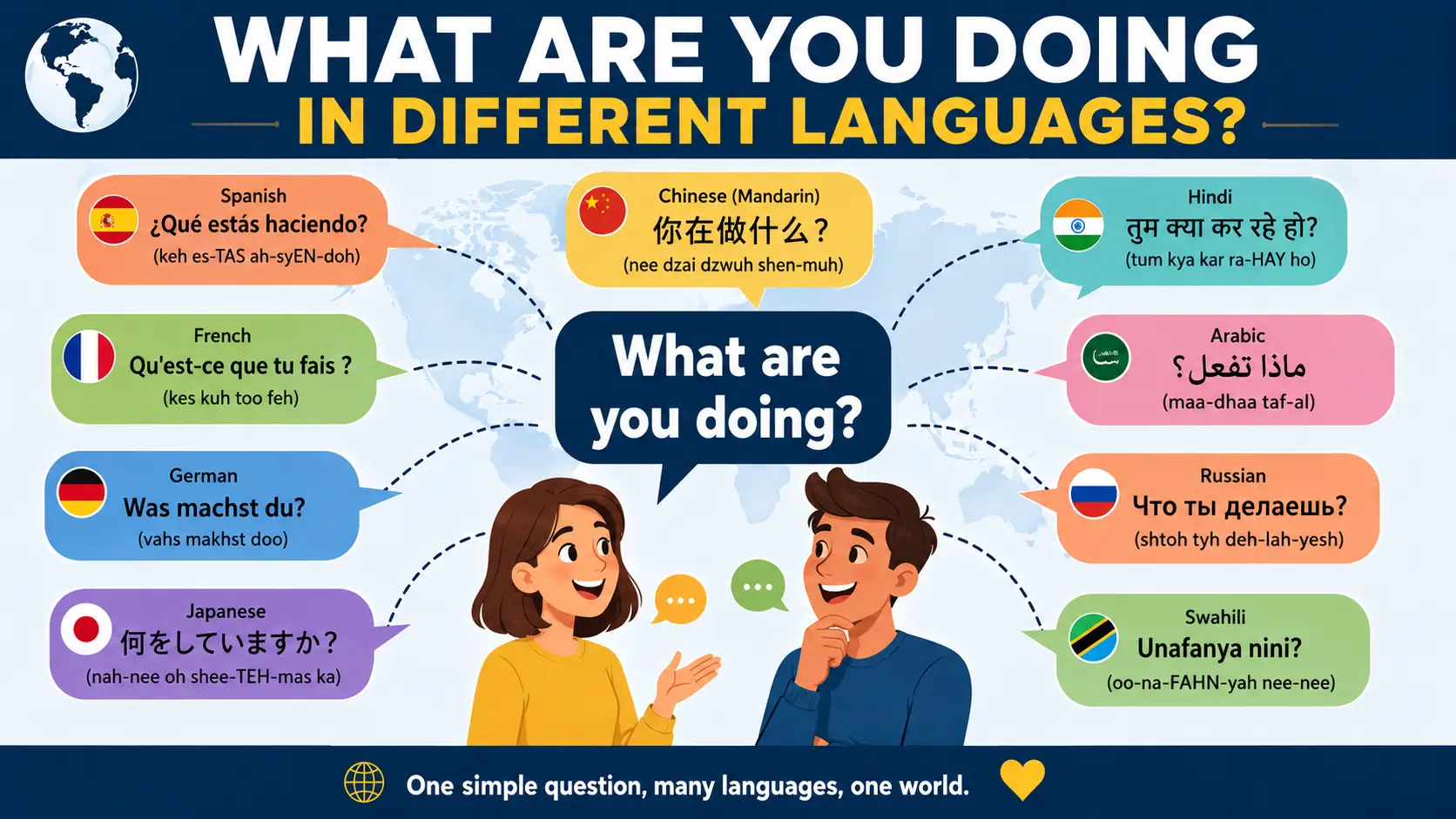
Want to know what are you doing in different languages? This simple guide gives you 70 useful translations of this everyday question, along with easy English pronunciations and real-life examples.
“What are you doing?” is one of the most common conversational phrases in the world. You can use it when talking to a friend, family member, classmate, coworker, or someone you have just met. Depending on the language and relationship, the wording may change between informal and formal speech.
Below, you will find what are you doing in all languages covered in one easy-to-read table. Each translation includes the native phrase, a simple pronunciation guide, an example sentence, and the English meaning of that example.
What Does “What Are You Doing?” Mean?
“What are you doing?” is a question used to ask what someone is currently doing or what activity they are engaged in.
For example:
- “What are you doing right now?”
- “What are you doing after work?”
- “Hey, what are you doing?”
The exact meaning can depend on context. It may simply ask about someone’s current activity, or it can be used casually to start a conversation.
What Are You Doing in Different Languages: 70 Translations
The following table shows how to say what are you doing in different languages. Pronunciations are simplified for English speakers and are intended as practical guides rather than exact phonetic transcriptions.
| # | Language | Native Phrase | Easy English Pronunciation | Real-Life Example | English Meaning |
|---|---|---|---|---|---|
| 1 | English | What are you doing? | wot ar yoo doo-ing | What are you doing right now? | What activity are you doing right now? |
| 2 | Spanish | ¿Qué estás haciendo? | keh es-TAS ah-SYEN-doh | ¿Qué estás haciendo ahora? | What are you doing now? |
| 3 | French | Qu’est-ce que tu fais ? | kes kuh too feh | Qu’est-ce que tu fais ce soir ? | What are you doing tonight? |
| 4 | German | Was machst du? | vahs makhst doo | Was machst du gerade? | What are you doing right now? |
| 5 | Italian | Cosa stai facendo? | KOH-zah stai fah-CHEN-doh | Cosa stai facendo adesso? | What are you doing now? |
| 6 | Portuguese | O que você está fazendo? | oo kee vo-SEH es-TAH fah-ZEN-doh | O que você está fazendo agora? | What are you doing now? |
| 7 | Dutch | Wat ben je aan het doen? | vat ben yuh an hut doon | Wat ben je aan het doen? | What are you doing? |
| 8 | Swedish | Vad gör du? | vahd yer doo | Vad gör du nu? | What are you doing now? |
| 9 | Norwegian | Hva gjør du? | vah yeur doo | Hva gjør du i kveld? | What are you doing tonight? |
| 10 | Danish | Hvad laver du? | vah lair-er doo | Hvad laver du nu? | What are you doing now? |
| 11 | Finnish | Mitä sinä teet? | MEE-tah SEE-nah tayt | Mitä sinä teet nyt? | What are you doing now? |
| 12 | Icelandic | Hvað ertu að gera? | kvath ER-too ath YEH-ra | Hvað ertu að gera núna? | What are you doing now? |
| 13 | Irish | Cad atá tú a dhéanamh? | kad ah-taw too uh YEN-yiv | Cad atá tú a dhéanamh anois? | What are you doing now? |
| 14 | Welsh | Beth wyt ti’n wneud? | beth weet teen wayd | Beth wyt ti’n wneud nawr? | What are you doing now? |
| 15 | Polish | Co robisz? | tsoh ROH-bish | Co robisz teraz? | What are you doing now? |
| 16 | Czech | Co děláš? | tsoh DYEH-lash | Co děláš teď? | What are you doing now? |
| 17 | Slovak | Čo robíš? | choh ROH-beesh | Čo robíš teraz? | What are you doing now? |
| 18 | Slovenian | Kaj delaš? | kai DEH-lash | Kaj delaš zdaj? | What are you doing now? |
| 19 | Croatian | Što radiš? | shtoh RAH-deesh | Što radiš sada? | What are you doing now? |
| 20 | Serbian | Šta radiš? | shtah RAH-deesh | Šta radiš sada? | What are you doing now? |
| 21 | Bosnian | Šta radiš? | shtah RAH-deesh | Šta radiš danas? | What are you doing today? |
| 22 | Bulgarian | Какво правиш? | kak-VOH PRA-vish | Какво правиш сега? | What are you doing now? |
| 23 | Macedonian | Што правиш? | shtoh PRA-vish | Што правиш сега? | What are you doing now? |
| 24 | Russian | Что ты делаешь? | shtoh tyh DEH-lah-yesh | Что ты делаешь сейчас? | What are you doing now? |
| 25 | Ukrainian | Що ти робиш? | shcho ty ROH-bish | Що ти робиш зараз? | What are you doing now? |
| 26 | Belarusian | Што ты робіш? | shtoh tyh ROH-bish | Што ты робіш зараз? | What are you doing now? |
| 27 | Lithuanian | Ką tu darai? | kah too DAH-rye | Ką tu darai dabar? | What are you doing now? |
| 28 | Latvian | Ko tu dari? | koh too DAH-ree | Ko tu dari tagad? | What are you doing now? |
| 29 | Estonian | Mida sa teed? | MEE-dah sah tayd | Mida sa praegu teed? | What are you doing right now? |
| 30 | Hungarian | Mit csinálsz? | meet CHEE-nals | Mit csinálsz most? | What are you doing now? |
| 31 | Romanian | Ce faci? | cheh fach | Ce faci acum? | What are you doing now? |
| 32 | Albanian | Çfarë po bën? | CHFAH-reh poh ben | Çfarë po bën tani? | What are you doing now? |
| 33 | Greek | Τι κάνεις; | tee KAH-nees | Τι κάνεις τώρα; | What are you doing now? |
| 34 | Turkish | Ne yapıyorsun? | neh yah-puh-YOR-soon | Şimdi ne yapıyorsun? | What are you doing now? |
| 35 | Azerbaijani | Nə edirsən? | nah eh-DEER-sen | İndi nə edirsən? | What are you doing now? |
| 36 | Armenian | Ի՞նչ ես անում։ | inch es ah-NOOM | Հիմա ի՞նչ ես անում։ | What are you doing now? |
| 37 | Georgian | რას აკეთებ? | ras ah-KEH-teb | ახლა რას აკეთებ? | What are you doing now? |
| 38 | Persian | داری چیکار میکنی؟ | da-ree chee-KAR mee-KOH-nee | الان داری چیکار میکنی؟ | What are you doing now? |
| 39 | Arabic | ماذا تفعل؟ | maa-dhaa taf-al | ماذا تفعل الآن؟ | What are you doing now? |
| 40 | Hebrew | מה אתה עושה? | mah ah-TAH oh-SEH | מה אתה עושה עכשיו? | What are you doing now? |
| 41 | Hindi | तुम क्या कर रहे हो? | tum kya kar ra-HAY ho | तुम अभी क्या कर रहे हो? | What are you doing right now? |
| 42 | Urdu | آپ کیا کر رہے ہیں؟ | aap kya kar ra-HAY hain | آپ ابھی کیا کر رہے ہیں؟ | What are you doing right now? |
| 43 | Bengali | তুমি কী করছ? | too-mee kee KOR-chho | তুমি এখন কী করছ? | What are you doing now? |
| 44 | Punjabi | ਤੁਸੀਂ ਕੀ ਕਰ ਰਹੇ ਹੋ? | tus-see kee kar ra-HAY ho | ਤੁਸੀਂ ਹੁਣ ਕੀ ਕਰ ਰਹੇ ਹੋ? | What are you doing now? |
| 45 | Gujarati | તમે શું કરી રહ્યા છો? | ta-meh shoon ka-REE ra-HYA cho | તમે અત્યારે શું કરી રહ્યા છો? | What are you doing right now? |
| 46 | Marathi | तू काय करत आहेस? | too kai karat ah-HES | तू आत्ता काय करत आहेस? | What are you doing right now? |
| 47 | Nepali | तिमी के गर्दैछौ? | tee-mee keh gar-DYE-chow | तिमी अहिले के गर्दैछौ? | What are you doing now? |
| 48 | Sinhala | ඔයා මොකද කරන්නේ? | oh-YAH moh-kah-dah ka-RAN-neh | ඔයා දැන් මොකද කරන්නේ? | What are you doing now? |
| 49 | Tamil | நீ என்ன செய்கிறாய்? | nee en-na say-gi-RYE | நீ இப்போது என்ன செய்கிறாய்? | What are you doing now? |
| 50 | Telugu | నువ్వు ఏమి చేస్తున్నావు? | noov-voo AY-mee chest-TOON-naa-voo | నువ్వు ఇప్పుడు ఏమి చేస్తున్నావు? | What are you doing now? |
| 51 | Kannada | ನೀನು ಏನು ಮಾಡುತ್ತಿದ್ದೀಯ? | nee-noo AY-noo maa-DUT-ti-dee-ya | ನೀನು ಈಗ ಏನು ಮಾಡುತ್ತಿದ್ದೀಯ? | What are you doing now? |
| 52 | Malayalam | നീ എന്ത് ചെയ്യുന്നു? | nee enth CHEY-yun-noo | നീ ഇപ്പോൾ എന്ത് ചെയ്യുന്നു? | What are you doing now? |
| 53 | Chinese (Mandarin) | 你在做什么? | nee dzai dzwuh shen-muh | 你现在在做什么? | What are you doing now? |
| 54 | Japanese | 何をしていますか? | nah-nee oh shee-TEH-mas kah | 今何をしていますか? | What are you doing now? |
| 55 | Korean | 뭐 하고 있어요? | mwo ha-go ee-SSUH-yo | 지금 뭐 하고 있어요? | What are you doing now? |
| 56 | Vietnamese | Bạn đang làm gì? | ban dang lam zee | Bạn đang làm gì vậy? | What are you doing? |
| 57 | Thai | คุณกำลังทำอะไรอยู่? | koon gam-lang tam ah-ry yoo | ตอนนี้คุณกำลังทำอะไรอยู่? | What are you doing now? |
| 58 | Indonesian | Kamu sedang apa? | KAH-moo suh-dang AH-pah | Kamu sedang apa sekarang? | What are you doing now? |
| 59 | Malay | Awak sedang buat apa? | AH-wak suh-dang boo-at AH-pah | Awak sedang buat apa sekarang? | What are you doing now? |
| 60 | Filipino | Ano ang ginagawa mo? | AH-noh ang gee-na-GAH-wah moh | Ano ang ginagawa mo ngayon? | What are you doing now? |
| 61 | Mongolian | Чи юу хийж байна? | chee yoo khEEzh bai-na | Чи одоо юу хийж байна? | What are you doing now? |
| 62 | Swahili | Unafanya nini? | oo-na-FAHN-yah NEE-nee | Unafanya nini sasa? | What are you doing now? |
| 63 | Afrikaans | Wat doen jy? | vat doon yay | Wat doen jy nou? | What are you doing now? |
| 64 | Zulu | Wenzani? | wen-ZAH-nee | Wenzani manje? | What are you doing now? |
| 65 | Xhosa | Wenza ntoni? | wen-zah n-TOH-nee | Wenza ntoni ngoku? | What are you doing now? |
| 66 | Amharic | ምን እያደረግህ ነው? | min ee-ya-deh-regk neh | አሁን ምን እያደረግህ ነው? | What are you doing now? |
| 67 | Somali | Maxaad samaynaysaa? | ma-KHAAD sa-may-NAY-sah | Hadda maxaad samaynaysaa? | What are you doing now? |
| 68 | Hausa | Me kake yi? | meh kah-keh yee | Yanzu me kake yi? | What are you doing now? |
| 69 | Yoruba | Kí ni o ń ṣe? | kee nee ohn sheh | Kí ni o ń ṣe báyìí? | What are you doing now? |
| 70 | Igbo | Gịnị ka ị na-eme? | ghee-nee kah ee nah EH-meh | Gịnị ka ị na-eme ugbu a? | What are you doing now? |
How to Use “What Are You Doing?” Naturally
Learning a direct translation is useful, but understanding the situation in which a phrase is used makes your language skills much stronger.
In casual conversations, the question is often used between friends. For example, you might ask someone what they are doing before suggesting an activity.
Example:
“What are you doing tonight? Do you want to watch a movie?”
The same idea can also be used to ask about someone’s current activity:
“What are you doing right now?”
In some languages, the wording changes depending on whether you are speaking to a friend, an older person, a stranger, or someone in a formal setting.
Formal and Informal Translations
One important point about what are you doing translations is that many languages have different levels of politeness.
English usually uses the same basic phrase whether you are speaking to a close friend or a stranger. Other languages may require a different pronoun, verb form, or expression.
For example, languages such as Spanish, French, German, Russian, and Hindi can distinguish between informal and formal speech.
When speaking naturally, always consider:
- Who you are talking to
- Your relationship with that person
- The situation
- Whether the language has formal and informal pronouns
- Regional differences
For everyday conversations with friends, the informal version is often the most natural choice.
What Are You Doing Around the World?
The phrase what are you doing around the world shows how everyday communication can differ while expressing the same basic idea.
European languages often use a verb meaning “do” or “make.” Many Asian languages use structures that emphasize an action currently taking place. African languages can also express the same idea through different verb constructions.
Although the grammar varies, the conversational purpose remains familiar: you want to know what another person is doing.
This makes the phrase especially useful for travelers, language learners, students, and anyone communicating with people from different cultures.
Common Situations for Saying “What Are You Doing?”
Asking About Someone’s Current Activity
This is the most direct use.
Example:
“What are you doing right now?”
You are asking about the activity happening at the moment.
Starting a Conversation
The phrase can also work as a casual conversation starter.
Example:
“Hey, what are you doing?”
Depending on tone, this can simply mean that you want to talk.
Making Plans
You can use the question when deciding whether someone is available.
Example:
“What are you doing this weekend?”
Here, the question is about plans rather than something happening at the exact moment.
Checking on a Friend
If someone has been quiet or unavailable, you might ask:
“What are you doing?”
This can naturally lead to a longer conversation.
Tips for Learning These Translations
If you are learning how to say what are you doing in different languages, do not try to memorize all 70 phrases at once.
Start with a few languages that are personally useful. Learn the phrase, pronunciation, and one practical sentence together. This makes it easier to remember how the expression actually works.
It is also helpful to listen to native speakers because pronunciation can differ from simple English pronunciation guides.
Finally, remember that a literal translation is not always the phrase a native speaker would choose in every situation. Context, formality, age, relationship, and regional usage can all affect the most natural wording.
Frequently Asked Questions
1. How do you say “what are you doing” in different languages?
The phrase has different translations depending on the language. For example, Spanish uses “¿Qué estás haciendo?”, French uses “Qu’est-ce que tu fais ?”, German uses “Was machst du?”, and Italian uses “Cosa stai facendo?”
2. What is “what are you doing” in Spanish?
In Spanish, “What are you doing?” is commonly translated as “¿Qué estás haciendo?”. A natural example is “¿Qué estás haciendo ahora?”, meaning “What are you doing now?”
3. How do you say “what are you doing” in French?
In French, a common informal translation is “Qu’est-ce que tu fais ?”. It is used when asking someone what they are doing.
4. What is the difference between “what are you doing?” and “what are you up to?”
“What are you doing?” usually asks about a person’s current activity. “What are you up to?” is a more casual English expression that can ask about someone’s current activity or plans.
5. Can these translations be used in formal conversations?
Not always. Some languages distinguish strongly between formal and informal speech. Before using a translation with a stranger, older person, teacher, customer, or professional contact, check whether the language has a formal version.
Conclusion
Learning what are you doing in different languages is a simple and practical way to build everyday vocabulary. The phrase appears frequently in conversations, messages, travel situations, and casual interactions.
With the 70 translations above, you can explore what are you doing in all languages from Europe, Asia, Africa, and other parts of the world. Focus on the languages you use most, practice the pronunciation, and learn each phrase in a real conversational sentence.
The key is not simply memorizing translations. Understanding when and how native speakers use the phrase will help you communicate more naturally.

I am Ricardo Hunter, Administrator at LingoBuz, passionate about languages, translations, and global communication. I help create useful, clear content that makes exploring different languages simple, enjoyable, and accessible.