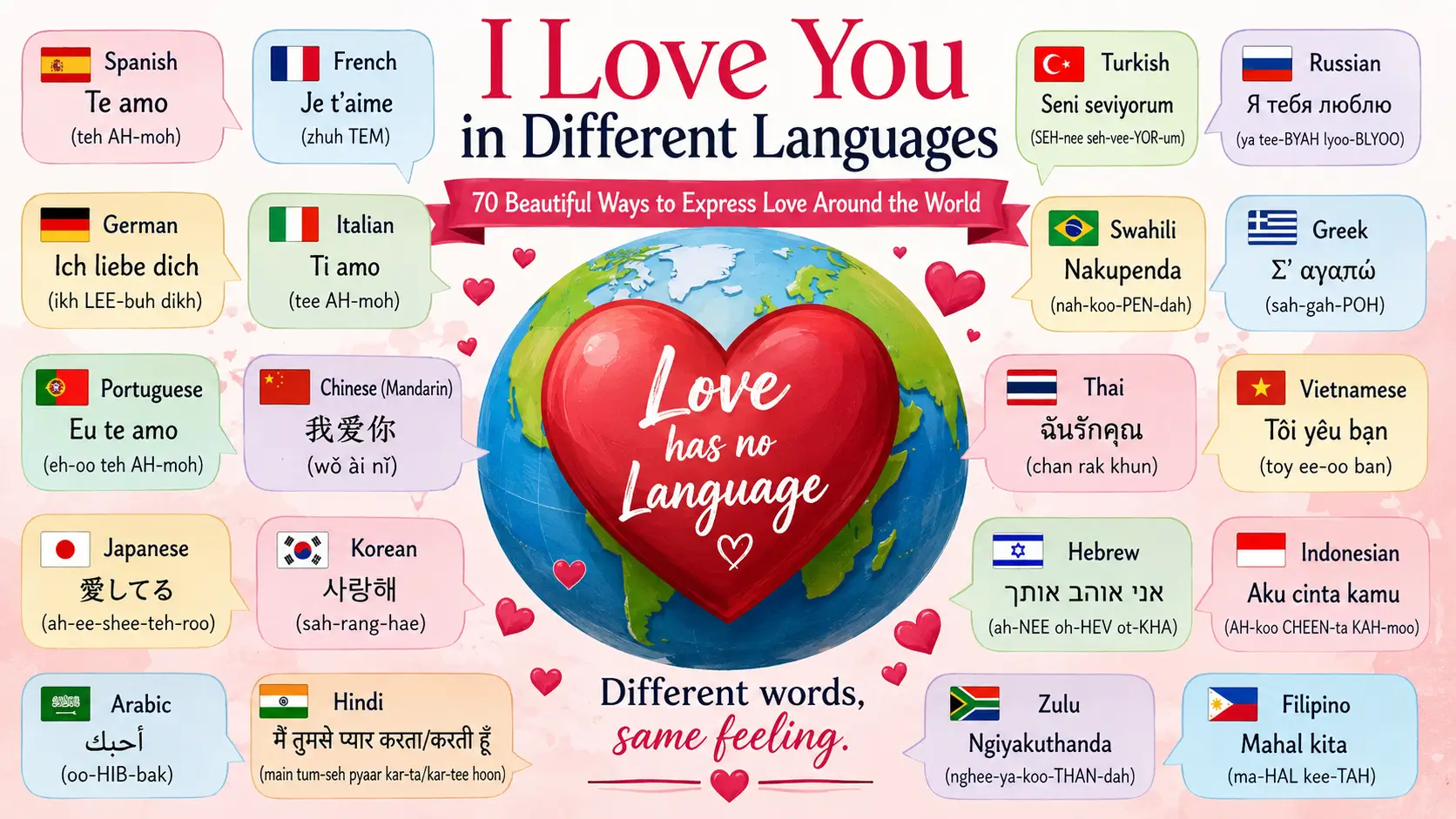
Love is a universal feeling, but the words used to express it can be wonderfully different from one language to another. Learning how to say “I love you in different languages” is a simple way to connect with people, understand other cultures, write a romantic message, or surprise someone special.
Whether you are looking for “I love you” translations, wondering how to say “I love you” in different languages, or simply exploring how love is expressed around the world, this guide gives you 70 useful examples.
Below, you will find the native phrase, an easy English pronunciation, a short real-life example, and the English meaning of that example.
I Love You in Different Languages: 70 Translations
| # | Language | Native Phrase | Easy English Pronunciation | Example Sentence | English Meaning |
|---|---|---|---|---|---|
| 1 | English | I love you | eye luv yoo | I love you more every day. | My love for you grows every day. |
| 2 | Spanish | Te amo | teh AH-moh | Te amo con todo mi corazón. | I love you with all my heart. |
| 3 | French | Je t’aime | zhuh TEM | Je t’aime de tout mon cœur. | I love you with all my heart. |
| 4 | German | Ich liebe dich | ikh LEE-buh dikh | Ich liebe dich von ganzem Herzen. | I love you with all my heart. |
| 5 | Italian | Ti amo | tee AH-moh | Ti amo più di ieri. | I love you more than yesterday. |
| 6 | Portuguese | Eu te amo | eh-oo teh AH-moh | Eu te amo para sempre. | I love you forever. |
| 7 | Dutch | Ik hou van je | ik how van yuh | Ik hou van je, mijn liefste. | I love you, my love. |
| 8 | Afrikaans | Ek is lief vir jou | ek iss leef feer yow | Ek is lief vir jou. | I love you. |
| 9 | Swedish | Jag älskar dig | yahg EL-skar day | Jag älskar dig av hela mitt hjärta. | I love you with all my heart. |
| 10 | Norwegian | Jeg elsker deg | yai EL-sker die | Jeg elsker deg så mye. | I love you so much. |
| 11 | Danish | Jeg elsker dig | yai EL-sker dye | Jeg elsker dig hver dag. | I love you every day. |
| 12 | Icelandic | Ég elska þig | yehg EL-ska thig | Ég elska þig af öllu hjarta. | I love you with all my heart. |
| 13 | Finnish | Rakastan sinua | RAH-kas-tan SEE-noo-ah | Rakastan sinua aina. | I will always love you. |
| 14 | Estonian | Ma armastan sind | ma AR-mas-tan sind | Ma armastan sind väga. | I love you very much. |
| 15 | Latvian | Es tevi mīlu | ess TEH-vee MEE-loo | Es tevi mīlu no visas sirds. | I love you with all my heart. |
| 16 | Lithuanian | Aš tave myliu | ash TAH-veh MEE-lyoo | Aš tave myliu labai. | I love you very much. |
| 17 | Polish | Kocham cię | KOH-ham chyeh | Kocham cię całym sercem. | I love you with all my heart. |
| 18 | Czech | Miluji tě | MEE-loo-yee tyeh | Miluji tě z celého srdce. | I love you with all my heart. |
| 19 | Slovak | Ľúbim ťa | LYOO-bim tya | Ľúbim ťa celým srdcom. | I love you with all my heart. |
| 20 | Slovenian | Ljubim te | LYOO-bim teh | Ljubim te iz vsega srca. | I love you with all my heart. |
| 21 | Croatian | Volim te | VOH-lim teh | Volim te svim srcem. | I love you with all my heart. |
| 22 | Serbian | Волим те | VOH-lim teh | Волим те из свег срца. | I love you with all my heart. |
| 23 | Bosnian | Volim te | VOH-lim teh | Volim te svim srcem. | I love you with all my heart. |
| 24 | Macedonian | Те сакам | teh SAH-kam | Те сакам од сè срце. | I love you with all my heart. |
| 25 | Bulgarian | Обичам те | oh-BEE-cham teh | Обичам те от цялото си сърце. | I love you with all my heart. |
| 26 | Romanian | Te iubesc | teh yoo-BESK | Te iubesc din toată inima. | I love you with all my heart. |
| 27 | Albanian | Të dua | tuh DOO-ah | Të dua shumë. | I love you very much. |
| 28 | Greek | Σ’ αγαπώ | sah-gah-POH | Σ’ αγαπώ με όλη μου την καρδιά. | I love you with all my heart. |
| 29 | Russian | Я тебя люблю | ya tee-BYAH lyoo-BLYOO | Я тебя люблю всем сердцем. | I love you with all my heart. |
| 30 | Ukrainian | Я тебе кохаю | ya teh-BEH ko-KHA-yoo | Я тебе кохаю всім серцем. | I love you with all my heart. |
| 31 | Belarusian | Я цябе кахаю | ya tsya-BEH ka-KHA-yoo | Я цябе кахаю ўсім сэрцам. | I love you with all my heart. |
| 32 | Armenian | Ես քեզ սիրում եմ | yes kez see-ROOM yem | Ես քեզ շատ եմ սիրում։ | I love you very much. |
| 33 | Georgian | მე შენ მიყვარხარ | meh shen miq-VAR-khar | მე შენ ძალიან მიყვარხარ. | I love you very much. |
| 34 | Turkish | Seni seviyorum | SEH-nee seh-vee-YOR-um | Seni bütün kalbimle seviyorum. | I love you with all my heart. |
| 35 | Azerbaijani | Mən səni sevirəm | men seh-NEE seh-vee-REM | Mən səni çox sevirəm. | I love you very much. |
| 36 | Persian | دوستت دارم | doos-ET DAH-ram | دوستت دارم از صمیم قلب. | I love you from the bottom of my heart. |
| 37 | Arabic | أحبك | oo-HIB-bak | أحبك من كل قلبي. | I love you with all my heart. |
| 38 | Hebrew | אני אוהב אותך / אני אוהבת אותך | ah-NEE oh-HEV ot-KHA / ah-NEE oh-HEV-et ot-KHA | אני אוהב אותך מכל הלב. | I love you with all my heart. |
| 39 | Hindi | मैं तुमसे प्यार करता/करती हूँ | main tum-seh pyaar kar-ta/kar-tee hoon | मैं तुमसे बहुत प्यार करता हूँ। | I love you very much. |
| 40 | Urdu | میں تم سے محبت کرتا/کرتی ہوں | main tum se mohabbat kar-ta/kar-tee hoon | میں تم سے بہت محبت کرتا ہوں۔ | I love you very much. |
| 41 | Bengali | আমি তোমাকে ভালোবাসি | ah-mee toh-mah-keh bhalo-bah-shee | আমি তোমাকে খুব ভালোবাসি। | I love you very much. |
| 42 | Punjabi | ਮੈਂ ਤੈਨੂੰ ਪਿਆਰ ਕਰਦਾ/ਕਰਦੀ ਹਾਂ | main tai-noon pyaar kar-da/kar-dee haan | ਮੈਂ ਤੈਨੂੰ ਬਹੁਤ ਪਿਆਰ ਕਰਦਾ ਹਾਂ। | I love you very much. |
| 43 | Gujarati | હું તને પ્રેમ કરું છું | hoon tuh-neh prem kar-oon chhoon | હું તને ખૂબ પ્રેમ કરું છું. | I love you very much. |
| 44 | Marathi | माझं तुझ्यावर प्रेम आहे | majh tujh-yavar prem aa-he | माझं तुझ्यावर खूप प्रेम आहे. | I love you very much. |
| 45 | Nepali | म तिमीलाई माया गर्छु | ma tee-mee-lai ma-ya gar-chhu | म तिमीलाई धेरै माया गर्छु। | I love you very much. |
| 46 | Sinhala | මම ඔයාට ආදරෙයි | ma-ma o-ya-ta aa-da-ray | මම ඔයාට ගොඩක් ආදරෙයි. | I love you very much. |
| 47 | Tamil | நான் உன்னை காதலிக்கிறேன் | naan un-nai kaa-da-li-kki-ren | நான் உன்னை மிகவும் காதலிக்கிறேன். | I love you very much. |
| 48 | Telugu | నేను నిన్ను ప్రేమిస్తున్నాను | nay-noo nin-noo preh-mis-too-na-noo | నేను నిన్ను చాలా ప్రేమిస్తున్నాను. | I love you very much. |
| 49 | Kannada | ನಾನು ನಿನ್ನನ್ನು ಪ್ರೀತಿಸುತ್ತೇನೆ | naa-noo nin-na-nu pree-tee-sut-tay-nay | ನಾನು ನಿನ್ನನ್ನು ತುಂಬಾ ಪ್ರೀತಿಸುತ್ತೇನೆ. | I love you very much. |
| 50 | Malayalam | ഞാൻ നിന്നെ സ്നേഹിക്കുന്നു | nyan nin-nay snay-hi-kin-noo | ഞാൻ നിന്നെ ഒരുപാട് സ്നേഹിക്കുന്നു. | I love you very much. |
| 51 | Thai | ฉันรักคุณ / ผมรักคุณ | chan rak khun / pom rak khun | ฉันรักคุณมาก | I love you very much. |
| 52 | Vietnamese | Tôi yêu bạn | toy ee-oo ban | Tôi yêu bạn rất nhiều. | I love you very much. |
| 53 | Indonesian | Aku cinta kamu | AH-koo CHEEN-ta KAH-moo | Aku cinta kamu selamanya. | I love you forever. |
| 54 | Malay | Saya cintakan awak | SAH-yah chin-TAH-kan AH-wak | Saya cintakan awak sepenuh hati. | I love you with all my heart. |
| 55 | Filipino | Mahal kita | ma-HAL kee-TAH | Mahal kita nang buong puso. | I love you with all my heart. |
| 56 | Tagalog | Mahal kita | ma-HAL kee-TAH | Mahal kita palagi. | I will always love you. |
| 57 | Chinese (Mandarin) | 我爱你 | wǒ ài nǐ | 我爱你一辈子。 | I will love you for a lifetime. |
| 58 | Cantonese | 我愛你 | ngoh oi néih | 我愛你一世。 | I love you for a lifetime. |
| 59 | Japanese | 愛してる | ah-ee-shee-teh-roo | 愛してるよ。 | I love you. |
| 60 | Korean | 사랑해 | sah-rang-hae | 나는 너를 사랑해. | I love you. |
| 61 | Mongolian | Би чамд хайртай | bee chamd khairtai | Би чамд маш их хайртай. | I love you very much. |
| 62 | Kazakh | Мен сені сүйемін | men seh-nee soo-yeh-min | Мен сені шын жүрегіммен сүйемін. | I love you with all my heart. |
| 63 | Uzbek | Men seni sevaman | men seh-nee seh-vah-man | Men seni juda sevaman. | I love you very much. |
| 64 | Swahili | Nakupenda | nah-koo-PEN-dah | Nakupenda sana. | I love you very much. |
| 65 | Zulu | Ngiyakuthanda | nghee-ya-koo-THAN-dah | Ngiyakuthanda kakhulu. | I love you very much. |
| 66 | Xhosa | Ndiyakuthanda | n-dee-ya-koo-THAN-dah | Ndiyakuthanda kakhulu. | I love you very much. |
| 67 | Yoruba | Mo nífẹ̀ẹ́ rẹ | moh nee-FEH-eh reh | Mo nífẹ̀ẹ́ rẹ gan-an. | I love you very much. |
| 68 | Igbo | A hụrụ m gị n’anya | ah HOO-rahm ghee N-yahn-yah | A hụrụ m gị n’anya nke ukwuu. | I love you very much. |
| 69 | Hawaiian | Aloha au iā ʻoe | ah-LOH-ha ow ee-AH oh-eh | Aloha au iā ʻoe me kuʻu puʻuwai. | I love you with my heart. |
| 70 | Latin | Te amo | teh AH-moh | Te amo ex toto corde. | I love you with all my heart. |
How to Say “I Love You” in Different Languages
The most familiar phrase in many languages is a direct equivalent of “I love you,” but the exact wording can depend on gender, relationship, formality, dialect, and cultural context.
For example, Hindi, Urdu, Punjabi, and Hebrew can change depending on the speaker’s gender or the person being addressed. In Japanese and Korean, the level of directness also matters. A literal translation may therefore not always be the most natural phrase in everyday conversation.
If you are learning how to say “I love you” in different languages, it is useful to learn both the phrase and when native speakers normally use it.
Romantic Ways to Use “I Love You” Around the World
Knowing the translation is only the first step. The phrase becomes more meaningful when used naturally.
You can use these expressions in:
- A romantic text message
- A handwritten love letter
- A wedding speech
- An anniversary card
- A social media caption
- A greeting card
- A personal conversation
- A message to a partner living abroad
A simple phrase in another language can make a message feel personal and memorable.
Why “I Love You” Translations Are Different
Languages do not always express emotions in exactly the same way. Some languages use a direct phrase, while others rely heavily on context, relationship, or grammatical distinctions.
For example, several languages have different ways of expressing romantic love, affection, friendship, or family love. Some cultures may also use affectionate expressions more frequently than others.
This is why a good translation should consider meaning and context, rather than simply replacing one English word with another.
“I Love You” in All Languages: What to Remember
There are thousands of languages spoken around the world, so it is impossible to list literally every language in one article. The 70 languages above provide a broad selection from Europe, Asia, Africa, the Middle East, Oceania, and the Americas.
If you want to use one of these phrases with a native speaker, checking the local context is especially useful. Pronunciation can vary by region, and some languages have formal and informal forms.
The examples in this guide are designed to give learners a practical starting point.
Tips for Saying “I Love You” Naturally
Learn the pronunciation
A correct phrase can sound very different when pronounced incorrectly. Use the pronunciation guide as a starting point, but listen to native speakers when possible.
Understand the relationship
Some expressions are strongly romantic, while others can be used more broadly for affection. Make sure the phrase matches your relationship with the person.
Respect cultural differences
Not every culture uses direct declarations of love in the same situations. A phrase that sounds normal in one country may feel very strong or formal somewhere else.
Focus on meaning
If you are writing a romantic message, combining “I love you” with a short personal sentence can make the message much more meaningful.
Popular “I Love You” Translations at a Glance
Some of the most commonly searched translations include:
- Spanish: Te amo
- French: Je t’aime
- Italian: Ti amo
- German: Ich liebe dich
- Portuguese: Eu te amo
- Arabic: أحبك
- Hindi: मैं तुमसे प्यार करता/करती हूँ
- Urdu: میں تم سے محبت کرتا/کرتی ہوں
- Japanese: 愛してる
- Korean: 사랑해
- Chinese: 我爱你
- Turkish: Seni seviyorum
- Russian: Я тебя люблю
- Greek: Σ’ αγαπώ
- Swahili: Nakupenda
These are useful starting points when exploring I love you around the world.
Frequently Asked Questions
1. What is “I love you” in the most popular languages?
Some popular translations are Te amo in Spanish, Je t’aime in French, Ti amo in Italian, Ich liebe dich in German, Eu te amo in Portuguese, Seni seviyorum in Turkish, 我爱你 in Mandarin Chinese, and 사랑해 in Korean.
2. How do you say “I love you” in 70 different languages?
There are many ways to express love across languages. This guide provides exactly 70 examples, including the native phrase, an easy pronunciation guide, a practical example sentence, and its English meaning.
3. What is the easiest “I love you” translation to pronounce?
Some short expressions are relatively easy for English speakers, such as Ti amo in Italian, Te amo in Spanish, Mahal kita in Filipino, and Nakupenda in Swahili. Pronunciation still benefits from listening to native speakers.
4. Is “I love you” the same in every language?
No. Languages differ in grammar, pronunciation, cultural usage, and levels of formality. Some languages also distinguish between romantic love and other forms of affection.
5. Why should I learn “I love you” in another language?
“I love you” may be only three words in English, but its meaning is powerful in every part of the world. From Te amo and Je t’aime to 我爱你, 사랑해, and Nakupenda, these expressions show how different languages give voice to one of humanity’s most universal emotions.
Learning the phrase can help you communicate affection, appreciate another culture, create a thoughtful romantic message, or connect with someone who speaks another language. Even a few words spoken sincerely can make a meaningful impression.
Conclusion
Whether you are studying languages, writing a romantic message, traveling, or simply curious about I love you in different languages, learning these translations is a beautiful way to discover how people around the world express affection.

I am Ricardo Hunter, Administrator at LingoBuz, passionate about languages, translations, and global communication. I help create useful, clear content that makes exploring different languages simple, enjoyable, and accessible.