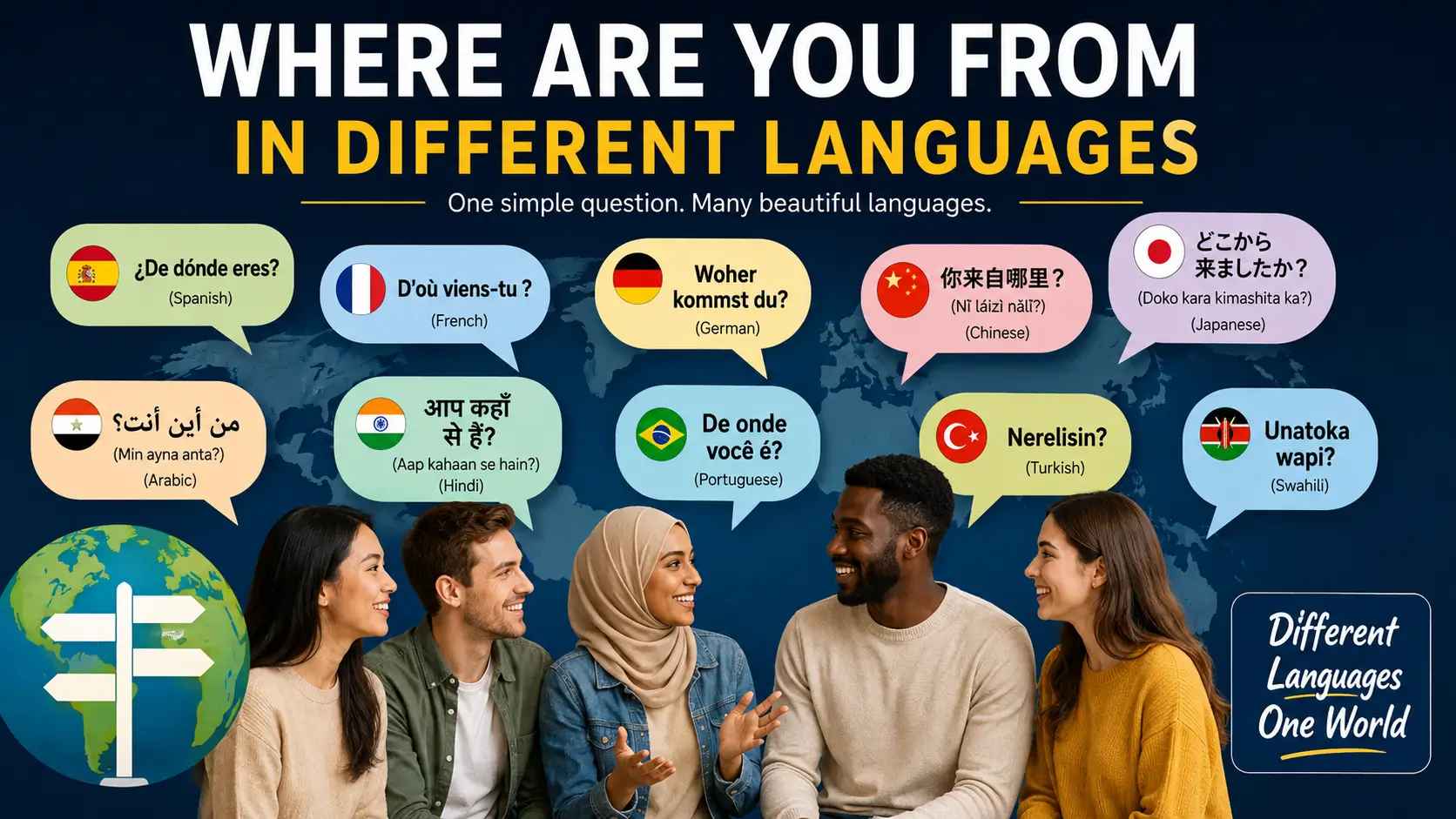
Learning how to say “Where are you from?” in different languages is a simple way to start conversations, make new friends, and communicate more naturally while traveling. This common question is useful in everyday conversations because it helps you learn about someone’s country, city, culture, or background.
Whether you are traveling abroad, learning a new language, meeting international friends, or simply exploring world languages, knowing this phrase can be surprisingly useful.
Below, you will find “where are you from” in all languages with the native translation, an easy English pronunciation, a short real-life example, and the English meaning of each example.
Where Are You From in Different Languages
The exact wording can change depending on the language, level of formality, and whether you are speaking to one person or several people. The translations below use common, natural forms suitable for everyday conversation.
| # | Language | Native Phrase | Easy English Pronunciation | Example Sentence | English Meaning |
|---|---|---|---|---|---|
| 1 | English | Where are you from? | wair ar yoo frum? | Where are you from? | Where do you come from? |
| 2 | Spanish | ¿De dónde eres? | deh DON-deh EH-res? | Hola, ¿de dónde eres? | Hi, where are you from? |
| 3 | French | D’où viens-tu ? | doo vyahn-too? | Bonjour, d’où viens-tu ? | Hello, where are you from? |
| 4 | German | Woher kommst du? | vo-hair komst doo? | Woher kommst du? | Where are you from? |
| 5 | Italian | Di dove sei? | dee DOH-veh say? | Ciao, di dove sei? | Hi, where are you from? |
| 6 | Portuguese | De onde você é? | dee ON-jee vo-SEH eh? | De onde você é? | Where are you from? |
| 7 | Dutch | Waar kom je vandaan? | vahr kom yuh fan-DAHN? | Waar kom je vandaan? | Where are you from? |
| 8 | Swedish | Var kommer du ifrån? | vahr KOM-mer doo ee-FRAWN? | Var kommer du ifrån? | Where are you from? |
| 9 | Norwegian | Hvor kommer du fra? | voor KOM-mer doo frah? | Hvor kommer du fra? | Where are you from? |
| 10 | Danish | Hvor kommer du fra? | vor KOM-mer doo frah? | Hvor kommer du fra? | Where are you from? |
| 11 | Finnish | Mistä olet kotoisin? | MEES-tah oh-let KOH-toh-seen? | Mistä olet kotoisin? | Where are you from? |
| 12 | Icelandic | Hvaðan kemur þú? | kvah-than KEM-ur thoo? | Hvaðan kemur þú? | Where are you from? |
| 13 | Irish | Cá as tú? | kaw ahs too? | Cá as tú? | Where are you from? |
| 14 | Welsh | O ble wyt ti? | oh bleh weet tee? | O ble wyt ti? | Where are you from? |
| 15 | Scottish Gaelic | Cò às a tha thu? | koh ahs uh ha hoo? | Cò às a tha thu? | Where are you from? |
| 16 | Polish | Skąd jesteś? | skont YES-tesh? | Skąd jesteś? | Where are you from? |
| 17 | Czech | Odkud jsi? | OT-kood ysee? | Odkud jsi? | Where are you from? |
| 18 | Slovak | Odkiaľ si? | OT-kyahl see? | Odkiaľ si? | Where are you from? |
| 19 | Slovenian | Od kod si? | od kod see? | Od kod si? | Where are you from? |
| 20 | Croatian | Odakle si? | oh-DAHK-leh see? | Odakle si? | Where are you from? |
| 21 | Serbian | Odakle si? | oh-DAHK-leh see? | Odakle si? | Where are you from? |
| 22 | Bosnian | Odakle si? | oh-DAHK-leh see? | Odakle si? | Where are you from? |
| 23 | Bulgarian | Откъде си? | ot-KUH-deh see? | Откъде си? | Where are you from? |
| 24 | Macedonian | Од каде си? | od KAH-deh see? | Од каде си? | Where are you from? |
| 25 | Romanian | De unde ești? | deh OON-deh yesht? | De unde ești? | Where are you from? |
| 26 | Hungarian | Honnan jöttél? | HON-nahn YUT-tale? | Honnan jöttél? | Where are you from? |
| 27 | Greek | Από πού είσαι; | ah-POO EE-seh? | Από πού είσαι; | Where are you from? |
| 28 | Russian | Откуда ты? | ot-KOO-dah ty? | Откуда ты? | Where are you from? |
| 29 | Ukrainian | Звідки ти? | ZVEED-ky ty? | Звідки ти? | Where are you from? |
| 30 | Belarusian | Адкуль ты? | ad-KOOL ty? | Адкуль ты? | Where are you from? |
| 31 | Lithuanian | Iš kur tu? | ish koor too? | Iš kur tu? | Where are you from? |
| 32 | Latvian | No kurienes tu esi? | noh koo-ree-EH-nes too EH-see? | No kurienes tu esi? | Where are you from? |
| 33 | Estonian | Kust sa pärit oled? | koost sah PAIR-it OH-led? | Kust sa pärit oled? | Where are you from? |
| 34 | Albanian | Nga je? | ngah yeh? | Nga je? | Where are you from? |
| 35 | Armenian | Որտեղացի՞ ես։ | vor-teh-gha-TSEE es? | Որտեղացի՞ ես։ | Where are you from? |
| 36 | Georgian | საიდან ხარ? | sah-ee-DAN khar? | საიდან ხარ? | Where are you from? |
| 37 | Turkish | Nerelisin? | neh-reh-LEE-sin? | Nerelisin? | Where are you from? |
| 38 | Azerbaijani | Haralısan? | hah-rah-luh-SAHN? | Haralısan? | Where are you from? |
| 39 | Persian | اهل کجایی؟ | ahl-e ko-jah-EE? | اهل کجایی؟ | Where are you from? |
| 40 | Arabic | من أين أنت؟ | min ayn anta/anti? | من أين أنت؟ | Where are you from? |
| 41 | Hebrew | מאיפה אתה? / מאיפה את? | may-EE-foh ah-TAH / ah-T? | מאיפה אתה? | Where are you from? |
| 42 | Hindi | आप कहाँ से हैं? | aap kahaan se hain? | आप कहाँ से हैं? | Where are you from? |
| 43 | Urdu | آپ کہاں سے ہیں؟ | aap kahaan se hain? | آپ کہاں سے ہیں؟ | Where are you from? |
| 44 | Bengali | আপনি কোথা থেকে এসেছেন? | ap-nee KOTH-ah theh-keh EH-she-chen? | আপনি কোথা থেকে এসেছেন? | Where are you from? |
| 45 | Punjabi | ਤੁਸੀਂ ਕਿੱਥੋਂ ਹੋ? | tusin KIT-thon ho? | ਤੁਸੀਂ ਕਿੱਥੋਂ ਹੋ? | Where are you from? |
| 46 | Gujarati | તમે ક્યાંથી છો? | tame KYAN-thi cho? | તમે ક્યાંથી છો? | Where are you from? |
| 47 | Marathi | तुम्ही कुठून आहात? | tum-HEE koo-THOON aa-HAT? | तुम्ही कुठून आहात? | Where are you from? |
| 48 | Nepali | तपाईं कहाँबाट हुनुहुन्छ? | tap-AIN kahaan-BAAT hoo-noo-hun-chha? | तपाईं कहाँबाट हुनुहुन्छ? | Where are you from? |
| 49 | Sinhala | ඔබ කොහෙන්ද? | oba koh-HEN-dah? | ඔබ කොහෙන්ද? | Where are you from? |
| 50 | Tamil | நீங்கள் எங்கிருந்து வருகிறீர்கள்? | neeng-gal en-gir-un-dhu va-ru-geer-eer-gal? | நீங்கள் எங்கிருந்து வருகிறீர்கள்? | Where are you from? |
| 51 | Telugu | మీరు ఎక్కడి వారు? | meeru ek-KAH-di vaaru? | మీరు ఎక్కడి వారు? | Where are you from? |
| 52 | Kannada | ನೀವು ಎಲ್ಲಿಯವರು? | neevu el-LEE-ya-varu? | ನೀವು ಎಲ್ಲಿಯವರು? | Where are you from? |
| 53 | Malayalam | നിങ്ങൾ എവിടെ നിന്നാണ്? | ning-gal EV-i-deh nin-DAHN? | നിങ്ങൾ എവിടെ നിന്നാണ്? | Where are you from? |
| 54 | Chinese (Mandarin) | 你来自哪里? | nee tzy-lai nah-lee? | 你来自哪里? | Where are you from? |
| 55 | Japanese | どこから来ましたか? | doh-koh kah-rah kee-mah-shee-tah kah? | どこから来ましたか? | Where did you come from? |
| 56 | Korean | 어디에서 왔어요? | uh-dee-eh-suh waht-suh-yo? | 어디에서 왔어요? | Where are you from? |
| 57 | Vietnamese | Bạn đến từ đâu? | ban den too dow? | Bạn đến từ đâu? | Where are you from? |
| 58 | Thai | คุณมาจากไหน? | khun maa jahk nai? | คุณมาจากไหน? | Where are you from? |
| 59 | Indonesian | Kamu dari mana? | KAH-moo dah-ree MAH-nah? | Kamu dari mana? | Where are you from? |
| 60 | Malay | Awak dari mana? | AH-wak dah-ree MAH-nah? | Awak dari mana? | Where are you from? |
| 61 | Filipino | Taga-saan ka? | tah-gah sah-AHN kah? | Taga-saan ka? | Where are you from? |
| 62 | Burmese | ဘယ်ကလာတာလဲ? | beh kah la-ta leh? | ဘယ်ကလာတာလဲ? | Where are you from? |
| 63 | Khmer | អ្នកមកពីណា? | neak mok pee nah? | អ្នកមកពីណា? | Where are you from? |
| 64 | Lao | ເຈົ້າມາຈາກໃສ? | jao maa jahk sai? | ເຈົ້າມາຈາກໃສ? | Where are you from? |
| 65 | Mongolian | Та хаанаас ирсэн бэ? | ta kha-naas ir-sen beh? | Та хаанаас ирсэн бэ? | Where are you from? |
| 66 | Swahili | Unatoka wapi? | oo-nah-TOH-kah WAH-pee? | Unatoka wapi? | Where are you from? |
| 67 | Afrikaans | Waar kom jy vandaan? | vahr kom yay fan-DAHN? | Waar kom jy vandaan? | Where are you from? |
| 68 | Zulu | Uvelaphi? | oo-veh-LAH-pee? | Uvelaphi? | Where are you from? |
| 69 | Yoruba | Nibo ni o ti wa? | nee-BOH nee oh tee wah? | Nibo ni o ti wa? | Where are you from? |
| 70 | Haitian Creole | Ki kote ou soti? | kee koh-TEH oo soh-TEE? | Ki kote ou soti? | Where are you from? |
How to Say “Where Are You From?” in Different Languages
The phrase “Where are you from?” is usually used to ask about someone’s place of origin. Depending on the language, it can refer to a person’s country, city, hometown, or general background.
For example, Spanish speakers commonly say “¿De dónde eres?”, while German speakers use “Woher kommst du?”. In Turkish, “Nerelisin?” is a short and natural way to ask someone’s origin.
In some languages, the most natural translation is closer to “Where do you come from?” rather than a literal translation of the English sentence. This is normal because languages use different grammatical structures to express the same idea.
“Where Are You From?” Translations for Travel
This question is particularly useful when traveling. You might use it when meeting someone at a hotel, restaurant, airport, language class, tour, or social event.
A simple conversation could look like this:
English:
“Hi! Where are you from?”
“I’m from Pakistan.”
Spanish:
“¿De dónde eres?”
“Soy de Pakistán.”
The question is often one of the easiest conversation starters because it naturally leads to other topics such as travel, food, culture, cities, and languages.
Where Are You From Around the World?
People express the same idea in many different ways around the world. European languages often use structures based on words meaning “from” or “come,” while many Asian languages use expressions asking where someone came from or where they are originally connected.
For language learners, this is an important reminder: literal translation is not always the best translation. A phrase that sounds perfectly natural in one language may sound unusual if translated word-for-word into another.
When learning “where are you from” around the world, focus on the natural expression rather than translating every individual English word.
Formal and Informal Ways to Ask Where Someone Is From
Some languages distinguish clearly between formal and informal speech.
For example, Spanish commonly uses “¿De dónde eres?” when speaking informally to one person, while “¿De dónde es usted?” is a formal alternative.
German also has a distinction:
- Informal: Woher kommst du?
- Formal: Woher kommen Sie?
French similarly distinguishes between informal “D’où viens-tu ?” and formal “D’où venez-vous ?”
These differences matter when speaking with strangers, older people, customers, teachers, or people in professional situations.
How to Answer “Where Are You From?”
Once you learn the question, it is useful to know how to answer it.
In English, common answers include:
- “I’m from Pakistan.”
- “I’m from Lahore.”
- “I come from Canada.”
- “I’m originally from India.”
The same basic idea can be expressed differently in other languages. Learning both the question and answer makes it easier to have a complete conversation rather than memorizing a single phrase.
Why Learn “Where Are You From?” in Other Languages?
Learning this phrase has several practical benefits:
Travel: It can help you start friendly conversations with locals and other travelers.
Language learning: It introduces useful vocabulary related to countries, cities, nationalities, and origins.
Social conversations: Asking someone’s background is a natural way to learn more about them.
Cultural awareness: Different languages show how cultures structure questions about identity and origin.
Everyday communication: It is one of the most useful beginner phrases to know when meeting someone for the first time.
Tips for Pronouncing These Translations
English pronunciation guides in the table are only approximate. They are designed to help English speakers get close to the original sound.
For the best pronunciation:
- Listen to native speakers whenever possible.
- Pay attention to vowel sounds.
- Practice the entire phrase rather than individual words.
- Notice whether the language uses sounds that do not exist in English.
- Repeat the phrase several times at a natural speaking speed.
Remember that pronunciation can also vary by region. A phrase spoken in one country or dialect may sound slightly different somewhere else.
Common Mistakes When Asking Where Someone Is From
One common mistake is translating the English sentence word-for-word. Natural expressions often do not follow the same structure.
Another mistake is ignoring formality. In languages such as French, German, Spanish, and others, the appropriate form may depend on who you are speaking to.
It is also helpful to avoid assuming someone’s nationality based on appearance, accent, or name. The question works best when it is asked naturally and respectfully.
Frequently Asked Questions
1. How do you say “Where are you from?” in different languages?
“Where are you from?” has different translations depending on the language. Examples include Spanish “¿De dónde eres?”, French “D’où viens-tu ?”, German “Woher kommst du?”, Italian “Di dove sei?”, and Turkish “Nerelisin?”
2. What is the most common way to ask where someone is from?
In English, the most common phrase is “Where are you from?” In other languages, natural equivalents may literally mean “Where do you come from?” or “From where are you?”
3. How do I answer “Where are you from?”?
You can answer with your country, city, or hometown. For example, you can say “I’m from Pakistan,” “I’m from Lahore,” or “I’m originally from Canada.”
4. Is “Where are you from?” formal or informal?
In English, “Where are you from?” can be used in both casual and many neutral situations. Other languages may have separate formal and informal versions, so it is important to learn the appropriate form.
5. Why is “Where are you from?” useful when learning a language?
It is a practical conversation starter that helps you practice questions, pronunciation, countries, nationalities, cities, and everyday vocabulary. It is especially useful for travelers and beginners.
Conclusion
Learning “where are you from” in different languages gives you a simple phrase that can open the door to meaningful conversations. From Spanish and French to Hindi, Urdu, Mandarin, Japanese, Swahili, and Haitian Creole, the same basic question appears in many fascinating forms.
Use the 70 translations above to practice pronunciation, understand different sentence structures, and become more confident when meeting people from around the world. The best way to remember a new phrase is to use it in a real conversation.

I am Scarlett Wilson, a passionate language writer who loves exploring different languages, words, meanings, translations, and useful phrases. I enjoy making language learning simple, clear, and interesting for everyone.