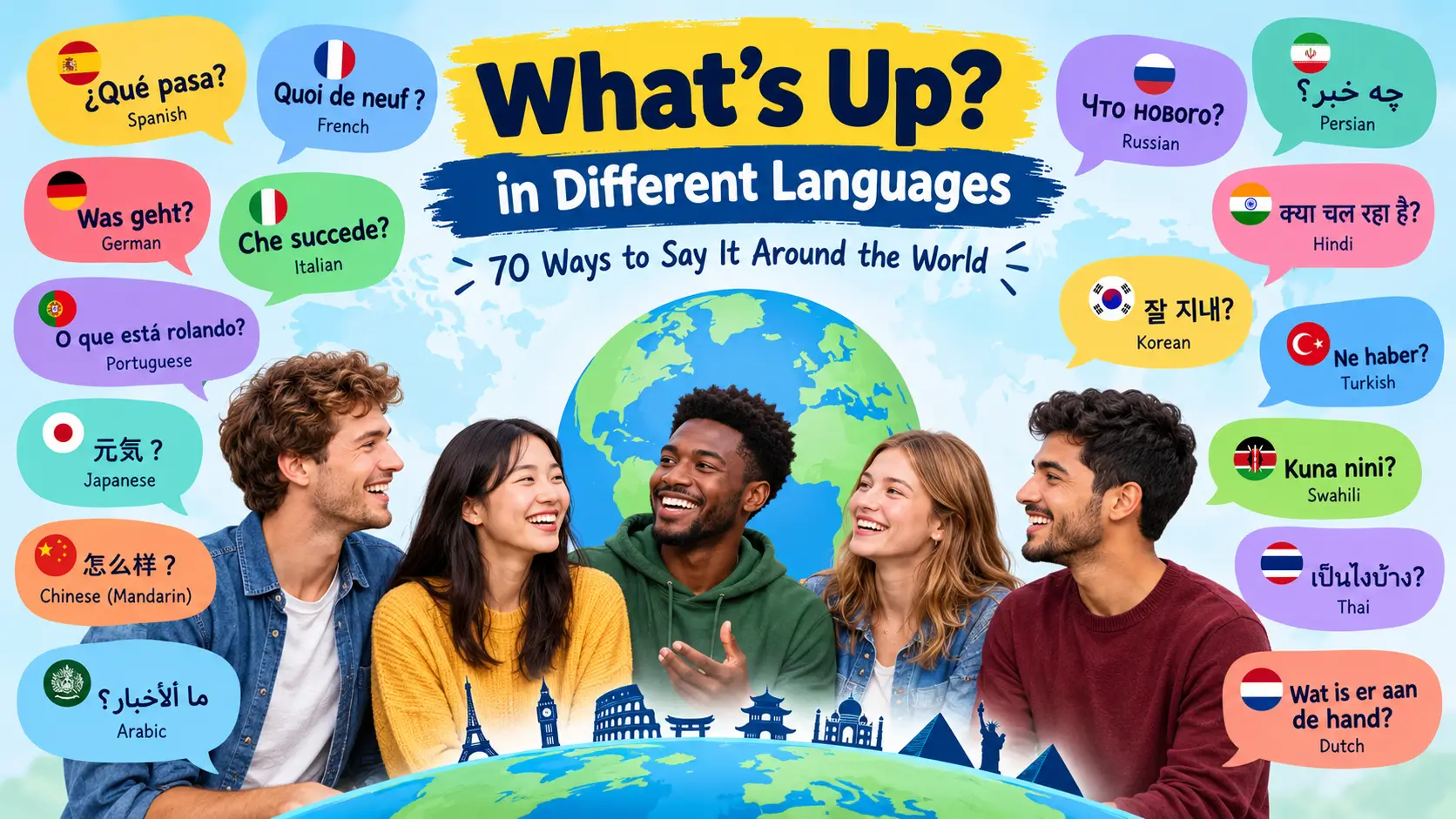
Wondering how to say “what’s up?” in different languages? This casual English greeting is commonly used to ask someone how they are, what they are doing, or whether anything interesting is happening. Unlike a formal question such as “How are you?”, “What’s up?” is friendly, relaxed, and often used between friends, classmates, coworkers, and family members.
Below, you’ll find 70 different languages, including the native phrase, an easy English pronunciation, and a short example showing how the expression can be used naturally.
What Does “What’s Up?” Mean?
“What’s up?” is an informal greeting or question. Depending on the situation, it can mean:
- How are you?
- What are you doing?
- What is happening?
- Is everything okay?
- What’s new?
The exact translation can vary because some languages use a phrase equivalent to “How are you?” while others use a phrase closer to “What is happening?”
“What’s Up” in Different Languages: 70 Translations
| # | Language | Native phrase | Easy English pronunciation | Example sentence | English meaning |
|---|---|---|---|---|---|
| 1 | Spanish | ¿Qué pasa? | keh PAH-sah | ¡Hola! ¿Qué pasa? | Hi! What’s up? |
| 2 | French | Quoi de neuf ? | kwah duh NERF | Salut, quoi de neuf ? | Hey, what’s up? |
| 3 | German | Was geht? | vahs GATE | Hey, was geht? | Hey, what’s up? |
| 4 | Italian | Che succede? | keh soo-CHEH-deh | Ciao, che succede? | Hi, what’s up? |
| 5 | Portuguese | O que está rolando? | oo keh stah ho-LAHN-doo | O que está rolando por aí? | What’s going on over there? |
| 6 | Dutch | Wat is er aan de hand? | vaht iss er ahn duh hahnt | Hé, wat is er aan de hand? | Hey, what’s up? |
| 7 | Swedish | Vad händer? | vahd HEN-der | Hej, vad händer? | Hey, what’s up? |
| 8 | Norwegian | Hva skjer? | vah SHARE | Hei, hva skjer? | Hi, what’s up? |
| 9 | Danish | Hvad sker der? | vel SKEHR dare | Hej, hvad sker der? | Hey, what’s happening? |
| 10 | Finnish | Mitä kuuluu? | MEE-tah KOO-loo | Hei, mitä kuuluu? | Hi, how are you? |
| 11 | Icelandic | Hvað segirðu? | kvath SAY-yir-thoo | Hæ, hvað segirðu? | Hi, what’s up? |
| 12 | Irish | Cad atá ar bun? | kahd ah-taw ar bun | Dia dhuit, cad atá ar bun? | Hello, what’s going on? |
| 13 | Welsh | Sut mae? | sit my | Helo, sut mae? | Hello, how are you? |
| 14 | Polish | Co słychać? | tso SWIH-hach | Cześć, co słychać? | Hi, what’s up? |
| 15 | Czech | Co se děje? | tso seh DYEH-yeh | Ahoj, co se děje? | Hi, what’s happening? |
| 16 | Slovak | Čo sa deje? | cho sah DEH-yeh | Ahoj, čo sa deje? | Hi, what’s happening? |
| 17 | Slovenian | Kaj dogaja? | kye doh-GAH-yah | Živjo, kaj dogaja? | Hi, what’s up? |
| 18 | Croatian | Što ima? | shtoh EE-mah | Bok, što ima? | Hi, what’s up? |
| 19 | Serbian | Šta ima? | shtah EE-mah | Ćao, šta ima? | Hi, what’s up? |
| 20 | Bosnian | Šta ima? | shtah EE-mah | Zdravo, šta ima? | Hello, what’s up? |
| 21 | Bulgarian | Какво става? | KAK-voh STAH-vah | Здравей, какво става? | Hello, what’s up? |
| 22 | Macedonian | Што има? | shtoh EE-mah | Здраво, што има? | Hi, what’s up? |
| 23 | Russian | Что нового? | shtoh NOH-vuh-vuh | Привет, что нового? | Hi, what’s new? |
| 24 | Ukrainian | Що нового? | shcho NOH-vo-ho | Привіт, що нового? | Hi, what’s new? |
| 25 | Belarusian | Што новага? | shtoh noh-VAH-hah | Прывітанне, што новага? | Hello, what’s new? |
| 26 | Lithuanian | Kas naujo? | kahs NOW-yoh | Labas, kas naujo? | Hi, what’s new? |
| 27 | Latvian | Kas jauns? | kahs yowns | Sveiki, kas jauns? | Hello, what’s new? |
| 28 | Estonian | Mis toimub? | miss TOY-moob | Tere, mis toimub? | Hi, what’s going on? |
| 29 | Hungarian | Mi újság? | mee OOY-shahg | Szia, mi újság? | Hi, what’s up? |
| 30 | Romanian | Ce mai faci? | cheh my fach | Salut, ce mai faci? | Hi, how are you? |
| 31 | Greek | Τι κάνεις; | tee KAH-nees | Γεια, τι κάνεις; | Hi, how are you? |
| 32 | Albanian | Ç’kemi? | CHEH-mee | Përshëndetje, ç’kemi? | Hello, what’s up? |
| 33 | Armenian | Ի՞նչ կա։ | inch kah | Բարև, ի՞նչ կա։ | Hi, what’s up? |
| 34 | Georgian | რა ხდება? | rah HDEH-bah | გამარჯობა, რა ხდება? | Hello, what’s happening? |
| 35 | Turkish | Ne haber? | neh hah-BEHR | Selam, ne haber? | Hi, what’s up? |
| 36 | Azerbaijani | Nə var, nə yox? | nah var, nah yokh | Salam, nə var, nə yox? | Hi, what’s up? |
| 37 | Persian | چه خبر؟ | cheh KHA-bar | سلام، چه خبر؟ | Hi, what’s up? |
| 38 | Arabic | ما الأخبار؟ | ma al-akh-BAR | مرحبًا، ما الأخبار؟ | Hello, what’s new? |
| 39 | Hebrew | מה נשמע? | mah nish-MAH | היי, מה נשמע? | Hey, what’s up? |
| 40 | Hindi | क्या चल रहा है? | kya chal RAH-ha hai | अरे, क्या चल रहा है? | Hey, what’s going on? |
| 41 | Urdu | کیا حال ہے؟ | kya haal hai | ارے، کیا حال ہے؟ | Hey, how are you? |
| 42 | Bengali | কী খবর? | kee KHO-bor | হ্যালো, কী খবর? | Hello, what’s up? |
| 43 | Punjabi | ਕੀ ਹਾਲ ਹੈ? | kee haal hai | ਸਤ ਸ੍ਰੀ ਅਕਾਲ, ਕੀ ਹਾਲ ਹੈ? | Hello, how are you? |
| 44 | Gujarati | શું ચાલે છે? | shoon CHA-leh chhe | હાય, શું ચાલે છે? | Hi, what’s going on? |
| 45 | Marathi | काय चाललंय? | kay CHAL-lay | हाय, काय चाललंय? | Hi, what’s going on? |
| 46 | Nepali | के छ? | keh chha | नमस्ते, के छ? | Hello, what’s up? |
| 47 | Sinhala | මොකද වෙන්නේ? | mok-uh-dah VEH-neh | ආයුබෝවන්, මොකද වෙන්නේ? | Hello, what’s happening? |
| 48 | Tamil | என்ன விஷயம்? | en-nah VISH-uh-yam | ஹாய், என்ன விஷயம்? | Hi, what’s up? |
| 49 | Telugu | ఏంటి సంగతులు? | ayn-tee SAN-guh-too-loo | హాయ్, ఏంటి సంగతులు? | Hi, what’s up? |
| 50 | Kannada | ಏನು ಸಮಾಚಾರ? | EH-noo suh-MAH-cha-ra | ಹಾಯ್, ಏನು ಸಮಾಚಾರ? | Hi, what’s up? |
| 51 | Malayalam | എന്തുണ്ട് വിശേഷം? | en-thun-doo vi-SHEH-sham | ഹായ്, എന്തുണ്ട് വിശേഷം? | Hi, what’s new? |
| 52 | Thai | เป็นไงบ้าง? | pen ngai bahng | สวัสดี เป็นไงบ้าง? | Hi, how are you? |
| 53 | Vietnamese | Có chuyện gì vậy? | kaw chwee-en zee vay | Chào, có chuyện gì vậy? | Hi, what’s going on? |
| 54 | Indonesian | Ada apa? | AH-dah AH-pah | Hai, ada apa? | Hi, what’s up? |
| 55 | Malay | Apa khabar? | AH-pah KHA-bar | Hai, apa khabar? | Hi, how are you? |
| 56 | Filipino | Anong balita? | ah-NONG bah-LEE-tah | Hi, anong balita? | Hi, what’s new? |
| 57 | Javanese | Piye kabare? | PEE-yeh kah-BAH-reh | Halo, piye kabare? | Hello, how are you? |
| 58 | Chinese (Mandarin) | 怎么样? | zěn me yàng | 你好,怎么样? | Hi, how’s it going? |
| 59 | Cantonese | 點呀? | dim aa | 你好,點呀? | Hi, how are you? |
| 60 | Japanese | 元気? | genki? | やあ、元気? | Hey, how are you? |
| 61 | Korean | 잘 지내? | jal ji-nae | 안녕, 잘 지내? | Hi, how are you? |
| 62 | Mongolian | Юу байна? | yoo bai-na | Сайн уу, юу байна? | Hi, what’s up? |
| 63 | Swahili | Kuna nini? | KOO-nah NEE-nee | Habari, kuna nini? | Hi, what’s up? |
| 64 | Zulu | Kwenzenjani? | kwen-zen-JAH-nee | Sawubona, kwenzenjani? | Hello, what’s going on? |
| 65 | Afrikaans | Wat gaan aan? | vut khahn ahn | Hallo, wat gaan aan? | Hello, what’s going on? |
| 66 | Amharic | ምን አዲስ ነገር አለ? | min ah-DEES neh-ger ah-leh | ሰላም፣ ምን አዲስ ነገር አለ? | Hello, what’s new? |
| 67 | Hausa | Me ke faruwa? | meh keh fah-ROO-wah | Sannu, me ke faruwa? | Hello, what’s happening? |
| 68 | Yoruba | Kí ló ń ṣẹlẹ̀? | kee lohn SHEH-leh | Ẹ n lẹ, kí ló ń ṣẹlẹ̀? | Hello, what’s happening? |
| 69 | Somali | Maxaa cusub? | ma-KHAA koo-SOOB | Salaan, maxaa cusub? | Hello, what’s new? |
| 70 | Malagasy | Inona vaovao? | ee-NOO-nah va-OO-voo | Salama, inona vaovao? | Hello, what’s new? |
How to Say “What’s Up?” in Different Languages
There is no single universal translation for “what’s up?” The most natural expression depends on the language and the social situation.
For example, Spanish speakers commonly use “¿Qué pasa?”, while French speakers may say “Quoi de neuf ?”. In Japanese, “元気?” (Genki?) is closer to asking whether someone is doing well. Hindi can use “क्या चल रहा है?”, which is closer to asking what is going on.
This is why literal translations are not always the best translations. A natural phrase is usually more useful than translating every English word individually.
“What’s Up?” Around the World
The expressions above show how a simple English greeting changes across cultures. Some languages focus on what is happening, while others focus on a person’s well-being or what is new in their life.
In casual conversations, native speakers often shorten greetings, use informal forms, or choose expressions that sound more natural among friends. Context, age, relationship, and regional habits can all influence the best choice.
Formal vs. Casual Ways to Ask “What’s Up?”
“What’s up?” is generally informal in English. When speaking with someone in a professional or formal setting, alternatives such as “How are you?”, “How have you been?”, or “How is everything going?” may be more appropriate.
The same principle applies to translations. A phrase that sounds natural between close friends may not be suitable when speaking to a teacher, customer, manager, or someone you have just met.
Common Uses of “What’s Up?”
“What’s up?” can serve several purposes in everyday conversation.
As a Greeting
Someone may say “What’s up?” simply to greet a friend without expecting a detailed answer.
To Ask What Is Happening
The phrase can also ask about a current situation, especially when something unusual has happened.
To Ask About Someone’s Life
In casual conversation, it can mean something similar to “What’s new?” or “How have you been?”
To Check If Something Is Wrong
Depending on tone, “What’s up?” can also ask whether there is a problem.
Tips for Using “What’s Up?” Naturally
When learning how to say “what’s up” in different languages, remember these practical points:
- Check whether the expression is formal or informal.
- Learn the phrase in its natural context rather than translating word by word.
- Pay attention to pronunciation and rhythm.
- Use formal alternatives when speaking in professional situations.
- Notice how native speakers greet friends and family.
- Remember that regional variations are normal.
Frequently Asked Questions
1. What is the most common meaning of “what’s up”?
“What’s up?” is a casual greeting that can mean “How are you?”, “What’s happening?”, “What are you doing?”, or “What’s new?”, depending on the context.
2. How do you say “what’s up” in Spanish?
A common Spanish equivalent is “¿Qué pasa?”, which can mean “What’s up?” or “What’s happening?” in casual conversation.
3. How do you say “what’s up” in French?
A natural casual expression is “Quoi de neuf ?”, meaning “What’s new?” It is commonly used as a friendly informal greeting.
4. Is “what’s up” formal or informal?
“What’s up?” is primarily informal. It is best suited to friends, family members, classmates, and other people with whom casual conversation is appropriate.
5. Can “what’s up” have different translations in the same language?
Yes. The best translation can change according to context, region, age, relationship, and level of formality. Some languages have expressions closer to “How are you?” while others mean “What’s happening?” or “What’s new?”
Conclusion
Learning “what’s up” in different languages is a useful way to understand everyday greetings and conversational culture around the world. The 70 translations above show that the most natural equivalent is not always a literal translation. Some expressions ask what is happening, some ask how someone is doing, and others ask what is new.
Whether you are studying languages, traveling, communicating with international friends, or simply exploring “what’s up” translations, learning these natural expressions can make everyday conversations more friendly and authentic.

I am Scarlett Wilson, a passionate language writer who loves exploring different languages, words, meanings, translations, and useful phrases. I enjoy making language learning simple, clear, and interesting for everyone.