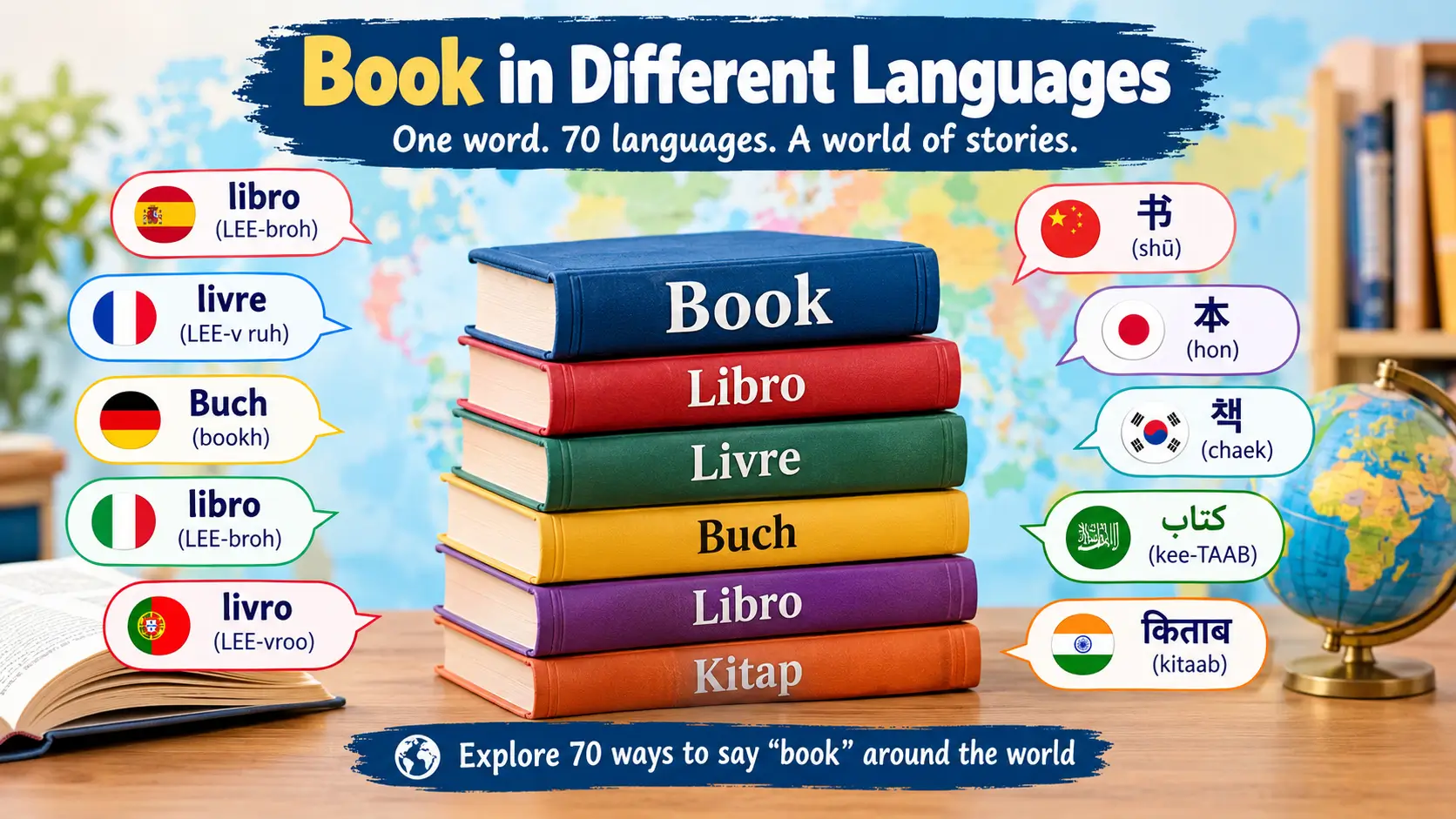
A book is one of the most universal words in everyday communication, connecting people through reading, education, stories, and knowledge. If you want to know how to say book in different languages, this guide gives you 70 translations with native terms, simple English pronunciations, and practical example sentences.
Whether you are learning a new language, traveling, studying, writing, or simply exploring book translations around the world, the table below makes it easy to compare the word across languages.
Book in All Languages
The word “book” can look and sound very different from one language to another. In some languages, the word is closely related to older Germanic or Latin roots, while others have completely different forms.
Here are 70 ways to say book in different languages:
| # | Language | Native word for “Book” | Easy English pronunciation | Example sentence | English meaning |
|---|---|---|---|---|---|
| 1 | English | book | book | I bought a new book. | I bought a new book. |
| 2 | Spanish | libro | LEE-broh | Este libro es interesante. | This book is interesting. |
| 3 | French | livre | LEE-vruh | J’ai acheté un livre. | I bought a book. |
| 4 | German | Buch | bookh | Ich lese ein Buch. | I am reading a book. |
| 5 | Italian | libro | LEE-broh | Ho un nuovo libro. | I have a new book. |
| 6 | Portuguese | livro | LEE-vroo | Eu comprei um livro. | I bought a book. |
| 7 | Dutch | boek | book | Ik lees een boek. | I am reading a book. |
| 8 | Afrikaans | boek | book | Ek lees ’n boek. | I am reading a book. |
| 9 | Danish | bog | boh | Jeg læser en bog. | I am reading a book. |
| 10 | Norwegian | bok | book | Jeg leser en bok. | I am reading a book. |
| 11 | Swedish | bok | book | Jag läser en bok. | I am reading a book. |
| 12 | Finnish | kirja | KEE-ryah | Luen kirjaa. | I am reading a book. |
| 13 | Estonian | raamat | RAH-maht | Ma loen raamatut. | I am reading a book. |
| 14 | Latvian | grāmata | GRAA-mah-tah | Es lasu grāmatu. | I am reading a book. |
| 15 | Lithuanian | knyga | KNEE-gah | Aš skaitau knygą. | I am reading a book. |
| 16 | Polish | książka | KSHONSH-kah | Czytam książkę. | I am reading a book. |
| 17 | Czech | kniha | KNEE-hah | Čtu knihu. | I am reading a book. |
| 18 | Slovak | kniha | KNEE-hah | Čítam knihu. | I am reading a book. |
| 19 | Slovenian | knjiga | KNYEE-gah | Berem knjigo. | I am reading a book. |
| 20 | Croatian | knjiga | KNYEE-gah | Čitam knjigu. | I am reading a book. |
| 21 | Serbian | књига | KNYEE-gah | Читам књигу. | I am reading a book. |
| 22 | Bulgarian | книга | KNEE-gah | Чета книга. | I am reading a book. |
| 23 | Macedonian | книга | KNEE-gah | Читам книга. | I am reading a book. |
| 24 | Romanian | carte | KAR-teh | Citesc o carte. | I am reading a book. |
| 25 | Hungarian | könyv | KURN-yv | Olvasok egy könyvet. | I am reading a book. |
| 26 | Greek | βιβλίο | vee-VLEE-oh | Διαβάζω ένα βιβλίο. | I am reading a book. |
| 27 | Albanian | libër | LEE-buhr | Po lexoj një libër. | I am reading a book. |
| 28 | Russian | книга | KNEE-gah | Я читаю книгу. | I am reading a book. |
| 29 | Ukrainian | книга | KNYEE-hah | Я читаю книгу. | I am reading a book. |
| 30 | Armenian | գիրք | geerk | Ես գիրք եմ կարդում։ | I am reading a book. |
| 31 | Georgian | წიგნი | TS’IG-nee | მე წიგნს ვკითხულობ. | I am reading a book. |
| 32 | Azerbaijani | kitab | kee-TAHB | Mən kitab oxuyuram. | I am reading a book. |
| 33 | Turkish | kitap | kee-TAHP | Bir kitap okuyorum. | I am reading a book. |
| 34 | Arabic | كتاب | kee-TAAB | أنا أقرأ كتابًا. | I am reading a book. |
| 35 | Hebrew | ספר | SEH-fer | אני קורא ספר. | I am reading a book. |
| 36 | Persian | کتاب | kee-TAAB | من یک کتاب میخوانم. | I am reading a book. |
| 37 | Urdu | کتاب | kee-TAAB | میں ایک کتاب پڑھ رہا ہوں۔ | I am reading a book. |
| 38 | Hindi | किताब | kee-TAAB | मैं एक किताब पढ़ रहा हूँ। | I am reading a book. |
| 39 | Bengali | বই | boi | আমি একটি বই পড়ছি। | I am reading a book. |
| 40 | Punjabi | ਕਿਤਾਬ | kee-TAAB | ਮੈਂ ਇੱਕ ਕਿਤਾਬ ਪੜ੍ਹ ਰਿਹਾ ਹਾਂ। | I am reading a book. |
| 41 | Gujarati | પુસ્તક | POOS-tak | હું એક પુસ્તક વાંચું છું. | I am reading a book. |
| 42 | Marathi | पुस्तक | POOS-tak | मी एक पुस्तक वाचत आहे. | I am reading a book. |
| 43 | Nepali | किताब | kee-TAAB | म किताब पढ्दै छु। | I am reading a book. |
| 44 | Sinhala | පොත | POH-tah | මම පොතක් කියවනවා. | I am reading a book. |
| 45 | Tamil | புத்தகம் | POOT-tha-gam | நான் ஒரு புத்தகம் படிக்கிறேன். | I am reading a book. |
| 46 | Telugu | పుస్తకం | POOS-ta-kam | నేను ఒక పుస్తకం చదువుతున్నాను. | I am reading a book. |
| 47 | Kannada | ಪುಸ್ತಕ | POOS-ta-ka | ನಾನು ಒಂದು ಪುಸ್ತಕ ಓದುತ್ತಿದ್ದೇನೆ. | I am reading a book. |
| 48 | Malayalam | പുസ്തകം | POOS-tha-kam | ഞാൻ ഒരു പുസ്തകം വായിക്കുന്നു. | I am reading a book. |
| 49 | Odia | ବହି | ba-hee | ମୁଁ ଏକ ବହି ପଢୁଛି। | I am reading a book. |
| 50 | Thai | หนังสือ | nang-SUE | ฉันกำลังอ่านหนังสือ | I am reading a book. |
| 51 | Lao | ປື້ມ | peuem | ຂ້ອຍກຳລັງອ່ານປື້ມ. | I am reading a book. |
| 52 | Khmer | សៀវភៅ | siev-phov | ខ្ញុំកំពុងអានសៀវភៅ។ | I am reading a book. |
| 53 | Vietnamese | sách | sahk | Tôi đang đọc sách. | I am reading a book. |
| 54 | Indonesian | buku | BOO-koo | Saya sedang membaca buku. | I am reading a book. |
| 55 | Malay | buku | BOO-koo | Saya sedang membaca buku. | I am reading a book. |
| 56 | Filipino | aklat | AK-laht | Nagbabasa ako ng aklat. | I am reading a book. |
| 57 | Chinese | 书 | shū | 我正在看书。 | I am reading a book. |
| 58 | Japanese | 本 | hon | 私は本を読んでいます。 | I am reading a book. |
| 59 | Korean | 책 | chaek | 저는 책을 읽고 있어요. | I am reading a book. |
| 60 | Mongolian | ном | nom | Би ном уншиж байна. | I am reading a book. |
| 61 | Burmese | စာအုပ် | sa-ohk | ကျွန်တော် စာအုပ်ဖတ်နေတယ်။ | I am reading a book. |
| 62 | Swahili | kitabu | kee-TAH-boo | Ninasoma kitabu. | I am reading a book. |
| 63 | Zulu | incwadi | in-KWAH-dee | Ngifunda incwadi. | I am reading a book. |
| 64 | Xhosa | incwadi | in-KWAH-dee | Ndifunda incwadi. | I am reading a book. |
| 65 | Yoruba | ìwé | ee-WEH | Mo ń ka ìwé. | I am reading a book. |
| 66 | Igbo | akwụkwọ | ah-KWOO-kwuh | Ana m agụ akwụkwọ. | I am reading a book. |
| 67 | Somali | buug | BOOG | Waxaan akhrinayaa buug. | I am reading a book. |
| 68 | Amharic | መጽሐፍ | mets-HAF | መጽሐፍ እያነበብኩ ነው። | I am reading a book. |
| 69 | Hausa | littafi | lee-TAH-fee | Ina karanta littafi. | I am reading a book. |
| 70 | Swahili | kitabu | kee-TAH-boo | Kitabu hiki ni kizuri. | This book is good. |
How to Say “Book” in Different Languages
The most common translations for book include libro in Spanish and Italian, livre in French, Buch in German, livro in Portuguese, kitab in several languages of South and West Asia, and kitabu in Swahili.
Some languages use a word that is easy for English speakers to recognize, while others have completely different sounds and writing systems. For example, Chinese uses 书, Japanese uses 本, and Korean uses 책.
The pronunciation column above provides a simple English-friendly guide. These approximations are designed for learners and may not capture every sound found in the original language.
Book Translations Around the World
The word book is closely connected with education, literature, storytelling, religion, history, and entertainment. Because books are used in nearly every culture, the concept has a place in virtually every major language.
In European languages, you can see several related forms. Spanish and Italian both use libro, while Portuguese uses livro. German uses Buch, and Dutch uses boek. Slavic languages such as Polish, Czech, Russian, Bulgarian, and Serbian have their own related forms.
Across Asia, the differences become even more noticeable. Hindi and Urdu use forms based on kitab, while Bengali uses boi. Chinese uses 书, Japanese uses 本, and Korean uses 책.
African languages also have distinctive terms. Swahili uses kitabu, while Zulu and Xhosa use incwadi. These differences make learning vocabulary an interesting way to explore language and culture.
Why Learn the Word “Book” in Other Languages?
Learning one simple word in several languages can be a useful starting point for language study. Book is particularly practical because it appears in conversations about school, libraries, reading, literature, travel, and hobbies.
Knowing this word can also help you recognize signs, titles, menus, educational materials, and basic conversations when visiting another country.
For language learners, comparing the same word across languages can also make vocabulary patterns easier to remember.
Book in Different Writing Systems
One fascinating part of learning book in all languages is seeing how the word changes between writing systems.
Latin-based languages may use familiar letters, such as libro, livre, Buch, and kitabu. Other languages use completely different scripts. For example:
- Arabic: كتاب
- Hebrew: ספר
- Hindi: किताब
- Bengali: বই
- Tamil: புத்தகம்
- Thai: หนังสือ
- Chinese: 书
- Japanese: 本
- Korean: 책
- Georgian: წიგნი
- Armenian: գիրք
Learning both the native spelling and pronunciation gives you a better understanding of how the word is actually used.
Common Uses of the Word “Book”
The English word book can refer to several related things. Most commonly, it means a written or printed work containing pages bound together.
For example:
- I bought a book yesterday.
- This book is very interesting.
- She is reading a history book.
- Please open your book.
- The library has thousands of books.
English also uses book as a verb. For example, you can book a hotel, book a flight, or book a table. However, the translations in this article focus primarily on the noun book, meaning a written or printed work.
Tips for Learning Book Translations
If you are studying several languages, avoid trying to memorize all 70 translations at once. Start with five or ten languages that are most relevant to your interests.
Write each native word beside its pronunciation and use it in a short sentence. Repetition is especially helpful for words that use unfamiliar scripts.
You can also group languages by region. For example, learn European translations first, followed by South Asian, East Asian, Southeast Asian, and African languages.
Most importantly, remember that the pronunciation guides in this table are simplified for English speakers. For accurate speaking, listening to native speakers and learning the pronunciation rules of the individual language is recommended.
Frequently Asked Questions
1. How do you say “book” in different languages?
“Book” has many translations. Examples include libro in Spanish and Italian, livre in French, Buch in German, livro in Portuguese, kitabu in Swahili, 书 in Chinese, 本 in Japanese, and 책 in Korean.
2. What is the word for book in Spanish?
The Spanish word for book is libro. A common sentence is Este libro es interesante, meaning “This book is interesting.”
3. How do you say book in French?
The French word for book is livre. For example, J’ai acheté un livre means “I bought a book.”
4. What is book in Hindi and Urdu?
In Hindi, book is किताब (kitaab). In Urdu, it is کتاب (kitaab). The two words are closely related and are commonly used in everyday speech.
5. What is book in Chinese, Japanese, and Korean?
In Chinese, book is 书 (shū). In Japanese, the common word is 本 (hon), and in Korean, it is 책 (chaek). These languages use different writing systems, making their translations visually distinct.
Conclusion
Learning how to say book in different languages is a simple way to expand your vocabulary while discovering how languages express the same everyday idea. From libro and livre to kitabu, 书, 本, and 책, each translation reflects the vocabulary and writing system of its language.
Use the 70-language table as a quick reference for studying, traveling, communicating, or exploring book translations around the world.

I am Ricardo Hunter, Administrator at LingoBuz, passionate about languages, translations, and global communication. I help create useful, clear content that makes exploring different languages simple, enjoyable, and accessible.