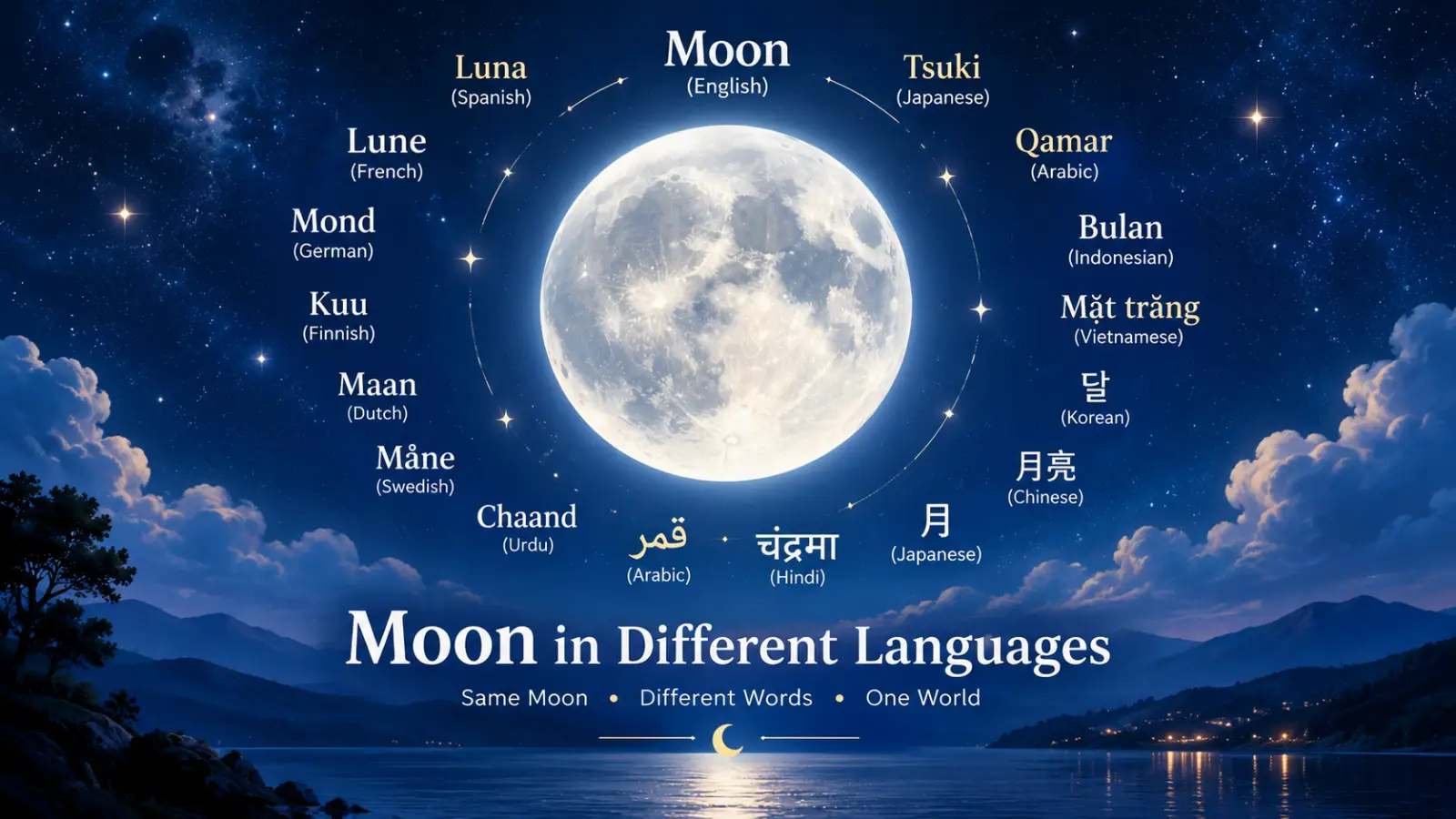
The Moon has fascinated people for thousands of years. It brightens the night sky, inspires poets, influences calendars, and appears in countless legends. Although people around the world look at the same celestial object, they use different words to describe it.
For example, Spanish and Italian speakers call the Moon Luna, while French speakers use Lune. In German, the word is Mond, and Finnish speakers say Kuu. Similarly, people who speak Urdu use چاند (Chaand), while Japanese speakers write 月 and pronounce it tsuki.
Learning how to say Moon in different languages offers more than a vocabulary lesson. It also introduces us to different writing systems, historical connections, cultural traditions, and fascinating mythological stories.
In this guide, you will discover 100+ Moon translations, easy pronunciation guides, interesting linguistic facts, and famous names associated with the Moon in mythology. Whether you are a language learner, a writer, or simply curious about the night sky, this collection will help you explore the many ways people describe our natural satellite.
Moon in Different Languages: Complete List
Languages often use completely different words for the same object. However, some share similar terms because of historical relationships, borrowed vocabulary, or common linguistic roots.
Below, you will find Moon translations from European, Asian, Middle Eastern, African, and other languages, along with approximate pronunciation guides.
Moon in European Languages
European languages offer several interesting examples of how words for the Moon have evolved. For instance, Spanish and Italian share Luna, whereas English uses Moon and German uses Mond.
| Language | Word for Moon | Easy Pronunciation |
|---|---|---|
| English | Moon | Moon |
| Spanish | Luna | LOO-nah |
| French | Lune | Loon |
| German | Mond | Mohnt |
| Italian | Luna | LOO-nah |
| Portuguese | Lua | LOO-ah |
| Dutch | Maan | Maan |
| Swedish | Måne | MOH-neh |
| Norwegian | Måne | MOH-neh |
| Danish | Måne | MOH-neh |
| Finnish | Kuu | Koo |
| Estonian | Kuu | Koo |
| Russian | Луна (Luna) | LOO-nah |
| Polish | Księżyc | Approx. KSHEN-zhits |
| Czech | Měsíc | MYEH-seets |
| Slovak | Mesiac | MEH-see-ats |
| Hungarian | Hold | Hold |
| Romanian | Lună | LOO-nuh |
| Greek | Φεγγάρι (Fengári) | feh-GHAH-ree |
| Albanian | Hënë | HUH-nuh |
| Basque | Ilargia | ee-LAR-gee-ah |
| Belarusian | Месяц (Miesiats) | MYEH-syats |
| Bosnian | Mjesec | MYEH-sehts |
| Bulgarian | Луна (Luna) | LOO-nah |
| Catalan | Lluna | LYOO-nah |
| Corsican | Luna | LOO-nah |
| Croatian | Mjesec | MYEH-sehts |
| Frisian | Moanne | MOH-nuh |
| Galician | Lúa | LOO-ah |
| Icelandic | Tungl | Toongl |
| Irish | Gealach | GYAL-akh |
| Latvian | Mēness | MEH-ness |
| Lithuanian | Mėnulis | MEH-noo-lis |
| Luxembourgish | Mound | Moont |
| Macedonian | Месечина (Mesečina) | meh-seh-CHEE-nah |
| Maltese | Qamar | KAH-mar |
| Serbian | Месец (Mesec) | MEH-sehts |
| Slovenian | Luna | LOO-nah |
| Ukrainian | Місяць (Misiats) | MEE-syats |
| Welsh | Lleuad | Approx. HLAY-ad |
| Yiddish | לבנה (Levone) | leh-VOH-neh |
Interesting fact: Several European languages use words that resemble one another. For example, Spanish Luna, Italian Luna, and French Lune share a Latin origin. By contrast, Finnish Kuu belongs to a different language family and has its own linguistic history.
Moon in Asian Languages
Asia contains thousands of languages, making it an especially fascinating region for exploring Moon names and translations. Some languages use short everyday words, while others have distinct terms for the Moon in literary or formal contexts.
| Language | Word for Moon | Easy Pronunciation |
|---|---|---|
| Hindi | चंद्रमा (Chandrama) | chun-drah-MAH |
| Bengali | চাঁদ (Chand) | Chahn |
| Japanese | 月 (Tsuki) | TSOO-kee |
| Chinese (Simplified) | 月亮 (Yuèliàng) | yweh-lyahng |
| Chinese (Traditional) | 月亮 (Yuèliàng) | yweh-lyahng |
| Korean | 달 (Dal) | Dahl |
| Vietnamese | Mặt trăng | Approx. maht-trahng |
| Thai | ดวงจันทร์ (Duang Chan) | Approx. doo-ang-jan |
| Indonesian | Bulan | BOO-lahn |
| Malay | Bulan | BOO-lahn |
| Kashmiri | Zoon | Zoon |
| Armenian | Լուսին (Lusin) | loo-SEEN |
| Azerbaijani | Ay | Eye |
| Georgian | მთვარე (Mtvare) | mtvah-reh |
| Gujarati | ચંદ્ર (Chandra) | CHUN-drah |
| Hmong | Hli | Hlee |
| Kannada | ಚಂದ್ರ (Chandra) | CHUN-drah |
| Kazakh | Ай (Ay) | Eye |
| Khmer | ព្រះច័ន្ទ (Preah Chan) | Approx. preah-chan |
| Kyrgyz | Ай (Ay) | Eye |
| Lao | ເດືອນ (Duean) | Approx. duean |
| Malayalam | ചന്ദ്രൻ (Chandran) | CHUN-dran |
| Marathi | चंद्र (Chandra) | CHUN-drah |
| Mongolian | Сар (Sar) | Sar |
| Burmese | လ (La) | Lah |
| Nepali | चन्द्रमा (Chandrama) | chun-drah-MAH |
| Odia | ଚନ୍ଦ୍ର (Chandra) | CHUN-drah |
| Pashto | سپوږمۍ (Spogmai) | spog-MAI |
| Punjabi | ਚੰਦ (Chand) | Chahnd |
| Sindhi | چنڊ (Chand) | Chahn-d |
| Sinhala | සඳ (Sanda) | SUN-dah |
| Tajik | Моҳ (Moh) | Moh |
| Tamil | நிலா (Nila) | NEE-lah |
| Telugu | చంద్రుడు (Chandrudu) | Approx. chun-drah-doo |
| Turkmen | Aý | Eye |
| Urdu | چاند (Chaand) | Chahnd |
| Uyghur | ئاي (Ay) | Eye |
| Uzbek | Oy | Oy |
Did you know? The word Bulan means Moon in both Indonesian and Malay. Similarly, Ay appears in several Turkic languages, including Azerbaijani, Kazakh, Kyrgyz, and Turkmen.
Japanese provides another interesting example. The character 月 can refer to the Moon or the concept of a month, depending on its reading and context. Therefore, understanding the surrounding words helps learners identify the intended meaning.
Moon in Middle Eastern Languages
The Moon holds a prominent place in poetry, calendars, literature, and cultural traditions across the Middle East. Consequently, several languages have well-known lunar vocabulary.
| Language | Word for Moon | Easy Pronunciation |
|---|---|---|
| Arabic | قمر (Qamar) | KAH-mar |
| Hebrew | ירח (Yareach) | yah-REH-akh |
| Persian | ماه (Mah) | Mah |
| Kurdish (Kurmanji) | Hêv | Hehv |
In Arabic, Qamar is a familiar word for the Moon and appears in literary expressions and personal names. Persian speakers use Mah, which also appears in poetic descriptions of beauty.
Meanwhile, Urdu uses Chaand, a word that frequently appears in poetry, songs, and everyday expressions. These examples show how lunar vocabulary can connect language with cultural expression.
Moon in African Languages
African languages offer another rich collection of words for the Moon. Although pronunciation varies between regions and dialects, the following examples provide a useful starting point for language learners.
| Language | Word for Moon | Easy Pronunciation |
|---|---|---|
| Afrikaans | Maan | Maan |
| Amharic | ጨረቃ (Ch’ereqa) | chuh-reh-kah |
| Chichewa | Mwezi | mweh-zee |
| Hausa | Wata | WAH-tah |
| Igbo | Ọnwa | OHN-wah |
| Kinyarwanda | Ukwezi | oo-kweh-zee |
| Sesotho | Khoeli | kho-eh-lee |
| Shona | Mwedzi | mweh-dzee |
| Somali | Dayax | DAH-yakh |
| Swahili | Mwezi | mweh-zee |
| Xhosa | Inyanga | een-YAH-ngah |
| Yoruba | Oṣupa | oh-SHOO-pah |
| Zulu | Inyanga | een-YAH-ngah |
For example, Swahili and Chichewa both use Mwezi, although the word can also refer to a month in relevant contexts. Likewise, Xhosa and Zulu use Inyanga for the Moon.
These similarities illustrate an important point: related languages sometimes share vocabulary, while local usage and context influence how speakers understand a word.
Moon in Other Languages and Fictional Languages
Beyond widely spoken languages, the Moon also appears in constructed languages and fictional universes. These examples demonstrate how writers and creators develop vocabulary to build imaginary worlds.
| Language | Word for Moon | Pronunciation |
|---|---|---|
| Esperanto | Luno | LOO-noh |
| Klingon | maS | Mahss |
Esperanto uses Luno for the Moon. In the fictional language Klingon from Star Trek, maS means Moon.
Although constructed languages differ from naturally developed languages, they offer an entertaining way to explore how people create words, grammar, and entire linguistic systems.
Pronunciation note: All pronunciation guides in this article are approximate. Native pronunciation may differ because of regional accents, tones, vowel sounds, and writing conventions. In addition, some languages use the same word for the Moon and a month, depending on context.
How to Say Moon in Different Languages
If you want to learn how to say Moon in different languages, begin with these popular translations. They are easy to remember and provide a useful introduction to several major languages.
- Luna , Spanish and Italian.
- Lune, French.
- Mond, German.
- Lua, Portuguese.
- Kuu, Finnish and Estonian.
- Måne, Swedish, Norwegian, and Danish.
- Qamar, Arabic.
- Chaand, Urdu.
- Chand, Punjabi and Bengali, with differences in script and pronunciation.
- Tsuki, Japanese.
- Yuèliàng, Mandarin Chinese.
- Bulan, Indonesian and Malay.
- Mwezi, Swahili and Chichewa.
- Nila, Tamil.
- Ay, Azerbaijani, Kazakh, Kyrgyz, and Turkmen.
For beginners, learning five words at a time can make memorization easier. You can also write each word on a flashcard, listen to a native speaker, and practise saying it aloud.
Why Is the Moon Called Luna in Many Languages?
The word Luna is particularly recognizable because Spanish and Italian use it for the Moon. Both languages developed from Latin, which explains why they share this word.
French uses Lune, another word with Latin roots. Similarly, Portuguese uses Lua. These similarities reflect historical relationships between the Romance languages.
However, not every language follows the same pattern. English uses Moon, German uses Mond, and Finnish uses Kuu. These words reflect different linguistic histories rather than a single universal naming system.
The word Luna also appears in literature, astronomy-related names, and popular culture. As a result, people often recognize it even when they do not speak Spanish or Italian.
Moon Names in Mythology and Ancient Cultures
Throughout history, people have connected the Moon with gods, goddesses, seasonal cycles, calendars, and creation stories. Different civilizations developed their own lunar traditions, and many of these stories continue to influence art and literature today.
However, mythological Moon names are not always direct translations of the word Moon. Some refer to deities, while others describe a divine personification or a cultural association.
Here are several well-known examples.
1. Selene, Greek Mythology
Selene is the Greek goddess and personification of the Moon. Ancient Greek art and literature often portray her travelling across the night sky.
2. Diana, Roman Mythology
Diana is a Roman goddess associated with hunting, wilderness, and the Moon. Over time, lunar symbolism became an important part of her cultural identity.
3. Artemis, Greek Mythology
Artemis is the Greek goddess of hunting and wilderness. Although her earliest associations extend beyond the Moon, later traditions increasingly connected her with lunar imagery.
4. Sin and Nanna, Mesopotamian Traditions
Sin, also known as Nanna in Sumerian tradition, was a major Mesopotamian Moon god. Worship of this deity played an important role in several ancient religious centres.
5. Chandra, Hindu Traditions
Chandra is a lunar deity in Hindu traditions. The name also appears in South Asian vocabulary related to the Moon, connecting mythology with everyday language.
6. Ix Chel, Maya Traditions
Ix Chel is a Maya goddess associated in various sources with the Moon, fertility, healing, and other aspects of life. Her roles and attributes vary across historical interpretations and traditions.
7. Chang’e, Chinese Mythology
Chang’e is a famous figure in Chinese lunar mythology. One popular legend tells how she came to live on the Moon, and the story remains closely associated with the Mid-Autumn Festival.
8. Máni, Norse Mythology
Máni personifies the Moon in Norse mythology. Traditional Norse stories also connect Máni with the passage of time and the movement of celestial bodies.
9. Mėnuo, Lithuanian Mythology
Mėnuo is a lunar figure in Lithuanian mythology. Stories involving Mėnuo reflect traditional beliefs about celestial movements and the natural world.
These figures show how the Moon has inspired different cultures to explain the night sky. Moreover, their stories reveal how people have connected astronomy, spirituality, nature, and human experience.
Interesting Facts About the Moon Around the World
The Moon looks familiar to people everywhere. Nevertheless, languages and cultures describe it in surprisingly different ways.
- One Moon, many words: English speakers say Moon, Spanish speakers say Luna, and Japanese speakers use Tsuki.
- Shared linguistic roots: Spanish and Italian both use Luna, while Swedish, Norwegian, and Danish use Måne.
- Different writing systems: Japanese and Chinese use 月, Korean uses 달, and Urdu uses چاند.
- Words with multiple meanings: In some languages, the same word can refer to the Moon and a month, depending on the context.
- A source of inspiration: Poets, musicians, storytellers, and artists frequently use the Moon as a symbol of beauty, mystery, hope, or longing.
- A connection to calendars: Many communities have historically used lunar phases to track time, organize festivals, and mark religious occasions.
- A familiar celestial neighbour: Although languages differ, people across the world share a view of the same natural satellite.
In addition to these facts, the Moon’s changing appearance has inspired expressions about new beginnings, romance, and the passage of time. Its cultural significance continues to evolve as people explore space and learn more about the universe.
Frequently Asked Questions About Moon in Different Languages
What is the word for Moon in different languages?
The Moon has many names around the world. For example, Spanish uses Luna, French uses Lune, German uses Mond, Finnish uses Kuu, Arabic uses Qamar, Japanese uses Tsuki, and Urdu uses Chaand.
What is Moon called in Urdu?
In Urdu, the Moon is called چاند (Chaand). People commonly use this word in everyday conversation, poetry, songs, and expressions that describe beauty.
What is Moon called in Hindi?
In Hindi, चंद्रमा (Chandrama) is a common word for the Moon. People also frequently use चाँद (Chaand) in everyday speech and poetry.
What is Moon called in Arabic?
Arabic speakers call the Moon قمر (Qamar). The word appears in everyday conversation, literature, and cultural expressions.
What is Moon called in Japanese?
In Japanese, the Moon is written as 月 and commonly read as tsuki. Depending on the context, the same character can also relate to the concept of a month.
What is Moon called in Chinese?
In Mandarin Chinese, a common word for the Moon is 月亮 (Yuèliàng). The character 月 also appears in words associated with months and lunar concepts.
What is Moon called in Punjabi?
In Punjabi, people commonly use ਚੰਦ (Chand) for the Moon. The word appears in Punjabi poetry, songs, and everyday expressions.
Why do different languages have different names for the Moon?
Languages develop through different histories, communities, and cultural influences. Consequently, speakers create and preserve different words for the same natural object. Some terms share ancient roots, while others developed independently.
What are some mythological names for the Moon?
Famous lunar figures include Selene and Artemis from Greek mythology, Sin from Mesopotamian traditions, Chandra from Hindu traditions, Chang’e from Chinese mythology, and Máni from Norse mythology. These names refer to mythological figures rather than ordinary translations in every case.
Which languages use the word Luna?
Spanish and Italian use Luna for the Moon. Related forms, including French Lune and Portuguese Lua, also reflect the historical influence of Latin.
Is the Moon called the same thing in every language?
No. Languages use different words, sounds, and writing systems. For example, English uses Moon, Arabic uses Qamar, Japanese uses Tsuki, and Urdu uses Chaand.
How can I remember Moon translations easily?
Start with a few familiar languages and practise five words each day. In addition, use flashcards, listen to native speakers, and connect each word with its original writing system or cultural background.
Conclusion:
The Moon remains one of the most recognizable sights in the night sky, yet its name changes from one language to another. From Luna and Lune to Kuu, Qamar, Tsuki, and Chaand, each word offers a glimpse into the history and culture of the people who use it.
Moreover, exploring Moon in different languages helps learners discover linguistic diversity, appreciate cultural traditions, and understand how people describe the same natural wonder in different ways.
Whether you are learning a new language, researching Moon names, writing a poem, or choosing a meaningful name, these translations provide a useful place to begin.
Do you know another word for the Moon? Share the language and its translation to help expand this collection and celebrate the beauty of languages around the world.

I am Ricardo Hunter, Administrator at LingoBuz, passionate about languages, translations, and global communication. I help create useful, clear content that makes exploring different languages simple, enjoyable, and accessible.