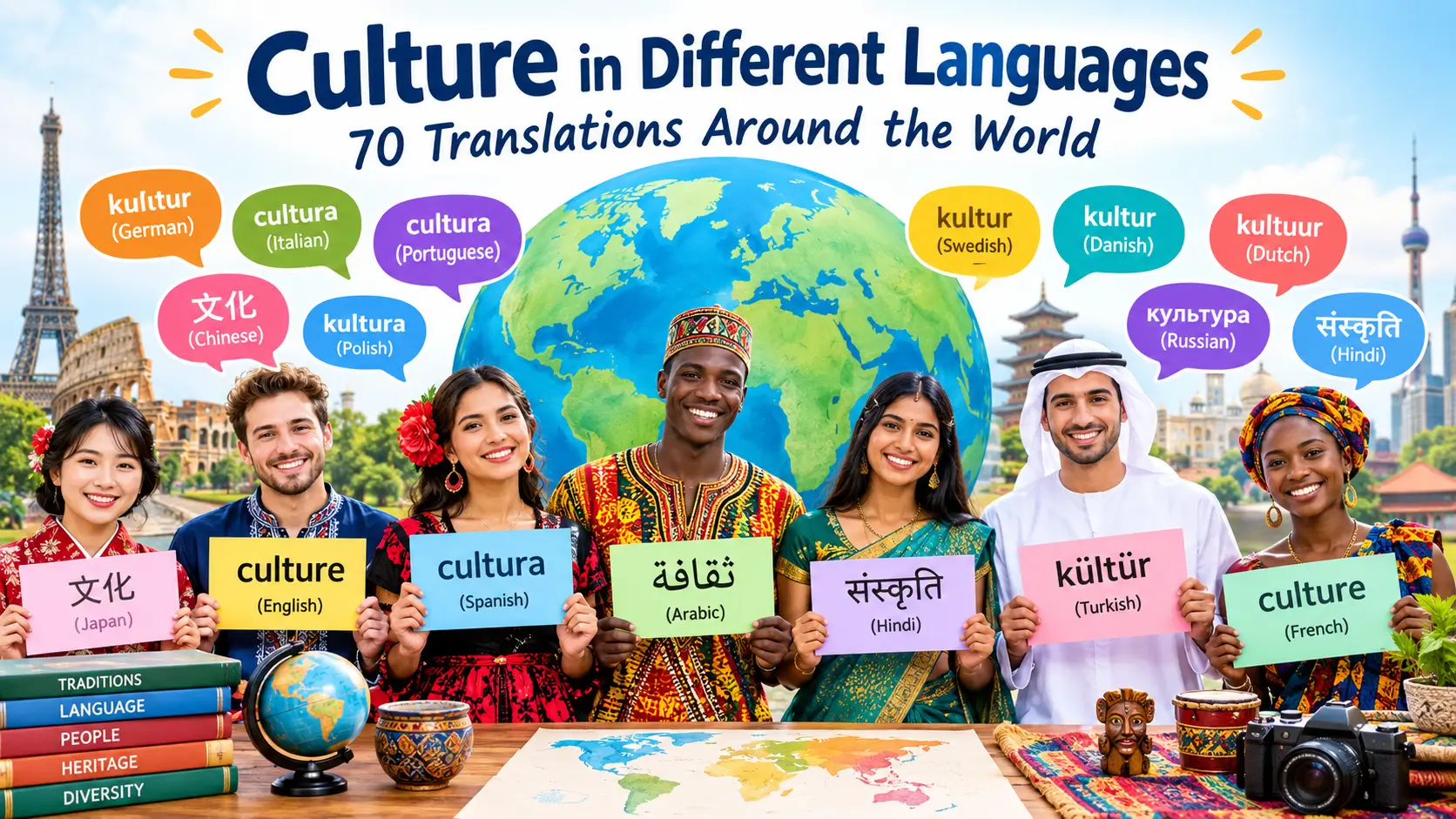
Culture is one of the most meaningful words for understanding people, communities, traditions, and ways of life. It describes the beliefs, customs, arts, values, languages, food, celebrations, and social practices that shape a society.
If you are learning a new language, traveling, studying anthropology, writing about international communities, or simply curious about global vocabulary, learning the word “culture” in different languages is a useful place to start.
Below, you will find culture translations in 70 languages, including the native word, an easy English pronunciation, and a practical example sentence. This guide makes it easy to learn how to say culture in different languages while seeing how the word is naturally used.
Culture in All Languages: 70 Useful Translations
The following table provides culture in all languages with simple examples for everyday learning.
| # | Language | Native Phrase | Easy English Pronunciation | Example Sentence | English Meaning |
|---|---|---|---|---|---|
| 1 | English | culture | KUL-chur | Culture shapes our identity. | Culture shapes our identity. |
| 2 | Spanish | cultura | kool-TOO-rah | La cultura es muy importante. | Culture is very important. |
| 3 | French | culture | kool-TUR | La culture est importante. | Culture is important. |
| 4 | German | Kultur | kool-TOOR | Die Kultur ist faszinierend. | The culture is fascinating. |
| 5 | Italian | cultura | kool-TOO-rah | La cultura italiana è famosa. | Italian culture is famous. |
| 6 | Portuguese | cultura | kool-TOO-rah | A cultura local é rica. | The local culture is rich. |
| 7 | Dutch | cultuur | kuhl-TOOR | De cultuur is interessant. | The culture is interesting. |
| 8 | Swedish | kultur | kool-TOOR | Svensk kultur är intressant. | Swedish culture is interesting. |
| 9 | Danish | kultur | kool-TOOR | Dansk kultur er interessant. | Danish culture is interesting. |
| 10 | Norwegian | kultur | kool-TOOR | Norsk kultur er unik. | Norwegian culture is unique. |
| 11 | Finnish | kulttuuri | kool-too-ree | Kulttuuri on tärkeää. | Culture is important. |
| 12 | Icelandic | menning | MEN-ning | Menning er mikilvæg. | Culture is important. |
| 13 | Irish | cultúr | KUL-toor | Tá an cultúr saibhir. | The culture is rich. |
| 14 | Welsh | diwylliant | dih-WIL-yant | Mae’r diwylliant yn bwysig. | The culture is important. |
| 15 | Polish | kultura | kool-TOO-rah | Kultura jest ważna. | Culture is important. |
| 16 | Czech | kultura | kool-TOO-rah | Kultura je důležitá. | Culture is important. |
| 17 | Slovak | kultúra | kool-TOO-rah | Kultúra je dôležitá. | Culture is important. |
| 18 | Slovenian | kultura | kool-TOO-rah | Kultura je pomembna. | Culture is important. |
| 19 | Croatian | kultura | kool-TOO-rah | Kultura je važna. | Culture is important. |
| 20 | Serbian | култура | kool-TOO-rah | Култура је важна. | Culture is important. |
| 21 | Bosnian | kultura | kool-TOO-rah | Kultura je važna. | Culture is important. |
| 22 | Bulgarian | култура | kool-TOO-rah | Културата е важна. | Culture is important. |
| 23 | Macedonian | култура | kool-TOO-rah | Културата е важна. | Culture is important. |
| 24 | Russian | культура | kool-TOO-rah | Культура важна для общества. | Culture is important for society. |
| 25 | Ukrainian | культура | kool-TOO-rah | Культура важлива для суспільства. | Culture is important for society. |
| 26 | Belarusian | культура | kool-TOO-rah | Культура важная для народа. | Culture is important for the people. |
| 27 | Lithuanian | kultūra | kool-TOO-rah | Kultūra yra svarbi. | Culture is important. |
| 28 | Latvian | kultūra | kool-TOO-rah | Kultūra ir svarīga. | Culture is important. |
| 29 | Estonian | kultuur | kool-TOOR | Kultuur on tähtis. | Culture is important. |
| 30 | Hungarian | kultúra | kool-TOO-rah | A kultúra fontos. | Culture is important. |
| 31 | Romanian | cultură | kool-TOO-rah | Cultura este importantă. | Culture is important. |
| 32 | Albanian | kulturë | kool-TOOR-uh | Kultura është e rëndësishme. | Culture is important. |
| 33 | Greek | πολιτισμός | poh-lee-tee-zMOS | Ο πολιτισμός είναι σημαντικός. | Culture is important. |
| 34 | Turkish | kültür | kool-TUR | Kültür çok önemlidir. | Culture is very important. |
| 35 | Azerbaijani | mədəniyyət | mah-deh-nee-YET | Mədəniyyət çox vacibdir. | Culture is very important. |
| 36 | Armenian | մշակույթ | mush-ah-KOYT | Մշակույթը կարևոր է։ | Culture is important. |
| 37 | Georgian | კულტურა | kool-TOO-rah | კულტურა მნიშვნელოვანია. | Culture is important. |
| 38 | Arabic | ثقافة | tha-QAA-fah | الثقافة مهمة. | Culture is important. |
| 39 | Hebrew | תרבות | tar-BOOT | התרבות חשובה. | Culture is important. |
| 40 | Persian | فرهنگ | far-HANG | فرهنگ بسیار مهم است. | Culture is very important. |
| 41 | Urdu | ثقافت | sa-QAA-fat | ثقافت ہماری شناخت ہے۔ | Culture is our identity. |
| 42 | Hindi | संस्कृति | sans-KRI-tee | संस्कृति हमारी पहचान है। | Culture is our identity. |
| 43 | Bengali | সংস্কৃতি | shong-SKRI-tee | সংস্কৃতি আমাদের পরিচয়। | Culture is our identity. |
| 44 | Punjabi | ਸਭਿਆਚਾਰ | sabh-yaa-CHAAR | ਸਭਿਆਚਾਰ ਸਾਡੀ ਪਛਾਣ ਹੈ। | Culture is our identity. |
| 45 | Gujarati | સંસ્કૃતિ | sans-KRUH-tee | સંસ્કૃતિ આપણી ઓળખ છે. | Culture is our identity. |
| 46 | Marathi | संस्कृती | sans-KROO-tee | संस्कृती आपली ओळख आहे. | Culture is our identity. |
| 47 | Nepali | संस्कृति | sun-SKRI-tee | संस्कृति हाम्रो पहिचान हो। | Culture is our identity. |
| 48 | Sinhala | සංස්කෘතිය | sang-skroo-tee-ya | සංස්කෘතිය වැදගත්ය. | Culture is important. |
| 49 | Tamil | கலாச்சாரம் | ka-laa-CHAA-ram | கலாச்சாரம் முக்கியம். | Culture is important. |
| 50 | Telugu | సంస్కృతి | sams-KRUH-tee | సంస్కృతి చాలా ముఖ్యం. | Culture is very important. |
| 51 | Kannada | ಸಂಸ್ಕೃತಿ | sams-KRUH-tee | ಸಂಸ್ಕೃತಿ ಬಹಳ ಮುಖ್ಯ. | Culture is very important. |
| 52 | Malayalam | സംസ്കാരം | sams-KAA-ram | സംസ്കാരം പ്രധാനമാണ്. | Culture is important. |
| 53 | Odia | ସଂସ୍କୃତି | shong-SKRI-tee | ସଂସ୍କୃତି ଗୁରୁତ୍ୱପୂର୍ଣ୍ଣ। | Culture is important. |
| 54 | Assamese | সংস্কৃতি | shong-SKRI-tee | সংস্কৃতি আমাৰ পৰিচয়। | Culture is our identity. |
| 55 | Chinese | 文化 | wén huà | 文化很重要。 | Culture is important. |
| 56 | Japanese | 文化 | bunka | 文化は大切です。 | Culture is important. |
| 57 | Korean | 문화 | munhwa | 문화는 중요합니다. | Culture is important. |
| 58 | Vietnamese | văn hóa | van HWA | Văn hóa rất quan trọng. | Culture is very important. |
| 59 | Thai | วัฒนธรรม | wat-tha-na-tham | วัฒนธรรมสำคัญมาก | Culture is very important. |
| 60 | Indonesian | budaya | boo-DAH-yah | Budaya sangat penting. | Culture is very important. |
| 61 | Malay | budaya | boo-DAH-yah | Budaya sangat penting. | Culture is very important. |
| 62 | Filipino | kultura | kool-TOO-rah | Mahalaga ang kultura. | Culture is important. |
| 63 | Mongolian | соёл | soy-OL | Соёл чухал. | Culture is important. |
| 64 | Swahili | utamaduni | oo-ta-ma-DOO-nee | Utamaduni ni muhimu. | Culture is important. |
| 65 | Afrikaans | kultuur | kool-TOOR | Kultuur is belangrik. | Culture is important. |
| 66 | Zulu | isiko | ee-SEE-koh | Isiko lethu libalulekile. | Our culture is important. |
| 67 | Xhosa | inkcubeko | een-KOO-beh-koh | Inkcubeko yethu ibalulekile. | Our culture is important. |
| 68 | Yoruba | àṣà | ah-SHAH | Àṣà wa ṣe pàtàkì. | Our culture is important. |
| 69 | Hausa | al’ada | al-AH-dah | Al’ada tana da muhimmanci. | Culture is important. |
| 70 | Amharic | ባህል | bah-hil | ባህል አስፈላጊ ነው። | Culture is important. |
What Does “Culture” Mean?
The word culture generally refers to the shared ideas, customs, traditions, behaviors, values, arts, knowledge, and social practices of a particular group or society.
Culture can include many aspects of everyday life, such as:
- Language and communication
- Food and cooking
- Clothing and traditional dress
- Music and dance
- Art and literature
- Religious and social traditions
- Family customs
- Festivals and celebrations
- Social values
- Historical traditions
Because culture influences how people live and interact, it is an important concept in travel, education, history, sociology, anthropology, and international communication.
How to Say Culture in Different Languages
If you are searching for how to say culture in different languages, the translations above show that many European languages use closely related forms.
For example, Spanish uses cultura, Italian uses cultura, Portuguese uses cultura, while German uses Kultur. Several Slavic languages also have closely related forms such as kultura or культура.
Asian languages can have very different words. Chinese uses 文化, Japanese uses 文化, and Korean uses 문화. In South Asian languages, words derived from concepts related to tradition, civilization, and cultural practice are commonly used.
This variety shows how the idea of culture is expressed differently across linguistic traditions.
Culture Translations in European Languages
European culture translations often reveal similarities between related languages.
Romance languages such as Spanish, French, Italian, Portuguese, and Romanian have forms that are historically connected to Latin terminology. Slavic languages, including Polish, Czech, Croatian, Serbian, Bulgarian, Russian, and Ukrainian, also use closely related forms.
Germanic languages show more variation. English uses “culture,” while German uses “Kultur,” Dutch uses “cultuur,” and Scandinavian languages commonly use “kultur.”
Learning these similarities can make vocabulary easier to remember when studying several European languages.
Culture in Asian Languages
The word culture takes many interesting forms across Asia.
In Chinese, 文化 is used for culture and is also associated with broader ideas of cultural and intellectual development. Japanese uses 文化, pronounced according to Japanese reading conventions, while Korean uses 문화.
In South Asian languages, forms such as Hindi संस्कृति, Bengali সংস্কৃতি, Nepali संस्कृति, and Marathi संस्कृती are commonly used to express the concept of culture.
These translations are useful for travelers, students, translators, and anyone interested in comparing languages and societies.
Culture Around the World
Culture around the world is incredibly diverse. Two communities may speak different languages, eat different foods, celebrate different holidays, and follow different social customs while sharing universal human experiences.
Culture is not limited to traditional ceremonies. Modern culture can also include popular music, movies, social media, fashion, sports, technology, and contemporary art.
Understanding cultural vocabulary is therefore useful when communicating internationally. Knowing even one important word in another language can also make conversations feel more respectful and welcoming.
Why Learn the Word “Culture” in Other Languages?
Learning this word in different languages can be useful for several reasons.
Travel: Understanding basic cultural vocabulary can help you discuss local traditions and customs.
Language learning: The word provides useful vocabulary for conversations about society, history, and daily life.
Education: Students studying history, sociology, anthropology, or international relations may encounter the term frequently.
Translation: Knowing the correct native expression helps avoid relying on literal translations.
Cross-cultural communication: Discussing culture requires sensitivity because traditions and values can differ significantly between communities.
Culture and Language
Language itself is an important part of culture. Words can carry historical meanings, social associations, and ideas that do not always translate perfectly into another language.
For this reason, learning culture in different languages is more than memorizing vocabulary. It can also encourage learners to understand how different societies describe identity, tradition, community, and social life.
A good language learner should pay attention not only to the dictionary meaning but also to how a word is used naturally in conversation.
Common Uses of the Word “Culture”
The word culture can appear in many everyday contexts.
For example, people may talk about:
- Local culture
- National culture
- Traditional culture
- Popular culture
- Business culture
- Workplace culture
- Food culture
- Youth culture
- Cultural heritage
- Cultural diversity
- Cultural identity
- Cultural traditions
These expressions demonstrate how broad the meaning of culture can be.
Is “Culture” the Same in Every Language?
Not necessarily. A translation may provide the closest equivalent, but the cultural concept surrounding the word can vary.
Some languages may use one common word for culture in a broad sense, while particular contexts may require additional terms for traditions, customs, civilization, heritage, or social practices.
Therefore, when learning culture translations, it is helpful to learn the word together with example sentences and related vocabulary.
Tips for Remembering Culture Translations
A simple way to remember these translations is to group languages together.
First, notice similar European forms such as cultura, kultura, and Kultur. Then learn distinctive forms from languages such as Chinese, Japanese, Arabic, Hindi, Korean, and Swahili.
You can also create flashcards using the native word on one side and an example sentence on the other. Repeating the word in a real context is usually more effective than memorizing an isolated translation.
Frequently Asked Questions About Culture in Different Languages
1. What is “culture” in different languages?
“Culture” has different translations around the world. Examples include cultura in Spanish and Italian, Kultur in German, 文化 in Chinese and Japanese, 문화 in Korean, and ثقافة in Arabic.
2. How do you say “culture” in Spanish?
In Spanish, “culture” is cultura. It is commonly used when discussing traditions, arts, customs, and the way of life of a community.
3. What is the word for culture in French?
The French word for culture is culture. It is written similarly to English, although the pronunciation differs.
4. How do you say “culture” in Hindi?
In Hindi, “culture” is commonly expressed as संस्कृति. It is used when discussing traditions, values, heritage, and cultural identity.
5. Why are culture translations useful?
Culture translations are useful for language learning, travel, education, translation, international communication, and understanding how societies describe traditions and identity.
Conclusion
Learning culture in different languages is a simple way to expand your vocabulary while discovering how people around the world express ideas about traditions, identity, customs, and society. From familiar forms such as cultura and kultura to distinctive words and scripts across Asia and Africa, these 70 translations provide a useful starting point for global language learning.
Whether you are studying languages, preparing for travel, researching cultural traditions, or simply exploring culture around the world, learning this word in context can help you communicate more naturally and understand other communities with greater appreciation.

I’m Jesse Crawford, a language enthusiast and writer passionate about exploring different languages. I create helpful content that makes words, meanings, translations, and language learning simple, useful, and enjoyable for everyone.