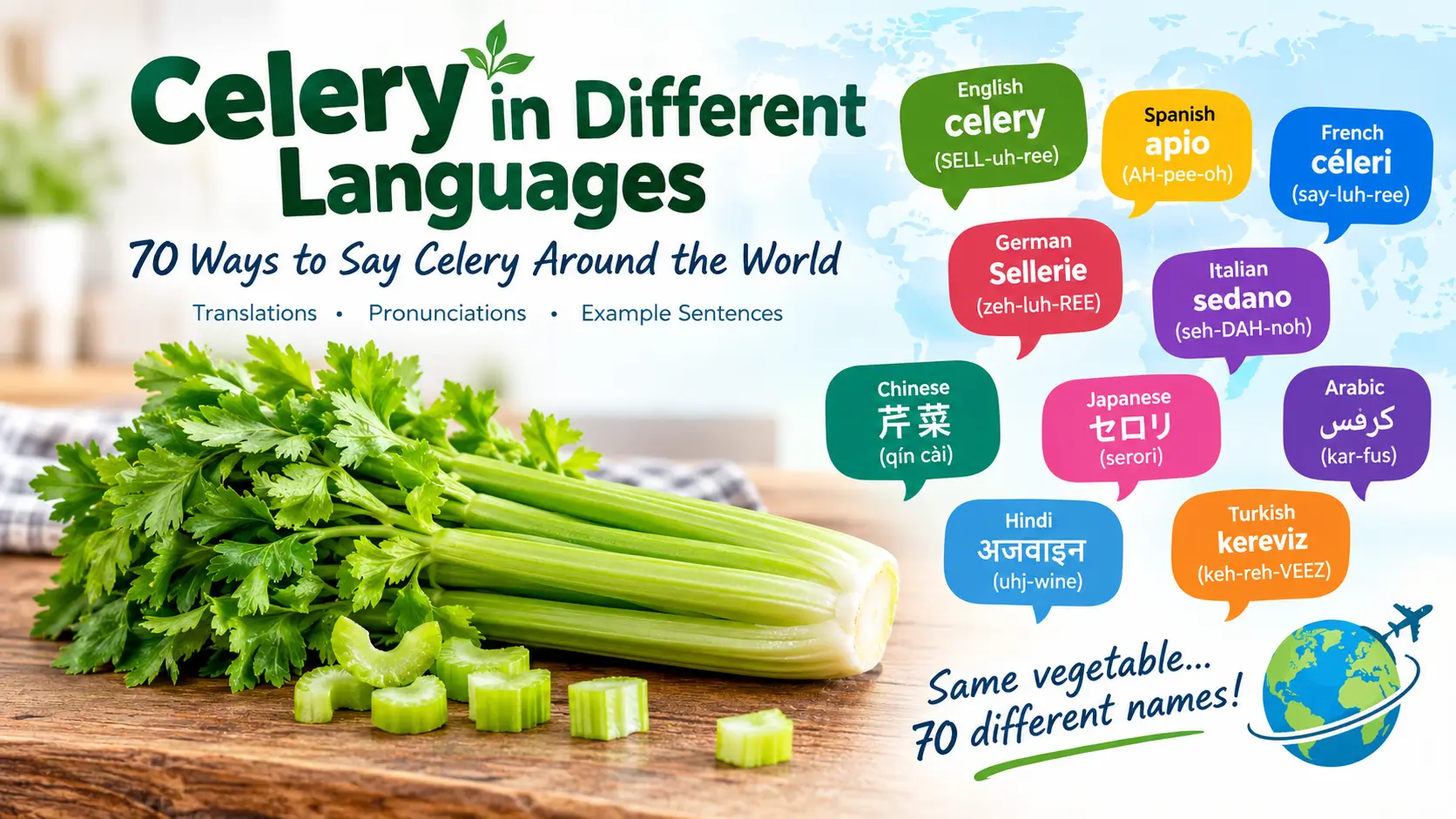
Have you ever wondered how to say celery in different languages? Celery is a familiar vegetable used in salads, soups, sauces, juices, and many traditional dishes. Learning its name in other languages is useful for travelers, language learners, food lovers, translators, and anyone interested in how everyday foods are described around the world.
In this guide, you will discover celery translations in 70 different languages, along with simple English pronunciations and practical example sentences. This makes it easy to understand how to say celery naturally in different parts of the world.
Celery in All Languages
The word celery generally refers to the crisp green plant commonly used as a vegetable and seasoning. While the pronunciation and spelling change considerably between languages, many European languages have related forms because of the word’s long history in European languages.
Here is a convenient list showing how to say celery in different languages:
| # | Language | Native phrase | Easy English pronunciation | Example sentence | English meaning |
|---|---|---|---|---|---|
| 1 | English | celery | SELL-uh-ree | I added celery to the soup. | I added celery to the soup. |
| 2 | Spanish | apio | AH-pee-oh | Compré apio para la ensalada. | I bought celery for the salad. |
| 3 | French | céleri | SAY-luh-ree | J’ai ajouté du céleri à la soupe. | I added celery to the soup. |
| 4 | German | Sellerie | zeh-luh-REE | Ich schneide Sellerie für die Suppe. | I am cutting celery for the soup. |
| 5 | Italian | sedano | seh-DAH-noh | Ho comprato del sedano fresco. | I bought fresh celery. |
| 6 | Portuguese | aipo | EYE-poh | Eu coloquei aipo na sopa. | I put celery in the soup. |
| 7 | Dutch | selderij | SELL-duh-ray | Ik voeg selderij toe aan de soep. | I am adding celery to the soup. |
| 8 | Swedish | selleri | SELL-uh-ree | Jag hackar selleri till salladen. | I am chopping celery for the salad. |
| 9 | Norwegian | selleri | SELL-uh-ree | Jeg kjøpte selleri i dag. | I bought celery today. |
| 10 | Danish | selleri | SELL-uh-ree | Jeg skærer selleri til salaten. | I am cutting celery for the salad. |
| 11 | Finnish | selleri | SELL-eh-ree | Lisäsin selleriä keittoon. | I added celery to the soup. |
| 12 | Icelandic | sellerí | SELL-eh-ree | Ég keypti sellerí í búðinni. | I bought celery at the store. |
| 13 | Irish | soilire | SILL-ih-ruh | Chuir mé soilire sa sailéad. | I put celery in the salad. |
| 14 | Scottish Gaelic | soilire | SILL-uh-ruh | Tha soilire anns an t-salad. | There is celery in the salad. |
| 15 | Welsh | seleri | seh-LEH-ree | Rwy’n ychwanegu seleri at y cawl. | I am adding celery to the soup. |
| 16 | Polish | seler | SEH-ler | Kupiłem świeży seler. | I bought fresh celery. |
| 17 | Czech | celer | TSEH-ler | Přidal jsem celer do polévky. | I added celery to the soup. |
| 18 | Slovak | zeler | ZEH-ler | Kúpil som čerstvý zeler. | I bought fresh celery. |
| 19 | Slovenian | zelena | zeh-LEH-nah | Dodal sem zeleno v juho. | I added celery to the soup. |
| 20 | Croatian | celer | TSEH-ler | Kupio sam svježi celer. | I bought fresh celery. |
| 21 | Serbian | celer / целер | TSEH-ler | Kupio sam svež celer. | I bought fresh celery. |
| 22 | Bosnian | celer | TSEH-ler | Dodao sam celer u supu. | I added celery to the soup. |
| 23 | Bulgarian | целина | tseh-LEE-nah | Добавих целина към супата. | I added celery to the soup. |
| 24 | Macedonian | целер | TSEH-ler | Додадов целер во супата. | I added celery to the soup. |
| 25 | Russian | сельдерей | sehl-deh-RYEY | Я добавил сельдерей в супу. | I added celery to the soup. |
| 26 | Ukrainian | селера | seh-LEH-rah | Я додав селеру до супу. | I added celery to the soup. |
| 27 | Belarusian | салера | sah-LEH-rah | Я дадаў салеру ў суп. | I added celery to the soup. |
| 28 | Lithuanian | salieras | sah-lee-EH-rahs | Į sriubą įdėjau salierų. | I added celery to the soup. |
| 29 | Latvian | selerija | seh-LEH-ree-yah | Es pievienoju seleriju zupai. | I am adding celery to the soup. |
| 30 | Estonian | seller | SELL-er | Lisasin supile sellerit. | I added celery to the soup. |
| 31 | Hungarian | zeller | ZEH-ler | Zellert tettem a levesbe. | I put celery in the soup. |
| 32 | Romanian | țelină | tseh-LEE-nuh | Am pus țelină în supă. | I put celery in the soup. |
| 33 | Albanian | selino | seh-LEE-noh | Shtova selino në supë. | I added celery to the soup. |
| 34 | Greek | σέλινο | SEH-lee-noh | Έβαλα σέλινο στη σούπα. | I put celery in the soup. |
| 35 | Turkish | kereviz | keh-reh-VEEZ | Çorbaya kereviz ekledim. | I added celery to the soup. |
| 36 | Azerbaijani | kərəviz | keh-reh-VEEZ | Şorbaya kərəviz əlavə etdim. | I added celery to the soup. |
| 37 | Armenian | նեխուր | neh-KHOOR | Ես նեխուր ավելացրի ապուրին։ | I added celery to the soup. |
| 38 | Georgian | ნიახური | nee-ah-KHOO-ree | სუპში ნიახური დავამატე. | I added celery to the soup. |
| 39 | Persian | کرفس | kar-FESS | من کرفس به سوپ اضافه کردم. | I added celery to the soup. |
| 40 | Arabic | كرفس | KAR-fus | أضفت الكرفس إلى الحساء. | I added celery to the soup. |
| 41 | Hebrew | סלרי | SEL-eh-ree | הוספתי סלרי למרק. | I added celery to the soup. |
| 42 | Hindi | अजवाइन | uhj-wine | मैंने सूप में अजवाइन डाली। | I added celery to the soup. |
| 43 | Urdu | اجوائن | uhj-WAIN | میں نے سوپ میں اجوائن ڈالی۔ | I added celery to the soup. |
| 44 | Bengali | সেলারি | seh-LAH-ree | আমি স্যুপে সেলারি দিয়েছি। | I added celery to the soup. |
| 45 | Punjabi | ਸੈਲਰੀ | seh-LER-ee | ਮੈਂ ਸੂਪ ਵਿੱਚ ਸੈਲਰੀ ਪਾਈ। | I added celery to the soup. |
| 46 | Gujarati | સેલરી | seh-LAIR-ee | મેં સૂપમાં સેલરી ઉમેરી. | I added celery to the soup. |
| 47 | Marathi | सेलरी | seh-LER-ee | मी सूपमध्ये सेलरी घातली. | I added celery to the soup. |
| 48 | Tamil | செலரி | seh-LAH-ree | நான் சூப்பில் செலரி சேர்த்தேன். | I added celery to the soup. |
| 49 | Telugu | సెలెరీ | seh-leh-REE | నేను సూప్లో సెలెరీ వేశాను. | I added celery to the soup. |
| 50 | Kannada | ಸೆಲರಿ | seh-LUH-ree | ನಾನು ಸೂಪ್ಗೆ ಸೆಲರಿ ಹಾಕಿದೆ. | I added celery to the soup. |
| 51 | Malayalam | സെലറി | seh-LAIR-ee | ഞാൻ സൂപ്പിൽ സെലറി ചേർത്തു. | I added celery to the soup. |
| 52 | Odia | ସେଲେରି | seh-LEH-ree | ମୁଁ ସୁପ୍ରେ ସେଲେରି ଦେଲି। | I added celery to the soup. |
| 53 | Chinese (Mandarin) | 芹菜 | qín cài | 我在汤里加了芹菜。 | I added celery to the soup. |
| 54 | Japanese | セロリ | serori | スープにセロリを入れました。 | I put celery in the soup. |
| 55 | Korean | 셀러리 | sell-reo-ri | 수프에 셀러리를 넣었어요. | I put celery in the soup. |
| 56 | Vietnamese | cần tây | kuhn tay | Tôi cho cần tây vào súp. | I put celery in the soup. |
| 57 | Thai | ขึ้นฉ่าย | kheun-chai | ฉันใส่ขึ้นฉ่ายในซุป | I put celery in the soup. |
| 58 | Indonesian | seledri | seh-LED-ree | Saya menambahkan seledri ke sup. | I added celery to the soup. |
| 59 | Malay | saderi | sah-DEH-ree | Saya menambah saderi ke dalam sup. | I added celery to the soup. |
| 60 | Filipino | kintsay | KEEN-tsigh | Naglagay ako ng kintsay sa sopas. | I put celery in the soup. |
| 61 | Swahili | seleri | seh-LEH-ree | Niliweka seleri kwenye supu. | I put celery in the soup. |
| 62 | Afrikaans | seldery | SELL-duh-ree | Ek voeg seldery by die sop. | I am adding celery to the soup. |
| 63 | Amharic | ሴሌሪ | seh-LEH-ree | ሴሌሪ ወደ ሾርባው ጨመርኩ። | I added celery to the soup. |
| 64 | Somali | seleri | seh-LEH-ree | Waxaan maraqa ku daray seleri. | I added celery to the soup. |
| 65 | Malagasy | seleria | seh-LEH-ree-ah | Nampiana seleria ny lasopy. | Celery was added to the soup. |
| 66 | Esperanto | celerio | tseh-LEH-ree-oh | Mi aldonis celerion al la supo. | I added celery to the soup. |
| 67 | Latin | apium | AH-pee-oom | Apium in pulmento posui. | I put celery in the soup. |
| 68 | Basque | apioa | ah-pee-OH-ah | Apioa zopari gehitu diot. | I added celery to the soup. |
| 69 | Catalan | api | ah-PEE | He afegit api a la sopa. | I added celery to the soup. |
| 70 | Galician | apio | AH-pee-oh | Engadín apio á sopa. | I added celery to the soup. |
What Is Celery?
Celery is a crunchy, aromatic plant commonly eaten as a vegetable. Its stalks are especially popular in salads, soups, stews, stir-fries, sauces, and snacks. The leaves and seeds can also be used for flavoring.
The plant belongs to the Apiaceae family, which also includes carrots, parsley, fennel, and coriander. Celery is valued for its fresh flavor and crisp texture.
Why Learn Celery Translations?
Knowing the word for celery in another language can be surprisingly practical.
If you are traveling, shopping for groceries, reading a foreign recipe, or communicating with someone from another country, knowing the local food vocabulary makes everyday conversations easier.
For language learners, food words are also useful because they appear frequently in menus, recipes, supermarkets, cooking instructions, and casual conversations.
How to Say Celery in Different Languages
The translation of celery varies significantly across language families.
For example, Spanish uses apio, Italian uses sedano, Turkish uses kereviz, Chinese uses 芹菜, and Japanese uses セロリ. Several European languages use forms that are historically related, while other languages have completely different words.
When learning a new language, it is helpful to learn the native spelling together with a simple pronunciation guide. This lets you recognize the word when reading it and use it when speaking.
Celery Around the World
Celery is used in many different cuisines around the world.
In European cooking, it is commonly used as a base ingredient for soups, sauces, stews, and vegetable dishes. In Asian cuisines, celery may appear in stir-fries, soups, noodle dishes, and other savory recipes.
In many countries, celery is also eaten raw. Its crunchy stalks can be served with dips, added to salads, or blended into drinks.
Although the cooking traditions differ, celery remains a useful ingredient because its mild, fresh flavor works well with many other foods.
Celery Vocabulary for Travelers
If you are visiting a foreign country, knowing the local word for celery can help when buying ingredients or ordering food.
You may see the word on:
- Grocery store labels
- Restaurant menus
- Food packaging
- Farmers’ market signs
- Recipe books
- Cooking websites
- Ingredient lists
Learning the word in advance can also be helpful if you are discussing ingredients with a local cook or asking whether a particular dish contains celery.
Are Celery and Celery Root the Same?
Celery and celery root come from closely related forms of the same plant, but they are used differently.
Celery is generally grown for its crisp stalks and leaves. Celery root, also called celeriac, is cultivated mainly for its large underground stem and has a different appearance and culinary use.
Because some languages use related words for celery and celeriac, context can sometimes be important when translating recipes or shopping for ingredients.
Celery in All Languages: Quick Learning Tips
The easiest way to remember food vocabulary is to connect each word with something familiar.
Try these methods:
- Read the native spelling aloud. This helps connect the written word with its sound.
- Use the word in a sentence. A practical sentence is easier to remember than an isolated vocabulary item.
- Group related languages together. Similar words can help you recognize patterns.
- Practice while cooking. Say the word when you see or use celery.
- Review regularly. Short, repeated practice is more effective than memorizing a long list once.
Common Uses of Celery
Celery is a versatile ingredient and can be used in many everyday dishes.
Soups and Stews
Chopped celery is frequently cooked with onions, carrots, and other vegetables to create a flavorful base for soups and stews.
Salads
Raw celery adds a crisp texture to green salads, chicken salads, pasta salads, and other cold dishes.
Snacks
Celery sticks can be eaten raw with dips, spreads, or other toppings.
Juices and Smoothies
Celery is also used in fresh vegetable juices and blended drinks.
Seasoning
Celery leaves and celery seeds can add aroma and flavor to different dishes.
Frequently Asked Questions
1. What is celery called in Spanish?
Celery is called apio in Spanish. It is commonly used in soups, salads, sauces, and other dishes.
2. How do you say celery in different languages?
The word changes from language to language. Some examples include apio in Spanish, sedano in Italian, céleri in French, kereviz in Turkish, 芹菜 in Mandarin Chinese, and セロリ in Japanese.
3. What is celery called in Hindi and Urdu?
In Hindi, celery is commonly referred to as अजवाइन, while in Urdu it is commonly written as اجوائن. However, regional usage can vary, and these terms may also refer to related aromatic seeds or herbs in South Asian contexts.
4. What is celery called in Chinese?
Celery is called 芹菜 in Mandarin Chinese. The term is widely used for the common celery vegetable.
5. Why are celery names similar in some languages?
Many European celery words have historical connections and developed from older terms used for the plant. As languages evolved and borrowed vocabulary from one another, related forms appeared in several modern languages.
Conclusion
Learning celery in different languages is a simple way to expand your food and travel vocabulary. From apio in Spanish and sedano in Italian to 芹菜 in Chinese and セロリ in Japanese, the names of this familiar vegetable reveal interesting differences between languages and cultures.
Whether you are studying languages, reading international recipes, traveling, or simply curious about celery around the world, this 70-language guide gives you a practical starting point for learning celery translations.

I am Ava Jones, a language enthusiast and author passionate about exploring different languages, sharing useful phrases, explaining meanings, and helping readers communicate confidently across cultures and countries.