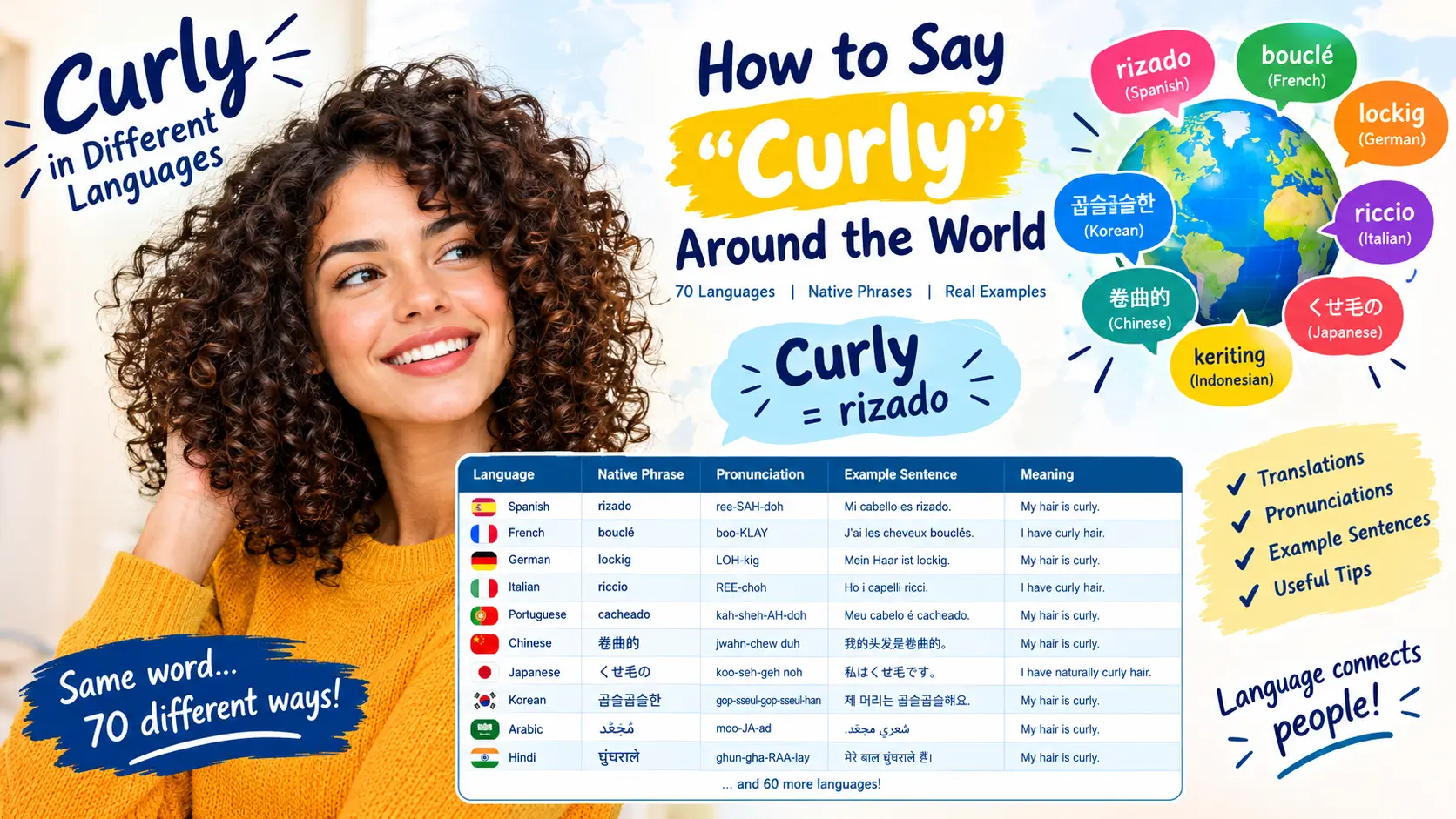
Looking for “curly” in different languages? The word “curly” is commonly used to describe hair, fur, or something that forms curls, loops, or rounded shapes. Learning how to say it in another language can be useful when talking about hairstyles, describing someone’s appearance, shopping for hair products, or simply expanding your vocabulary.
In this guide, you’ll find curly translations in 70 different languages, including the native expression, an easy English pronunciation, and a short example sentence. Because adjectives can change according to gender, number, or grammatical context in some languages, the examples below use natural forms where appropriate.
Curly in All Languages
The following table answers the common search query “how to say curly in different languages” and provides practical examples for everyday use.
| # | Language | Native Phrase | Easy English Pronunciation | Example Sentence | English Meaning |
|---|---|---|---|---|---|
| 1 | Spanish | rizado | ree-SAH-doh | Mi cabello es rizado. | My hair is curly. |
| 2 | French | bouclé | boo-KLAY | J’ai les cheveux bouclés. | I have curly hair. |
| 3 | German | lockig | LOH-kig | Mein Haar ist lockig. | My hair is curly. |
| 4 | Italian | riccio | REE-choh | Ho i capelli ricci. | I have curly hair. |
| 5 | Portuguese | cacheado | kah-sheh-AH-doh | Meu cabelo é cacheado. | My hair is curly. |
| 6 | Dutch | krullend | KRUH-lent | Mijn haar is krullend. | My hair is curly. |
| 7 | Swedish | lockig | LOH-kig | Mitt hår är lockigt. | My hair is curly. |
| 8 | Norwegian | krøllete | KRUHL-leh-teh | Håret mitt er krøllete. | My hair is curly. |
| 9 | Danish | krøllet | KRUHL-et | Mit hår er krøllet. | My hair is curly. |
| 10 | Finnish | kihara | KEE-hah-rah | Hiukseni ovat kiharat. | My hair is curly. |
| 11 | Icelandic | krullaður | KRUH-lah-thur | Hárið mitt er krullað. | My hair is curly. |
| 12 | Irish | cuachach | KOO-uh-kh | Tá mo chuid gruaige cuachach. | My hair is curly. |
| 13 | Welsh | cyrliog | kur-lee-og | Mae fy ngwallt yn gyrliog. | My hair is curly. |
| 14 | Scottish Gaelic | dualach | DOO-uh-lakh | Tha m’ fhalt dualach. | My hair is curly. |
| 15 | Polish | kręcony | kren-TSAW-nih | Mam kręcone włosy. | I have curly hair. |
| 16 | Czech | kudrnatý | KOODR-nah-tee | Mám kudrnaté vlasy. | I have curly hair. |
| 17 | Slovak | kučeravý | KOO-cheh-rah-vee | Mám kučeravé vlasy. | I have curly hair. |
| 18 | Slovenian | kodrast | KOH-drast | Imam kodraste lase. | I have curly hair. |
| 19 | Croatian | kovrčav | KOH-vr-chav | Imam kovrčavu kosu. | I have curly hair. |
| 20 | Serbian | коврџав | KOVR-dzhav | Имам коврџаву косу. | I have curly hair. |
| 21 | Bulgarian | къдрав | KAH-drav | Имам къдрава коса. | I have curly hair. |
| 22 | Macedonian | кадрав | KAH-drav | Имам кадрава коса. | I have curly hair. |
| 23 | Russian | кудрявый | koo-DRYAH-vy | У меня кудрявые волосы. | I have curly hair. |
| 24 | Ukrainian | кучерявий | koo-cheh-RYAH-vy | У мене кучеряве волосся. | I have curly hair. |
| 25 | Belarusian | кучаравы | koo-cha-RAH-vy | У мяне кучаравыя валасы. | I have curly hair. |
| 26 | Lithuanian | garbanotas | gar-bah-NOH-tas | Mano plaukai garbanoti. | My hair is curly. |
| 27 | Latvian | cirtains | TSEER-tahyns | Mani mati ir cirtaini. | My hair is curly. |
| 28 | Estonian | lokkis | LOK-kis | Mu juuksed on lokkis. | My hair is curly. |
| 29 | Hungarian | göndör | GUHN-dohr | Göndör a hajam. | My hair is curly. |
| 30 | Romanian | creț | krets | Am părul creț. | I have curly hair. |
| 31 | Albanian | kaçurrel | kah-choo-RELL | Kam flokë kaçurrelë. | I have curly hair. |
| 32 | Greek | σγουρός | sgoo-ROSS | Έχω σγουρά μαλλιά. | I have curly hair. |
| 33 | Turkish | kıvırcık | kuh-vuhr-JUK | Saçlarım kıvırcık. | My hair is curly. |
| 34 | Maltese | kaboċċa | kah-BOTCH-ah | Xagħri huwa kaboċċa. | My hair is curly. |
| 35 | Arabic | مُجَعَّد | moo-JA-ad | شعري مجعّد. | My hair is curly. |
| 36 | Hebrew | מתולתל | meh-too-LA-tal | השיער שלי מתולתל. | My hair is curly. |
| 37 | Persian | فرفری | far-far-EE | موهای من فرفری است. | My hair is curly. |
| 38 | Urdu | گھنگریالے | ghung-gree-YAA-lay | میرے بال گھنگریالے ہیں۔ | My hair is curly. |
| 39 | Hindi | घुंघराले | ghun-gha-RAA-lay | मेरे बाल घुंघराले हैं। | My hair is curly. |
| 40 | Bengali | কোঁকড়ানো | kon-krah-NOH | আমার চুল কোঁকড়ানো। | My hair is curly. |
| 41 | Punjabi | ਘੁੰਗਰਾਲੇ | ghung-graa-LAY | ਮੇਰੇ ਵਾਲ ਘੁੰਗਰਾਲੇ ਹਨ। | My hair is curly. |
| 42 | Gujarati | વાંકડિયા | vaan-ka-DI-yaa | મારા વાળ વાંકડિયા છે. | My hair is curly. |
| 43 | Marathi | कुरळे | koo-RAH-lay | माझे केस कुरळे आहेत. | My hair is curly. |
| 44 | Nepali | घुँघरालो | ghun-ghaa-RAH-lo | मेरो कपाल घुँघरालो छ। | My hair is curly. |
| 45 | Sinhala | රැලි සහිත | rae-lee sa-hee-tha | මගේ කොණ්ඩය රැලි සහිතයි. | My hair is curly. |
| 46 | Tamil | சுருள் | soo-RUL | என் முடி சுருளாக உள்ளது. | My hair is curly. |
| 47 | Telugu | గిరజాల | gee-ra-JAA-la | నా జుట్టు గిరజాలగా ఉంది. | My hair is curly. |
| 48 | Kannada | ಗುಂಗುರು | goon-GOO-roo | ನನ್ನ ಕೂದಲು ಗುಂಗುರು. | My hair is curly. |
| 49 | Malayalam | ചുരുണ്ട | choo-RUN-da | എന്റെ മുടി ചുരുണ്ടതാണ്. | My hair is curly. |
| 50 | Thai | หยิก | yik | ผมของฉันหยิก | My hair is curly. |
| 51 | Lao | ຜົມຫຍິກ | phom yik | ຜົມຂອງຂ້ອຍຫຍິກ. | My hair is curly. |
| 52 | Khmer | រួញ | ru-ŏn | សក់ខ្ញុំរួញ។ | My hair is curly. |
| 53 | Vietnamese | xoăn | swahn | Tóc tôi xoăn. | My hair is curly. |
| 54 | Indonesian | keriting | keh-RI-ting | Rambut saya keriting. | My hair is curly. |
| 55 | Malay | keriting | keh-RI-ting | Rambut saya keriting. | My hair is curly. |
| 56 | Filipino | kulot | koo-LOT | Kulot ang buhok ko. | My hair is curly. |
| 57 | Javanese | kriting | KREE-ting | Rambutku kriting. | My hair is curly. |
| 58 | Chinese (Mandarin) | 卷曲的 | jwahn-chew duh | 我的头发是卷曲的。 | My hair is curly. |
| 59 | Japanese | くせ毛の | koo-seh-geh noh | 私はくせ毛です。 | I have naturally curly hair. |
| 60 | Korean | 곱슬곱슬한 | gop-sseul-gop-sseul-han | 제 머리는 곱슬곱슬해요. | My hair is curly. |
| 61 | Mongolian | буржгар | boorj-GAR | Миний үс буржгар. | My hair is curly. |
| 62 | Georgian | ხვეული | khveh-OO-lee | ჩემი თმა ხვეულია. | My hair is curly. |
| 63 | Armenian | գանգուր | gang-GOOR | Մազերս գանգուր են։ | My hair is curly. |
| 64 | Azerbaijani | buruq | boo-ROOK | Saçım buruqdur. | My hair is curly. |
| 65 | Kazakh | бұйра | boo-YRAH | Менің шашым бұйра. | My hair is curly. |
| 66 | Uzbek | jingalak | jeen-gah-LAK | Sochim jingalak. | My hair is curly. |
| 67 | Swahili | ya kujipinda | yah koo-jee-PIN-dah | Nywele zangu ni za kujipinda. | My hair is curly. |
| 68 | Zulu | okugoqene | oh-go-go-NEH | Izinwele zami zigobile. | My hair is curly. |
| 69 | Afrikaans | krullerig | KRUH-leh-rikh | My hare is krullerig. | My hair is curly. |
| 70 | Haitian Creole | boukle | BOO-kleh | Cheve mwen boukle. | My hair is curly. |
What Does “Curly” Mean?
“Curly” is an adjective used to describe something that forms curls, loops, or rounded bends. It is most often associated with curly hair, but it can also describe fur, ribbons, decorative designs, or other objects with a curled shape.
For example:
- Curly hair describes hair that naturally forms curls.
- Curly fur describes animal fur with a curled texture.
- A curly ribbon describes a ribbon formed into curls.
- Curly lines describes lines that bend or spiral.
The exact translation can change depending on what is being described.
How to Say “Curly” in Different Languages for Hair
When talking about hair, many languages use an adjective that agrees with the noun or changes according to grammatical gender or number. In everyday conversation, you may therefore encounter a slightly different form from the basic dictionary form.
For example, Spanish uses forms such as rizado and rizada, while French commonly uses bouclé or bouclée depending on the grammatical context. Similar changes occur in several European languages.
If your goal is to describe someone’s hairstyle, it is best to learn the complete phrase rather than memorizing the adjective alone.
Curly Hair Around the World
Curly hair is described in many different ways around the world. Some languages use a word closely related to “curl,” while others use expressions that describe hair as twisted, wavy, looped, or coiled.
This makes curly around the world an interesting example of how languages categorize physical characteristics differently. Even when two languages use completely different words, the everyday meaning can remain easy to understand from context.
Curly Translations for Everyday Conversations
If you are traveling or speaking with someone in another language, the phrase “curly hair” is often more useful than the isolated word “curly.”
You might use it when:
- Describing your hairstyle
- Identifying someone
- Talking about a haircut
- Shopping for hair-care products
- Discussing natural hair texture
- Giving directions to a stylist
- Complimenting someone’s appearance
Learning the complete phrase helps you communicate more naturally than relying on a single translated adjective.
Why Learn “Curly” in Different Languages?
Learning one descriptive word in several languages can improve vocabulary and cultural understanding. It can also help language learners recognize related words when reading or listening.
The word curly is especially practical because hair and appearance are common topics in casual conversation. Knowing the appropriate translation can make descriptions clearer and more natural.
Tips for Using Curly Translations Correctly
When using a translation for “curly,” keep these points in mind:
- Check the context. Curly hair and a curly line may require different expressions.
- Watch grammatical agreement. Some languages change adjectives based on gender or number.
- Learn complete phrases. “My hair is curly” may be more useful than the isolated adjective.
- Consider natural usage. A dictionary translation may not always be the phrase native speakers use most often.
- Pay attention to pronunciation. Similar-looking words can sound very different across languages.
Frequently Asked Questions About Curly in Different Languages
1. How do you say “curly” in Spanish?
“Curly” is commonly translated as rizado in Spanish. When describing hair, you can use a sentence such as “Mi cabello es rizado,” meaning “My hair is curly.”
2. What is the word for “curly” in French?
The common French adjective is bouclé, with forms changing according to grammatical context. For hair, French commonly uses expressions involving “cheveux bouclés.”
3. How do you say “curly hair” in different languages?
“Curly hair” has different forms across languages. Examples include capelli ricci in Italian, pelo rizado in Spanish, cacheado expressions in Portuguese, and 곱슬머리 in Korean.
4. Is “curly” the same as “wavy” in every language?
No. Curly and wavy usually describe different hair textures. Some languages distinguish these textures with separate words, while the exact distinction and everyday usage can vary by language and region.
5. Why can the translation of “curly” change in the same language?
In many languages, adjectives change according to grammatical gender, number, or the noun they describe. Context can also affect whether a word refers to curly hair, curled objects, or another type of curved shape.
Conclusion
Learning curly in different languages is a simple way to expand your vocabulary and communicate more naturally when describing hair, fur, shapes, and textures. The 70 translations above show how one familiar English adjective can have many different forms around the world.
For practical communication, focus not only on the individual translation but also on the complete phrase used by native speakers. This makes it easier to describe curly hair and related features accurately in everyday conversations.
I am Ricardo Hunter, Administrator at LingoBuz, passionate about languages, translations, and global communication. I help create useful, clear content that makes exploring different languages simple, enjoyable, and accessible.