A cupcake is a small, individually sized cake that is usually baked in a paper liner and decorated with frosting, cream, sprinkles, fruit, or other toppings. Because cupcakes are popular in bakeries, cafés, parties, birthdays, and celebrations worldwide, knowing how to say cupcake in different languages can be useful for travelers, language learners, food lovers, and anyone interested in international vocabulary.
In many languages, the English word “cupcake” is borrowed directly or adapted slightly to fit local pronunciation. Other languages use a descriptive expression meaning something like “small cake” or “cake in a cup.”
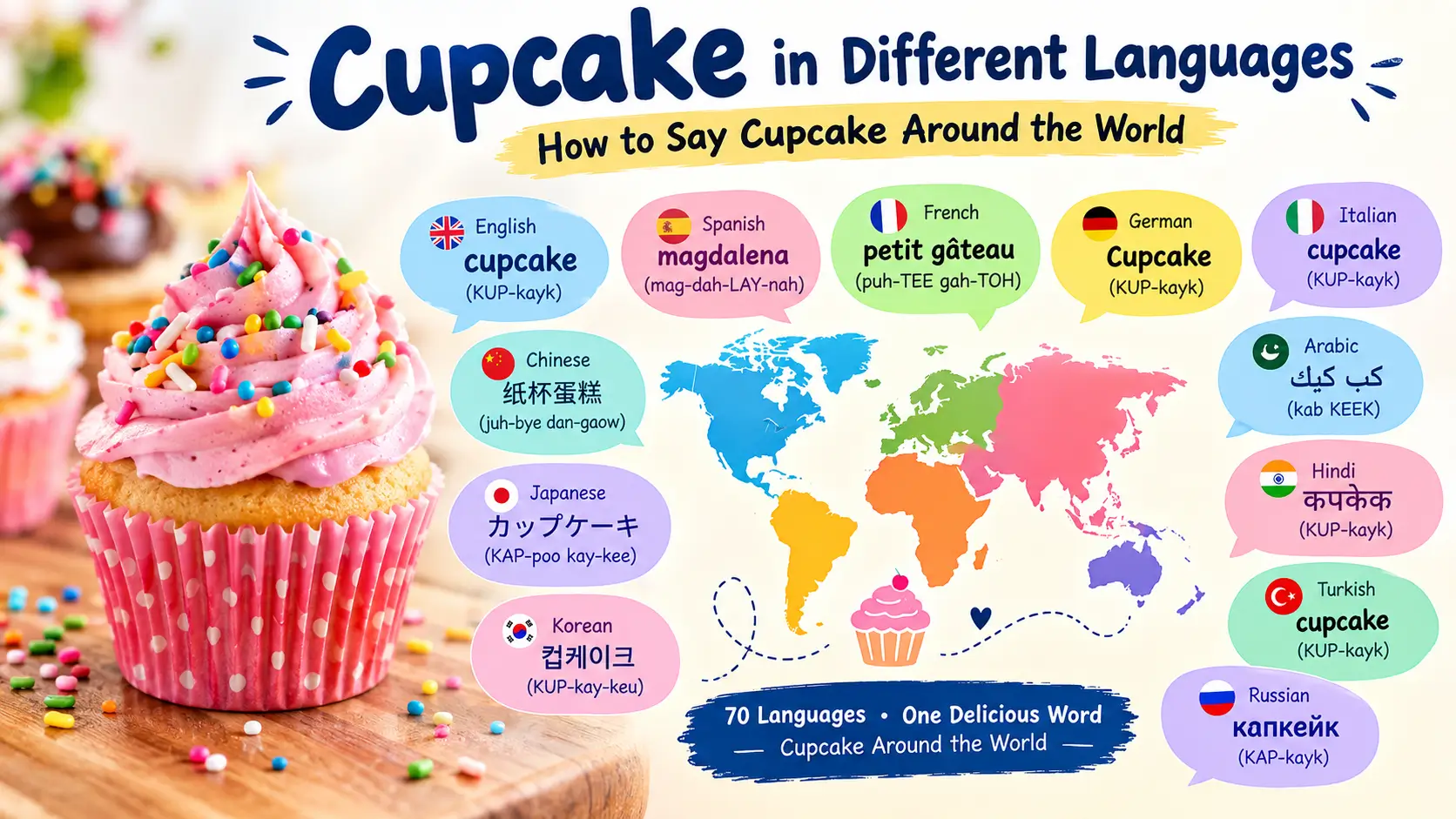
Below, you will find cupcake in all languages in one easy-to-read table. Each entry includes the native term, a simple English pronunciation, and a short example sentence with its English meaning.
Cupcake in Different Languages: 70 Translations
| # | Language | Native phrase | Easy English pronunciation | Example sentence | English meaning |
|---|---|---|---|---|---|
| 1 | English | cupcake | KUP-kayk | I baked a cupcake today. | I baked a cupcake today. |
| 2 | Spanish | magdalena | mag-dah-LAY-nah | Compré una magdalena. | I bought a cupcake. |
| 3 | French | petit gâteau | puh-TEE gah-TOH | J’aime ce petit gâteau. | I like this cupcake. |
| 4 | German | Cupcake | KUP-kayk | Ich esse einen Cupcake. | I am eating a cupcake. |
| 5 | Italian | cupcake | KUP-kayk | Ho mangiato un cupcake. | I ate a cupcake. |
| 6 | Portuguese | cupcake | KUP-kayk | Eu quero um cupcake. | I want a cupcake. |
| 7 | Dutch | cupcake | KUP-kayk | Ik heb een cupcake gebakken. | I baked a cupcake. |
| 8 | Swedish | cupcake | KUP-kayk | Jag åt en cupcake. | I ate a cupcake. |
| 9 | Norwegian | cupcake | KUP-kayk | Jeg kjøpte en cupcake. | I bought a cupcake. |
| 10 | Danish | cupcake | KUP-kayk | Jeg spiste en cupcake. | I ate a cupcake. |
| 11 | Finnish | kuppikakku | KOOP-pee-kak-koo | Söin kuppikakun. | I ate a cupcake. |
| 12 | Icelandic | bollakaka | BOT-la-ka-ka | Ég bakaði bollaköku. | I baked a cupcake. |
| 13 | Irish | cupcake | KUP-kayk | Fuair mé cupcake. | I got a cupcake. |
| 14 | Welsh | cacen gwpan | KAK-en GWO-pan | Dw i eisiau cacen gwpan. | I want a cupcake. |
| 15 | Scottish Gaelic | cèic chupa | kayk KHOO-pa | Tha cèic chupa agam. | I have a cupcake. |
| 16 | Catalan | magdalena | mag-dah-LAY-nah | He comprat una magdalena. | I bought a cupcake. |
| 17 | Galician | madalena | ma-da-LAY-na | Comín unha madalena. | I ate a cupcake. |
| 18 | Basque | cupcake | KUP-kayk | Cupcake bat jan dut. | I ate a cupcake. |
| 19 | Romanian | brioșă | bree-OH-shuh | Am cumpărat o brioșă. | I bought a cupcake. |
| 20 | Hungarian | cupcake | KUP-kayk | Ettem egy cupcake-et. | I ate a cupcake. |
| 21 | Polish | babeczka | ba-BETCH-ka | Zjadłem babeczkę. | I ate a cupcake. |
| 22 | Czech | cupcake | KUP-kayk | Dal jsem si cupcake. | I had a cupcake. |
| 23 | Slovak | cupcake | KUP-kayk | Dal som si cupcake. | I had a cupcake. |
| 24 | Slovenian | tortica | tor-TEE-tsa | Pojedla sem tortico. | I ate a small cake. |
| 25 | Croatian | cupcake | KUP-kayk | Kupila sam cupcake. | I bought a cupcake. |
| 26 | Serbian | kolačić | ko-LA-chitch | Pojeo sam kolačić. | I ate a small cake. |
| 27 | Bosnian | cupcake | KUP-kayk | Kupio sam cupcake. | I bought a cupcake. |
| 28 | Bulgarian | къпкейк | KUP-kayk | Купих къпкейк. | I bought a cupcake. |
| 29 | Macedonian | кејкче | KAYK-cheh | Јадев кејкче. | I ate a small cake. |
| 30 | Russian | капкейк | KAP-kayk | Я купил капкейк. | I bought a cupcake. |
| 31 | Ukrainian | капкейк | KAP-kayk | Я купив капкейк. | I bought a cupcake. |
| 32 | Belarusian | капкейк | KAP-kayk | Я купіў капкейк. | I bought a cupcake. |
| 33 | Lithuanian | keksiukas | kek-SEE-oo-kas | Aš valgiau keksiuką. | I ate a cupcake. |
| 34 | Latvian | kēkss | KAYKS | Es apēdu kēksu. | I ate a cupcake. |
| 35 | Estonian | tassikook | TAS-see-kook | Ma sõin tassikooki. | I ate a cupcake. |
| 36 | Greek | κεκάκι | keh-KAH-kee | Έφαγα ένα κεκάκι. | I ate a cupcake. |
| 37 | Albanian | kek i vogël | kek ee VO-gul | Hëngra një kek të vogël. | I ate a small cake. |
| 38 | Turkish | cupcake | KUP-kayk | Bir cupcake aldım. | I bought a cupcake. |
| 39 | Azerbaijani | kapkeyk | kap-KAYK | Mən kapkeyk aldım. | I bought a cupcake. |
| 40 | Armenian | քափքեյք | kap-KAYK | Ես քափքեյք կերա։ | I ate a cupcake. |
| 41 | Georgian | კაპქეიქი | kap-KAY-kee | კაპქეიქი ვიყიდე. | I bought a cupcake. |
| 42 | Arabic | كَب كيك | kab KEEK | أكلت كَب كيك. | I ate a cupcake. |
| 43 | Hebrew | קאפקייק | KAP-kayk | אכלתי קאפקייק. | I ate a cupcake. |
| 44 | Persian | کاپکیک | kaap-KEEK | من یک کاپکیک خوردم. | I ate a cupcake. |
| 45 | Urdu | کپ کیک | KUP-kayk | میں نے کپ کیک کھایا۔ | I ate a cupcake. |
| 46 | Hindi | कपकेक | KUP-kayk | मैंने कपकेक खाया। | I ate a cupcake. |
| 47 | Bengali | কাপকেক | KAP-kek | আমি একটি কাপকেক খেয়েছি। | I ate a cupcake. |
| 48 | Punjabi | ਕੱਪਕੇਕ | KUP-kayk | ਮੈਂ ਕੱਪਕੇਕ ਖਾਧਾ। | I ate a cupcake. |
| 49 | Gujarati | કપકેક | KUP-kayk | મેં કપકેક ખાધો. | I ate a cupcake. |
| 50 | Marathi | कपकेक | KUP-kayk | मी कपकेक खाल्ला. | I ate a cupcake. |
| 51 | Tamil | கப்கேக் | KUP-kayk | நான் கப்கேக் சாப்பிட்டேன். | I ate a cupcake. |
| 52 | Telugu | కప్కేక్ | KUP-kayk | నేను కప్కేక్ తిన్నాను. | I ate a cupcake. |
| 53 | Kannada | ಕಪ್ಕೇಕ್ | KUP-kayk | ನಾನು ಕಪ್ಕೇಕ್ ತಿಂದೆ. | I ate a cupcake. |
| 54 | Malayalam | കപ്പ്കേക്ക് | KUP-kayk | ഞാൻ കപ്പ്കേക്ക് കഴിച്ചു. | I ate a cupcake. |
| 55 | Sinhala | කප්කේක් | KUP-kayk | මම කප්කේක් කෑවා. | I ate a cupcake. |
| 56 | Nepali | कपकेक | KUP-kayk | मैले कपकेक खाएँ। | I ate a cupcake. |
| 57 | Chinese (Mandarin) | 纸杯蛋糕 | juh-bye dan-gaow | 我吃了一个纸杯蛋糕。 | I ate a cupcake. |
| 58 | Japanese | カップケーキ | KAP-poo kay-kee | カップケーキを食べました。 | I ate a cupcake. |
| 59 | Korean | 컵케이크 | KUP-kay-keu | 컵케이크를 먹었어요. | I ate a cupcake. |
| 60 | Vietnamese | bánh cupcake | ban KUP-kayk | Tôi ăn một chiếc bánh cupcake. | I ate a cupcake. |
| 61 | Thai | คัพเค้ก | KAP-kayk | ฉันกินคัพเค้ก | I ate a cupcake. |
| 62 | Indonesian | cupcake | KUP-kayk | Saya membeli cupcake. | I bought a cupcake. |
| 63 | Malay | kek cawan | kek CHA-wan | Saya makan kek cawan. | I ate a cupcake. |
| 64 | Filipino | cupcake | KUP-kayk | Kumain ako ng cupcake. | I ate a cupcake. |
| 65 | Swahili | keki ndogo | KEH-kee NDO-go | Nilikula keki ndogo. | I ate a small cake. |
| 66 | Afrikaans | kolwyntjie | kol-VAYN-kee | Ek het ‘n kolwyntjie geëet. | I ate a cupcake. |
| 67 | Amharic | ካፕኬክ | KAP-kayk | ካፕኬክ በላሁ። | I ate a cupcake. |
| 68 | Haitian Creole | cupcake | KUP-kayk | Mwen manje yon cupcake. | I am eating a cupcake. |
| 69 | Esperanto | kuketo | koo-KEH-toh | Mi manĝis kuketon. | I ate a small cake. |
| 70 | Latin | placenta parva | pla-KEN-ta PAR-va | Placenta parva mihi placet. | I like the small cake. |
How to Say Cupcake in Different Languages
The easiest way to learn how to say cupcake in different languages is to notice the patterns between languages.
In several European and Asian languages, “cupcake” is used as a borrowed English word. This is especially common in places where international bakery culture has made the English term familiar.
Other languages translate the concept more literally. For example, Finnish uses kuppikakku, while Malay uses kek cawan. These expressions describe the idea of a small cake associated with a cup or individual serving.
Some languages also use words for muffins, small cakes, or pastries depending on local culinary traditions. Because these foods are not always exactly identical, context matters when choosing a translation.
Cupcake Translations Around the World
Cupcakes are now common at birthday parties, weddings, cafés, school events, office celebrations, and family gatherings. Their small size makes them convenient to serve, while frosting and decorations make them easy to customize.
The word can therefore appear differently from one region to another. In some languages, the English spelling remains recognizable. In others, the word is written using a different alphabet or translated into a descriptive local expression.
For language learners, learning both the native phrase and its pronunciation is useful. It makes it easier to recognize the word when reading a menu and use it naturally when speaking.
Popular Ways to Use the Word Cupcake
The word “cupcake” can appear in many everyday sentences. Here are a few useful examples:
- I would like a chocolate cupcake.
- She made cupcakes for the party.
- Which cupcake do you want?
- This cupcake has vanilla frosting.
- I bought six cupcakes from the bakery.
- The children decorated their own cupcakes.
- Would you like another cupcake?
- These cupcakes are freshly baked.
These simple sentences can help you practice cupcake translations in context rather than memorizing a word by itself.
Cupcake Vocabulary for Travelers and Food Lovers
If you are traveling internationally, bakery vocabulary can be surprisingly useful. A cupcake may appear on a café menu under a local translation, an English loanword, or a word describing a similar small cake.
When ordering, you can combine the word for cupcake with useful terms such as:
- chocolate cupcake
- vanilla cupcake
- strawberry cupcake
- birthday cupcake
- red velvet cupcake
- mini cupcake
- chocolate frosting
- vanilla frosting
- freshly baked cupcake
Learning these combinations gives you more practical vocabulary than learning the translation of “cupcake” alone.
Cupcake in All Languages: What to Remember
There is not always a single perfect one-to-one translation for food words. Culinary traditions differ, and a local word may describe a food that is similar to a cupcake rather than completely identical.
For that reason, the table above includes commonly used translations, loanwords, and descriptive equivalents. When communicating in a particular country, local usage and context can help determine which expression sounds most natural.
The most important point is that cupcake around the world often retains a connection to the English word, especially in modern bakery and café settings.
Why Food Words Change Between Languages
Food vocabulary frequently crosses linguistic boundaries. Popular foods can spread internationally through restaurants, tourism, media, trade, and cultural exchange.
When a new food becomes popular, a language may borrow its original name. Alternatively, speakers may create a native word based on the appearance, ingredients, preparation method, or serving style of the food.
That is why the translations for cupcake range from direct adaptations such as “cupcake” and “kapkeyk” to descriptive expressions such as “kuppikakku” and “kek cawan.”
Frequently Asked Questions About Cupcake in Different Languages
1. How do you say cupcake in different languages?
The word “cupcake” is translated or adapted differently around the world. Examples include cupcake in Italian and German, magdalena in Spanish, kuppikakku in Finnish, babeczka in Polish, 纸杯蛋糕 in Mandarin Chinese, and 컵케이크 in Korean.
2. What is cupcake called in Spanish?
A commonly used Spanish word for a small cake or cupcake is magdalena. Depending on the country and exact type of baked good, other terms may also be used.
3. What is cupcake called in French?
In French, petit gâteau literally means “small cake” and can describe a small cake. In modern French-speaking settings, the English word “cupcake” is also commonly recognized.
4. What is cupcake called in Hindi and Urdu?
In Hindi, cupcake is commonly written as कपकेक, while in Urdu it is written کپ کیک. Both forms closely follow the English word.
5. Why do some languages use the English word cupcake?
“Cupcake” has become an international bakery term. When foods spread across countries, languages often borrow the original name rather than creating a completely new word. This is why the English-derived term appears in many languages.
Conclusion
Learning cupcake in different languages is a simple and enjoyable way to explore how food vocabulary travels across cultures. Some languages borrow the English word, while others use expressions meaning small cake, cup cake, or a similar baked treat.
Whether you are learning languages, traveling, writing multilingual content, or simply curious about cupcake in all languages, these 70 translations provide a useful starting point for understanding how this popular dessert is expressed around the world.

I am Scarlett Wilson, a passionate language writer who loves exploring different languages, words, meanings, translations, and useful phrases. I enjoy making language learning simple, clear, and interesting for everyone.