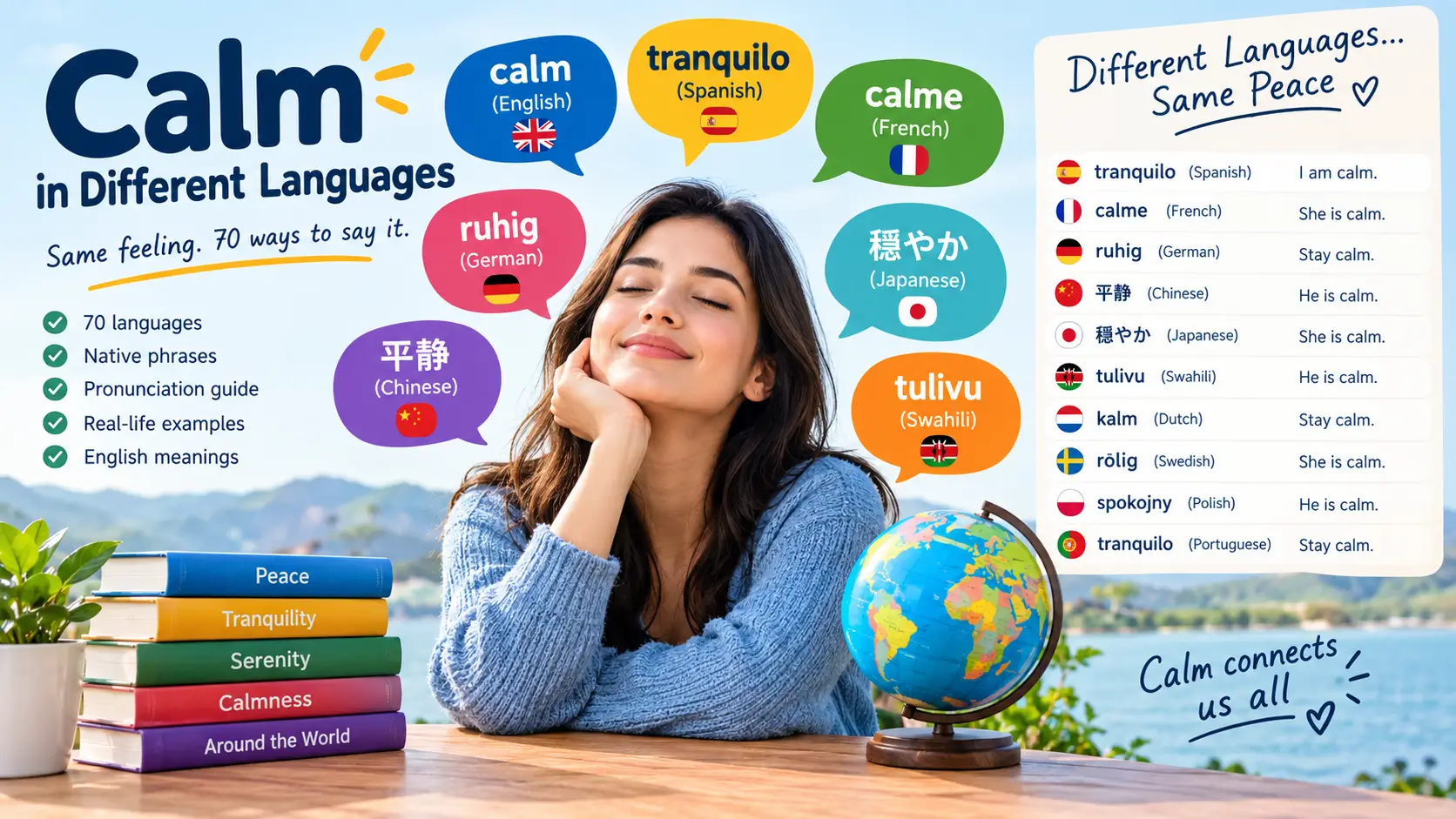
The word “calm” describes a peaceful, quiet, and relaxed state without stress, anger, or excitement. Learning how to say calm in different languages is useful for travelers, language learners, writers, students, and anyone interested in how emotions and everyday ideas are expressed around the world.
Because languages can use different grammatical forms, the exact translation of “calm” may change depending on whether you mean a calm person, a calm situation, calm behavior, or the act of calming down. The table below focuses mainly on the adjective or commonly used expression for a peaceful or relaxed state.
Calm in Different Languages
Here is a quick answer to how to say “calm” in different languages. The examples use natural, short sentences to show how each translation can appear in everyday communication.
| # | Language | Native phrase | Easy English pronunciation | Example sentence | English meaning |
|---|---|---|---|---|---|
| 1 | English | calm | kahm | She stayed calm during the meeting. | She remained peaceful during the meeting. |
| 2 | Spanish | tranquilo / tranquila | trahn-KEE-loh / trahn-KEE-lah | Ella está tranquila ahora. | She is calm now. |
| 3 | French | calme | kalm | Il reste calme. | He remains calm. |
| 4 | German | ruhig | ROO-ikh | Bitte bleib ruhig. | Please stay calm. |
| 5 | Italian | calmo / calma | KAHL-moh / KAHL-mah | Lei è calma oggi. | She is calm today. |
| 6 | Portuguese | calmo / calma | KAHL-moo / KAHL-mah | Ele está calmo agora. | He is calm now. |
| 7 | Dutch | kalm | kahlm | Blijf kalm. | Stay calm. |
| 8 | Swedish | lugn | loong | Hon är lugn nu. | She is calm now. |
| 9 | Norwegian | rolig | ROO-lee | Han er rolig nå. | He is calm now. |
| 10 | Danish | rolig | ROH-lee | Hun er rolig nu. | She is calm now. |
| 11 | Finnish | rauhallinen | ROW-hahl-lee-nen | Hän on rauhallinen. | He is calm. |
| 12 | Icelandic | rólegur / róleg | ROH-leh-gur / ROH-leh | Hún er róleg. | She is calm. |
| 13 | Irish | socair | SUH-kir | Tá sí socair. | She is calm. |
| 14 | Scottish Gaelic | ciùin | kyoo-in | Tha e ciùin. | He is calm. |
| 15 | Welsh | tawel | TOW-el | Mae hi’n dawel. | She is calm. |
| 16 | Polish | spokojny / spokojna | spoh-KOY-nih / spoh-KOY-nah | Ona jest spokojna. | She is calm. |
| 17 | Czech | klidný / klidná | KLEED-nee / KLEED-nah | Ona je klidná. | She is calm. |
| 18 | Slovak | pokojný / pokojná | POH-koy-nee / POH-koy-nah | Ona je pokojná. | She is calm. |
| 19 | Slovenian | miren / mirna | MEE-ren / MEER-nah | Ona je mirna. | She is calm. |
| 20 | Croatian | miran / mirna | MEE-rahn / MEER-nah | Ona je mirna. | She is calm. |
| 21 | Serbian | miran / mirna | MEE-rahn / MEER-nah | Ona je mirna. | She is calm. |
| 22 | Bosnian | miran / mirna | MEE-rahn / MEER-nah | Ona je mirna. | She is calm. |
| 23 | Bulgarian | спокоен / спокойна | spoh-KOH-yen / spoh-KOHY-nah | Тя е спокойна. | She is calm. |
| 24 | Macedonian | мирен / мирна | MEE-ren / MEER-nah | Таа е мирна. | She is calm. |
| 25 | Russian | спокойный / спокойная | spah-KOY-nih / spah-KOY-nah-yah | Она спокойна. | She is calm. |
| 26 | Ukrainian | спокійний / спокійна | spoh-KEE-nee / spoh-KEE-nah | Вона спокійна. | She is calm. |
| 27 | Belarusian | спакойны / спакойная | spa-KOY-nih / spa-KOY-nah-yah | Яна спакойная. | She is calm. |
| 28 | Lithuanian | ramus / rami | RAH-moos / RAH-mee | Ji rami. | She is calm. |
| 29 | Latvian | mierīgs / mierīga | MYEH-reeks / MYEH-ree-gah | Viņa ir mierīga. | She is calm. |
| 30 | Estonian | rahulik | RAH-hoo-leek | Ta on rahulik. | She is calm. |
| 31 | Hungarian | nyugodt | NYOO-got | Ő nyugodt. | He is calm. |
| 32 | Romanian | calm / calmă | kahlm / KAHL-muh | Ea este calmă. | She is calm. |
| 33 | Albanian | i qetë / e qetë | ee chet / eh chet | Ajo është e qetë. | She is calm. |
| 34 | Greek | ήρεμος / ήρεμη | EE-reh-mos / EE-reh-mee | Είναι ήρεμη. | She is calm. |
| 35 | Turkish | sakin | sah-KEEN | O sakin. | He or she is calm. |
| 36 | Azerbaijani | sakit | sah-KEET | O sakitdir. | He or she is calm. |
| 37 | Armenian | հանգիստ | hahng-IST | Նա հանգիստ է։ | He or she is calm. |
| 38 | Georgian | მშვიდი | mshvee-DEE | ის მშვიდია. | He or she is calm. |
| 39 | Persian | آرام | ah-RAAM | او آرام است. | He or she is calm. |
| 40 | Arabic | هادئ / هادئة | HAA-dee / HAA-dee-ah | هي هادئة الآن. | She is calm now. |
| 41 | Hebrew | רגוע / רגועה | rah-GOO-ah / reh-goo-AH | היא רגועה עכשיו. | She is calm now. |
| 42 | Hindi | शांत | shaant | वह शांत है। | He or she is calm. |
| 43 | Urdu | پُرسکون | pur-sukOON | وہ پُرسکون ہے۔ | He or she is calm. |
| 44 | Bengali | শান্ত | shanto | সে শান্ত আছে। | He or she is calm. |
| 45 | Punjabi | ਸ਼ਾਂਤ | shaant | ਉਹ ਸ਼ਾਂਤ ਹੈ। | He or she is calm. |
| 46 | Gujarati | શાંત | shaant | તે શાંત છે. | He or she is calm. |
| 47 | Marathi | शांत | shaant | ती शांत आहे. | She is calm. |
| 48 | Nepali | शान्त | shaant | उनी शान्त छन्। | They are calm. |
| 49 | Sinhala | සන්සුන් | sansoon | ඇය සන්සුන්ය. | She is calm. |
| 50 | Tamil | அமைதியான | amai-dhi-yaa-na | அவள் அமைதியாக இருக்கிறாள். | She is calm. |
| 51 | Telugu | ప్రశాంతమైన | prash-aan-ta-mai-na | ఆమె ప్రశాంతంగా ఉంది. | She is calm. |
| 52 | Kannada | ಶಾಂತ | shaanta | ಅವಳು ಶಾಂತವಾಗಿದ್ದಾಳೆ. | She is calm. |
| 53 | Malayalam | ശാന്തമായ | shaan-tha-maa-ya | അവൾ ശാന്തയാണ്. | She is calm. |
| 54 | Odia | ଶାନ୍ତ | shaanta | ସେ ଶାନ୍ତ ଅଛି। | He or she is calm. |
| 55 | Assamese | শান্ত | shaanto | তাই শান্ত। | She is calm. |
| 56 | Chinese (Mandarin) | 平静 | píngjìng | 她很平静。 | She is very calm. |
| 57 | Cantonese | 平靜 | ping4 zing6 | 佢好平靜。 | She is very calm. |
| 58 | Japanese | 穏やか | odayaka | 彼女は穏やかです。 | She is calm. |
| 59 | Korean | 차분하다 | chabunhada | 그녀는 차분해요. | She is calm. |
| 60 | Vietnamese | bình tĩnh | bing TING | Cô ấy bình tĩnh. | She is calm. |
| 61 | Thai | สงบ | sa-ngop | เธอสงบมาก | She is very calm. |
| 62 | Indonesian | tenang | tuh-nahng | Dia tetap tenang. | He or she stays calm. |
| 63 | Malay | tenang | tuh-nahng | Dia tetap tenang. | He or she stays calm. |
| 64 | Filipino | kalmado / kalmada | kal-MAH-doh / kal-MAH-dah | Kalmado siya. | He is calm. |
| 65 | Javanese | tentrem | TEN-trem | Dheweke tentrem. | He or she is calm. |
| 66 | Swahili | tulivu | too-LEE-voo | Yeye ni mtulivu. | He or she is calm. |
| 67 | Zulu | ezolile | eh-zoh-LEE-leh | Uye wazola. | He or she became calm. |
| 68 | Afrikaans | kalm | kahlm | Bly kalm. | Stay calm. |
| 69 | Haitian Creole | kalm | kahlm | Li rete kalm. | He or she stays calm. |
| 70 | Esperanto | trankvila | trahnk-VEE-lah | Ŝi estas trankvila. | She is calm. |
What Does “Calm” Mean?
Calm generally describes a person, place, situation, or state that is peaceful and free from strong agitation.
For example:
- A calm person does not easily become upset.
- A calm environment is quiet and peaceful.
- A calm sea has little or no strong movement.
- To stay calm means to remain composed during a difficult situation.
The meaning can shift slightly when translated because some languages favor words meaning peaceful, quiet, composed, relaxed, still, or tranquil.
Calm in All Languages: Understanding the Differences
Searching for calm in all languages can produce different results depending on the grammatical context. A direct dictionary translation is not always the most natural expression in everyday speech.
For instance, English uses the same word for several situations:
“Stay calm.”
“She is calm.”
“The sea is calm.”
Other languages may use different forms depending on gender, number, tense, or context.
This is why the table includes practical sentences rather than only isolated vocabulary.
How to Say Calm in Different Languages
If you want to know how to say calm in different languages, start with the form that fits your sentence.
In many European languages, the translation changes according to grammatical gender. Spanish uses tranquilo for masculine contexts and tranquila for feminine contexts. Italian similarly uses calmo and calma.
In languages such as English, French, Dutch, and Afrikaans, the adjective is generally less complicated in this particular respect.
Asian languages can express the concept differently. Mandarin uses 平静, while Japanese commonly uses 穏やか for a gentle or peaceful quality. Korean uses 차분하다, which can describe someone being composed or calm.
Calm Translations for Everyday Conversations
The word “calm” is especially useful when talking about emotions and behavior.
Here are a few common English expressions and their general meanings:
- Stay calm — remain composed.
- Keep calm — do not panic or become upset.
- Calm down — become less upset or excited.
- A calm person — someone who remains composed.
- A calm place — a peaceful or quiet place.
- Calm weather — weather without strong winds or disturbance.
- Calm water — water with little movement.
When translating these phrases, it is important to consider the complete expression rather than replacing the English word word-for-word.
Calm Around the World
The idea of calm is familiar across cultures, but languages can emphasize different shades of meaning.
Some translations focus on peace and tranquility, while others emphasize self-control, quietness, or emotional composure. This makes calm around the world an interesting example of how vocabulary reflects the way languages organize meaning.
For language learners, learning the surrounding expression can be more useful than memorizing a single dictionary entry.
Calm as a Positive Personal Quality
Being calm is often associated with patience, composure, and thoughtful behavior. In everyday English, someone may be described as calm when they can handle an unexpected situation without reacting impulsively.
For example:
“She remained calm when the plans changed.”
The sentence suggests emotional control rather than simply physical quietness.
Similar distinctions matter when using calm translations in another language. A word that describes a quiet environment may not always be the best choice for describing a person’s emotional state.
Common Uses of the Word “Calm”
The word calm can function in several ways in English.
Calm as an adjective
It describes someone or something peaceful or composed.
Example:
“Everyone was calm after the announcement.”
Calm as a verb
It can mean to make someone or something less upset or agitated.
Example:
“He tried to calm the child.”
Calm as a noun
It can refer to a peaceful state.
Example:
“After the storm, there was a sense of calm.”
This grammatical difference is important when searching for translations because another language may use separate words or constructions for each meaning.
Tips for Learning Calm in Another Language
If you are memorizing vocabulary, avoid learning the translated word completely by itself.
Instead, learn it inside a short sentence such as:
- Stay calm.
- She is calm.
- The room is calm.
- Keep calm and breathe.
- The water is calm.
Learning the word in context makes it easier to remember how it works grammatically and when native speakers would naturally use it.
Frequently Asked Questions About Calm in Different Languages
1. What is “calm” in Spanish?
“Calm” is commonly translated as tranquilo for masculine contexts and tranquila for feminine contexts. The appropriate form depends on the person or noun being described.
2. What is the word for calm in French?
The French word is calme. It can describe a person, environment, situation, or other context involving peacefulness or lack of agitation.
3. How do you say calm in Japanese?
A common Japanese translation is 穏やか (odayaka), which can describe someone or something peaceful, gentle, or tranquil.
4. What is calm in Chinese?
In Mandarin Chinese, 平静 (píngjìng) commonly expresses the idea of being calm, peaceful, or emotionally composed.
5. Why are there different translations for “calm”?
“Calm” has several meanings in English, including peaceful, quiet, composed, and less agitated. Different languages may use different words depending on whether you are describing a person, emotion, environment, weather, water, or an action.
Conclusion
Learning calm in different languages provides more than a list of translations. It shows how languages express peace, emotional control, quietness, and tranquility in different ways. From Spanish tranquilo and French calme to Mandarin 平静, Japanese 穏やか, and Swahili tulivu, these translations can help language learners communicate more naturally.
For the most accurate usage, always consider the complete sentence and the context in which you want to use the word.

I’m Jesse Crawford, a language enthusiast and writer passionate about exploring different languages. I create helpful content that makes words, meanings, translations, and language learning simple, useful, and enjoyable for everyone.