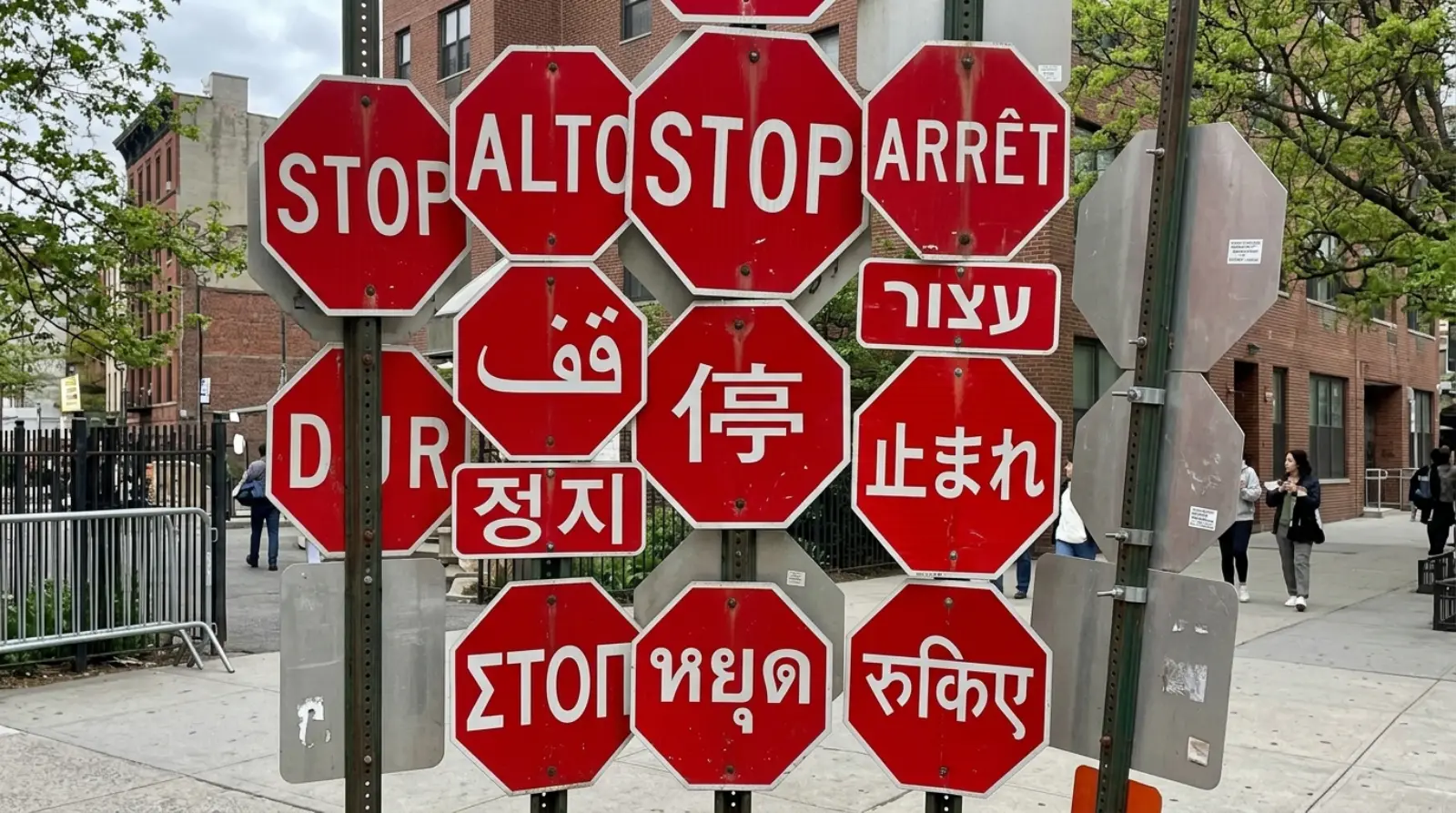
The word “stop” is one of the most useful words to learn in any language. Whether you are traveling abroad, learning a new language, watching foreign movies, or talking to people from different cultures, knowing how to say “stop” can make communication easier.
Although the meaning is similar across languages, the words and expressions can differ. Some languages use a short command, while others change the expression depending on whether you want someone to stop moving, talking, or doing something.
In this guide, you will discover 70 ways to say stop in different languages, including native phrases, easy English pronunciations, real-life example sentences, and their English meanings. Each group contains 10 languages to make the tables easier to read on mobile devices.
Stop in Different Languages: Quick Overview
Here are a few common translations to help you get started.
| Language | Word for Stop | Pronunciation |
|---|---|---|
| Spanish | ¡Para! | PAH-rah |
| French | Arrête ! | Ah-RET |
| German | Stopp! | SHTOP |
| Italian | Fermati! | fehr-MAH-tee |
| Portuguese | Pare! | pah-REH |
| Turkish | Dur! | door |
| Hindi | रुको! | ROO-koh |
| Urdu | رکو! | ROO-koh |
| Mandarin Chinese | 停下! | tíng xià |
| Japanese | 止まって! | toh-MAHT-teh |
These are useful starting points, but some expressions are more appropriate for casual conversations than formal situations. The following tables provide 70 translations with examples to help you understand how they are used.
1. Stop in European Languages
European languages offer several familiar ways to express the command “stop.” Some use words that look similar to English, while others have distinct vocabulary.
| # | Language | Native Phrase | Easy Pronunciation | Example Sentence | English Meaning |
|---|---|---|---|---|---|
| 1 | English | Stop! | Stop | Stop right here! | Stop right here! |
| 2 | Spanish | ¡Para! | PAH-rah | ¡Para aquí! | Stop here! |
| 3 | French | Arrête ! | Ah-RET | Arrête maintenant ! | Stop now! |
| 4 | German | Stopp! | SHTOP | Stopp, bitte! | Stop, please! |
| 5 | Italian | Fermati! | fehr-MAH-tee | Fermati qui! | Stop here! |
| 6 | Portuguese | Pare! | pah-REH | Pare aqui! | Stop here! |
| 7 | Dutch | Stop! | Stop | Stop nu! | Stop now! |
| 8 | Afrikaans | Stop! | Stop | Stop asseblief! | Stop, please! |
| 9 | Swedish | Stanna! | STAHN-nah | Stanna här! | Stop here! |
| 10 | Norwegian | Stopp! | Stop | Stopp nå! | Stop now! |
In everyday conversation, the tone you use can make a difference. For example, adding a word such as “please” can make a command sound more polite.
2. More European Languages
The next 10 languages include Nordic, Celtic, and Central European languages. Their translations show that even neighboring countries may use different expressions for the same command.
| # | Language | Native Phrase | Easy Pronunciation | Example Sentence | English Meaning |
|---|---|---|---|---|---|
| 11 | Danish | Stop! | Stop | Stop her! | Stop here! |
| 12 | Finnish | Pysähdy! | PUY-sah-duh | Pysähdy tähän! | Stop here! |
| 13 | Icelandic | Stopp! | Stop | Stopp núna! | Stop now! |
| 14 | Irish | Stop! | Stop | Stop anois! | Stop now! |
| 15 | Welsh | Stopiwch! | stop-EE-ookh | Stopiwch yma! | Stop here! |
| 16 | Polish | Zatrzymaj się! | zah-TSHI-mahy shyeh | Zatrzymaj się tutaj! | Stop here! |
| 17 | Czech | Zastav! | ZAH-stahf | Zastav tady! | Stop here! |
| 18 | Slovak | Zastav! | ZAH-stahv | Zastav tu! | Stop here! |
| 19 | Slovenian | Ustavi! | oos-TAH-vee | Ustavi tukaj! | Stop here! |
| 20 | Croatian | Stani! | STAH-nee | Stani ovdje! | Stop here! |
Some languages use a different command when addressing one person versus a group. If you are speaking with someone you do not know well, learning the polite form is a good idea.
3. Stop in Slavic and Nearby Languages
Slavic languages often share historical connections, but their words, pronunciation, and writing systems are not identical. This group also includes Greek, Albanian, and Romanian.
| # | Language | Native Phrase | Easy Pronunciation | Example Sentence | English Meaning |
|---|---|---|---|---|---|
| 21 | Serbian | Стани! | STAH-nee | Стани овде! | Stop here! |
| 22 | Bosnian | Stani! | STAH-nee | Stani ovdje! | Stop here! |
| 23 | Bulgarian | Спри! | spree | Спри тук! | Stop here! |
| 24 | Macedonian | Застани! | zah-STAH-nee | Застани тука! | Stop here! |
| 25 | Russian | Стой! | stoy | Стой здесь! | Stop here! |
| 26 | Ukrainian | Зупинись! | zoo-puh-NEES | Зупинись тут! | Stop here! |
| 27 | Belarusian | Спыніся! | spuh-NEE-syah | Спыніся тут! | Stop here! |
| 28 | Greek | Σταμάτα! | stah-MAH-tah | Σταμάτα εδώ! | Stop here! |
| 29 | Albanian | Ndal! | ndahl | Ndal këtu! | Stop here! |
| 30 | Romanian | Oprește-te! | oh-PRESH-teh-teh | Oprește-te aici! | Stop here! |
Notice that Russian, Ukrainian, Bulgarian, and Macedonian use Cyrillic writing systems. Learning to recognize the native spelling alongside the pronunciation can help you identify these commands on signs and in conversations.
4. Stop in Other European and Middle Eastern Languages
This group includes additional European languages, followed by Turkish, Arabic, Hebrew, Persian, Hindi, and Urdu. Several of these languages use writing systems that differ from the Latin alphabet.
| # | Language | Native Phrase | Easy Pronunciation | Example Sentence | English Meaning |
|---|---|---|---|---|---|
| 31 | Hungarian | Állj! | ahly | Állj meg itt! | Stop here! |
| 32 | Estonian | Peatu! | PEH-ah-too | Peatu siin! | Stop here! |
| 33 | Latvian | Apstājies! | ap-STAH-yehs | Apstājies šeit! | Stop here! |
| 34 | Lithuanian | Stok! | stok | Stok čia! | Stop here! |
| 35 | Turkish | Dur! | door | Dur burada! | Stop here! |
| 36 | Arabic | قِفْ! | qif | قف هنا! | Stop here! |
| 37 | Hebrew | עצור! | at-ZOR | עצור כאן! | Stop here! |
| 38 | Persian (Farsi) | بایست! | bah-YEST | اینجا بایست! | Stop here! |
| 39 | Hindi | रुको! | ROO-koh | यहाँ रुको! | Stop here! |
| 40 | Urdu | رکو! | ROO-koh | یہاں رکو! | Stop here! |
Arabic, Hebrew, Persian, Hindi, and Urdu are written from right to left. Their scripts may look unfamiliar to English readers, but learning a few everyday expressions can be a helpful introduction to each language.
5. Stop in South Asian Languages
South Asia is home to many languages, each with its own vocabulary and cultural background. The following translations are useful examples of how to express “stop” in several widely spoken regional languages.
| # | Language | Native Phrase | Easy Pronunciation | Example Sentence | English Meaning |
|---|---|---|---|---|---|
| 41 | Bengali | থামো! | THAH-moh | এখানে থামো! | Stop here! |
| 42 | Punjabi | ਰੁਕੋ! | roo-KOH | ਇੱਥੇ ਰੁਕੋ! | Stop here! |
| 43 | Gujarati | રોકો! | ROH-koh | અહીં રોકો! | Stop here! |
| 44 | Marathi | थांब! | THAHMB | इथे थांब! | Stop here! |
| 45 | Nepali | रोक! | rok | यहाँ रोक! | Stop here! |
| 46 | Sinhala | නවත්වන්න! | nah-vath-VAHN-nah | මෙතැන නවත්වන්න! | Stop here! |
| 47 | Tamil | நில்! | neel | இங்கே நில்! | Stop here! |
| 48 | Telugu | ఆపు! | AH-poo | ఇక్కడ ఆపు! | Stop here! |
| 49 | Kannada | ನಿಲ್ಲು! | NIL-loo | ಇಲ್ಲಿ ನಿಲ್ಲು! | Stop here! |
| 50 | Malayalam | നിർത്തൂ! | neer-THOO | ഇവിടെ നിർത്തൂ! | Stop here! |
The appropriate expression may vary depending on the situation and the person you are addressing. Some forms are more informal, while others are better suited to polite requests or instructions.
6. Stop in East and Southeast Asian Languages
East and Southeast Asia include languages with a wide variety of sounds and writing systems. These translations are especially useful for travelers who want to understand basic instructions or communicate simple requests.
| # | Language | Native Phrase | Easy Pronunciation | Example Sentence | English Meaning |
|---|---|---|---|---|---|
| 51 | Mandarin Chinese | 停下! | tíng xià | 请在这里停下! | Please stop here! |
| 52 | Japanese | 止まって! | toh-MAHT-teh | ここで止まって! | Stop here! |
| 53 | Korean | 멈춰! | meom-chwo | 여기서 멈춰! | Stop here! |
| 54 | Thai | หยุด! | yoot | หยุดตรงนี้! | Stop here! |
| 55 | Vietnamese | Dừng lại! | zoong lie | Dừng lại ở đây! | Stop here! |
| 56 | Indonesian | Berhenti! | ber-HEN-tee | Berhenti di sini! | Stop here! |
| 57 | Malay | Berhenti! | ber-HEN-tee | Berhenti di sini! | Stop here! |
| 58 | Filipino (Tagalog) | Tumigil ka! | too-MEE-gheel kah | Tumigil ka rito! | Stop here! |
| 59 | Khmer | ឈប់! | chhop | ឈប់នៅទីនេះ! | Stop here! |
| 60 | Lao | ຢຸດ! | yoot | ຢຸດຢູ່ນີ້! | Stop here! |
Mandarin Chinese uses tones, so the pitch of your voice can change the meaning of a word. Japanese and Korean also have their own pronunciation patterns, making it useful to listen to native speakers when practicing.
7. Stop in African and Caucasian Languages
The final 10 languages come from Africa and the Caucasus region. They demonstrate how different communities express a common everyday instruction.
| # | Language | Native Phrase | Easy Pronunciation | Example Sentence | English Meaning |
|---|---|---|---|---|---|
| 61 | Swahili | Simama! | see-MAH-mah | Simama hapa! | Stop here! |
| 62 | Zulu | Yima! | YEE-mah | Yima lapha! | Stop here! |
| 63 | Xhosa | Yima! | YEE-mah | Yima apha! | Stop here! |
| 64 | Amharic | ቁም! | koom | እዚህ ቁም! | Stop here! |
| 65 | Somali | Jooji! | JOH-jee | Halkan ku jooji! | Stop here! |
| 66 | Hausa | Tsaya! | TSAH-yah | Tsaya a nan! | Stop here! |
| 67 | Yoruba | Dúró! | DOO-roh | Dúró níbí! | Stop here! |
| 68 | Igbo | Kwụsị! | kwoo-SHEE | Kwụsị ebe a! | Stop here! |
| 69 | Georgian | გაჩერდი! | gah-CHER-dee | აქ გაჩერდი! | Stop here! |
| 70 | Armenian | Կանգնի՛ր։ | kahng-NEER | Այստեղ կանգնիր։ | Stop here! |
These examples offer a starting point for exploring languages that may be less familiar to English speakers. Pronunciation guides are approximate, and local usage can vary.
Translation note: The phrases above are practical examples rather than universal equivalents for every situation. Some commands are informal, and native speakers may choose different expressions depending on context.
How to Say Stop Politely in Different Languages
A direct command can sound strong or abrupt, especially when speaking with strangers. If you want to ask someone to stop politely, use the local equivalent of “please” or choose a respectful form.
Here are a few examples:
| Language | Polite Expression | English Meaning |
|---|---|---|
| Spanish | Pare, por favor. | Please stop. |
| French | Arrêtez, s’il vous plaît. | Please stop. |
| German | Bitte hören Sie auf. | Please stop. |
| Japanese | やめてください。 | Please stop. |
| Mandarin Chinese | 请停下。 | Please stop. |
| Hindi | कृपया रुकिए। | Please stop. |
| Urdu | براہِ کرم رک جائیں۔ | Please stop. |
These expressions can be useful in everyday situations, such as asking someone to pause, requesting that a person stop an activity, or speaking respectfully to someone you do not know.
Different Uses of the Word “Stop”
The meaning of “stop” changes slightly depending on what someone is doing. A word used to stop physical movement may not be the best choice when asking someone to end an activity.
| Situation | Example Sentence | Meaning |
|---|---|---|
| Stopping movement | Stop here! | Remain at this location. |
| Stopping speech | Stop talking! | Do not continue speaking. |
| Ending an activity | Stop playing! | End the activity. |
| Stopping a vehicle | Stop the car! | Bring the vehicle to a halt. |
| Setting a boundary | Stop bothering me! | Do not continue the unwanted behavior. |
| Taking a break | Let’s stop for a moment. | Pause temporarily. |
When learning a new language, try practicing these different situations instead of memorizing only one translation. This will help you choose a more natural expression when speaking.
Tips for Learning Stop Translations
Learning 70 translations may seem difficult at first, but dividing them into smaller groups makes the process easier.
- Practice 10 words at a time: Start with one table and review it before moving to the next.
- Read the native spelling: Familiarity with different writing systems can help you recognize words in signs and messages.
- Say the phrases aloud: Practice pronunciation slowly before trying to speak at a normal speed.
- Use example sentences: Connecting a word with a situation makes it easier to remember.
- Review regularly: Revisit the phrases after a day, a week, and a month.
- Learn polite forms: A respectful expression can be more appropriate than a direct command when talking to strangers.
Consistency matters more than memorizing all the translations in one sitting. A few minutes of practice each day can help you retain new vocabulary.
FAQs
1. How do you say stop in different languages?
Some common translations include para in Spanish, arrête in French, dur in Turkish, ruko in Hindi and Urdu, and berhenti in Indonesian and Malay. The exact expression depends on the context and level of politeness.
2. How many languages are included in this article?
This article includes 70 languages organized into seven tables, with 10 languages in each group. Every entry includes a native phrase, an easy pronunciation guide, an example sentence, and its English meaning.
3. What is the most common word for stop around the world?
There is no single word used in every language. Some languages use forms similar to the English word “stop,” while others use distinct expressions, such as para in Spanish, dur in Turkish, and berhenti in Indonesian.
4. How do you say stop politely in another language?
You can use the local equivalent of “please” or a respectful command. For example, Arrêtez, s’il vous plaît means “Please stop” in French. The most natural polite form depends on the language and situation.
5. Why should you learn how to say stop in 70 languages?
Learning these translations can help with travel, language study, basic communication, and understanding simple instructions. It can also help you recognize words used in conversations, films, and signs in different countries.
Conclusion
Learning how to say “stop” in different languages is a simple way to build vocabulary and improve cross-cultural communication. These 70 translations introduce useful expressions from Europe, Asia, Africa, and the Caucasus region, with native phrases, pronunciation guides, and practical examples.
Practice a few languages at a time, pay attention to the situation in which each phrase is used, and learn polite alternatives when possible. With regular practice, these everyday expressions can become a useful part of your language-learning journey.

I am Scarlett Wilson, a passionate language writer who loves exploring different languages, words, meanings, translations, and useful phrases. I enjoy making language learning simple, clear, and interesting for everyone.