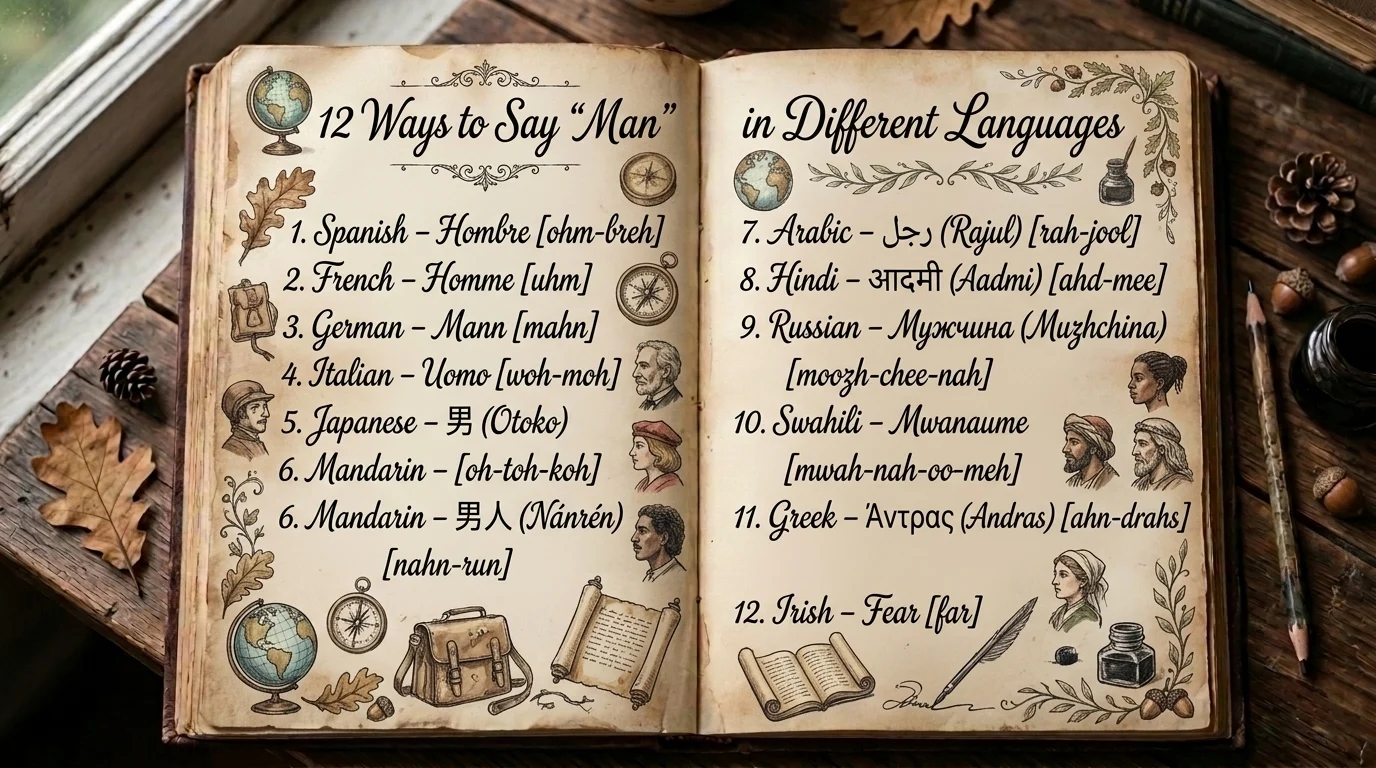
The word “man” is used around the world to describe an adult male, but its translation changes from one language to another. Learning how to say man in different languages is useful for language learners, travelers, writers, students, and anyone interested in world cultures.
In this guide, you will discover 70 translations of “man” in different languages, including native words, easy English pronunciations, and practical example sentences with their English meanings. The examples will help you understand how these words appear in everyday conversations.
Some languages also use different words for “man,” “male,” “husband,” and “person.” The translations below generally refer to an adult male human, although the exact meaning can depend on context.
Man in Different Languages: 70 Translations
- The following table covers 70 languages from Europe, Asia, Africa, the Middle East, and other regions. Each entry includes the native phrase for “man,” a simplified pronunciation guide, and a short example sentence.
Pronunciations are approximate guides for English speakers. They do not capture every regional accent or sound perfectly.
| # | Language | Word for “man” | Easy pronunciation | Example sentence | English meaning |
|---|---|---|---|---|---|
| 1 | Spanish | Hombre | OHM-bray | El hombre está aquí. | The man is here. |
| 2 | French | Homme | OM | L’homme est ici. | The man is here. |
| 3 | German | Mann | mahn | Der Mann ist hier. | The man is here. |
| 4 | Italian | Uomo | WOH-moh | L’uomo è qui. | The man is here. |
| 5 | Portuguese | Homem | OH-meng | O homem está aqui. | The man is here. |
| 6 | Dutch | Man | mahn | De man is hier. | The man is here. |
| 7 | Swedish | Man | mahn | Mannen är här. | The man is here. |
| 8 | Norwegian | Mann | mahn | Mannen er her. | The man is here. |
| 9 | Danish | Mand | man | Manden er her. | The man is here. |
| 10 | Icelandic | Maður | MA-thur | Maðurinn er hér. | The man is here. |
| 11 | Finnish | Mies | mee-ess | Mies on täällä. | The man is here. |
| 12 | Estonian | Mees | mees | Mees on siin. | The man is here. |
| 13 | Latvian | Vīrietis | VEE-ree-eh-tis | Vīrietis ir šeit. | The man is here. |
| 14 | Lithuanian | Vyras | VEE-ras | Vyras yra čia. | The man is here. |
| 15 | Polish | Mężczyzna | menzh-CHIZ-na | Mężczyzna jest tutaj. | The man is here. |
| 16 | Czech | Muž | moosh | Muž je tady. | The man is here. |
| 17 | Slovak | Muž | moosh | Muž je tu. | The man is here. |
| 18 | Slovenian | Moški | MOHSH-kee | Moški je tukaj. | The man is here. |
| 19 | Croatian | Muškarac | moosh-KAH-rats | Muškarac je ovdje. | The man is here. |
| 20 | Serbian | Мушкарац | moosh-KAH-rats | Мушкарац је овде. | The man is here. |
| 21 | Bulgarian | Мъж | muhzh | Мъжът е тук. | The man is here. |
| 22 | Macedonian | Маж | mahzh | Мажот е тука. | The man is here. |
| 23 | Russian | Мужчина | moosh-CHEE-na | Мужчина здесь. | The man is here. |
| 24 | Ukrainian | Чоловік | choh-loh-VEEK | Чоловік тут. | The man is here. |
| 25 | Belarusian | Мужчына | moosh-CHI-na | Мужчына тут. | The man is here. |
| 26 | Greek | Άνδρας | AN-thras | Ο άνδρας είναι εδώ. | The man is here. |
| 27 | Albanian | Burrë | BOOR-uh | Burri është këtu. | The man is here. |
| 28 | Romanian | Bărbat | buhr-BAHT | Bărbatul este aici. | The man is here. |
| 29 | Hungarian | Férfi | FAIR-fee | A férfi itt van. | The man is here. |
| 30 | Turkish | Erkek | EHR-kehk | Adam burada. | The man is here. |
| 31 | Arabic | رجل | RAH-jul | الرجل هنا. | The man is here. |
| 32 | Hebrew | גבר | GAH-ver | הגבר כאן. | The man is here. |
| 33 | Persian (Farsi) | مرد | mard | مرد اینجاست. | The man is here. |
| 34 | Urdu | مرد | mard | مرد یہاں ہے۔ | The man is here. |
| 35 | Hindi | आदमी | AH-dmee | आदमी यहाँ है। | The man is here. |
| 36 | Bengali | পুরুষ | POO-roosh | পুরুষটি এখানে আছে। | The man is here. |
| 37 | Punjabi | ਆਦਮੀ | AA-dmee | ਆਦਮੀ ਇੱਥੇ ਹੈ। | The man is here. |
| 38 | Gujarati | પુરુષ | POO-roosh | પુરુષ અહીં છે. | The man is here. |
| 39 | Marathi | पुरुष | POO-roosh | पुरुष येथे आहे. | The man is here. |
| 40 | Nepali | पुरुष | POO-roosh | पुरुष यहाँ छ। | The man is here. |
| 41 | Sinhala | පිරිමියා | pee-ree-mee-YAH | පිරිමියා මෙහි සිටී. | The man is here. |
| 42 | Tamil | ஆண் | ahn | அந்த ஆண் இங்கே இருக்கிறார். | That man is here. |
| 43 | Telugu | పురుషుడు | poo-roo-SHOO-doo | ఆ పురుషుడు ఇక్కడ ఉన్నాడు. | That man is here. |
| 44 | Kannada | ಪುರುಷ | POO-roo-sha | ಆ ಪುರುಷ ಇಲ್ಲಿ ಇದ್ದಾನೆ. | That man is here. |
| 45 | Malayalam | പുരുഷൻ | poo-roo-SHAN | ആ പുരുഷൻ ഇവിടെയുണ്ട്. | That man is here. |
| 46 | Chinese (Mandarin) | 男人 | nánrén | 那个男人在这里。 | That man is here. |
| 47 | Japanese | 男性 | dansei | 男性がここにいます。 | A man is here. |
| 48 | Korean | 남자 | namja | 그 남자는 여기 있어요. | That man is here. |
| 49 | Vietnamese | Đàn ông | dahn awng | Người đàn ông ở đây. | The man is here. |
| 50 | Thai | ผู้ชาย | phûu-chaai | ผู้ชายอยู่ที่นี่ | The man is here. |
| 51 | Indonesian | Pria | PREE-ah | Pria itu ada di sini. | That man is here. |
| 52 | Malay | Lelaki | luh-LAH-kee | Lelaki itu ada di sini. | That man is here. |
| 53 | Filipino (Tagalog) | Lalaki | lah-LAH-kee | Nandito ang lalaki. | The man is here. |
| 54 | Burmese | အမျိုးသား | ah-myo-tha | အမျိုးသားက ဒီမှာရှိတယ်။ | The man is here. |
| 55 | Khmer | បុរស | boh-ros | បុរសនៅទីនេះ។ | The man is here. |
| 56 | Lao | ຜູ້ຊາຍ | phoo-saai | ຜູ້ຊາຍຢູ່ນີ້. | The man is here. |
| 57 | Mongolian | Эрэгтэй | eh-reg-tai | Эрэгтэй энд байна. | The man is here. |
| 58 | Kazakh | Ер адам | yehr ah-DAHM | Ер адам осында. | The man is here. |
| 59 | Uzbek | Erkak | ehr-KAHK | Erkak shu yerda. | The man is here. |
| 60 | Swahili | Mwanaume | mwah-NAH-oo-meh | Mwanaume yuko hapa. | The man is here. |
| 61 | Zulu | Indoda | een-DOH-dah | Indoda ilapha. | The man is here. |
| 62 | Xhosa | Indoda | een-DOH-dah | Indoda ilapha. | The man is here. |
| 63 | Afrikaans | Man | mahn | Die man is hier. | The man is here. |
| 64 | Amharic | ወንድ | wend | ወንዱ እዚህ ነው። | The man is here. |
| 65 | Yoruba | Ọkùnrin | aw-KOON-reen | Ọkùnrin náà wà níbí. | The man is here. |
| 66 | Igbo | Nwoke | NWOH-keh | Nwoke ahụ nọ ebe a. | That man is here. |
| 67 | Hausa | Namiji | nah-MEE-jee | Namijin yana nan. | The man is here. |
| 68 | Somali | Nin | neen | Ninku waa halkan. | The man is here. |
| 69 | Irish | Fear | far | Tá an fear anseo. | The man is here. |
| 70 | Welsh | Dyn | deen | Mae’r dyn yma. | The man is here. |
How to Say “Man” in Different Languages
To say “man” in another language, start by choosing the translation that fits your meaning. A word used for an adult male may differ from a word used for a husband, a gentleman, or a human being in general.
For example:
- Spanish: hombre generally means “man.”
- French: homme means “man” and can also mean “human being” in some contexts.
- German: Mann means “man” or “husband,” depending on the sentence.
- Japanese: 男性 refers to a male or man, while 男の人 is another common way to refer to a man.
- Hindi: आदमी commonly means “man” and can also mean “person” in everyday speech.
- Arabic: رجل generally means “man,” while other words are used for a male person in different contexts.
The best translation depends on the sentence, relationship, and level of formality.
Man in All Languages: Important Differences
Although many languages have a single common word for “man,” their grammatical systems and everyday expressions vary.
Gender and grammar: Some languages change words according to grammatical gender, case, or number. In other languages, the form changes depending on whether the speaker is referring to one person or several.
Formal and informal speech: Certain languages have several ways to refer to a man. One word may sound neutral, while another may be more polite, casual, or specific.
Man versus person: English sometimes uses “man” in a broad sense, as in older expressions referring to humanity. Many modern translations distinguish more clearly between an adult male and a person of any gender.
Regional differences: Pronunciation and vocabulary can change between regions, even when people speak the same language. A translation that is common in one country may sound less natural in another.
Man Translations Around the World
The translations in this list show how different cultures express a familiar concept. European languages include forms such as hombre, homme, Mann, and uomo. Across South Asia, common words include आदमी, مرد, and পুরুষ. East and Southeast Asian languages use forms such as 男人, 남자, đàn ông, and ผู้ชาย.
African languages also have distinct words, including mwanaume in Swahili, indoda in Zulu and Xhosa, and ọkùnrin in Yoruba.
These examples are useful for basic vocabulary learning, travel preparation, language comparison, and writing. However, they are not interchangeable in every situation. Always consider the context when choosing a translation.
Tips for Learning the Word “Man” in Another Language
- Learn the native script: Seeing the original spelling helps you recognize the word in books, signs, and conversations.
- Practice the pronunciation: Read the pronunciation guide aloud, then listen to a native speaker when possible.
- Memorize a complete sentence: Learning “The man is here” gives you more context than memorizing an isolated word.
- Check regional usage: If you are traveling, focus on the language and dialect spoken in your destination.
- Learn related vocabulary: Study words for “woman,” “person,” “boy,” “husband,” and “people” to understand the differences.
Frequently Asked Questions
1. What is the word for man in different languages?
The word varies by language. Examples include hombre in Spanish, homme in French, Mann in German, uomo in Italian, 男人 in Mandarin Chinese, and مرد in Urdu and Persian.
2. How do you say man in 70 languages?
You can use the 70-language table above to find the native word, an easy pronunciation guide, and an example sentence with its English meaning.
3. What is the most common translation of man in Spanish?
The standard Spanish word for an adult male is hombre. For example, El hombre está aquí means “The man is here.”
4. Is the word for man the same as the word for male?
Not always. “Man” usually refers to an adult male human, while “male” can describe sex or gender in a broader range of contexts. Some languages use different words for these meanings.
5. Why does the word for man change between languages?
Languages develop their vocabulary through different histories, cultures, and grammatical systems. As a result, each language has its own word, pronunciation, and usage rules for referring to an adult male.
Conclusion
Learning man in different languages is a practical way to expand your vocabulary and explore linguistic diversity. From hombre and homme to 男人 and mwanaume, each translation reflects the vocabulary and grammatical patterns of its language.
Use the 70 translations and example sentences as a starting point for language study, travel, and communication. For the most natural results, pay attention to pronunciation, regional differences, and the context in which each word is used.

I am Ricardo Hunter, Administrator at LingoBuz, passionate about languages, translations, and global communication. I help create useful, clear content that makes exploring different languages simple, enjoyable, and accessible.