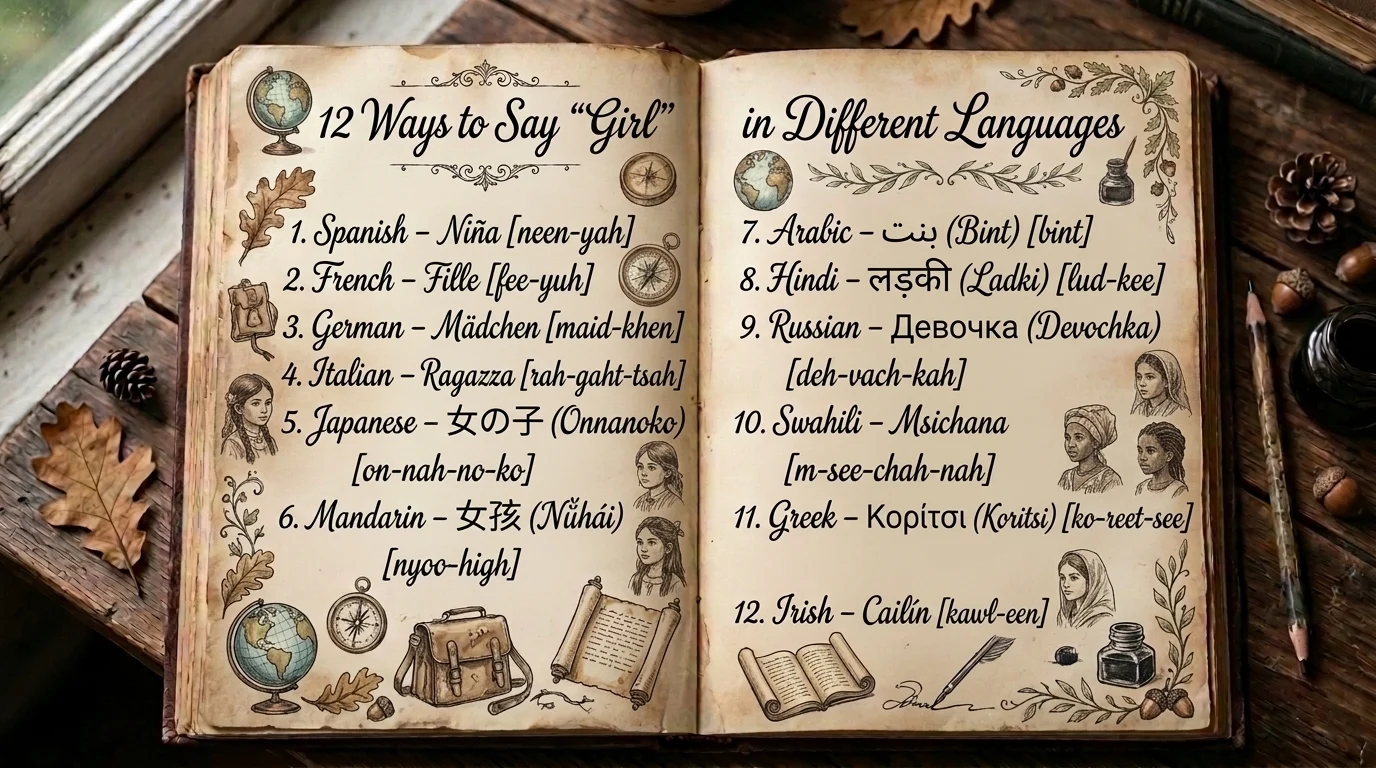
The word “girl” is used around the world to describe a female child or young female person, but every language has its own word, pronunciation, and cultural nuances. Learning how to say girl in different languages is useful for language learners, travelers, students, writers, and anyone interested in world languages.
In this guide, you will discover girl in 70 different languages, including the correct native word, an easy English pronunciation, and a short example sentence with its English meaning. The examples use simple, everyday language to help you understand how each translation works in context.
Whether you are searching for girl in all languages, girl translations, or how to say girl in different languages, this list provides a practical starting point.
How to Say “Girl” in Different Languages
The translation of “girl” can vary depending on age, context, and local usage. Some languages use different words for a young child, a teenage girl, or a young woman. The table below gives a common, natural equivalent for each language.
Girl in 70 Different Languages: Translation Table
The following table includes 70 languages from Europe, Asia, Africa, the Middle East, and other regions. Each example means “The girl is happy,” making it easier to see the word in a real sentence.
| No. | Language | Native word for girl | Easy pronunciation | Example sentence in the language | English meaning |
|---|---|---|---|---|---|
| 1 | English | Girl | gurl | The girl is happy. | The girl is happy. |
| 2 | Spanish | Niña | NEEN-yah | La niña está feliz. | The girl is happy. |
| 3 | French | Fille | fee | La fille est heureuse. | The girl is happy. |
| 4 | German | Mädchen | MET-khen | Das Mädchen ist glücklich. | The girl is happy. |
| 5 | Italian | Ragazza | rah-GAHT-tsah | La ragazza è felice. | The girl is happy. |
| 6 | Portuguese | Menina | meh-NEE-nah | A menina está feliz. | The girl is happy. |
| 7 | Dutch | Meisje | MAY-shuh | Het meisje is blij. | The girl is happy. |
| 8 | Swedish | Flicka | FLIK-ah | Flickan är glad. | The girl is happy. |
| 9 | Norwegian | Jente | YEN-tuh | Jenta er glad. | The girl is happy. |
| 10 | Danish | Pige | PEE-uh | Pigen er glad. | The girl is happy. |
| 11 | Finnish | Tyttö | TÜT-tö | Tyttö on iloinen. | The girl is happy. |
| 12 | Icelandic | Stúlka | STOOL-kah | Stúlkan er glöð. | The girl is happy. |
| 13 | Irish | Cailín | kaw-LEEN | Tá an cailín sásta. | The girl is happy. |
| 14 | Welsh | Merch | mehrkh | Mae’r ferch yn hapus. | The girl is happy. |
| 15 | Polish | Dziewczyna | jeh-CHIH-nah | Dziewczyna jest szczęśliwa. | The girl is happy. |
| 16 | Czech | Dívka | DEEF-kah | Dívka je šťastná. | The girl is happy. |
| 17 | Slovak | Dievča | DYEH-vchah | Dievča je šťastné. | The girl is happy. |
| 18 | Slovenian | Dekle | DEH-kleh | Dekle je veselo. | The girl is happy. |
| 19 | Croatian | Djevojka | dyeh-VOY-kah | Djevojka je sretna. | The girl is happy. |
| 20 | Serbian | Девојка | DEH-voy-kah | Девојка је срећна. | The girl is happy. |
| 21 | Bulgarian | Момиче | MOH-mee-cheh | Момичето е щастливо. | The girl is happy. |
| 22 | Russian | Девочка | DYEH-vach-kah | Девочка счастлива. | The girl is happy. |
| 23 | Ukrainian | Дівчина | DEEV-chih-nah | Дівчина щаслива. | The girl is happy. |
| 24 | Greek | Κορίτσι | koh-REET-see | Το κορίτσι είναι χαρούμενο. | The girl is happy. |
| 25 | Romanian | Fată | FAH-tuh | Fata este fericită. | The girl is happy. |
| 26 | Hungarian | Lány | lahn-y | A lány boldog. | The girl is happy. |
| 27 | Albanian | Vajzë | VAHY-zuh | Vajza është e lumtur. | The girl is happy. |
| 28 | Turkish | Kız | kuhz | Kız mutlu. | The girl is happy. |
| 29 | Arabic | فتاة | FAH-taat | الفتاة سعيدة. | The girl is happy. |
| 30 | Hebrew | ילדה | yal-DAH | הילדה שמחה. | The girl is happy. |
| 31 | Persian (Farsi) | دختر | dokh-TAR | دختر خوشحال است. | The girl is happy. |
| 32 | Urdu | لڑکی | LAR-kee | لڑکی خوش ہے۔ | The girl is happy. |
| 33 | Hindi | लड़की | LAR-kee | लड़की खुश है। | The girl is happy. |
| 34 | Bengali | মেয়ে | MEH-yeh | মেয়েটি খুশি। | The girl is happy. |
| 35 | Punjabi | ਕੁੜੀ | koo-REE | ਕੁੜੀ ਖੁਸ਼ ਹੈ। | The girl is happy. |
| 36 | Gujarati | છોકરી | chhoh-kree | છોકરી ખુશ છે. | The girl is happy. |
| 37 | Marathi | मुलगी | MOOL-gee | मुलगी आनंदी आहे. | The girl is happy. |
| 38 | Nepali | केटी | KAY-tee | केटी खुसी छे। | The girl is happy. |
| 39 | Sinhala | ගැහැණු ළමයා | gah-HEH-noo lah-MAH-yah | ගැහැණු ළමයා සතුටින් සිටී. | The girl is happy. |
| 40 | Tamil | பெண் | pen | பெண் மகிழ்ச்சியாக இருக்கிறாள். | The girl is happy. |
| 41 | Telugu | అమ్మాయి | am-MAH-yee | అమ్మాయి సంతోషంగా ఉంది. | The girl is happy. |
| 42 | Kannada | ಹುಡುಗಿ | hoo-doo-gee | ಹುಡುಗಿ ಸಂತೋಷವಾಗಿದ್ದಾಳೆ. | The girl is happy. |
| 43 | Malayalam | പെൺകുട്ടി | pen-KUT-tee | പെൺകുട്ടി സന്തോഷവതിയാണ്. | The girl is happy. |
| 44 | Thai | เด็กผู้หญิง | dek poo-YING | เด็กผู้หญิงมีความสุข | The girl is happy. |
| 45 | Lao | ເດັກຍິງ | dek ying | ເດັກຍິງມີຄວາມສຸກ | The girl is happy. |
| 46 | Khmer | ក្មេងស្រី | kmeng srei | ក្មេងស្រីសប្បាយចិត្ត។ | The girl is happy. |
| 47 | Vietnamese | Cô gái | koh GAI | Cô gái vui vẻ. | The girl is happy. |
| 48 | Indonesian | Gadis | GAH-dees | Gadis itu bahagia. | The girl is happy. |
| 49 | Malay | Gadis | GAH-dees | Gadis itu gembira. | The girl is happy. |
| 50 | Filipino (Tagalog) | Babae | bah-BAH-eh | Masaya ang babae. | The girl is happy. |
| 51 | Mandarin Chinese | 女孩 | nǚ hái | 女孩很开心。 | The girl is happy. |
| 52 | Japanese | 女の子 | onna no ko | 女の子はうれしいです。 | The girl is happy. |
| 53 | Korean | 소녀 | so-nyeo | 소녀는 행복해요. | The girl is happy. |
| 54 | Mongolian | Охин | OH-khin | Охин баяртай байна. | The girl is happy. |
| 55 | Kazakh | Қыз | kuhz | Қыз бақытты. | The girl is happy. |
| 56 | Uzbek | Qiz | keez | Qiz baxtli. | The girl is happy. |
| 57 | Swahili | Msichana | msee-CHAH-nah | Msichana ana furaha. | The girl is happy. |
| 58 | Amharic | ሴት ልጅ | set lij | ሴት ልጅዋ ደስተኛ ናት። | The girl is happy. |
| 59 | Somali | Gabar | GAH-bar | Gabadhu way faraxsan tahay. | The girl is happy. |
| 60 | Yoruba | Ọmọbìnrin | aw-maw-BEEN-reen | Ọmọbìnrin náà dùn. | The girl is happy. |
| 61 | Igbo | Nwa agbọghọ | nwa ah-baw-GHAW | Nwa agbọghọ ahụ nwere obi ụtọ. | The girl is happy. |
| 62 | Hausa | Yarinya | yah-reen-yah | Yarinya tana farin ciki. | The girl is happy. |
| 63 | Zulu | Intombazane | een-tom-bah-ZAH-neh | Intombazane ijabule. | The girl is happy. |
| 64 | Xhosa | Intombazana | een-tom-bah-ZAH-nah | Intombazana yonwabile. | The girl is happy. |
| 65 | Afrikaans | Meisie | MAY-see | Die meisie is gelukkig. | The girl is happy. |
| 66 | Malagasy | Ankizivavy | an-kee-zee-VAH-vee | Faly ilay ankizivavy. | The girl is happy. |
| 67 | Haitian Creole | Tifi | tee-FEE | Tifi a kontan. | The girl is happy. |
| 68 | Esperanto | Knabino | knah-BEE-noh | La knabino estas feliĉa. | The girl is happy. |
| 69 | Latin | Puella | poo-EL-lah | Puella laeta est. | The girl is happy. |
| 70 | Basque | Neska | NES-kah | Neska pozik dago. | The girl is happy. |
Pronunciation note: English-style pronunciations are approximate guides, not exact phonetic transcriptions. Sounds, accents, and regional vocabulary may differ. In some languages, the example sentence uses a grammatical form of the word for “girl,” rather than repeating its dictionary form unchanged.
Why the Word for “Girl” Changes Across Languages
The word for “girl” does not always refer to exactly the same age group in every language. Some languages distinguish clearly between a female child and a young woman, while others use one word for several age groups.
For example:
- Spanish: Niña commonly means a girl or female child, while chica can mean a girl or young woman.
- French: Fille can mean “girl” and, in certain contexts, “daughter.”
- German: Mädchen commonly refers to a girl and is grammatically neuter.
- Hindi and Urdu: Ladki (लड़की / لڑکی) commonly means “girl” or “young woman,” depending on context.
- Japanese: Onna no ko (女の子) is a common expression for a girl, particularly a female child or young girl.
These differences matter when choosing girl translations for conversation, writing, travel, or language study.
Girl in All Languages: How to Choose the Right Translation
When learning how to say girl in different languages, consider these three points.
1. Think About Age and Context
If you are talking about a young child, choose the word commonly used for a female child. If you mean a teenager or young adult, another word may sound more natural.
2. Learn the Native Script
Romanized spellings are useful for beginners, but learning the original writing system helps you recognize the word in books, messages, signs, and everyday conversations.
For example, the Hindi word लड़की and the Urdu word لڑکی have similar pronunciation, even though they use different writing systems.
3. Practice the Word in a Sentence
Memorizing a single word is helpful, but a short sentence shows you how it works naturally. Practice simple expressions such as “The girl is happy,” “The girl is reading,” or “I met a girl.”
Remember that the exact translation may change according to grammar, gender agreement, formality, and local usage.
Common Uses of the Word “Girl” Around the World
The word “girl” appears in many everyday situations, from family conversations to school, storytelling, travel, and literature.
Here are a few useful English expressions to practice alongside the translations:
| English expression | When to use it |
|---|---|
| The girl is happy. | Describing someone’s feelings |
| The girl is my friend. | Introducing a friend |
| The girl is reading. | Describing an activity |
| I saw a girl. | Talking about someone you saw |
| A young girl | Referring to a female child |
When translating these expressions, remember that some languages change the word ending or sentence structure to fit the context. A direct word-for-word translation may not always sound natural.
Frequently Asked Questions
1. How do you say girl in different languages?
The word varies by language. For example, it is niña in Spanish, fille in French, Mädchen in German, ladki in Hindi and Urdu, and onna no ko in Japanese.
2. What is the word for girl in 10 different languages?
Here are 10 examples:
- Spanish: Niña
- French: Fille
- German: Mädchen
- Italian: Ragazza
- Portuguese: Menina
- Hindi: लड़की
- Urdu: لڑکی
- Arabic: فتاة
- Japanese: 女の子
- Mandarin Chinese: 女孩
3. Is the word for girl the same as the word for daughter?
Not always. Some languages use the same word for both meanings in certain contexts. In French, for example, fille can mean either “girl” or “daughter.” Other languages have distinct words for these relationships.
4. Which languages use similar words for girl?
Hindi and Urdu use ladki, written लड़की in Hindi and لڑکی in Urdu. Indonesian and Malay both use gadis. Similarities often reflect shared linguistic roots, historical contact, or closely related languages.
5. Why are there different translations for girl around the world?
Languages develop through different histories, cultures, and grammatical systems. Some distinguish between children and young women, while others use different expressions depending on formality or context. That is why the most natural translation depends on how the word is being used.
Conclusion
Learning how to say girl in different languages is a simple way to explore the diversity of language and culture. From niña in Spanish to ladki in Hindi and Urdu and gadis in Indonesian and Malay, each language offers its own expression and pronunciation.
Use this list of 70 girl translations to expand your vocabulary, practice everyday sentences, and discover how people around the world communicate.

I am Ava Jones, a language enthusiast and author passionate about exploring different languages, sharing useful phrases, explaining meanings, and helping readers communicate confidently across cultures and countries.