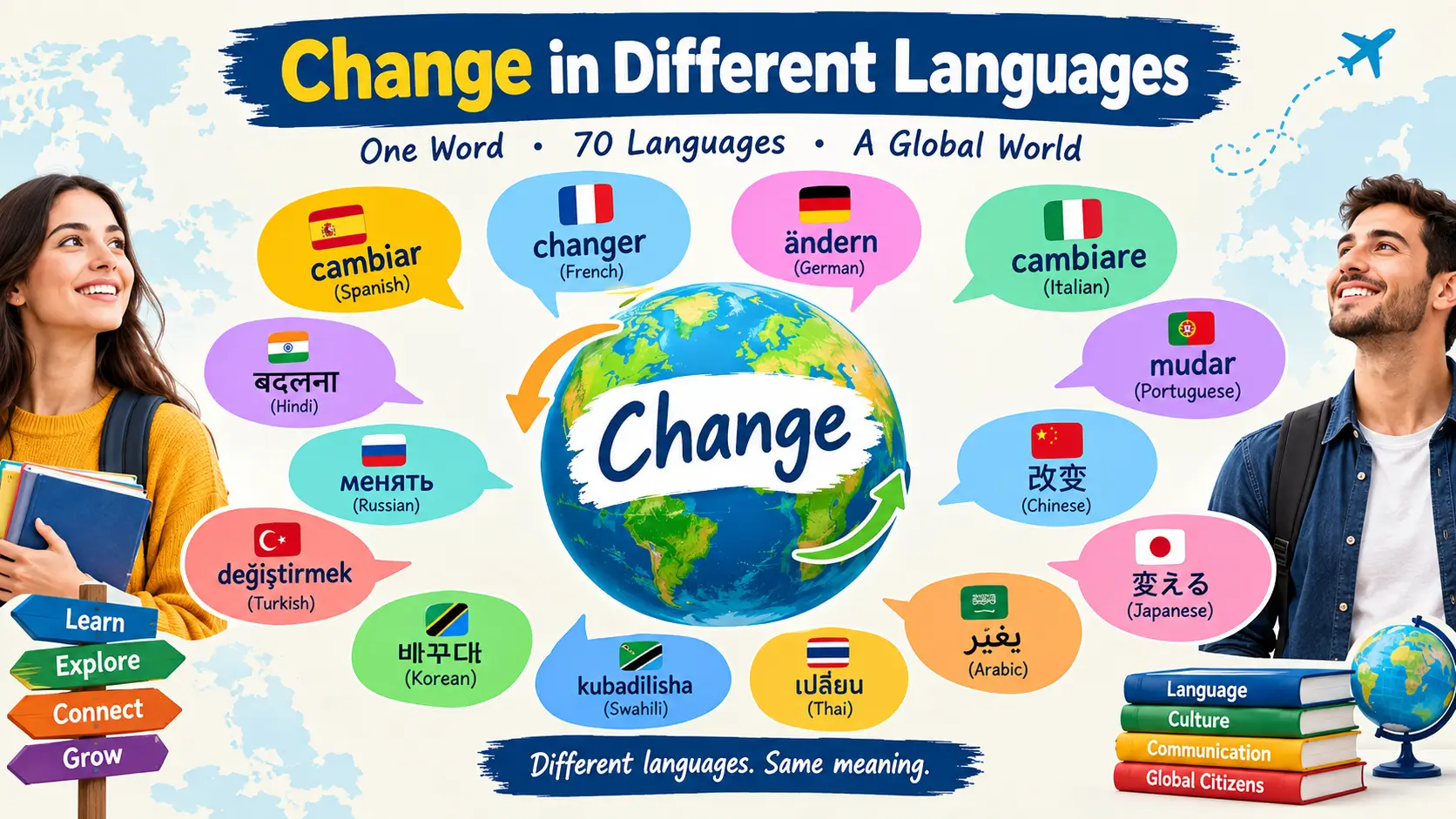
Change is a universal part of everyday life. Whether you are talking about changing your plans, changing clothes, changing a habit, or simply making something different, the word “change” appears in countless conversations around the world.
If you want to learn how to say change in different languages, this guide gives you 70 useful translations with simple English pronunciations and real-life examples. These change translations can help travelers, language learners, writers, students, and anyone interested in how everyday vocabulary varies across cultures.
Because “change” can be used as both a verb and a noun, the exact translation may depend on context. The table below primarily focuses on the everyday verb meaning “to change”, while the example sentences show how each expression can naturally be used.
Change in Different Languages
| # | Language | Native Phrase | Easy English Pronunciation | Example Sentence | English Meaning |
|---|---|---|---|---|---|
| 1 | English | change | chaynj | I need to change my clothes. | I need to put on different clothes. |
| 2 | Spanish | cambiar | kahm-BYAR | I want to change my plans. | I want to alter my plans. |
| 3 | French | changer | shahn-ZHAY | We need to change the date. | We need to move to a different date. |
| 4 | German | ändern | EN-dern | I want to change my schedule. | I want to alter my schedule. |
| 5 | Italian | cambiare | kahm-BYAH-reh | I need to change my seat. | I need to move to another seat. |
| 6 | Portuguese | mudar | moo-DAR | I want to change my job. | I want to get a different job. |
| 7 | Dutch | veranderen | fer-AHN-duh-run | Things can change quickly. | Things can become different quickly. |
| 8 | Swedish | ändra | EN-drah | I need to change my password. | I need to use a different password. |
| 9 | Norwegian | endre | EN-dreh | We should change our plans. | We should alter our plans. |
| 10 | Danish | ændre | EN-druh | I want to change the color. | I want to use a different color. |
| 11 | Finnish | muuttaa | MOO-tah | I want to change my plans. | I want to alter my plans. |
| 12 | Icelandic | breyta | BRAY-tah | We can change the plan. | We can alter the plan. |
| 13 | Irish | athraigh | AH-ree | We should change our route. | We should use a different route. |
| 14 | Welsh | newid | NAY-id | I want to change my clothes. | I want to put on different clothes. |
| 15 | Polish | zmieniać | ZMYEH-nyach | I often change my plans. | I often alter my plans. |
| 16 | Czech | změnit | ZMYEH-nit | We need to change the date. | We need to choose another date. |
| 17 | Slovak | zmeniť | ZMEH-nit | I want to change my answer. | I want to give a different answer. |
| 18 | Slovenian | spremeniti | spreh-MEH-nee-tee | We need to change the plan. | We need to alter the plan. |
| 19 | Croatian | promijeniti | proh-MYEH-nee-tee | I need to change my address. | I need to update my address. |
| 20 | Serbian | променити | proh-MEH-nee-tee | We should change the plan. | We should alter the plan. |
| 21 | Bulgarian | променям | proh-MEH-nyam | People can change over time. | People can become different over time. |
| 22 | Macedonian | промени | proh-MEH-nee | We need to change the schedule. | We need to alter the schedule. |
| 23 | Romanian | schimba | SHKEEM-bah | I want to change my clothes. | I want to put on different clothes. |
| 24 | Albanian | ndryshoj | ndruh-SHOY | I want to change my plans. | I want to alter my plans. |
| 25 | Greek | αλλάζω | ah-LAH-zoh | I want to change my job. | I want to get a different job. |
| 26 | Russian | менять | meh-NYAT | I need to change my password. | I need to use a different password. |
| 27 | Ukrainian | змінювати | zmee-NYOO-vah-ty | We can change the plan. | We can alter the plan. |
| 28 | Belarusian | мяняць | mya-NYATS | I want to change my answer. | I want to give another answer. |
| 29 | Lithuanian | keisti | KAY-stee | I need to change my clothes. | I need to put on different clothes. |
| 30 | Latvian | mainīt | MYE-nit | We should change the plan. | We should alter the plan. |
| 31 | Estonian | muutma | MOOT-mah | I want to change my schedule. | I want to alter my schedule. |
| 32 | Hungarian | változtatni | VAHL-toh-ztat-nee | We need to change the plan. | We need to alter the plan. |
| 33 | Turkish | değiştirmek | deh-YEESH-teer-mek | I want to change my clothes. | I want to put on different clothes. |
| 34 | Azerbaijani | dəyişmək | deh-YEESH-mek | We need to change the plan. | We need to alter the plan. |
| 35 | Kazakh | өзгерту | ohz-ger-TOO | I want to change my plans. | I want to alter my plans. |
| 36 | Uzbek | o‘zgartirmoq | ohz-gar-teer-MOK | We need to change the schedule. | We need to alter the schedule. |
| 37 | Kyrgyz | өзгөртүү | ohz-GER-too | We can change the plan. | We can alter the plan. |
| 38 | Tajik | тағйир додан | tahg-YEER doh-dan | We need to change the plan. | We need to alter the plan. |
| 39 | Persian | تغییر دادن | tagh-YEER dā-dan | I want to change my plans. | I want to alter my plans. |
| 40 | Arabic | يغيّر | yu-GHAY-yir | I need to change my plans. | I need to alter my plans. |
| 41 | Hebrew | לשנות | leh-sha-NOT | I want to change the plan. | I want to alter the plan. |
| 42 | Armenian | փոխել | po-KHEL | I need to change my clothes. | I need to put on different clothes. |
| 43 | Georgian | შეცვლა | shets-VLA | We need to change the plan. | We need to alter the plan. |
| 44 | Hindi | बदलना | bad-LAH-nah | मुझे अपनी योजना बदलनी है। | I need to change my plan. |
| 45 | Urdu | بدلنا | bad-LAH-na | مجھے اپنا منصوبہ بدلنا ہے۔ | I need to change my plan. |
| 46 | Bengali | পরিবর্তন করা | pori-BOR-ton kora | আমাকে আমার পরিকল্পনা পরিবর্তন করতে হবে। | I need to change my plan. |
| 47 | Punjabi | ਬਦਲਣਾ | bad-LA-na | ਮੈਨੂੰ ਆਪਣੀ ਯੋਜਨਾ ਬਦਲਣੀ ਹੈ। | I need to change my plan. |
| 48 | Gujarati | બદલવું | bad-LOO-voo | મારે મારી યોજના બદલવી છે. | I need to change my plan. |
| 49 | Marathi | बदलणे | ba-DAL-ne | मला माझी योजना बदलायची आहे. | I need to change my plan. |
| 50 | Nepali | परिवर्तन गर्नु | par-ee-VAR-tan garnu | मैले मेरो योजना परिवर्तन गर्नुपर्छ। | I need to change my plan. |
| 51 | Sinhala | වෙනස් කරනවා | veh-NAS kar-NA-wa | මට මගේ සැලැස්ම වෙනස් කරන්න ඕනෑ. | I need to change my plan. |
| 52 | Tamil | மாற்று | MAAT-roo | நான் என் திட்டத்தை மாற்ற வேண்டும். | I need to change my plan. |
| 53 | Telugu | మార్చు | MAAR-choo | నేను నా ప్రణాళికను మార్చాలి. | I need to change my plan. |
| 54 | Kannada | ಬದಲಾಯಿಸು | ba-da-LAA-yi-soo | ನಾನು ನನ್ನ ಯೋಜನೆಯನ್ನು ಬದಲಾಯಿಸಬೇಕು. | I need to change my plan. |
| 55 | Malayalam | മാറ്റുക | MAA-tuh-ka | എനിക്ക് എന്റെ പദ്ധതി മാറ്റണം. | I need to change my plan. |
| 56 | Chinese (Mandarin) | 改变 | gǎi biàn | 我想改变我的计划。 | I want to change my plan. |
| 57 | Japanese | 変える | kaeru | 私は予定を変えたいです。 | I want to change my plans. |
| 58 | Korean | 바꾸다 | bakkuda | 저는 계획을 바꾸고 싶어요. | I want to change my plan. |
| 59 | Vietnamese | thay đổi | thay DOY | Tôi muốn thay đổi kế hoạch. | I want to change my plan. |
| 60 | Thai | เปลี่ยน | bplìian | ฉันต้องการเปลี่ยนแผน | I want to change the plan. |
| 61 | Indonesian | mengubah | muh-NGOO-bah | Saya ingin mengubah rencana saya. | I want to change my plan. |
| 62 | Malay | mengubah | muh-NGOO-bah | Saya mahu mengubah rancangan saya. | I want to change my plan. |
| 63 | Filipino | baguhin | bah-goo-HIN | Kailangan kong baguhin ang plano ko. | I need to change my plan. |
| 64 | Swahili | kubadilisha | koo-bah-dee-LEE-shah | Ninataka kubadilisha mpango wangu. | I want to change my plan. |
| 65 | Afrikaans | verander | fer-AHN-der | Ek wil my plan verander. | I want to change my plan. |
| 66 | Amharic | መቀየር | me-keh-YER | እቅዴን መቀየር እፈልጋለሁ። | I want to change my plan. |
| 67 | Hausa | canza | CHAN-zah | Ina son canza shirina. | I want to change my plan. |
| 68 | Yoruba | yí padà | yee pah-DAH | Mo fẹ́ yí ètò mi padà. | I want to change my plan. |
| 69 | Zulu | shintsha | SHINT-shah | Ngifuna ukushintsha uhlelo lwami. | I want to change my plan. |
| 70 | Xhosa | tshintsha | TSHINT-shah | Ndifuna ukutshintsha icebo lam. | I want to change my plan. |
How to Say Change in Different Languages
The word “change” does not always translate into one fixed word. In many languages, the appropriate expression depends on whether you mean changing an object, changing a plan, becoming different, or making an alteration.
For example, Spanish commonly uses cambiar, while French uses changer and German uses ändern. In Mandarin Chinese, 改变 is commonly used for the idea of changing or altering something.
In South Asian languages, the everyday expression can also depend strongly on grammar and context. Hindi uses बदलना, while Urdu commonly uses بدلنا. These forms are useful when talking about changing plans, habits, clothes, or other things.
Change as a Verb
As a verb, “change” generally means to make something different or to become different.
Common examples include:
- Change your clothes.
- Change your plans.
- Change your address.
- Change your password.
- Change your opinion.
- Change your habits.
- Change the color.
- Change the schedule.
The surrounding words usually make the intended meaning clear.
Change as a Noun
“Change” can also be a noun. It may describe an alteration, transformation, or difference.
For example:
- “The company needs a change.”
- “A small change made a big difference.”
- “Change can be difficult.”
- “There has been a major change in the weather.”
The noun form is not always identical to the verb form in other languages, so learners should check the grammatical context before using a translation.
Why Learn Change Translations?
Learning how to say common words such as “change” in other languages can make communication easier when traveling or studying languages.
It can also help you understand cultural differences in everyday speech. A simple word may have several related expressions depending on whether someone is discussing personal behavior, physical objects, plans, money, or social situations.
For language learners, learning the word together with a complete sentence is often more useful than memorizing a translation by itself.
Change Around the World
The idea of change exists in every culture, but languages express it in different ways. Some languages use a single common verb for many situations, while others select different expressions depending on whether something is being replaced, modified, transformed, or exchanged.
This is why change in all languages should be understood through context rather than by simply matching one English word with one foreign word.
The 70 translations above provide a practical starting point for exploring change around the world.
Tips for Using the Word “Change” Correctly
When learning change in different languages, keep these tips in mind:
- Check the context. The translation for changing clothes may differ from changing money or changing your mind.
- Learn the verb form. Many everyday conversations use “change” as an action.
- Study example sentences. A sentence shows how the word works grammatically.
- Pay attention to pronunciation. Some sounds may not exist in English.
- Consider formal and informal speech. Some languages have different forms depending on the situation.
- Check regional differences. A word can vary between countries where the same language is spoken.
Common Meanings of “Change”
The English word “change” has several important meanings:
To Make Something Different
“I want to change the color.”
Here, change means to modify something.
To Become Different
“People change over time.”
Here, change means to become different.
To Replace Something
“I need to change my clothes.”
Here, change means to replace what you are currently wearing.
To Alter a Plan
“We need to change the schedule.”
Here, change means to make an adjustment to an existing plan.
To Exchange Money
“I need to change some dollars.”
In this context, change can refer to exchanging one currency for another.
Understanding these different meanings is important when looking for accurate change translations.
Frequently Asked Questions
1. How do you say “change” in different languages?
“Change” has different translations depending on the language and context. Examples include cambiar in Spanish, changer in French, ändern in German, cambiare in Italian, mudar in Portuguese, and 変える in Japanese.
2. What is “change” in the most common languages?
Some widely spoken translations include Spanish cambiar, French changer, German ändern, Italian cambiare, Portuguese mudar, Mandarin Chinese 改变, Hindi बदलना, Arabic يغيّر, and Japanese 変える.
3. What does “change” mean in another language?
The meaning depends on context. It can refer to making something different, becoming different, replacing something, modifying a plan, or exchanging something such as currency.
4. Why can “change” have different translations in the same language?
English “change” covers several meanings, while another language may use separate words for different situations. Grammar, tense, formality, and context can also affect the correct translation.
5. How can I learn “change” in all languages more easily?
Start with the languages you use most often and memorize the word together with a short sentence. Practicing pronunciation and seeing the word in real conversations can make it easier to remember.
Conclusion
Learning how to say change in different languages is a useful way to expand your vocabulary and understand how everyday ideas are expressed around the world. From Spanish and French to Hindi, Urdu, Mandarin, Japanese, Swahili, and many others, each language provides its own way to describe making something different or becoming different.
Use the 70-language table as a quick reference, but always consider the context before choosing a translation. Learning words through real-life sentences is one of the easiest ways to build practical multilingual vocabulary.

I am Scarlett Wilson, a passionate language writer who loves exploring different languages, words, meanings, translations, and useful phrases. I enjoy making language learning simple, clear, and interesting for everyone.