Caramel is one of the most familiar sweet flavors in the world. Made by heating sugar until it develops a rich golden-brown color and distinctive taste, caramel appears in desserts, sauces, candies, drinks, and many traditional foods.
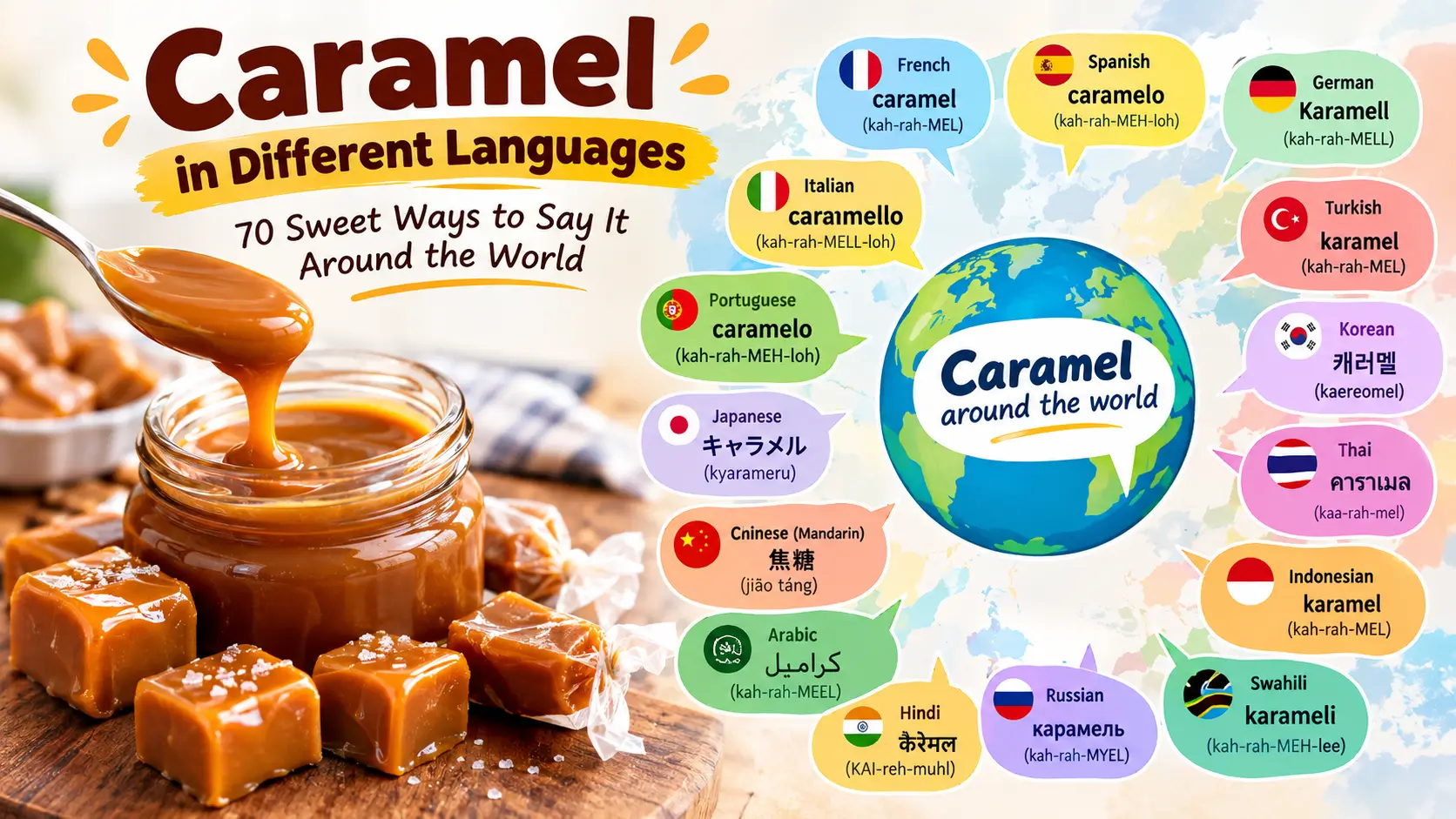
If you are wondering how to say caramel in different languages, this guide gives you 70 useful translations. Each entry includes the native word, an easy English pronunciation, and a short example sentence with its English meaning.
Whether you are learning languages, traveling, writing about food, or simply curious about how this delicious word changes around the world, these caramel translations provide a convenient reference.
Caramel in 70 Different Languages
The word for caramel is often similar across languages because the food and culinary term have spread internationally. However, pronunciation, spelling, grammatical gender, and local usage can differ.
| # | Language | Caramel in Native Language | Easy English Pronunciation | Example Sentence | English Meaning |
|---|---|---|---|---|---|
| 1 | English | caramel | KARR-uh-mel | I added caramel to my ice cream. | I added caramel to my ice cream. |
| 2 | Spanish | caramelo | kah-rah-MEH-loh | El helado tiene caramelo. | The ice cream has caramel. |
| 3 | French | caramel | kah-rah-MEL | J’aime le caramel dans les desserts. | I like caramel in desserts. |
| 4 | German | Karamell | kah-rah-MELL | Das Eis hat Karamell. | The ice cream has caramel. |
| 5 | Italian | caramello | kah-rah-MELL-loh | Il dolce ha del caramello. | The dessert has caramel. |
| 6 | Portuguese | caramelo | kah-rah-MEH-loh | Eu gosto de caramelo. | I like caramel. |
| 7 | Dutch | karamel | kah-rah-MEL | Ik eet karamel bij mijn ijs. | I eat caramel with my ice cream. |
| 8 | Swedish | karamell | kah-rah-MELL | Glassen har karamell. | The ice cream has caramel. |
| 9 | Danish | karamel | kah-rah-MEL | Jeg elsker karamel. | I love caramel. |
| 10 | Norwegian | karamell | kah-rah-MELL | Jeg liker karamell. | I like caramel. |
| 11 | Finnish | karamelli | kah-rah-MELL-lee | Jäätelössä on karamellia. | There is caramel in the ice cream. |
| 12 | Icelandic | karamella | kah-rah-MEL-la | Ég elska karamellu. | I love caramel. |
| 13 | Irish | caramal | KARR-uh-mal | Tá caramal sa mhilseog. | There is caramel in the dessert. |
| 14 | Welsh | caramel | kah-rah-MEL | Mae caramel ar yr hufen iâ. | There is caramel on the ice cream. |
| 15 | Polish | karmel | KAR-mel | Lubię karmel w lodach. | I like caramel in ice cream. |
| 16 | Czech | karamel | KAH-rah-mel | Mám rád karamel. | I like caramel. |
| 17 | Slovak | karamel | KAH-rah-mel | Mám rád karamel. | I like caramel. |
| 18 | Slovenian | karamela | kah-rah-MEH-lah | Obožujem karamelo. | I love caramel. |
| 19 | Croatian | karamela | kah-rah-MEH-lah | Volim karamelu. | I like caramel. |
| 20 | Serbian | карамела | kah-rah-MEH-lah | Волим карамелу. | I like caramel. |
| 21 | Bosnian | karamela | kah-rah-MEH-lah | Volim karamelu. | I like caramel. |
| 22 | Bulgarian | карамел | kah-rah-MEL | Обичам карамел. | I love caramel. |
| 23 | Macedonian | карамела | kah-rah-MEH-lah | Сакам карамела. | I love caramel. |
| 24 | Romanian | caramel | kah-rah-MEL | Îmi place caramelul. | I like caramel. |
| 25 | Hungarian | karamell | KAH-rah-mell | Szeretem a karamellt. | I like caramel. |
| 26 | Greek | καραμέλα | kah-rah-MEH-lah | Μου αρέσει η καραμέλα. | I like caramel. |
| 27 | Albanian | karamel | kah-rah-MEL | Më pëlqen karameli. | I like caramel. |
| 28 | Lithuanian | karamelė | kah-rah-meh-LEH | Man patinka karamelė. | I like caramel. |
| 29 | Latvian | karamele | kah-rah-MEH-leh | Man garšo karamele. | I like caramel. |
| 30 | Estonian | karamell | KAH-rah-mell | Mulle meeldib karamell. | I like caramel. |
| 31 | Russian | карамель | kah-rah-MYEL | Я люблю карамель. | I love caramel. |
| 32 | Ukrainian | карамель | kah-rah-MEL | Я люблю карамель. | I love caramel. |
| 33 | Belarusian | карамель | kah-rah-MYEL | Я люблю карамель. | I love caramel. |
| 34 | Armenian | կարամել | kah-rah-MEL | Ես սիրում եմ կարամել։ | I love caramel. |
| 35 | Georgian | კარამელი | kah-rah-MEH-lee | მე მიყვარს კარამელი. | I love caramel. |
| 36 | Turkish | karamel | kah-rah-MEL | Karamelli dondurma seviyorum. | I like caramel ice cream. |
| 37 | Azerbaijani | karamel | kah-rah-MEL | Mən karamel sevirəm. | I like caramel. |
| 38 | Persian | کارامل | kah-rah-MEL | من کارامل دوست دارم. | I like caramel. |
| 39 | Arabic | كراميل | kah-rah-MEEL | أحب الكراميل. | I love caramel. |
| 40 | Hebrew | קרמל | KAH-rah-mel | אני אוהב קרמל. | I like caramel. |
| 41 | Hindi | कैरेमल | KAI-reh-muhl | मुझे कैरेमल पसंद है। | I like caramel. |
| 42 | Urdu | کیریمل | KAI-ri-muhl | مجھے کیریمل پسند ہے۔ | I like caramel. |
| 43 | Bengali | ক্যারামেল | KAI-rah-mel | আমি ক্যারামেল পছন্দ করি। | I like caramel. |
| 44 | Punjabi | ਕੈਰਾਮਲ | KAI-rah-mal | ਮੈਨੂੰ ਕੈਰਾਮਲ ਪਸੰਦ ਹੈ। | I like caramel. |
| 45 | Gujarati | કેરામેલ | KAY-rah-mel | મને કેરામેલ ગમે છે. | I like caramel. |
| 46 | Marathi | कॅरॅमल | KAI-rah-muhl | मला कॅरॅमल आवडते. | I like caramel. |
| 47 | Tamil | கேரமல் | KAY-rah-mal | எனக்கு கேரமல் பிடிக்கும். | I like caramel. |
| 48 | Telugu | కారమెల్ | KAA-rah-mel | నాకు కారమెల్ ఇష్టం. | I like caramel. |
| 49 | Kannada | ಕ್ಯಾರಮೆಲ್ | KAI-rah-mel | ನನಗೆ ಕ್ಯಾರಮೆಲ್ ಇಷ್ಟ. | I like caramel. |
| 50 | Malayalam | കാരമൽ | KAA-rah-mal | എനിക്ക് കാരമൽ ഇഷ്ടമാണ്. | I like caramel. |
| 51 | Sinhala | කැරමල් | KAI-rah-mal | මම කැරමල් වලට කැමතියි. | I like caramel. |
| 52 | Nepali | क्यारामेल | KYA-rah-mel | मलाई क्यारामेल मन पर्छ। | I like caramel. |
| 53 | Chinese (Mandarin) | 焦糖 | jiāo táng | 我喜欢焦糖。 | I like caramel. |
| 54 | Japanese | キャラメル | kyarameru | キャラメルが好きです。 | I like caramel. |
| 55 | Korean | 캐러멜 | kaereomel | 저는 캐러멜을 좋아해요. | I like caramel. |
| 56 | Vietnamese | caramel | kah-rah-MEL | Tôi thích caramel. | I like caramel. |
| 57 | Thai | คาราเมล | kaa-rah-mel | ฉันชอบคาราเมล | I like caramel. |
| 58 | Indonesian | karamel | kah-rah-MEL | Saya suka karamel. | I like caramel. |
| 59 | Malay | karamel | kah-rah-MEL | Saya suka karamel. | I like caramel. |
| 60 | Filipino | karamelo | kah-rah-MEH-loh | Gusto ko ang karamelo. | I like caramel. |
| 61 | Swahili | karameli | kah-rah-MEH-lee | Ninapenda karameli. | I like caramel. |
| 62 | Afrikaans | karamel | KAH-rah-mel | Ek hou van karamel. | I like caramel. |
| 63 | Zulu | ikharameli | ee-kha-rah-MEH-lee | Ngiyathanda ikharameli. | I like caramel. |
| 64 | Xhosa | ikharameli | ee-kha-rah-MEH-lee | Ndiyayithanda ikharameli. | I like caramel. |
| 65 | Amharic | ካራሜል | kah-rah-MEL | ካራሜል እወዳለሁ። | I like caramel. |
| 66 | Somali | karamell | kah-rah-MELL | Waxaan jeclahay karamell. | I like caramel. |
| 67 | Malagasy | karamela | kah-rah-MEH-lah | Tiako ny karamela. | I like caramel. |
| 68 | Haitian Creole | karamèl | kah-rah-MEL | Mwen renmen karamèl. | I like caramel. |
| 69 | Esperanto | karamelo | kah-rah-MEH-loh | Mi ŝatas karamelon. | I like caramel. |
| 70 | Latin | caramelum | kah-rah-MEH-lum | Caramelum dulce est. | Caramel is sweet. |
How to Say Caramel in Different Languages
The easiest way to learn the word is to notice how frequently it resembles the English term. Spanish caramelo, Italian caramello, Portuguese caramelo, and Filipino karamelo, for example, share a recognizable sound and spelling.
In other languages, the word may be adapted to local writing systems. Arabic, Hebrew, Hindi, Urdu, Bengali, Chinese, Japanese, Korean, and several other languages use their own scripts.
One important exception is Mandarin Chinese, where 焦糖 (jiāo táng) is commonly used for caramel. The expression literally relates to the idea of burnt or caramelized sugar rather than simply copying the international spelling.
Caramel Translations Around the World
Caramel has become a global culinary term. It can describe the cooked sugar itself, a caramel-flavored ingredient, a sauce, candy, topping, or dessert component depending on the language and context.
In European languages, forms such as caramel, karamel, caramello, caramelo, and karamell are especially common. These similarities make the word relatively easy to recognize when traveling across Europe.
Across Asia, the spelling and pronunciation can change considerably. Japanese uses katakana for the borrowed culinary word, while Korean also uses a localized form. In Mandarin, the established term is different from the English loanword.
What Does Caramel Mean?
Caramel is produced when sugar is heated and undergoes caramelization. This process creates a characteristic brown color and a sweet, toasted flavor.
Depending on how it is prepared, caramel can be soft, chewy, liquid, or hard. It is commonly used in candies, cakes, puddings, cookies, ice cream, coffee drinks, and dessert sauces.
The term can therefore refer to both the ingredient and the flavor associated with it.
Caramel in Food and Desserts
Caramel is especially popular in desserts. Some familiar examples include caramel ice cream, caramel pudding, caramel apples, caramel candies, caramel sauce, and caramel-filled chocolates.
It is also frequently combined with ingredients such as chocolate, vanilla, coffee, sea salt, nuts, apples, and cream.
When ordering food in another country, knowing the local word for caramel can make it easier to understand menus and identify dessert flavors.
Why Are Caramel Words Similar in Many Languages?
The similarity comes largely from the international spread of culinary vocabulary. Many languages adopted words related to caramel and adapted them to their own spelling systems and pronunciation patterns.
That is why forms such as caramel, karamel, caramelo, caramello, and karamell appear across different language families.
However, similar spelling does not always mean identical pronunciation. Local pronunciation rules can significantly change the way the word sounds.
Caramel in All Languages: Quick Learning Tips
If you want to memorize caramel in different languages, group similar words together.
For example:
- caramel — French, Romanian, Vietnamese
- karamel — Dutch, Turkish, Azerbaijani
- karamell — German, Swedish, Norwegian, Hungarian
- caramelo — Spanish, Portuguese, Esperanto
- caramello — Italian
- karamela — Slovenian, Malagasy
- 焦糖 — Mandarin Chinese
- キャラメル — Japanese
- 캐러멜 — Korean
Learning these patterns can help you recognize related food vocabulary even when you encounter a language you have never studied before.
Frequently Asked Questions
1. How do you say caramel in different languages?
Caramel has many similar forms around the world. Examples include caramel in French, caramelo in Spanish, caramello in Italian, karamel in Turkish, karamell in German, 焦糖 in Mandarin Chinese, キャラメル in Japanese, and 캐러멜 in Korean.
2. What is caramel called in Spanish?
Caramel is caramelo in Spanish. It can refer to caramel candy and, depending on context, caramel as a sweet ingredient or flavor.
3. What is caramel called in French?
Caramel is caramel in French. The word is pronounced differently from English because French pronunciation rules apply.
4. What is caramel called in Japanese?
Caramel is commonly written キャラメル in Japanese. This is a katakana representation of the international word.
5. What is caramel called in Mandarin Chinese?
Caramel is commonly called 焦糖 (jiāo táng) in Mandarin Chinese. It is a standard culinary expression associated with caramelized sugar.
Conclusion
Learning caramel in different languages is a simple and enjoyable way to explore international food vocabulary. Many languages use words that closely resemble caramel, while others have their own traditional or adapted expressions.
From European forms such as caramelo, caramello, and karamell to Asian terms such as 焦糖, キャラメル, and 캐러멜, these 70 translations show how one familiar sweet flavor can be expressed around the world.
Use this list of caramel translations as a quick reference for language learning, travel, cooking, food writing, or discovering how people talk about sweet flavors around the world.

I’m Jesse Crawford, a language enthusiast and writer passionate about exploring different languages. I create helpful content that makes words, meanings, translations, and language learning simple, useful, and enjoyable for everyone.