The word “city” is one of the most useful everyday words for travelers, language learners, writers, and anyone interested in world languages. Although the idea of a city is universal, the word itself changes significantly from one language to another.
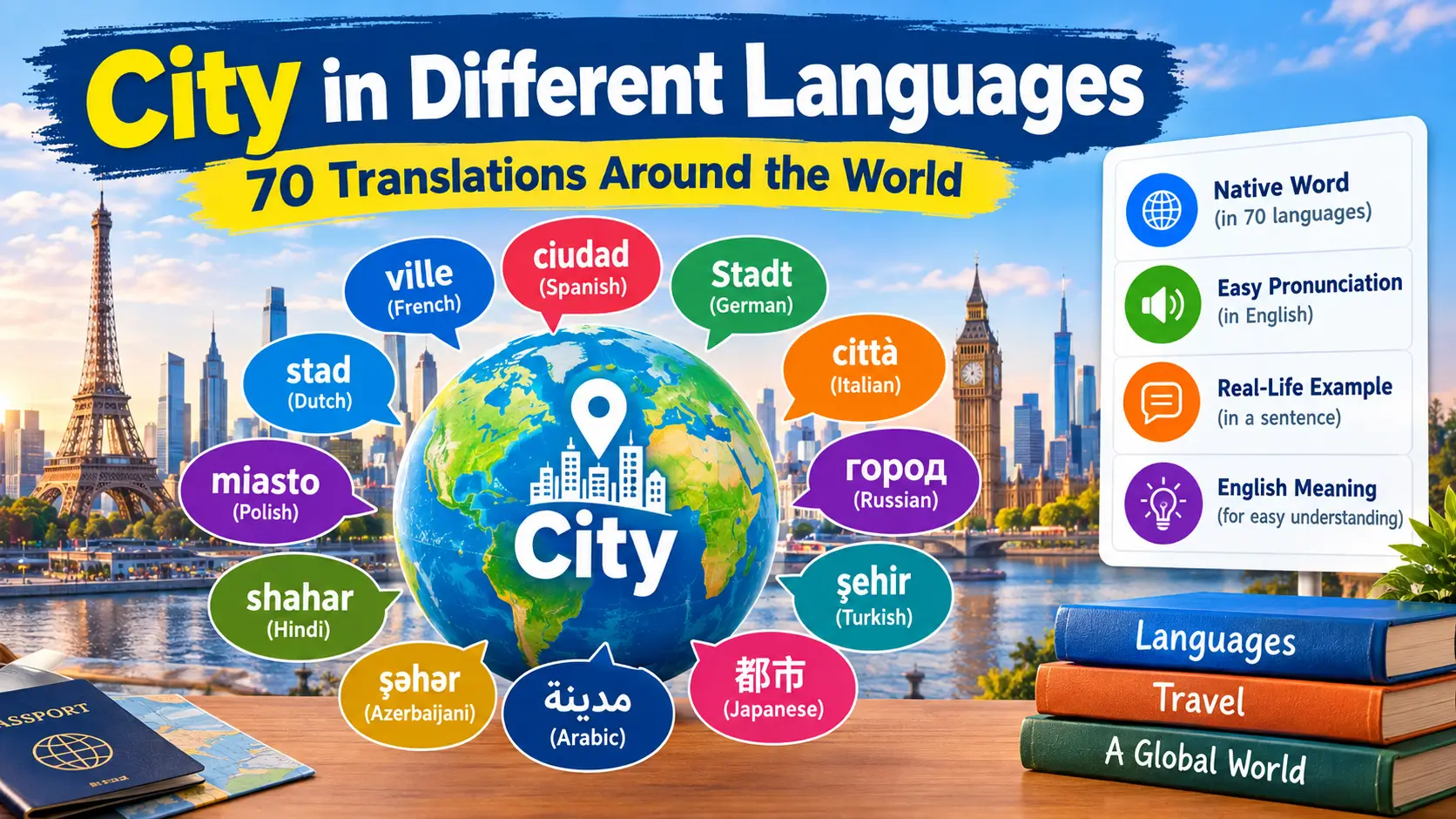
If you are searching for city in all languages, wondering how to say city in different languages, or looking for useful city translations, this guide gives you 70 carefully selected languages in one easy-to-read table.
You will find the native word, an easy English pronunciation, a short example sentence, and the English meaning. This makes it easier to understand how the word city is actually used in everyday communication around the world.
What Does “City” Mean?
A city is generally a large and densely populated urban settlement with buildings, roads, businesses, public services, and communities.
The exact definition of a city can vary between countries because different governments use different population, administrative, or legal standards. However, the basic idea remains similar: a city is a significant urban place where many people live and work.
City in Different Languages: 70 Translations
Here is a practical collection of city in different languages, including common native forms and simple pronunciation guides.
| # | Language | Native Phrase | Easy English Pronunciation | Example Sentence | English Meaning |
|---|---|---|---|---|---|
| 1 | Afrikaans | stad | staht | Ek woon in die stad. | I live in the city. |
| 2 | Albanian | qytet | CHOO-et | Ky qytet është i bukur. | This city is beautiful. |
| 3 | Amharic | ከተማ | keh-teh-ma | ይህ ከተማ ትልቅ ነው። | This city is large. |
| 4 | Arabic | مدينة | ma-DEE-na | هذه مدينة جميلة. | This is a beautiful city. |
| 5 | Armenian | քաղաք | kah-GHAHK | Այս քաղաքը գեղեցիկ է։ | This city is beautiful. |
| 6 | Assamese | চহৰ | SO-ho-r | এই চহৰখন ধুনীয়া। | This city is beautiful. |
| 7 | Aymara | jach’a marka | HAH-cha MAR-ka | Jach’a marka wali suma-wa. | The city is very beautiful. |
| 8 | Azerbaijani | şəhər | sheh-HER | Bu şəhər çox gözəldir. | This city is very beautiful. |
| 9 | Basque | hiria | hee-REE-ah | Hiria handia da. | The city is large. |
| 10 | Belarusian | горад | HO-rat | Гэты горад прыгожы. | This city is beautiful. |
| 11 | Bengali | শহর | SHO-hor | এই শহরটি সুন্দর। | This city is beautiful. |
| 12 | Bhojpuri | शहर | sha-HAR | ई शहर बहुत सुंदर बा। | This city is very beautiful. |
| 13 | Bosnian | grad | grahd | Ovaj grad je lijep. | This city is beautiful. |
| 14 | Bulgarian | град | graht | Този град е красив. | This city is beautiful. |
| 15 | Burmese | မြို့ | myoh | ဒီမြို့က လှတယ်။ | This city is beautiful. |
| 16 | Catalan | ciutat | see-oo-TAHT | Aquesta ciutat és gran. | This city is large. |
| 17 | Cebuano | siyudad | see-yoo-DAD | Matahum ang siyudad. | The city is beautiful. |
| 18 | Chinese (Simplified) | 城市 | chéng-shì | 这个城市很漂亮。 | This city is beautiful. |
| 19 | Chinese (Traditional) | 城市 | chéng-shì | 這個城市很漂亮。 | This city is beautiful. |
| 20 | Corsican | cità | chee-TAH | A cità hè bella. | The city is beautiful. |
| 21 | Croatian | grad | grahd | Ovaj grad je lijep. | This city is beautiful. |
| 22 | Czech | město | MYEH-stoh | Toto město je krásné. | This city is beautiful. |
| 23 | Danish | by | boo | Denne by er smuk. | This city is beautiful. |
| 24 | Dhivehi | ޝަހަރު | sha-ha-roo | މި ޝަހަރަކީ ރީތި ޝަހަރެއް. | This is a beautiful city. |
| 25 | Dutch | stad | staht | Deze stad is mooi. | This city is beautiful. |
| 26 | Esperanto | urbo | OOR-boh | Ĉi tiu urbo estas bela. | This city is beautiful. |
| 27 | Estonian | linn | linn | See linn on ilus. | This city is beautiful. |
| 28 | Ewe | dugã | doo-GAH | Dugã la nyo. | The city is beautiful. |
| 29 | Filipino | lungsod | LOONG-sod | Maganda ang lungsod. | The city is beautiful. |
| 30 | Finnish | kaupunki | KOW-poon-kee | Tämä kaupunki on kaunis. | This city is beautiful. |
| 31 | French | ville | veel | Cette ville est belle. | This city is beautiful. |
| 32 | Galician | cidade | see-DAH-deh | Esta cidade é fermosa. | This city is beautiful. |
| 33 | Georgian | ქალაქი | ka-la-kee | ეს ქალაქი ლამაზია. | This city is beautiful. |
| 34 | German | Stadt | shtat | Diese Stadt ist schön. | This city is beautiful. |
| 35 | Greek | πόλη | PO-lee | Αυτή η πόλη είναι όμορφη. | This city is beautiful. |
| 36 | Gujarati | શહેર | SHA-her | આ શહેર સુંદર છે. | This city is beautiful. |
| 37 | Haitian Creole | vil | veel | Vil la bèl. | The city is beautiful. |
| 38 | Hausa | birni | BEER-nee | Wannan birni yana da kyau. | This city is beautiful. |
| 39 | Hawaiian | kulanakauhale | koo-lah-nah-kow-HAH-leh | He nani kēia kulanakauhale. | This city is beautiful. |
| 40 | Hebrew | עיר | EER | העיר הזאת יפה. | This city is beautiful. |
| 41 | Hindi | शहर | SHA-har | यह शहर बहुत सुंदर है। | This city is very beautiful. |
| 42 | Hungarian | város | VAA-rosh | Ez a város szép. | This city is beautiful. |
| 43 | Icelandic | borg | por-k | Þessi borg er falleg. | This city is beautiful. |
| 44 | Indonesian | kota | KOH-ta | Kota ini indah. | This city is beautiful. |
| 45 | Irish | cathair | KA-hir | Tá an chathair go hálainn. | The city is beautiful. |
| 46 | Italian | città | chee-TAH | Questa città è bella. | This city is beautiful. |
| 47 | Japanese | 都市 | TO-shi | この都市は美しいです。 | This city is beautiful. |
| 48 | Javanese | kutha | KOO-thah | Kutha iki apik. | This city is beautiful. |
| 49 | Kannada | ನಗರ | NA-ga-ra | ಈ ನಗರ ಸುಂದರವಾಗಿದೆ. | This city is beautiful. |
| 50 | Kazakh | қала | qa-LA | Бұл қала әдемі. | This city is beautiful. |
| 51 | Khmer | ទីក្រុង | tii-krong | ទីក្រុងនេះស្អាត។ | This city is beautiful. |
| 52 | Korean | 도시 | do-si | 이 도시는 아름다워요. | This city is beautiful. |
| 53 | Lao | ເມືອງ | meuang | ເມືອງນີ້ງາມ. | This city is beautiful. |
| 54 | Latin | urbs | oorbs | Haec urbs pulchra est. | This city is beautiful. |
| 55 | Latvian | pilsēta | pil-SAY-ta | Šī pilsēta ir skaista. | This city is beautiful. |
| 56 | Lithuanian | miestas | MYES-tas | Šis miestas yra gražus. | This city is beautiful. |
| 57 | Malagasy | tanàna | ta-NAH-na | Tsara ity tanàna ity. | This city is beautiful. |
| 58 | Malay | bandar | BAHN-dar | Bandar ini cantik. | This city is beautiful. |
| 59 | Malayalam | നഗരം | na-ga-ram | ഈ നഗരം മനോഹരമാണ്. | This city is beautiful. |
| 60 | Marathi | शहर | sha-HAR | हे शहर सुंदर आहे. | This city is beautiful. |
| 61 | Mongolian | хот | khot | Энэ хот үзэсгэлэнтэй. | This city is beautiful. |
| 62 | Nepali | शहर | sha-HAR | यो शहर सुन्दर छ। | This city is beautiful. |
| 63 | Norwegian | by | bee | Denne byen er vakker. | This city is beautiful. |
| 64 | Persian | شهر | shahr | این شهر زیباست. | This city is beautiful. |
| 65 | Polish | miasto | MYA-stoh | To miasto jest piękne. | This city is beautiful. |
| 66 | Portuguese | cidade | see-DAH-deh | Esta cidade é bonita. | This city is beautiful. |
| 67 | Romanian | oraș | oh-RASH | Acest oraș este frumos. | This city is beautiful. |
| 68 | Russian | город | GO-rat | Этот город красивый. | This city is beautiful. |
| 69 | Serbian | град | grahd | Ovaj grad je lep. | This city is beautiful. |
| 70 | Slovak | mesto | MES-toh | Toto mesto je krásne. | This city is beautiful. |
How to Say “City” in Different Languages
There is no single universal translation for city. The word changes according to the language and its grammatical system.
For example, some familiar forms include ville in French, ciudad in Spanish, Stadt in German, città in Italian, miasto in Polish, город in Russian, and şehir in Turkish.
In some languages, the same word may be used for both a city and a broader urban settlement, while other languages have separate words for concepts such as “town,” “large city,” “capital,” or “metropolis.”
City Translations Around the World
The variety of words for city shows how languages develop their own vocabulary for places and communities.
Romance languages often have forms related to historical Latin vocabulary. Germanic languages have their own distinct terms, while Slavic languages frequently use related forms such as grad, gorod, or miasto.
Asian languages can use completely different structures. For example, Mandarin Chinese uses 城市, Japanese commonly uses 都市, and Korean uses 도시.
These differences make city translations especially interesting for language learners.
Why Learn the Word “City” in Other Languages?
Learning a basic word such as “city” can be useful in many situations.
Travel
You may need the word when asking about a destination, discussing transportation, finding accommodation, or talking about where you live.
Language Learning
Common nouns provide a useful foundation for building sentences. Once you know the local word for city, you can combine it with words such as “beautiful,” “large,” “old,” “capital,” or “near.”
Cultural Understanding
Different languages divide concepts differently. Learning the local vocabulary can give you a better understanding of how people describe their surroundings.
Writing and Communication
Knowing city in all languages can also help writers, students, translators, and multilingual content creators choose appropriate terminology.
City vs. Town: Are They the Same?
Not always.
In English, a city generally refers to a larger or officially recognized urban settlement, while a town is often smaller. However, the distinction varies greatly between countries.
Some languages have words that can cover a wider range of meanings than the English word “city.” Therefore, direct word-for-word translation does not always capture every cultural or administrative distinction.
Useful Phrases With “City”
Once you know how to say city, you can build many practical phrases.
Common examples include:
- big city
- small city
- beautiful city
- old city
- modern city
- capital city
- city center
- city life
- city park
- city streets
- near the city
- in the city
These phrases are particularly useful when traveling or learning conversational vocabulary.
How to Pronounce “City” in Different Languages
Pronunciation varies considerably across languages.
Some languages use sounds that are familiar to English speakers, while others contain sounds, tones, or writing systems that require more practice. The pronunciation guides in the table are intentionally simplified for English readers rather than being strict phonetic transcriptions.
For accurate pronunciation, it is also important to remember that regional accents can change how a word sounds.
City in All Languages: A Quick Comparison
Some of the most recognizable translations are:
- English: city
- French: ville
- Spanish: ciudad
- Italian: città
- German: Stadt
- Portuguese: cidade
- Dutch: stad
- Greek: πόλη
- Russian: город
- Polish: miasto
- Arabic: مدينة
- Hindi: शहर
- Persian: شهر
- Chinese: 城市
- Japanese: 都市
- Korean: 도시
- Indonesian: kota
- Turkish: şehir
This quick comparison makes it easy to see how different languages express the same everyday idea.
Frequently Asked Questions
1. How do you say “city” in different languages?
The word “city” has many different translations. Examples include ville in French, ciudad in Spanish, Stadt in German, città in Italian, город in Russian, 城市 in Chinese, and 도시 in Korean.
2. What is “city” in 10 different languages?
Ten examples are English city, French ville, Spanish ciudad, German Stadt, Italian città, Portuguese cidade, Russian город, Polish miasto, Arabic مدينة, and Hindi शहर.
3. What is the most common translation of “city”?
There is no single translation that is common across all languages. Every language has its own standard term, although some languages may have several words depending on size, location, or context.
4. How do you say “city” in European languages?
Examples include ville in French, ciudad in Spanish, Stadt in German, città in Italian, cidade in Portuguese, miasto in Polish, mesto in Slovak, město in Czech, and pilsēta in Latvian.
5. Why are there different words for “city” around the world?
Languages developed independently through different histories, cultures, and language families. As a result, the same concept can have completely different words and pronunciation patterns in different regions.
Conclusion
The word “city” may describe the same basic idea around the world, but its translation changes from language to language. From ville and ciudad to Stadt, città, miasto, 城市, and 도시, these 70 translations demonstrate the incredible variety of human language.
Whether you are traveling, studying languages, writing multilingual content, or simply curious about city around the world, learning these words is a simple and useful way to explore global vocabulary.

I am Ava Jones, a language enthusiast and author passionate about exploring different languages, sharing useful phrases, explaining meanings, and helping readers communicate confidently across cultures and countries.