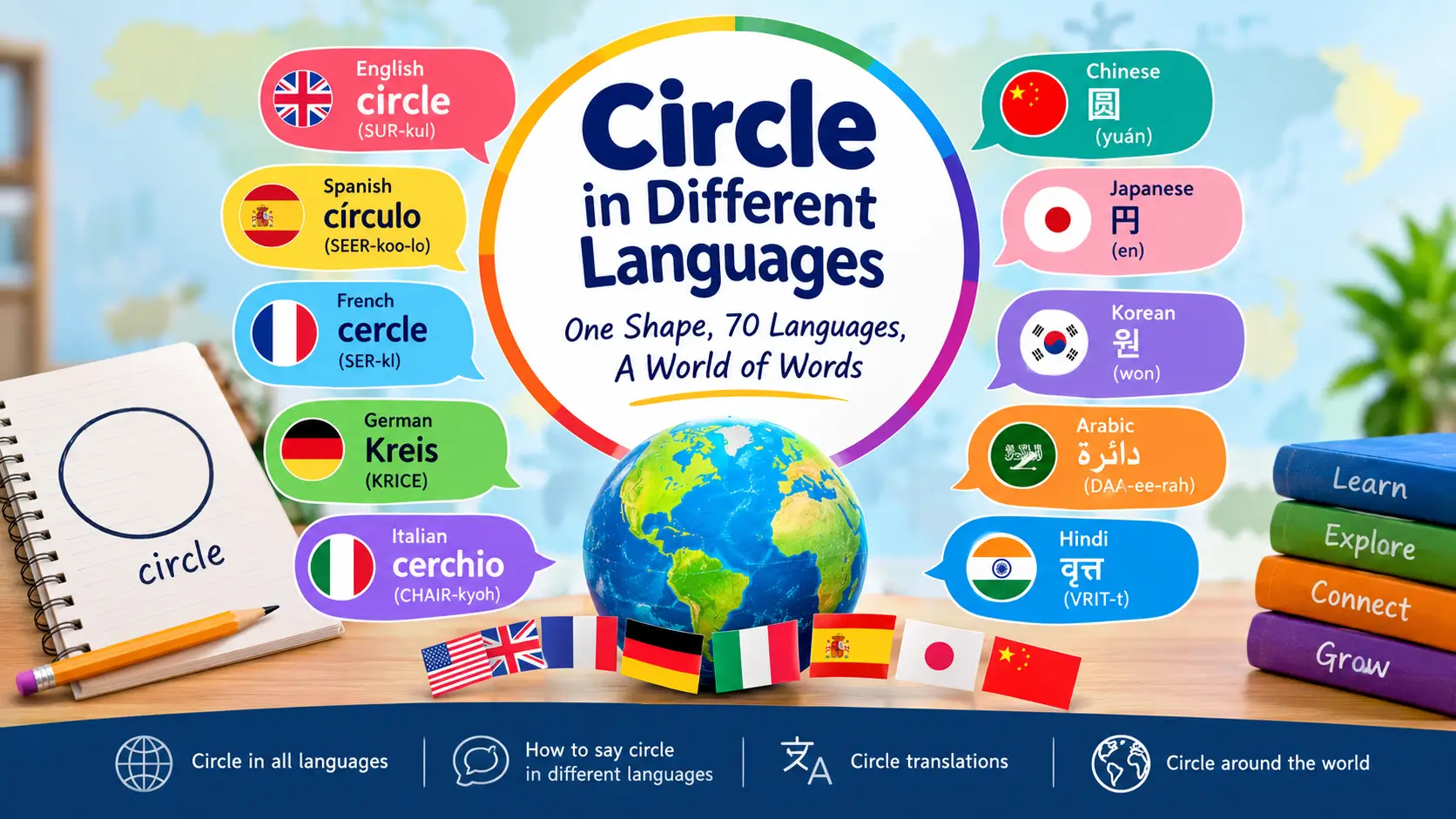
The word circle describes one of the most familiar shapes in the world: a perfectly round figure in which every point is the same distance from the center. It appears in mathematics, art, design, nature, architecture, signs, and everyday conversation.
If you are learning languages, traveling, studying geometry, or simply curious about circle in different languages, learning this simple word can be a useful vocabulary exercise. Below, you will find 70 circle translations, including the native word or phrase, an easy English pronunciation, and a practical example sentence.
This guide explains how to say circle in different languages and helps you understand how the concept is expressed around the world.
Circle in All Languages: 70 Translations
The table below provides circle in all languages in a simple format. Where a language uses different words depending on whether “circle” means a geometric shape, a group, or something that moves around, the table focuses primarily on the geometric shape.
| # | Language | Native phrase | Easy English pronunciation | Example sentence | English meaning |
|---|---|---|---|---|---|
| 1 | English | circle | SUR-kul | Draw a circle on the paper. | Draw a circle on the paper. |
| 2 | Spanish | círculo | SEER-koo-lo | Dibuja un círculo aquí. | Draw a circle here. |
| 3 | French | cercle | SER-kl | Dessine un cercle ici. | Draw a circle here. |
| 4 | German | Kreis | KRICE | Zeichne einen Kreis. | Draw a circle. |
| 5 | Italian | cerchio | CHAIR-kyoh | Disegna un cerchio. | Draw a circle. |
| 6 | Portuguese | círculo | SEER-koo-loo | Desenhe um círculo. | Draw a circle. |
| 7 | Dutch | cirkel | SEER-kul | Teken een cirkel. | Draw a circle. |
| 8 | Swedish | cirkel | SEER-kel | Rita en cirkel. | Draw a circle. |
| 9 | Norwegian | sirkel | SEER-kel | Tegn en sirkel. | Draw a circle. |
| 10 | Danish | cirkel | SEER-kel | Tegn en cirkel. | Draw a circle. |
| 11 | Finnish | ympyrä | UM-puh-rah | Piirrä ympyrä. | Draw a circle. |
| 12 | Icelandic | hringur | HRING-ur | Teiknaðu hring. | Draw a circle. |
| 13 | Irish | ciorcal | KEER-kul | Tarraing ciorcal. | Draw a circle. |
| 14 | Welsh | cylch | KULKH | Tynnwch gylch. | Draw a circle. |
| 15 | Polish | koło | KOH-woh | Narysuj koło. | Draw a circle. |
| 16 | Czech | kruh | KROOKH | Nakresli kruh. | Draw a circle. |
| 17 | Slovak | kruh | KROOKH | Nakresli kruh. | Draw a circle. |
| 18 | Slovenian | krog | KROHG | Nariši krog. | Draw a circle. |
| 19 | Croatian | krug | KROOG | Nacrtaj krug. | Draw a circle. |
| 20 | Serbian | круг | KROOG | Нацртај круг. | Draw a circle. |
| 21 | Bulgarian | кръг | KRUHG | Нарисувай кръг. | Draw a circle. |
| 22 | Macedonian | круг | KROOG | Нацртај круг. | Draw a circle. |
| 23 | Russian | круг | KROOK | Нарисуй круг. | Draw a circle. |
| 24 | Ukrainian | коло | KOH-loh | Намалюй коло. | Draw a circle. |
| 25 | Belarusian | круг | KROOG | Намалюй круг. | Draw a circle. |
| 26 | Lithuanian | apskritimas | ap-skree-TEE-mas | Nubrėžk apskritimą. | Draw a circle. |
| 27 | Latvian | aplis | AP-liss | Uzzīmē apli. | Draw a circle. |
| 28 | Estonian | ring | RING | Joonista ring. | Draw a circle. |
| 29 | Hungarian | kör | KUR | Rajzolj egy kört. | Draw a circle. |
| 30 | Romanian | cerc | CHERK | Desenează un cerc. | Draw a circle. |
| 31 | Albanian | rreth | RRETH | Vizato një rreth. | Draw a circle. |
| 32 | Greek | κύκλος | KEE-klohs | Σχεδίασε έναν κύκλο. | Draw a circle. |
| 33 | Turkish | daire | dah-ee-REH | Bir daire çiz. | Draw a circle. |
| 34 | Azerbaijani | dairə | dah-ee-REH | Bir dairə çək. | Draw a circle. |
| 35 | Armenian | շրջան | shur-YAN | Շրջան նկարիր։ | Draw a circle. |
| 36 | Georgian | წრე | TSREH | დახატე წრე. | Draw a circle. |
| 37 | Arabic | دائرة | DAA-ee-rah | ارسم دائرة. | Draw a circle. |
| 38 | Hebrew | מעגל | ma-AG-al | צייר מעגל. | Draw a circle. |
| 39 | Persian | دایره | DAA-yeh-reh | یک دایره بکش. | Draw a circle. |
| 40 | Urdu | دائرہ | DAA-i-rah | ایک دائرہ بنائیں۔ | Draw a circle. |
| 41 | Hindi | वृत्त | VRIT-t | एक वृत्त बनाइए। | Draw a circle. |
| 42 | Bengali | বৃত্ত | BRIT-to | একটি বৃত্ত আঁকুন। | Draw a circle. |
| 43 | Punjabi | ਚੱਕਰ | CHUK-kar | ਇੱਕ ਚੱਕਰ ਬਣਾਓ। | Draw a circle. |
| 44 | Gujarati | વર્તુળ | VAR-too-ul | એક વર્તુળ દોરો. | Draw a circle. |
| 45 | Marathi | वर्तुळ | VAR-tul | एक वर्तुळ काढा. | Draw a circle. |
| 46 | Nepali | वृत्त | VRIT-ta | एउटा वृत्त कोर्नुहोस्। | Draw a circle. |
| 47 | Sinhala | වෘත්තය | VUR-tha-ya | වෘත්තයක් අඳින්න. | Draw a circle. |
| 48 | Tamil | வட்டம் | VAT-tam | ஒரு வட்டம் வரையுங்கள். | Draw a circle. |
| 49 | Telugu | వృత్తం | VRIT-tam | ఒక వృత్తం గీయండి. | Draw a circle. |
| 50 | Kannada | ವೃತ್ತ | VRIT-ta | ಒಂದು ವೃತ್ತ ಬಿಡಿಸಿ. | Draw a circle. |
| 51 | Malayalam | വൃത്തം | VRIT-tam | ഒരു വൃത്തം വരയ്ക്കുക. | Draw a circle. |
| 52 | Thai | วงกลม | wong-glom | วาดวงกลม | Draw a circle. |
| 53 | Vietnamese | hình tròn | hing chon | Vẽ một hình tròn. | Draw a circle. |
| 54 | Indonesian | lingkaran | ling-KAH-ran | Gambar sebuah lingkaran. | Draw a circle. |
| 55 | Malay | bulatan | boo-LAH-tan | Lukis satu bulatan. | Draw a circle. |
| 56 | Filipino | bilog | bee-LOG | Gumuhit ng bilog. | Draw a circle. |
| 57 | Chinese | 圆 | yuán | 画一个圆。 | Draw a circle. |
| 58 | Japanese | 円 | en | 円を描いてください。 | Please draw a circle. |
| 59 | Korean | 원 | won | 원을 그리세요. | Draw a circle. |
| 60 | Mongolian | тойрог | TOY-rog | Тойрог зур. | Draw a circle. |
| 61 | Kazakh | шеңбер | sheng-BYER | Шеңбер сыз. | Draw a circle. |
| 62 | Uzbek | doira | doh-EE-rah | Doira chizing. | Draw a circle. |
| 63 | Swahili | duara | doo-AH-rah | Chora duara. | Draw a circle. |
| 64 | Afrikaans | sirkel | SEER-kel | Teken ‘n sirkel. | Draw a circle. |
| 65 | Zulu | indilinga | in-dee-LING-ah | Dweba indilinga. | Draw a circle. |
| 66 | Amharic | ክብ | kib | ክብ ሳል። | Draw a circle. |
| 67 | Somali | goobo | GOO-boh | Sawir goobo. | Draw a circle. |
| 68 | Yoruba | yípo | YEE-poh | Ya yípo kan. | Draw a circle. |
| 69 | Haitian Creole | sèk | SEK | Desine yon sèk. | Draw a circle. |
| 70 | Latin | circulus | KIR-koo-loos | Circulum trahe. | Draw a circle. |
What Does “Circle” Mean?
A circle is a round geometric shape formed by all points that are the same distance from a central point. That fixed distance is called the radius.
In everyday English, however, “circle” can have other meanings. It can describe a group of people, a circular movement, or something arranged in a round shape.
For example:
- Geometric: Draw a circle.
- Social: She has a close circle of friends.
- Movement: The birds circle above the field.
- Arrangement: Everyone sat in a circle.
The exact translation can therefore depend on the context.
How to Say “Circle” in Different Languages
If you are searching for how to say circle in different languages, the most useful approach is to learn the word together with an example.
Some translations are closely related because languages share historical roots. For example, several European languages use forms related to Latin circulus. Other languages use completely different words.
Asian languages can also express the geometric idea differently. Chinese uses 圆, Japanese commonly uses 円 for the geometric term, and Korean uses 원.
Circle Translations for Travel and Everyday Conversation
Knowing basic shape words can be surprisingly useful when communicating abroad.
You may need the word “circle” when:
- Giving directions
- Describing a logo or sign
- Explaining a drawing
- Talking about mathematics
- Shopping for a particular shape
- Discussing art or design
- Describing an object
- Helping children learn vocabulary
A short sentence is often easier to remember than a dictionary entry alone.
Circle Around the World
The idea of a circle is universal, but languages package the concept in different ways. Some languages have a short single-word translation, while others commonly use a phrase meaning something similar to round shape.
This makes circle around the world an interesting example of how languages describe the same basic concept through different vocabulary systems.
Circle in Mathematics
In mathematics, a circle has a precise definition.
Important circle-related terms include:
- Center: The fixed point in the middle.
- Radius: The distance from the center to the edge.
- Diameter: A line passing through the center from one side to the other.
- Circumference: The distance around the circle.
- Chord: A line segment connecting two points on the circle.
- Arc: A section of the circle’s circumference.
The basic relationship between radius and diameter is:
Diameter = 2 × Radius
The circumference can be calculated using:
C = 2πr
These mathematical terms are useful when studying geometry in another language.
Common Uses of the Word “Circle”
The English word circle appears in many situations beyond geometry.
Circle as a Shape
“The clock has a circle around the numbers.”
Circle as a Group
“He is part of my professional circle.”
Circle as an Action
“The plane began to circle the airport.”
Circle in Directions
“Go around the traffic circle and take the second exit.”
Context matters because the best translation may change depending on which meaning is intended.
Why Learn “Circle” in Multiple Languages?
Learning one everyday word across many languages can improve vocabulary, pronunciation, and cultural awareness.
The word is also easy to connect with visual memory. If you imagine a simple round shape while learning each translation, the vocabulary can become easier to recall.
For language learners, this is especially useful when building themed vocabulary lists around shapes, colors, numbers, objects, and common descriptions.
Tips for Remembering Circle Translations
Try these simple techniques:
- Connect the word to the shape. Imagine a circle whenever you review the vocabulary.
- Say the word aloud. Repetition helps reinforce pronunciation.
- Use a complete sentence. Context makes vocabulary easier to remember.
- Compare related languages. Similar words can reveal useful patterns.
- Practice regularly. A few minutes of review can be more effective than one long study session.
Frequently Asked Questions
1. What is “circle” in different languages?
“Circle” has different translations depending on the language. Examples include círculo in Spanish, cercle in French, Kreis in German, cerchio in Italian, دائرة in Arabic, 円 in Japanese, and 원 in Korean.
2. How do you say “circle” in Spanish?
In Spanish, “circle” is círculo. It is commonly used to describe a geometric circle or round shape.
3. What is the word for circle in French?
The French word for “circle” is cercle. It is used for the geometric shape and in several related expressions.
4. How do you say “circle” in Japanese?
The geometric term commonly used for “circle” in Japanese is 円. Japanese also has other related words depending on the specific meaning and context.
5. Is “circle” translated the same way in every language?
No. Different languages use different words and grammatical structures for the concept of a circle. Some languages may also use different terms depending on whether the word refers to a geometric shape, a group of people, or circular movement.
Conclusion
Learning circle in different languages is a simple way to expand vocabulary while discovering how different cultures express the same universal idea. From Spanish círculo and French cercle to Arabic دائرة, Chinese 圆, Japanese 円, and Korean 원, these circle translations show the fascinating variety of languages around the world.
Whether you are studying languages, teaching children, exploring geometry, or looking for circle in all languages, this 70-language guide gives you a practical starting point.

I am Ricardo Hunter, Administrator at LingoBuz, passionate about languages, translations, and global communication. I help create useful, clear content that makes exploring different languages simple, enjoyable, and accessible.