The word “cinder” usually refers to a small piece of partly burned coal, wood, or other material that remains after a fire. It can also describe a small piece of volcanic material, depending on the context. Learning the word in other languages is useful for travelers, language learners, translators, writers, and anyone interested in how everyday vocabulary changes across cultures.
In this guide, you will discover cinder in different languages, including the native translation, an easy English pronunciation, a practical example sentence, and the English meaning of that sentence. These cinder translations focus mainly on the common meaning of a burned or glowing fragment left by a fire. Where a language uses a different natural expression, the closest everyday equivalent is provided.
Cinder in Different Languages
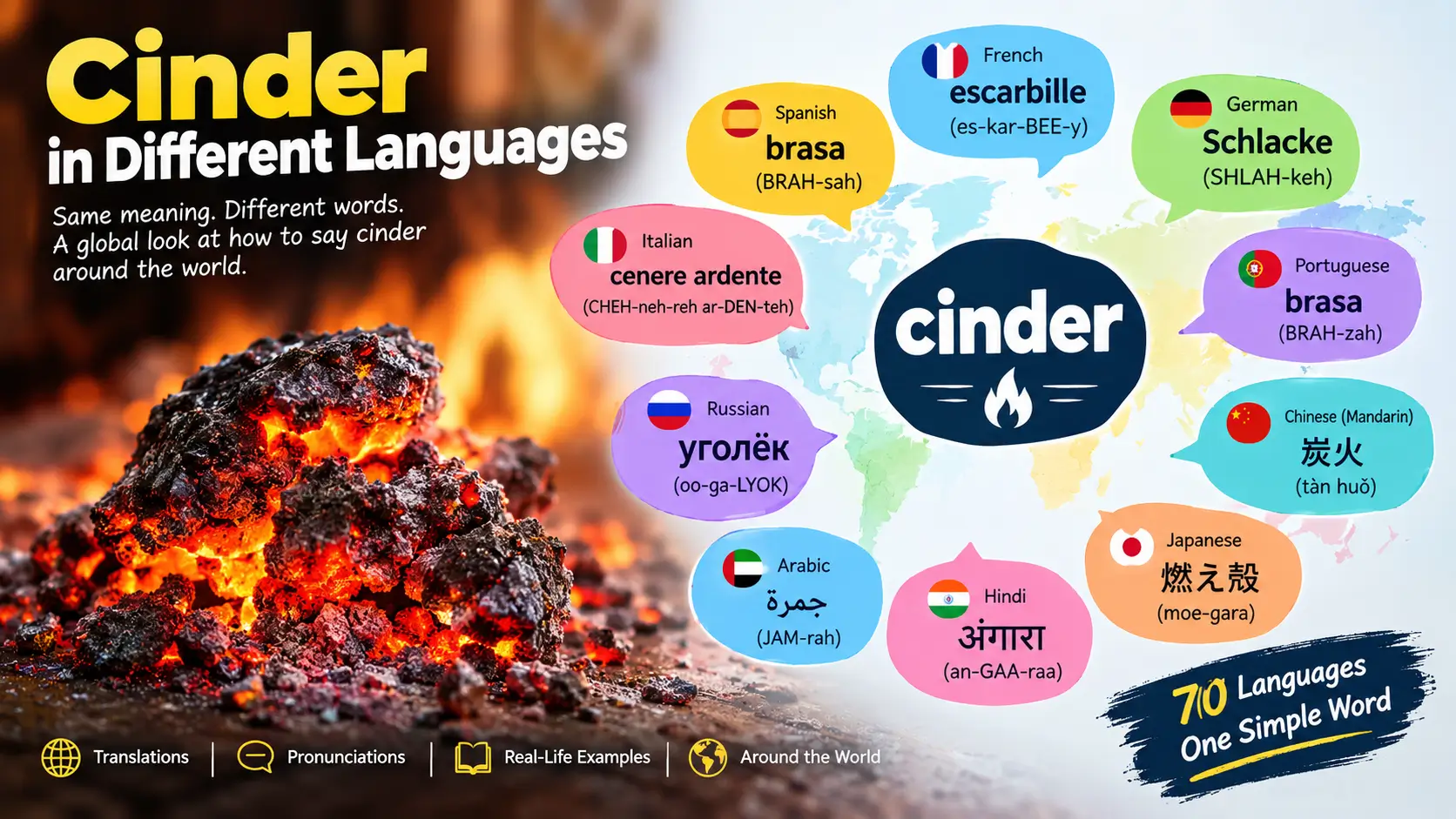
The table below gives 70 ways to say cinder in different languages. It is designed to make it easy to compare cinder in all languages and understand how the word works in real-life sentences.
| # | Language | Native Phrase | Easy English Pronunciation | Example Sentence | English Meaning |
|---|---|---|---|---|---|
| 1 | English | cinder | SIN-der | A cinder fell from the fire. | A small burned piece fell from the fire. |
| 2 | Spanish | brasa | BRAH-sah | Una brasa cayó del fuego. | An ember fell from the fire. |
| 3 | French | escarbille | es-kar-BEE-y | Une escarbille est tombée du feu. | A cinder fell from the fire. |
| 4 | German | Schlacke | SHLAH-keh | Eine Schlacke fiel aus dem Feuer. | A cinder fell from the fire. |
| 5 | Italian | cenere ardente | CHEH-neh-reh ar-DEN-teh | Una cenere ardente è caduta dal fuoco. | A glowing cinder fell from the fire. |
| 6 | Portuguese | brasa | BRAH-zah | Uma brasa caiu do fogo. | An ember fell from the fire. |
| 7 | Dutch | sintel | SIN-tel | Een sintel viel uit het vuur. | A cinder fell from the fire. |
| 8 | Afrikaans | sintel | SIN-tel | ’n Sintel het uit die vuur geval. | A cinder fell from the fire. |
| 9 | Swedish | glöd | GLOHD | En glöd föll från elden. | A glowing ember fell from the fire. |
| 10 | Norwegian | glør | GLUR | En glør falt fra bålet. | A glowing ember fell from the fire. |
| 11 | Danish | glød | GLUR | En glød faldt fra bålet. | A glowing ember fell from the fire. |
| 12 | Icelandic | glóð | GLOHTH | Glóð féll úr eldinum. | A glowing ember fell from the fire. |
| 13 | Finnish | kekäle | KEH-keh-leh | Kekäle putosi tulesta. | A glowing coal fell from the fire. |
| 14 | Estonian | hõõguv süsi | HUR-goov SOO-see | Hõõguv süsi kukkus tulest. | A glowing coal fell from the fire. |
| 15 | Latvian | kvēle | KVAY-leh | Kvēle nokrita no uguns. | A glowing cinder fell from the fire. |
| 16 | Lithuanian | žarija | ZHAH-ree-yah | Žarija nukrito nuo ugnies. | An ember fell from the fire. |
| 17 | Polish | żar | ZHAR | Żar spadł z ognia. | A glowing cinder fell from the fire. |
| 18 | Czech | žhavý uhlík | ZHAH-vee OO-gleek | Žhavý uhlík spadl z ohně. | A glowing coal fell from the fire. |
| 19 | Slovak | žeravý uhlík | ZHEH-rah-vee OO-gleek | Žeravý uhlík spadol z ohňa. | A glowing coal fell from the fire. |
| 20 | Slovenian | žerjavica | zheh-RYAH-vee-tsah | Žerjavica je padla iz ognja. | A glowing cinder fell from the fire. |
| 21 | Croatian | žar | ZHAR | Žar je pao s vatre. | A glowing cinder fell from the fire. |
| 22 | Serbian | жар | ZHAR | Жар је пао из ватре. | A glowing cinder fell from the fire. |
| 23 | Bosnian | žar | ZHAR | Žar je pao iz vatre. | A glowing cinder fell from the fire. |
| 24 | Bulgarian | жар | ZHAR | Жар падна от огъня. | A glowing cinder fell from the fire. |
| 25 | Macedonian | жар | ZHAR | Жар падна од огнот. | A glowing cinder fell from the fire. |
| 26 | Russian | уголёк | oo-ga-LYOK | Уголёк упал из костра. | A glowing coal fell from the campfire. |
| 27 | Ukrainian | жаринка | zha-RIN-kah | Жаринка впала з вогню. | A glowing cinder fell from the fire. |
| 28 | Belarusian | вугалёк | voo-ga-LYOK | Вугалёк упаў з агню. | A glowing coal fell from the fire. |
| 29 | Romanian | tăciune | tuh-CHOON-eh | Un tăciune a căzut din foc. | A cinder fell from the fire. |
| 30 | Hungarian | parázs | PAH-rahzh | Egy parázs kiesett a tűzből. | A glowing cinder fell from the fire. |
| 31 | Greek | αναμμένο κάρβουνο | ah-nah-MEH-no KAR-voo-no | Ένα αναμμένο κάρβουνο έπεσε από τη φωτιά. | A glowing coal fell from the fire. |
| 32 | Albanian | prush | PROOSH | Një prush ra nga zjarri. | A glowing cinder fell from the fire. |
| 33 | Turkish | kor | KOR | Ateşten bir kor düştü. | A glowing ember fell from the fire. |
| 34 | Azerbaijani | köz | KYOEZ | Oddan bir köz düşdü. | A glowing ember fell from the fire. |
| 35 | Georgian | ნაკვერცხალი | nak-VER-tskhah-lee | ნაკვერცხალი ცეცხლიდან გადმოვარდა. | A cinder fell from the fire. |
| 36 | Armenian | կայծակ | KAY-tsak | Կայծակ կրակից ընկավ։ | A glowing piece fell from the fire. |
| 37 | Arabic | جمرة | JAM-rah | سقطت جمرة من النار. | A cinder fell from the fire. |
| 38 | Hebrew | גחל | GAH-khal | גחל נפל מהאש. | A cinder fell from the fire. |
| 39 | Persian | اخگر | AKH-gar | اخگری از آتش افتاد. | A glowing cinder fell from the fire. |
| 40 | Urdu | انگارہ | an-GAA-rah | آگ سے ایک انگارہ گرا۔ | A cinder fell from the fire. |
| 41 | Hindi | अंगारा | an-GAA-raa | आग से एक अंगारा गिरा। | A cinder fell from the fire. |
| 42 | Bengali | অঙ্গার | ON-gar | আগুন থেকে একটি অঙ্গার পড়ল। | A cinder fell from the fire. |
| 43 | Punjabi | ਅੰਗਿਆਰ | an-GYAAR | ਅੱਗ ਵਿੱਚੋਂ ਇੱਕ ਅੰਗਿਆਰ ਡਿੱਗਿਆ। | A cinder fell from the fire. |
| 44 | Gujarati | અંગારો | an-GAA-ro | આગમાંથી એક અંગારો પડ્યો. | A cinder fell from the fire. |
| 45 | Marathi | निखारा | nee-KHAA-raa | आगीतून एक निखारा पडला. | A cinder fell from the fire. |
| 46 | Nepali | अंगारो | an-GAA-ro | आगोबाट एउटा अंगारो खस्यो। | A cinder fell from the fire. |
| 47 | Sinhala | ගිනි අඟුරු | GEE-nee ANG-goo-roo | ගින්නෙන් ගිනි අඟුරක් වැටුණා. | A cinder fell from the fire. |
| 48 | Tamil | நெருப்புத்தணல் | neh-RUP-poo-tha-nal | நெருப்பிலிருந்து ஒரு தணல் விழுந்தது. | A cinder fell from the fire. |
| 49 | Telugu | నిప్పురవ్వ | nip-pu-RAV-va | మంట నుంచి ఒక నిప్పురవ్వ పడింది. | A glowing cinder fell from the fire. |
| 50 | Kannada | ಕೆಂಡ | KEN-da | ಬೆಂಕಿಯಿಂದ ಒಂದು ಕೆಂಡ ಬಿತ್ತು. | A cinder fell from the fire. |
| 51 | Malayalam | കനൽ | ka-NAL | തീയിൽ നിന്ന് ഒരു കനൽ വീണു. | A glowing cinder fell from the fire. |
| 52 | Odia | ଅଙ୍ଗାର | on-GAA-ra | ନିଆଁରୁ ଏକ ଅଙ୍ଗାର ପଡ଼ିଲା। | A cinder fell from the fire. |
| 53 | Assamese | আঙঠা | aa-UNG-thaa | জুইৰ পৰা এটা আঙঠা পৰিল। | A cinder fell from the fire. |
| 54 | Chinese (Mandarin) | 炭火 | tàn huǒ | 一块炭火掉下来了。 | A piece of glowing coal fell down. |
| 55 | Japanese | 燃え殻 | moe-gara | 燃え殻が火から落ちた。 | A cinder fell from the fire. |
| 56 | Korean | 불씨 | bul-ssi | 불씨가 불에서 떨어졌어요. | A glowing ember fell from the fire. |
| 57 | Vietnamese | than hồng | tan hong | Một cục than hồng rơi khỏi lửa. | A glowing cinder fell from the fire. |
| 58 | Thai | ถ่านคุ | thaan khoo | ถ่านคุหล่นจากกองไฟ | A glowing cinder fell from the fire. |
| 59 | Indonesian | bara | BAH-rah | Bara jatuh dari api. | A glowing ember fell from the fire. |
| 60 | Malay | bara | BAH-rah | Bara jatuh dari api. | A glowing ember fell from the fire. |
| 61 | Filipino | baga | BAH-gah | Nahulog ang baga mula sa apoy. | A cinder fell from the fire. |
| 62 | Javanese | bara | BAH-rah | Bara tiba saka geni. | A cinder fell from the fire. |
| 63 | Swahili | kaa | KAH-ah | Kaa lilianguka kutoka motoni. | A glowing coal fell from the fire. |
| 64 | Zulu | ilahle | ee-LAH-hleh | Ilahle liwile emlilweni. | A cinder fell from the fire. |
| 65 | Xhosa | ilahle | ee-LAH-hleh | Ilahle liwile emlilweni. | A cinder fell from the fire. |
| 66 | Amharic | ፍም | fim | ፍም ከእሳቱ ወደቀ። | A cinder fell from the fire. |
| 67 | Somali | dhuxul | DHOO-khul | Dhuxul ayaa dabka ka dhacday. | A piece of charcoal fell from the fire. |
| 68 | Haitian Creole | chabon cho | shah-BON sho | Yon chabon cho tonbe nan dife a. | A hot cinder fell from the fire. |
| 69 | Latin | carbo ardens | KAR-boh AR-dens | Carbo ardens ex igne cecidit. | A glowing cinder fell from the fire. |
| 70 | Esperanto | ardaĵo | ar-DAH-yoh | Ardaĵo falis el la fajro. | A cinder fell from the fire. |
What Does “Cinder” Mean?
A cinder is generally a small piece of material that remains after something has burned. In everyday English, it can refer to a partly burned piece of wood or coal, especially one that may still be glowing.
The word can also be used in descriptions of volcanic material. For example, cinder can refer to small fragments of lava or other volcanic material produced during an eruption.
The exact translation depends on context. In many languages, the most natural equivalent is closer to ember, glowing coal, burning fragment, or ash-covered coal rather than a literal one-word translation.
How to Say Cinder in Different Languages
If you are wondering how to say cinder in different languages, the answer varies according to the meaning you intend.
For a piece of burning or glowing material from a fire, words such as brasa in Spanish and Portuguese, bara in Indonesian and Malay, żar in several Slavic languages, and angāra in Hindi and Urdu convey the idea of a glowing coal or ember.
This distinction is important because English separates words such as cinder, ember, coal, and ash, while another language may use one common word for two or more of these ideas.
Cinder vs. Ember: Are They the Same?
“Cinder” and “ember” are closely related, but they are not always exact synonyms.
An ember is typically a piece of material that is still glowing and capable of producing heat. A cinder can describe a partly burned piece left after a fire and may be less actively glowing.
For everyday conversation, however, many translations use a word meaning ember or glowing coal because that is often the most natural expression in the target language.
Cinder Translations Around the World
The cinder translations in this list show an interesting linguistic pattern. European languages often have separate words associated with glowing coal, ash, slag, or burned material. South Asian languages commonly use words associated with glowing or burning fragments. In many Asian and African languages, the natural translation is expressed through a phrase describing hot coal, fire residue, or an ember.
This is why a dictionary translation should always be checked against the sentence in which the word appears.
Common Uses of the Word “Cinder”
The word “cinder” can appear in several contexts:
- A cinder from a fire — a small burned fragment.
- Glowing cinder — a hot piece that still gives off light or heat.
- Cinder block — a lightweight concrete building block, traditionally associated with coal cinders.
- Volcanic cinder — a small fragment of volcanic material.
- Cinder path — a path historically made using crushed cinders or similar material.
Because these meanings are different, the best translation may change depending on the context.
How to Use “Cinder” in a Sentence
Here are a few natural English examples:
The wind blew a cinder out of the fireplace.
This means a small burned piece was carried out of the fireplace by the wind.
A glowing cinder remained after the fire went out.
This means a hot, glowing piece was still present after the main fire had disappeared.
The firefighter noticed a cinder near the dry grass.
Here, the cinder could still be hot enough to create a fire risk.
Why Cinder Translations Can Differ
Languages do not always divide the meanings of objects in the same way. One language may have a precise word for a glowing coal, while another may normally use a broader word for burning material.
For this reason, translating cinder in different languages word-for-word can sometimes produce an unnatural result. Context-based translation is usually more useful than simply matching one dictionary entry to another.
Cinder in All Languages: Quick Reference
For quick reference, some of the most useful equivalents are:
- Spanish: brasa
- French: escarbille
- German: Schlacke
- Italian: cenere ardente
- Portuguese: brasa
- Dutch: sintel
- Polish: żar
- Russian: уголёк
- Turkish: kor
- Arabic: جمرة
- Persian: اخگر
- Urdu: انگارہ
- Hindi: अंगारा
- Bengali: অঙ্গার
- Punjabi: ਅੰਗਿਆਰ
- Chinese: 炭火
- Japanese: 燃え殻
- Korean: 불씨
- Vietnamese: than hồng
- Indonesian: bara
- Malay: bara
- Swahili: kaa
- Latin: carbo ardens
- Esperanto: ardaĵo
Frequently Asked Questions About Cinder in Different Languages
1. What is “cinder” in Spanish?
The common Spanish word for a glowing piece of coal or wood is brasa. It is often used for an ember or hot coal remaining in a fire.
2. What is “cinder” in Hindi?
In Hindi, अंगारा (angāra) refers to a glowing piece of coal or burning material. It is a natural choice when describing a cinder from a fire.
3. What is “cinder” in Urdu?
In Urdu, انگارہ (angāra) means a glowing piece of coal or burning material and is commonly used for the idea of a cinder or ember.
4. Is “cinder” the same as “ember”?
Not always. An ember is generally a glowing, hot piece of wood or coal, while cinder can refer more broadly to a partly burned fragment left after a fire. The exact distinction depends on context.
5. What is the best way to translate “cinder”?
The best translation depends on what “cinder” means in the sentence. For a glowing piece from a fire, words meaning ember, glowing coal, or hot coal are often the most natural equivalents.
Conclusion
Learning cinder in different languages reveals how languages describe fire, heat, coal, and burned materials in different ways. Although a direct one-word translation is possible in some languages, others naturally use expressions such as “glowing coal” or “hot ember.”
Whether you are researching cinder in all languages, studying vocabulary, writing multilingual content, or looking for cinder translations around the world, the 70-language table above provides a practical starting point. Always consider the context, especially when “cinder” refers to volcanic material rather than a fragment left by a fire.

I am Ava Jones, a language enthusiast and author passionate about exploring different languages, sharing useful phrases, explaining meanings, and helping readers communicate confidently across cultures and countries.