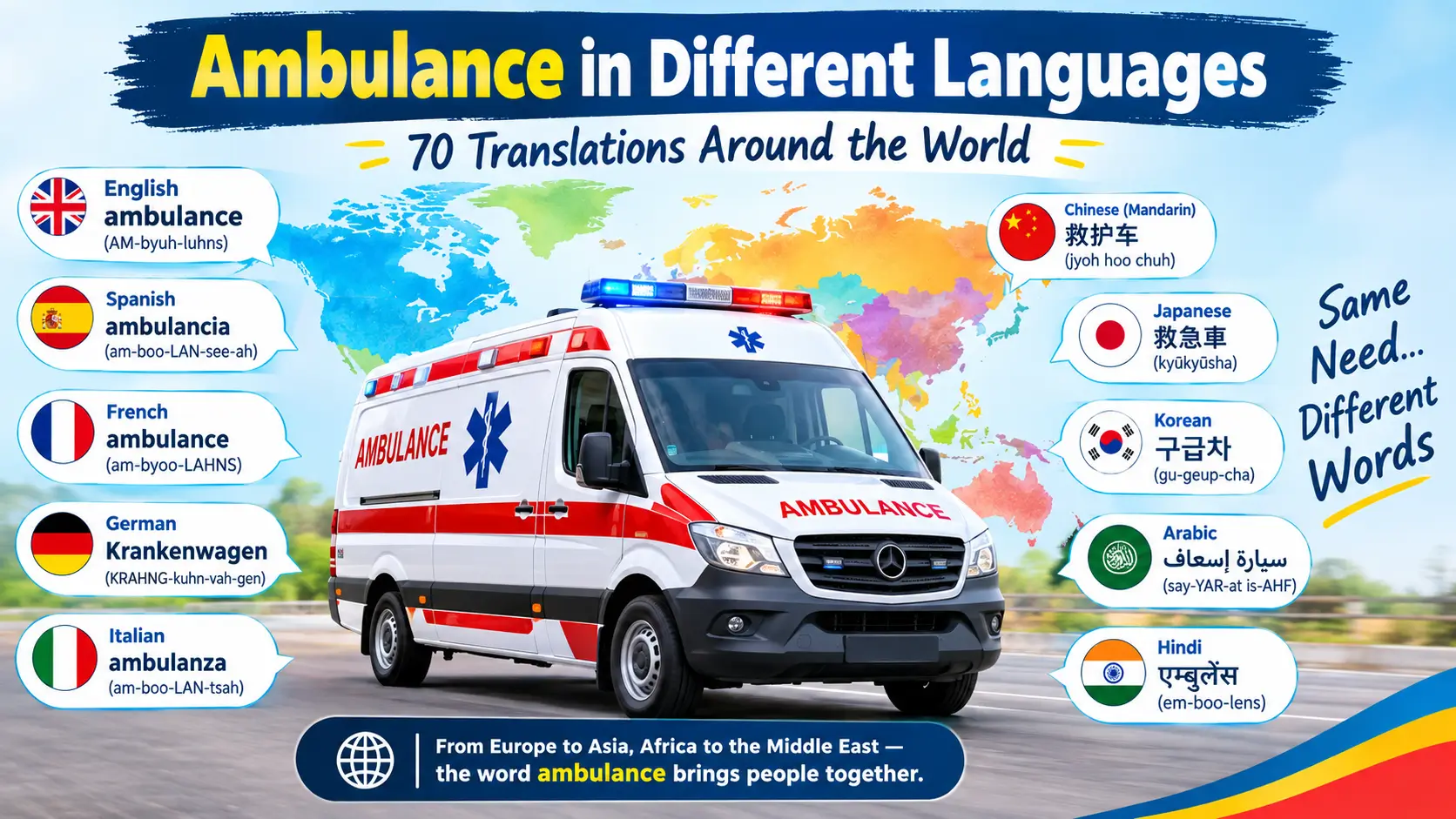
The word ambulance is one of the most important emergency terms to recognize when traveling, studying languages, or communicating during a medical emergency. Although the word is similar in many languages, its pronunciation and written form can vary significantly.
If you want to know how to say ambulance in different languages, this guide provides 70 translations with easy pronunciations and practical example sentences. You will also discover ambulance translations from Europe, Asia, Africa, the Middle East, and other parts of the world.
Whether you are learning vocabulary, preparing for international travel, or researching ambulance in all languages, this table makes the information easy to compare.
Ambulance in Different Languages: 70 Translations
| # | Language | Native Phrase | Easy English Pronunciation | Example Sentence | English Meaning |
|---|---|---|---|---|---|
| 1 | English | ambulance | AM-byuh-luhns | Call an ambulance quickly. | Call an ambulance quickly. |
| 2 | Spanish | ambulancia | am-boo-LAN-see-ah | La ambulancia está llegando. | The ambulance is arriving. |
| 3 | French | ambulance | am-byoo-LAHNS | L’ambulance arrive bientôt. | The ambulance is arriving soon. |
| 4 | German | Krankenwagen | KRAHNG-kuhn-vah-gen | Der Krankenwagen kommt. | The ambulance is coming. |
| 5 | Italian | ambulanza | am-boo-LAN-tsah | L’ambulanza sta arrivando. | The ambulance is arriving. |
| 6 | Portuguese | ambulância | am-boo-LAHN-see-ah | A ambulância chegou. | The ambulance arrived. |
| 7 | Dutch | ambulance | am-bu-LAN-suh | De ambulance komt eraan. | The ambulance is on its way. |
| 8 | Swedish | ambulans | am-boo-LAHNS | Ambulansen kommer snart. | The ambulance is coming soon. |
| 9 | Norwegian | ambulanse | am-boo-LAHN-suh | Ambulansen er her. | The ambulance is here. |
| 10 | Danish | ambulance | am-boo-LAN-suh | Ambulancen kommer nu. | The ambulance is coming now. |
| 11 | Finnish | ambulanssi | am-boo-LAHN-see | Ambulanssi saapuu pian. | The ambulance will arrive soon. |
| 12 | Icelandic | sjúkrabíll | SYOOK-rah-beetl | Sjúkrabíllinn kemur. | The ambulance is coming. |
| 13 | Irish | otharcharr | OH-hur-khahr | Tá an t-otharcharr ag teacht. | The ambulance is coming. |
| 14 | Welsh | ambiwlans | am-BEE-wlans | Mae’r ambiwlans yn dod. | The ambulance is coming. |
| 15 | Scottish Gaelic | carbad-eiridinn | KAR-bad EH-ri-din | Tha an carbad-eiridinn a’ tighinn. | The ambulance is coming. |
| 16 | Polish | karetka | ka-RET-kah | Karetka już jedzie. | The ambulance is already coming. |
| 17 | Czech | sanitka | SAH-neet-kah | Sanitka přijede brzy. | The ambulance will arrive soon. |
| 18 | Slovak | sanitka | SAH-neet-kah | Sanitka už prichádza. | The ambulance is already coming. |
| 19 | Slovenian | reševalno vozilo | reh-SHEH-vahl-noh vo-ZEE-loh | Reševalno vozilo prihaja. | The ambulance is coming. |
| 20 | Croatian | hitna pomoć | HEET-nah poh-MOHCH | Hitna pomoć stiže. | The ambulance is arriving. |
| 21 | Serbian | хитна помоћ | HEET-nah poh-MOCH | Хитна помоћ стиже. | The ambulance is arriving. |
| 22 | Bosnian | hitna pomoć | HEET-nah poh-MOHCH | Hitna pomoć dolazi. | The ambulance is coming. |
| 23 | Macedonian | брза помош | BR-zah POH-mosh | Брза помош пристигнува. | The ambulance is arriving. |
| 24 | Bulgarian | линейка | lee-NAY-kah | Линейката идва. | The ambulance is coming. |
| 25 | Romanian | ambulanță | am-boo-LANT-suh | Ambulanța sosește. | The ambulance is arriving. |
| 26 | Hungarian | mentőautó | MEN-toh-ow-toh | A mentőautó megérkezik. | The ambulance is arriving. |
| 27 | Greek | ασθενοφόρο | ah-stheh-no-FO-ro | Το ασθενοφόρο έρχεται. | The ambulance is coming. |
| 28 | Albanian | ambulancë | am-boo-LAHN-tsuh | Ambulanca po vjen. | The ambulance is coming. |
| 29 | Lithuanian | greitoji pagalba | GRAY-toy-yee pah-gal-BAH | Greitoji pagalba atvyksta. | The ambulance is arriving. |
| 30 | Latvian | ātrā palīdzība | AH-trah pah-LID-zee-bah | Ātrā palīdzība ir ceļā. | The ambulance is on the way. |
| 31 | Estonian | kiirabi | KEE-rah-bee | Kiirabi tuleb. | The ambulance is coming. |
| 32 | Russian | скорая помощь | SKOH-rah-yah POH-mosh | Скорая помощь уже едет. | The ambulance is already coming. |
| 33 | Ukrainian | швидка допомога | SHVYD-kah doh-poh-MOH-hah | Швидка допомога їде. | The ambulance is coming. |
| 34 | Belarusian | хуткая дапамога | khoot-KAH-yah dya-poh-MOH-gah | Хуткая дапамога едзе. | The ambulance is coming. |
| 35 | Armenian | շտապօգնություն | shtahp-og-noo-TYOON | Շտապօգնությունը գալիս է։ | The ambulance is coming. |
| 36 | Georgian | სასწრაფო დახმარება | sah-STSAH-fo dah-kh-mah-REH-bah | სასწრაფო დახმარება მოდის. | The ambulance is coming. |
| 37 | Turkish | ambulans | am-boo-LAHNS | Ambulans geliyor. | The ambulance is coming. |
| 38 | Azerbaijani | təcili yardım | teh-JEE-lee yah-RAHM | Təcili yardım gəlir. | The ambulance is coming. |
| 39 | Persian | آمبولانس | am-boo-LANS | آمبولانس در راه است. | The ambulance is on the way. |
| 40 | Arabic | سيارة إسعاف | say-YAR-at is-AHF | سيارة الإسعاف قادمة. | The ambulance is coming. |
| 41 | Hebrew | אמבולנס | am-boo-LAHNS | האמבולנס מגיע. | The ambulance is arriving. |
| 42 | Hindi | एम्बुलेंस | em-boo-lens | एम्बुलेंस आ रही है। | The ambulance is coming. |
| 43 | Urdu | ایمبولینس | em-boo-lens | ایمبولینس آ رہی ہے۔ | The ambulance is coming. |
| 44 | Bengali | অ্যাম্বুলেন্স | am-boo-lens | অ্যাম্বুলেন্স আসছে। | The ambulance is coming. |
| 45 | Punjabi | ਐਂਬੂਲੈਂਸ | aim-boo-lens | ਐਂਬੂਲੈਂਸ ਆ ਰਹੀ ਹੈ। | The ambulance is coming. |
| 46 | Gujarati | એમ્બ્યુલન્સ | em-byoo-lans | એમ્બ્યુલન્સ આવી રહી છે. | The ambulance is coming. |
| 47 | Marathi | रुग्णवाहिका | roog-nah-VAH-hee-kah | रुग्णवाहिका येत आहे. | The ambulance is coming. |
| 48 | Nepali | एम्बुलेन्स | em-boo-lens | एम्बुलेन्स आउँदैछ। | The ambulance is coming. |
| 49 | Sinhala | ගිලන් රථය | gee-LAN ra-tha-yah | ගිලන් රථය එනවා. | The ambulance is coming. |
| 50 | Tamil | ஆம்புலன்ஸ் | aam-boo-lans | ஆம்புலன்ஸ் வருகிறது. | The ambulance is coming. |
| 51 | Telugu | అంబులెన్స్ | am-boo-lens | అంబులెన్స్ వస్తోంది. | The ambulance is coming. |
| 52 | Kannada | ಆಂಬ್ಯುಲೆನ್ಸ್ | aam-byoo-lens | ಆಂಬ್ಯುಲೆನ್ಸ್ ಬರುತ್ತಿದೆ. | The ambulance is coming. |
| 53 | Malayalam | ആംബുലൻസ് | aam-boo-lans | ആംബുലൻസ് വരുന്നു. | The ambulance is coming. |
| 54 | Thai | รถพยาบาล | rot pha-yaa-baan | รถพยาบาลกำลังมา | The ambulance is coming. |
| 55 | Vietnamese | xe cứu thương | seh koo THUONG | Xe cứu thương đang đến. | The ambulance is arriving. |
| 56 | Indonesian | ambulans | am-boo-lans | Ambulans sedang datang. | The ambulance is coming. |
| 57 | Malay | ambulans | am-boo-lans | Ambulans sedang datang. | The ambulance is coming. |
| 58 | Filipino | ambulansya | am-boo-LAN-sha | Darating na ang ambulansya. | The ambulance is arriving. |
| 59 | Chinese (Mandarin) | 救护车 | jyoh hoo chuh | 救护车来了。 | The ambulance is here. |
| 60 | Japanese | 救急車 | kyūkyūsha | 救急車が来ています。 | The ambulance is coming. |
| 61 | Korean | 구급차 | gu-geup-cha | 구급차가 오고 있어요. | The ambulance is coming. |
| 62 | Mongolian | түргэн тусламжийн машин | toor-gen toos-lam-jin mash-een | Түргэн тусламжийн машин ирж байна. | The ambulance is coming. |
| 63 | Kazakh | жедел жәрдем | zhe-del zhar-dem | Жедел жәрдем келе жатыр. | The ambulance is coming. |
| 64 | Uzbek | tez yordam mashinasi | tez yah-dam mah-shee-na-see | Tez yordam mashinasi kelmoqda. | The ambulance is coming. |
| 65 | Swahili | ambulensi | am-boo-LEN-see | Ambulensi inakuja. | The ambulance is coming. |
| 66 | Afrikaans | ambulans | am-boo-LAHNS | Die ambulans kom. | The ambulance is coming. |
| 67 | Amharic | አምቡላንስ | am-boo-lans | አምቡላንስ እየመጣ ነው። | The ambulance is coming. |
| 68 | Somali | ambalaas | am-bah-LAAS | Ambalaasku wuu imaanayaa. | The ambulance is coming. |
| 69 | Yoruba | ọkọ aláìsàn | oh-koh ah-LAH-ee-sahn | Ọkọ aláìsàn ń bọ̀. | The ambulance is coming. |
| 70 | Hausa | motar asibiti | moh-tar ah-see-bee-tee | Motar asibiti tana zuwa. | The ambulance is coming. |
What Does Ambulance Mean?
An ambulance is an emergency vehicle designed to transport sick or injured people and, depending on the service, provide medical care during transportation.
The word is widely recognized internationally. Many languages use a form related to the English or French word ambulance, while others use a descriptive expression meaning something like “emergency vehicle,” “medical vehicle,” or “vehicle for the sick.”
This difference is one reason that learning ambulance in different languages can be useful for travelers and language learners.
How to Say Ambulance in Different Languages
The simplest way to learn the word is to group the translations by region.
In many European languages, the word looks or sounds similar to ambulance, including Spanish, French, Italian, Dutch, Turkish, Romanian, and several Scandinavian languages.
Other languages use completely different expressions. For example, German uses Krankenwagen, literally referring to a vehicle for sick people. Several Slavic languages commonly use expressions associated with emergency or urgent medical assistance.
Across Asia, translations vary even more. Mandarin Chinese uses 救护车, while Japanese uses 救急車 and Korean uses 구급차. In South Asia, several languages use forms derived from “ambulance,” while others have traditional descriptive terms.
Ambulance Translations in European Languages
European languages provide an interesting mix of similar and distinct vocabulary.
French uses ambulance, which has influenced terminology in several other languages. Spanish uses ambulancia, Italian uses ambulanza, and Portuguese uses ambulância.
German is different, using Krankenwagen, while Hungarian uses mentőautó. In Eastern Europe, terms such as скорая помощь in Russian and швидка допомога in Ukrainian refer to emergency medical assistance.
These differences show why simply recognizing the English spelling is not always enough when traveling.
Ambulance in Asian Languages
Asian languages offer some of the most interesting ambulance translations.
In Mandarin Chinese, 救护车 refers to an ambulance. Japanese uses 救急車, while Korean uses 구급차. Thai uses รถพยาบาล, and Vietnamese uses xe cứu thương.
In India and neighboring countries, the word is often recognizable as a variation of “ambulance.” Hindi uses एम्बुलेंस, Urdu uses ایمبولینس, and Bengali uses অ্যাম্বুলেন্স.
Knowing the local term can make emergency communication easier, particularly when asking for medical assistance.
Ambulance in Middle Eastern Languages
Arabic uses سيارة إسعاف, a phrase referring to an emergency or rescue vehicle. Persian commonly uses آمبولانس, while Hebrew uses אמבולנס.
Turkish uses ambulans, making it one of the easier terms for English speakers to recognize.
When traveling internationally, learning both the local word for ambulance and a simple emergency phrase can be helpful.
Ambulance Around the World
The word ambulance around the world demonstrates how languages borrow, adapt, and create their own vocabulary.
Some languages preserve a word that closely resembles the international term “ambulance.” Others describe the vehicle according to its purpose. The result is a fascinating range of words for the same essential emergency service.
The translations in this guide cover 70 languages and include European, Asian, African, and Middle Eastern languages.
Why Learn the Word Ambulance in Other Languages?
Learning this word can be practical rather than purely academic.
If you travel internationally, you may need to recognize an ambulance sign, ask someone to call an ambulance, or understand a conversation involving emergency medical services.
Language learners can also use the word to expand vocabulary around related terms such as:
- hospital
- doctor
- emergency
- medicine
- injury
- first aid
- patient
- police
- fire service
- emergency room
Learning these words together creates a useful emergency vocabulary set.
How to Use Ambulance in a Real-Life Situation
Knowing the translation is only the first step. In an emergency, a short and clear sentence is usually more useful than a complicated one.
Useful sentence patterns include:
- “Call an ambulance.”
- “The ambulance is coming.”
- “Where is the ambulance?”
- “We need an ambulance.”
- “Please call emergency services.”
When communicating with someone who does not speak your language, keeping your sentence short can reduce confusion.
Ambulance in All Languages: Quick Learning Tips
If your goal is to remember ambulance in all languages, avoid trying to memorize all 70 terms at once.
Start with five to ten languages that are relevant to your travel, work, family, or language studies. Then compare the spelling and pronunciation.
A useful strategy is to group similar words together. Terms such as ambulance, ambulancia, and ambulanza are easier to remember as a family because they share a common linguistic history.
For languages with completely different words, associate the native phrase with its meaning and example sentence.
Common Questions About Ambulance Translations
1. What is ambulance in different languages?
“Ambulance” has different translations depending on the language. Examples include ambulancia in Spanish, ambulanza in Italian, Krankenwagen in German, 救护车 in Mandarin Chinese, 救急車 in Japanese, and 구급차 in Korean.
2. How do you say ambulance in Spanish?
In Spanish, ambulance is ambulancia. It is commonly used when referring to an emergency medical vehicle.
3. What is ambulance in French?
In French, ambulance is ambulance. The spelling is the same as English, although the pronunciation differs.
4. What is ambulance in Hindi and Urdu?
Hindi uses एम्बुलेंस, while Urdu uses ایمبولینس. Both terms are commonly recognizable as adaptations of the international word “ambulance.”
5. Which languages use a word similar to ambulance?
Many languages use words that resemble ambulance, including Spanish, French, Italian, Portuguese, Dutch, Swedish, Norwegian, Danish, Turkish, Romanian, Indonesian, Malay, and several South Asian languages.
Conclusion
Learning ambulance in different languages is useful for travelers, students, multilingual families, and anyone interested in international vocabulary. The 70 translations above show how different languages express the same essential emergency concept.
From familiar forms such as “ambulance” and “ambulancia” to distinctive terms such as Krankenwagen, 救护车, and 救急車, these ambulance translations offer a useful introduction to emergency vocabulary around the world.

I am Scarlett Wilson, a passionate language writer who loves exploring different languages, words, meanings, translations, and useful phrases. I enjoy making language learning simple, clear, and interesting for everyone.