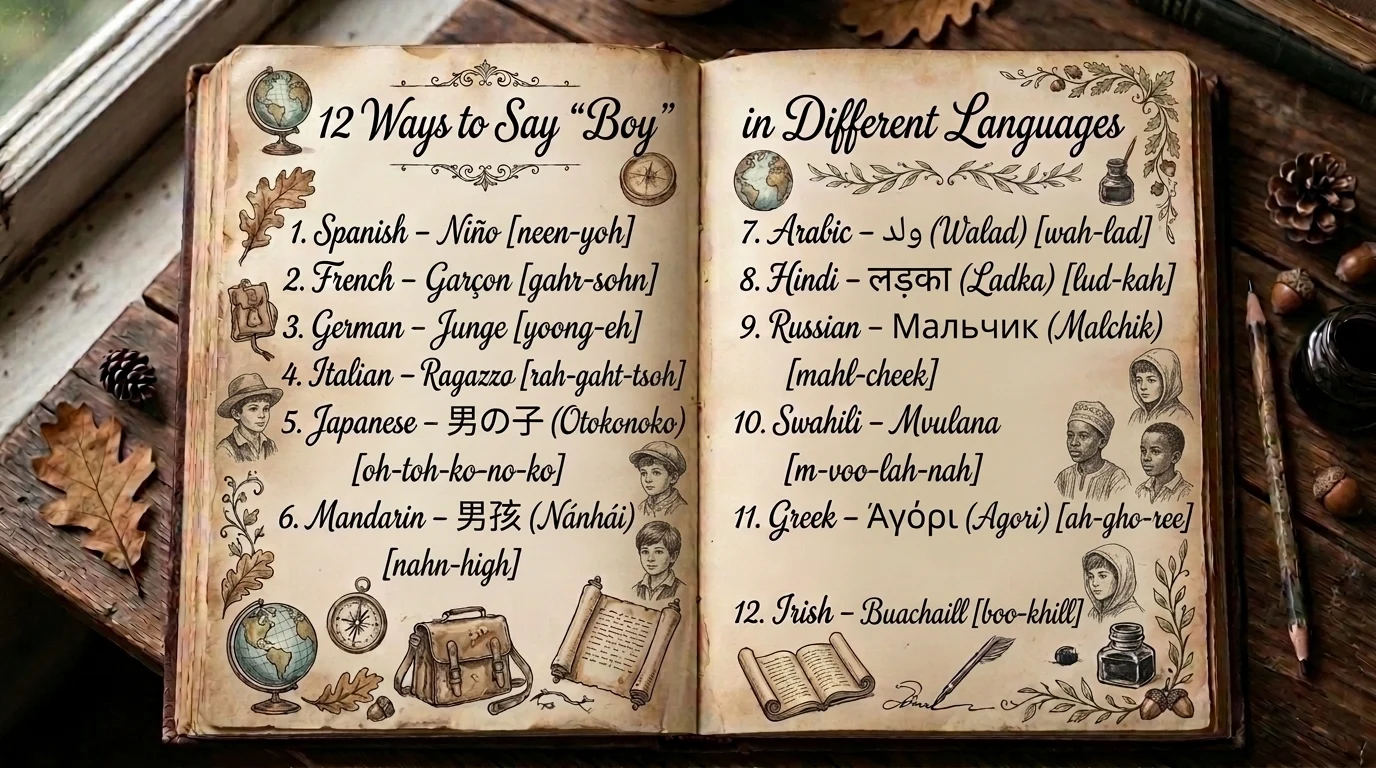
The word “boy” refers to a male child or young male person, but its translation changes from one language to another. Some languages use different words depending on a boy’s age, while others have informal expressions for a young man or male child.
In this guide, you’ll discover how to say boy in different languages, with 70 translations from around the world. Each entry includes the native word, an easy English pronunciation, a short example sentence, and its English meaning.
Whether you are learning a new language, choosing a meaningful name, studying vocabulary, or simply curious about how people communicate across cultures, this list of boy translations will help you get started.
How to Say “Boy” in Different Languages
The most useful translation depends on the language and context. For example, Spanish uses niño, French uses garçon, and German uses Junge. In some languages, the everyday word for “boy” can also mean “son,” “lad,” or “young man” in certain situations.
The table below covers 70 languages, including widely spoken world languages and several regional languages.
Boy in Different Languages: 70 Translations and Examples
| No. | Language | Native word for “boy” | Easy pronunciation | Example sentence | English meaning |
|---|---|---|---|---|---|
| 1 | Spanish | Niño | NEE-nyoh | El niño está aquí. | The boy is here. |
| 2 | French | Garçon | gar-SOHN | Le garçon est ici. | The boy is here. |
| 3 | German | Junge | YOONG-uh | Der Junge ist hier. | The boy is here. |
| 4 | Italian | Ragazzo | rah-GAHT-tsoh | Il ragazzo è qui. | The boy is here. |
| 5 | Portuguese | Menino | meh-NEE-noo | O menino está aqui. | The boy is here. |
| 6 | Dutch | Jongen | YONG-un | De jongen is hier. | The boy is here. |
| 7 | Afrikaans | Seun | SAYN | Die seun is hier. | The boy is here. |
| 8 | Swedish | Pojke | POY-keh | Pojken är här. | The boy is here. |
| 9 | Norwegian | Gutt | GOOT | Gutten er her. | The boy is here. |
| 10 | Danish | Dreng | DRENG | Drengen er her. | The boy is here. |
| 11 | Icelandic | Strákur | STRAU-kur | Strákurinn er hér. | The boy is here. |
| 12 | Finnish | Poika | POY-kah | Poika on täällä. | The boy is here. |
| 13 | Estonian | Poiss | POYS | Poiss on siin. | The boy is here. |
| 14 | Latvian | Zēns | ZAYNS | Zēns ir šeit. | The boy is here. |
| 15 | Lithuanian | Berniukas | ber-NEE-oo-kas | Berniukas yra čia. | The boy is here. |
| 16 | Polish | Chłopiec | HWOH-pyets | Chłopiec jest tutaj. | The boy is here. |
| 17 | Czech | Chlapec | KHLAH-pets | Chlapec je tady. | The boy is here. |
| 18 | Slovak | Chlapec | KHLAH-pets | Chlapec je tu. | The boy is here. |
| 19 | Slovenian | Deček | DEH-chek | Deček je tukaj. | The boy is here. |
| 20 | Croatian | Dječak | DYEH-chak | Dječak je ovdje. | The boy is here. |
| 21 | Serbian | Дечак | DEH-chak | Дечак је овде. | The boy is here. |
| 22 | Bosnian | Dječak | DYEH-chak | Dječak je ovdje. | The boy is here. |
| 23 | Bulgarian | Момче | MOM-cheh | Момчето е тук. | The boy is here. |
| 24 | Macedonian | Момче | MOM-cheh | Момчето е тука. | The boy is here. |
| 25 | Russian | Мальчик | MAL-chik | Мальчик здесь. | The boy is here. |
| 26 | Ukrainian | Хлопчик | KHLOP-chik | Хлопчик тут. | The boy is here. |
| 27 | Belarusian | Хлопчык | KHLOP-chik | Хлопчык тут. | The boy is here. |
| 28 | Greek | Αγόρι | ah-GHOH-ree | Το αγόρι είναι εδώ. | The boy is here. |
| 29 | Albanian | Djalë | JAH-luh | Djali është këtu. | The boy is here. |
| 30 | Romanian | Băiat | buh-YAHT | Băiatul este aici. | The boy is here. |
| 31 | Hungarian | Fiú | FEE-oo | A fiú itt van. | The boy is here. |
| 32 | Turkish | Oğlan | OH-lahn | Oğlan burada. | The boy is here. |
| 33 | Arabic | ولد | WA-lad | الولد هنا. | The boy is here. |
| 34 | Hebrew | ילד | YEH-led | הילד כאן. | The boy is here. |
| 35 | Persian (Farsi) | پسر | pe-SAR | پسر اینجاست. | The boy is here. |
| 36 | Urdu | لڑکا | LAR-ka | لڑکا یہاں ہے۔ | The boy is here. |
| 37 | Hindi | लड़का | LAR-ka | लड़का यहाँ है। | The boy is here. |
| 38 | Bengali | ছেলে | CHHE-leh | ছেলেটি এখানে আছে। | The boy is here. |
| 39 | Punjabi | ਮੁੰਡਾ | MUN-da | ਮੁੰਡਾ ਇੱਥੇ ਹੈ। | The boy is here. |
| 40 | Gujarati | છોકરો | CHHO-kroh | છોકરો અહીં છે. | The boy is here. |
| 41 | Marathi | मुलगा | MOO-la-ga | मुलगा इथे आहे. | The boy is here. |
| 42 | Nepali | केटा | KEH-ta | केटा यहाँ छ। | The boy is here. |
| 43 | Sinhala | පිරිමි ළමයා | pee-ree-mee la-ma-ya | පිරිමි ළමයා මෙහි සිටී. | The boy is here. |
| 44 | Tamil | சிறுவன் | si-ru-van | சிறுவன் இங்கே இருக்கிறான். | The boy is here. |
| 45 | Telugu | అబ్బాయి | ab-BAA-yee | అబ్బాయి ఇక్కడ ఉన్నాడు. | The boy is here. |
| 46 | Kannada | ಹುಡುಗ | hoo-DUGA | ಹುಡುಗ ಇಲ್ಲಿ ಇದ್ದಾನೆ. | The boy is here. |
| 47 | Malayalam | ആൺകുട്ടി | aan-KOO-tti | ആൺകുട്ടി ഇവിടെയുണ്ട്. | The boy is here. |
| 48 | Thai | เด็กผู้ชาย | dek phu chai | เด็กผู้ชายอยู่ที่นี่ | The boy is here. |
| 49 | Lao | ເດັກຊາຍ | dek sai | ເດັກຊາຍຢູ່ນີ້ | The boy is here. |
| 50 | Khmer | ក្មេងប្រុស | kmeng pros | ក្មេងប្រុសនៅទីនេះ។ | The boy is here. |
| 51 | Vietnamese | Cậu bé | kow beh | Cậu bé ở đây. | The boy is here. |
| 52 | Indonesian | Anak laki-laki | AH-nak LAH-kee LAH-kee | Anak laki-laki itu di sini. | The boy is here. |
| 53 | Malay | Budak lelaki | BOO-dak luh-LAH-kee | Budak lelaki itu di sini. | The boy is here. |
| 54 | Filipino (Tagalog) | Batang lalaki | BAH-tang lah-LAH-kee | Nandito ang batang lalaki. | The boy is here. |
| 55 | Mandarin Chinese | 男孩 | nán hái | 男孩在这里。 | The boy is here. |
| 56 | Cantonese | 男仔 | naam4 zai2 | 個男仔喺呢度。 | The boy is here. |
| 57 | Japanese | 男の子 | otoko no ko | 男の子がここにいます。 | The boy is here. |
| 58 | Korean | 소년 | so-nyeon | 소년이 여기 있어요. | The boy is here. |
| 59 | Mongolian | Хүү | khoo | Хүү энд байна. | The boy is here. |
| 60 | Kazakh | Ұл бала | ool bah-LAH | Ұл бала осында. | The boy is here. |
| 61 | Uzbek | Bola | boh-LAH | Bola shu yerda. | The boy is here. |
| 62 | Swahili | Mvulana | mvoo-LAH-nah | Mvulana yuko hapa. | The boy is here. |
| 63 | Amharic | ወንድ ልጅ | wend lij | ወንድ ልጁ እዚህ ነው። | The boy is here. |
| 64 | Yoruba | Ọmọkùnrin | aw-moh-KOON-rin | Ọmọkùnrin náà wà níbí. | The boy is here. |
| 65 | Igbo | Nwa nwoke | nwah NWOH-keh | Nwa nwoke ahụ nọ ebe a. | The boy is here. |
| 66 | Hausa | Yaro | YAH-roh | Yaron yana nan. | The boy is here. |
| 67 | Zulu | Umfana | oom-FAH-nah | Umfana ulapha. | The boy is here. |
| 68 | Xhosa | Inkwenkwe | een-KWEN-kweh | Inkwenkwe ilapha. | The boy is here. |
| 69 | Irish | Buachaill | BOO-a-khil | Tá an buachaill anseo. | The boy is here. |
| 70 | Welsh | Bachgen | BAHKH-gen | Mae’r bachgen yma. | The boy is here. |
Pronunciation guides are approximate and intended for English speakers. Regional accents, grammatical forms, and everyday usage may vary. In languages that use grammatical endings or articles, the word may appear in a slightly different form in the example sentence.
Boy in All Languages: Important Differences
Although many languages have a direct translation for “boy,” the words do not always carry exactly the same meaning.
- Child versus young man: Some words refer specifically to a male child, while others can describe a teenage boy or young adult.
- Boy versus son: A word meaning “boy” may also be used for “son” in particular expressions or family contexts.
- Formal versus informal language: Everyday conversation may use a different word from books, school lessons, or formal writing.
- Grammar and sentence structure: Articles, endings, and word order can change when a word is used in a complete sentence.
These differences matter when learning boy translations around the world. Memorizing a single word is useful, but understanding how people use it in conversation makes the translation more accurate.
How to Pronounce “Boy” in Different Languages
Pronunciation can be one of the hardest parts of learning vocabulary in a new language. A word written in the Latin alphabet may look familiar but sound different from what an English speaker expects.
Try these practical tips:
- Start with short words. Practice familiar examples such as niño, Junge, and poika.
- Pay attention to unfamiliar sounds. Spanish ñ, German j, and French nasal vowels do not match ordinary English spelling patterns.
- Learn the word in a sentence. Context helps you remember the pronunciation and how the word fits into natural speech.
- Listen to native speakers. Audio examples can help you recognize stress, rhythm, and sounds that written pronunciation guides cannot fully capture.
- Check the local context. Some languages have regional expressions or different words for boys of different ages.
Why the Word “Boy” Changes Across Cultures
Language reflects the way people describe age, family, and social relationships. In one language, a common word may emphasize childhood; in another, the same general idea may be expressed through a word that also means “lad” or “young man.”
The word can also change depending on tone. A term used affectionately by a family may sound too casual in a formal situation. Likewise, some expressions are appropriate for children but not for adult men.
When studying boy in different languages, it is helpful to learn not only the dictionary translation but also the cultural setting in which the word is commonly used.
FAQs
1. How do you say “boy” in 10 different languages?
Here are 10 common translations: Spanish niño, French garçon, German Junge, Italian ragazzo, Portuguese menino, Dutch jongen, Hindi लड़का, Urdu لڑکا, Japanese 男の子, and Mandarin Chinese 男孩.
2. What is the word for boy in all languages?
There is no single word used across all languages. Examples include niño in Spanish, garçon in French, boy in English, yaro in Hausa, and mvulana in Swahili. Each language has its own vocabulary and usage rules.
3. How do you say boy in Japanese and Chinese?
In Japanese, boy is 男の子 (otoko no ko). In Mandarin Chinese, it is 男孩 (nán hái). Both terms commonly refer to a male child.
4. What is the difference between “boy,” “son,” and “young man”?
A boy is generally a male child. A son is a male child in relation to a parent, regardless of his age. A young man usually refers to an older teenager or adult male. The precise distinctions depend on the language.
5. Why should I learn how to say boy in different languages?
Learning these translations can help you build vocabulary, communicate while traveling, understand other cultures, and improve your language-learning skills. It can also help with writing, educational projects, and understanding foreign-language conversations.
Conclusion
Learning how to say boy in different languages is a simple way to explore the diversity of human communication. From niño in Spanish to 男の子 in Japanese, each translation offers a useful glimpse into another language.
Use this list of 70 languages as a vocabulary reference, practice the example sentences, and remember that pronunciation and everyday usage can vary by region and context.

I am Ricardo Hunter, Administrator at LingoBuz, passionate about languages, translations, and global communication. I help create useful, clear content that makes exploring different languages simple, enjoyable, and accessible.