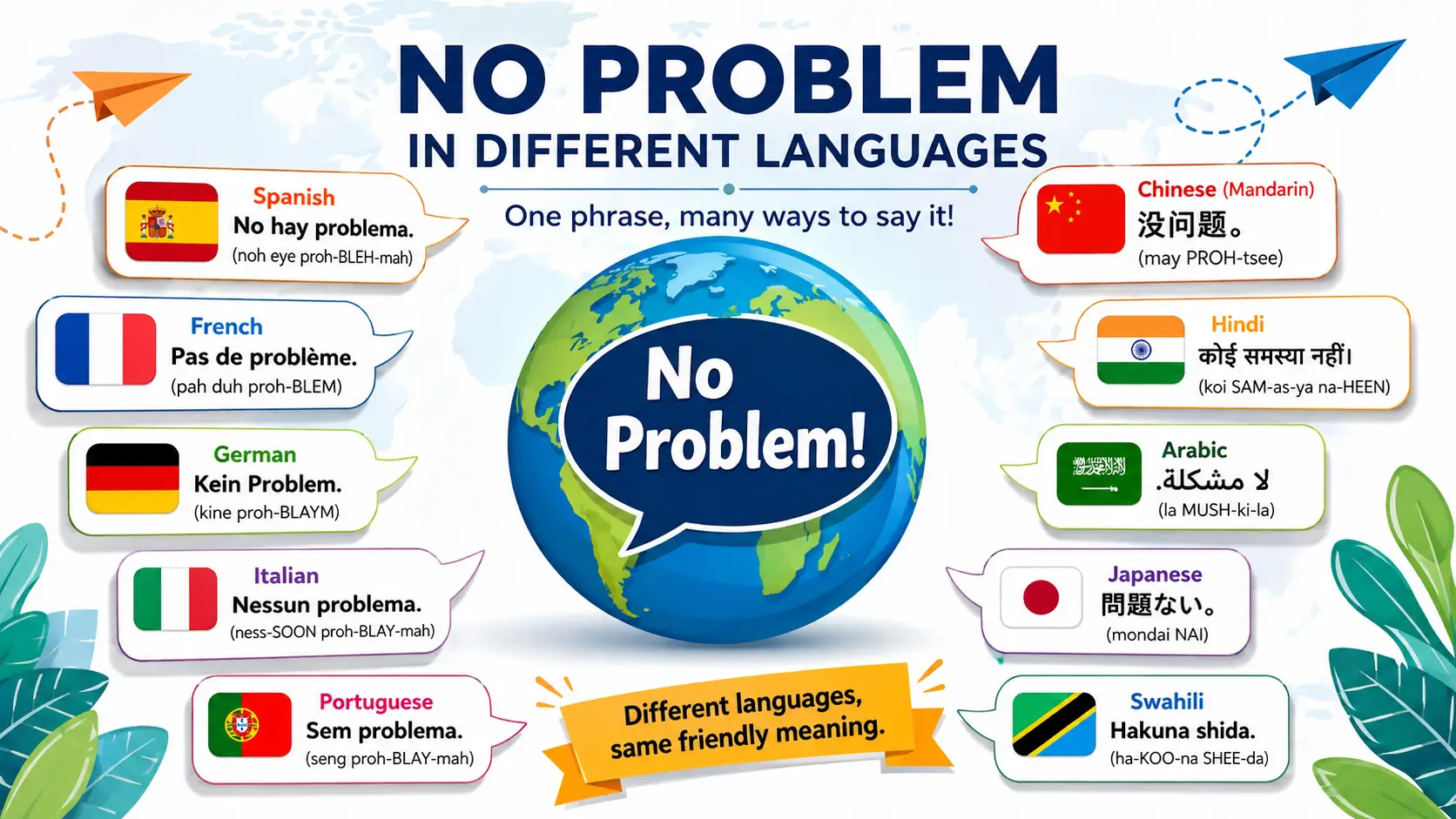
Knowing how to say “no problem” in different languages is a simple way to communicate politely and naturally with people from different cultures. Whether you are traveling, chatting with international friends, learning a new language, or simply curious about world languages, this useful phrase can help you sound more welcoming and friendly.
“No problem” can express several ideas depending on the situation. It may mean “it’s okay,” “you’re welcome,” “that’s fine,” “don’t worry,” or “there is no difficulty.” Because languages and cultures do not always use a direct word-for-word equivalent, the most natural translation can vary.
Below, you will find 70 no problem translations, including the native phrase, an easy English pronunciation, and a short example sentence with its English meaning.
No Problem in Different Languages at a Glance
| # | Language | Native Phrase | Easy English Pronunciation | Example Sentence | English Meaning |
|---|---|---|---|---|---|
| 1 | English | No problem. | noh PROB-luhm | No problem, I can help you. | It is okay; I can help you. |
| 2 | Spanish | No hay problema. | noh eye proh-BLEH-mah | No hay problema, puedo esperar. | No problem, I can wait. |
| 3 | French | Pas de problème. | pah duh proh-BLEM | Pas de problème, je peux attendre. | No problem, I can wait. |
| 4 | German | Kein Problem. | kine proh-BLAYM | Kein Problem, ich helfe dir. | No problem, I will help you. |
| 5 | Italian | Nessun problema. | ness-SOON proh-BLAY-mah | Nessun problema, posso aspettare. | No problem, I can wait. |
| 6 | Portuguese | Sem problema. | seng proh-BLAY-mah | Sem problema, posso ajudar. | No problem, I can help. |
| 7 | Dutch | Geen probleem. | khayn proh-BLAYM | Geen probleem, ik wacht wel. | No problem, I will wait. |
| 8 | Swedish | Inga problem. | ING-ah proh-BLEHM | Inga problem, jag kan hjälpa dig. | No problem, I can help you. |
| 9 | Norwegian | Ikke noe problem. | IK-keh noo proh-BLEHM | Ikke noe problem, jeg kan vente. | No problem, I can wait. |
| 10 | Danish | Intet problem. | IN-tet proh-BLEM | Intet problem, jeg hjælper dig. | No problem, I will help you. |
| 11 | Finnish | Ei ongelmaa. | ay ONG-el-maa | Ei ongelmaa, voin odottaa. | No problem, I can wait. |
| 12 | Icelandic | Ekkert mál. | EHK-kert mawl | Ekkert mál, ég bíð. | No problem, I will wait. |
| 13 | Irish | Fadhb ar bith. | fowb er bih | Fadhb ar bith, fanfaidh mé. | No problem, I will wait. |
| 14 | Welsh | Dim problem. | deem PROB-lem | Dim problem, gallaf aros. | No problem, I can wait. |
| 15 | Scottish Gaelic | Chan eil duilgheadas ann. | khan yel DOOL-yuh-das an | Chan eil duilgheadas ann, fuirichidh mi. | No problem, I will wait. |
| 16 | Polish | Nie ma problemu. | nyeh mah proh-BLEH-moo | Nie ma problemu, poczekam. | No problem, I will wait. |
| 17 | Czech | Žádný problém. | ZHAHD-nee PROH-blem | Žádný problém, počkám. | No problem, I will wait. |
| 18 | Slovak | Žiadny problém. | ZHYAD-nee PROH-blem | Žiadny problém, počkám. | No problem, I will wait. |
| 19 | Slovenian | Ni problema. | nee proh-BLEH-mah | Ni problema, počakam. | No problem, I will wait. |
| 20 | Croatian | Nema problema. | NEH-mah proh-BLEH-mah | Nema problema, mogu čekati. | No problem, I can wait. |
| 21 | Serbian | Нема проблема. | NEH-mah proh-BLEH-mah | Нема проблема, сачекаћу. | No problem, I will wait. |
| 22 | Bosnian | Nema problema. | NEH-mah proh-BLEH-mah | Nema problema, mogu čekati. | No problem, I can wait. |
| 23 | Macedonian | Нема проблем. | NEH-mah proh-BLEHM | Нема проблем, ќе почекам. | No problem, I will wait. |
| 24 | Bulgarian | Няма проблем. | NYA-mah proh-BLEM | Няма проблем, ще почакам. | No problem, I will wait. |
| 25 | Russian | Без проблем. | byez proh-BLYEM | Без проблем, я подожду. | No problem, I will wait. |
| 26 | Ukrainian | Без проблем. | bez proh-BLEM | Без проблем, я зачекаю. | No problem, I will wait. |
| 27 | Belarusian | Няма праблем. | NYA-mah prah-BLYEM | Няма праблем, я пачакаю. | No problem, I will wait. |
| 28 | Lithuanian | Jokių problemų. | YOH-kyoo proh-BLAY-moo | Jokių problemų, galiu palaukti. | No problem, I can wait. |
| 29 | Latvian | Nekādu problēmu. | neh-KAA-doo proh-BLAY-moo | Nekādu problēmu, es pagaidīšu. | No problem, I will wait. |
| 30 | Estonian | Pole probleemi. | POH-leh proh-BLAY-mee | Pole probleemi, ma ootan. | No problem, I will wait. |
| 31 | Romanian | Nicio problemă. | NEE-cho proh-BLEH-muh | Nicio problemă, pot aștepta. | No problem, I can wait. |
| 32 | Hungarian | Semmi probléma. | SHEM-mee proh-BLAY-ma | Semmi probléma, megvárom. | No problem, I will wait. |
| 33 | Greek | Κανένα πρόβλημα. | ka-NEH-na PRO-vli-ma | Κανένα πρόβλημα, μπορώ να περιμένω. | No problem, I can wait. |
| 34 | Albanian | S’ka problem. | ska proh-BLEM | S’ka problem, mund të pres. | No problem, I can wait. |
| 35 | Turkish | Sorun değil. | soh-ROON deh-YEEL | Sorun değil, bekleyebilirim. | No problem, I can wait. |
| 36 | Azerbaijani | Problem deyil. | proh-BLEM deh-YEEL | Problem deyil, gözləyə bilərəm. | No problem, I can wait. |
| 37 | Armenian | Խնդիր չկա։ | khun-DEER chka | Խնդիր չկա, կարող եմ սպասել։ | No problem, I can wait. |
| 38 | Georgian | პრობლემა არ არის. | proh-BLEH-ma ar ar-ees | პრობლემა არ არის, დაველოდები. | No problem, I will wait. |
| 39 | Arabic | لا مشكلة. | la MUSH-ki-la | لا مشكلة، سأنتظر. | No problem, I will wait. |
| 40 | Hebrew | אין בעיה. | ayn ba-AY-ah | אין בעיה, אני אחכה. | No problem, I will wait. |
| 41 | Persian | مشکلی نیست. | mosh-keh-LEE neest | مشکلی نیست، میتوانم صبر کنم. | No problem, I can wait. |
| 42 | Urdu | کوئی مسئلہ نہیں۔ | koi mas-la nahin | کوئی مسئلہ نہیں، میں انتظار کر سکتا ہوں۔ | No problem, I can wait. |
| 43 | Hindi | कोई समस्या नहीं। | koi SAM-as-ya na-HEEN | कोई समस्या नहीं, मैं इंतज़ार कर सकता हूँ। | No problem, I can wait. |
| 44 | Bengali | কোনো সমস্যা নেই। | kono shomosh-sha nei | কোনো সমস্যা নেই, আমি অপেক্ষা করতে পারি। | No problem, I can wait. |
| 45 | Punjabi | ਕੋਈ ਸਮੱਸਿਆ ਨਹੀਂ। | koi sam-SYA nahin | ਕੋਈ ਸਮੱਸਿਆ ਨਹੀਂ, ਮੈਂ ਉਡੀਕ ਕਰ ਸਕਦਾ ਹਾਂ। | No problem, I can wait. |
| 46 | Gujarati | કોઈ સમસ્યા નથી. | koi samas-ya na-THI | કોઈ સમસ્યા નથી, હું રાહ જોઈ શકું છું. | No problem, I can wait. |
| 47 | Marathi | काही हरकत नाही. | kaa-hee har-kat NAA-hee | काही हरकत नाही, मी थांबू शकतो. | No problem, I can wait. |
| 48 | Nepali | कुनै समस्या छैन। | koo-nai sam-as-ya CHAI-na | कुनै समस्या छैन, म पर्खन सक्छु। | No problem, I can wait. |
| 49 | Sinhala | ප්රශ්නයක් නැහැ. | prash-na-yak NA-ha | ප්රශ්නයක් නැහැ, මට ඉන්න පුළුවන්. | No problem, I can wait. |
| 50 | Tamil | பிரச்சனை இல்லை. | prach-NAI ill-LAI | பிரச்சனை இல்லை, நான் காத்திருக்கலாம். | No problem, I can wait. |
| 51 | Telugu | సమస్య లేదు. | sa-MAS-ya LEH-doo | సమస్య లేదు, నేను వేచి ఉంటాను. | No problem, I will wait. |
| 52 | Kannada | ಸಮಸ್ಯೆ ಇಲ್ಲ. | sa-MAS-yeh il-la | ಸಮಸ್ಯೆ ಇಲ್ಲ, ನಾನು ಕಾಯುತ್ತೇನೆ. | No problem, I will wait. |
| 53 | Malayalam | കുഴപ്പമില്ല. | kuzh-appam-ILLA | കുഴപ്പമില്ല, ഞാൻ കാത്തിരിക്കാം. | No problem, I can wait. |
| 54 | Chinese (Mandarin) | 没问题。 | may PROH-tsee | 没问题,我可以等。 | No problem, I can wait. |
| 55 | Japanese | 問題ない。 | mondai NAI | 問題ない、待てるよ。 | No problem, I can wait. |
| 56 | Korean | 문제없어요. | mun-jeh UP-suh-yo | 문제없어요, 기다릴게요. | No problem, I will wait. |
| 57 | Vietnamese | Không có vấn đề gì. | khong kaw vun DAY zee | Không có vấn đề gì, tôi có thể đợi. | No problem, I can wait. |
| 58 | Thai | ไม่มีปัญหา | mai mee pan-HAA | ไม่มีปัญหา ฉันรอได้ | No problem, I can wait. |
| 59 | Indonesian | Tidak masalah. | TEE-dak ma-SA-lah | Tidak masalah, saya bisa menunggu. | No problem, I can wait. |
| 60 | Malay | Tiada masalah. | tee-AH-dah ma-SA-lah | Tiada masalah, saya boleh tunggu. | No problem, I can wait. |
| 61 | Filipino | Walang problema. | wah-LANG proh-BLEH-mah | Walang problema, maghihintay ako. | No problem, I will wait. |
| 62 | Swahili | Hakuna shida. | ha-KOO-na SHEE-da | Hakuna shida, nitasubiri. | No problem, I will wait. |
| 63 | Afrikaans | Geen probleem. | khayn proh-BLAYM | Geen probleem, ek kan wag. | No problem, I can wait. |
| 64 | Zulu | Akunankinga. | ah-koo-nan-KEEN-gah | Akunankinga, ngizolinda. | No problem, I will wait. |
| 65 | Xhosa | Akukho ngxaki. | ah-kee-kho NG-kha-kee | Akukho ngxaki, ndiza kulinda. | No problem, I will wait. |
| 66 | Amharic | ችግር የለም። | chig-ir yeh-lem | ችግር የለም፣ እጠብቃለሁ። | No problem, I will wait. |
| 67 | Haitian Creole | Pa gen pwoblèm. | pah zhen pwo-BLEM | Pa gen pwoblèm, m ap tann. | No problem, I will wait. |
| 68 | Latin | Nulla quaestio. | NOOL-la kwy-STEE-oh | Nulla quaestio, exspectabo. | No problem, I will wait. |
| 69 | Esperanto | Neniu problemo. | neh-EE-oo proh-BLAY-mo | Neniu problemo, mi atendos. | No problem, I will wait. |
| 70 | Maltese | L-ebda problema. | leb-dah proh-BLAY-ma | L-ebda problema, nista’ nistenna. | No problem, I can wait. |
How to Say “No Problem” in Different Languages
The English phrase “no problem” is usually used to reassure someone that something is acceptable or easy to handle. For example, if someone apologizes for being late, you might say “No problem” to show that you are not upset.
In another situation, someone may thank you for helping them. Depending on the language and culture, a phrase equivalent to “no problem” may also work as a casual response to “thank you.”
However, direct translations are not always interchangeable. Some expressions literally mean “there is no problem,” while others are closer to “it’s okay,” “don’t worry,” or “no difficulty.”
“No Problem” in All Languages: Common Patterns
Looking at these no problem translations reveals several common patterns.
European languages frequently use a direct equivalent of the word “problem.” Examples include:
- Spanish: No hay problema
- French: Pas de problème
- German: Kein Problem
- Italian: Nessun problema
- Portuguese: Sem problema
- Dutch: Geen probleem
- Polish: Nie ma problemu
Other languages commonly use a structure meaning “there is no problem.” Arabic, Hebrew, Hindi, Urdu, and several other languages have natural expressions that communicate the same basic idea.
Asian languages can use expressions that sound different from the English phrase while still communicating that something is fine or acceptable. This is why learning the natural phrase is generally more useful than translating each English word individually.
No Problem Around the World
The phrase “no problem around the world” demonstrates how languages express reassurance in different ways.
In Spanish-speaking communities, “No hay problema” is widely understood. In France, “Pas de problème” is a familiar casual expression. German speakers commonly say “Kein Problem,” while Italian speakers use “Nessun problema.”
Across South Asia, you can hear expressions such as “کوئی مسئلہ نہیں” in Urdu and “कोई समस्या नहीं” in Hindi. In Mandarin Chinese, “没问题” is a very common way to say that something is fine.
These expressions are useful for travelers because they can make everyday interactions feel more natural and friendly.
When Should You Use “No Problem”?
You can use the phrase in several everyday situations.
When Someone Apologizes
If a friend says, “Sorry I am late,” you can respond with:
“No problem. Take your time.”
This communicates that you are not upset.
When Someone Thanks You
After helping someone, you may hear “Thank you.” In some languages, a local equivalent of “no problem” can be used as a relaxed response.
For example:
“No problem. Glad I could help.”
When Someone Asks for Help
If a person asks whether you can help them, you can use the expression to reassure them:
“No problem. I can help you.”
When Plans Change
If someone needs to change a meeting time, “no problem” can show flexibility:
“No problem. Tomorrow works for me.”
“No Problem” vs. “You’re Welcome”
These phrases are related but do not always mean exactly the same thing.
“You’re welcome” is primarily a response to “thank you.”
“No problem” usually reassures someone that an action, request, mistake, or inconvenience is acceptable.
For example:
- “Thank you for helping me.” — “You’re welcome.”
- “Sorry I made you wait.” — “No problem.”
In casual English, however, “no problem” is also frequently used after thanks.
Tips for Using No Problem Translations Naturally
When learning how to say “no problem” in different languages, remember these practical tips:
- Learn the natural expression, not only the literal translation.
- Listen to native speakers to understand pronunciation and tone.
- Consider the situation. A phrase suitable with friends may not be ideal in formal communication.
- Pay attention to politeness levels, especially in languages with formal and informal forms.
- Practice complete sentences instead of memorizing isolated vocabulary.
- Use the phrase confidently but naturally.
A small phrase such as “no problem” can make conversations smoother, particularly when traveling or communicating across cultures.
Why Learn “No Problem” in Different Languages?
Learning this everyday phrase offers more than vocabulary practice. It helps you understand how different cultures express reassurance, friendliness, agreement, and patience.
It is also a practical phrase for:
- Travelers
- Language learners
- Students
- Teachers
- International professionals
- Customer-service workers
- Multilingual families
- People communicating online
Because it appears frequently in everyday conversations, “no problem” in different languages is an excellent phrase to add to a beginner’s vocabulary.
Frequently Asked Questions
1. How do you say “no problem” in different languages?
“No problem” has different natural translations depending on the language. Examples include “No hay problema” in Spanish, “Pas de problème” in French, “Kein Problem” in German, “Nessun problema” in Italian, and “没问题” in Mandarin Chinese.
2. What is the most common translation of “no problem”?
There is no single universal translation. Many languages use a phrase equivalent to “no problem,” while others use expressions closer to “it’s okay,” “don’t worry,” or “there is no difficulty.”
3. How do you say “no problem” in Spanish?
In Spanish, you can say “No hay problema.” It literally communicates that there is no problem and is commonly used in everyday conversation.
4. How do you say “no problem” in French?
In French, “Pas de problème” is a common way to say “no problem.” It can be used in many casual situations to reassure someone or show that something is acceptable.
5. Is “no problem” the same as “you’re welcome”?
Not always. “You’re welcome” is specifically a response to thanks, while “no problem” can reassure someone after an apology, request, inconvenience, or thanks. The best expression depends on the language and situation.
Conclusion
Learning no problem in different languages is an easy and useful way to expand your everyday vocabulary. From Spanish and French to Urdu, Hindi, Mandarin, Japanese, Arabic, Swahili, and many more, each language has its own natural way of expressing reassurance.
The 70 translations above can help you discover how to say “no problem” in different languages, understand common “no problem” translations, and communicate more comfortably with people around the world. For the most natural results, practice each phrase in a complete sentence and pay attention to how native speakers use it in real conversations.

I am Scarlett Wilson, a passionate language writer who loves exploring different languages, words, meanings, translations, and useful phrases. I enjoy making language learning simple, clear, and interesting for everyone.