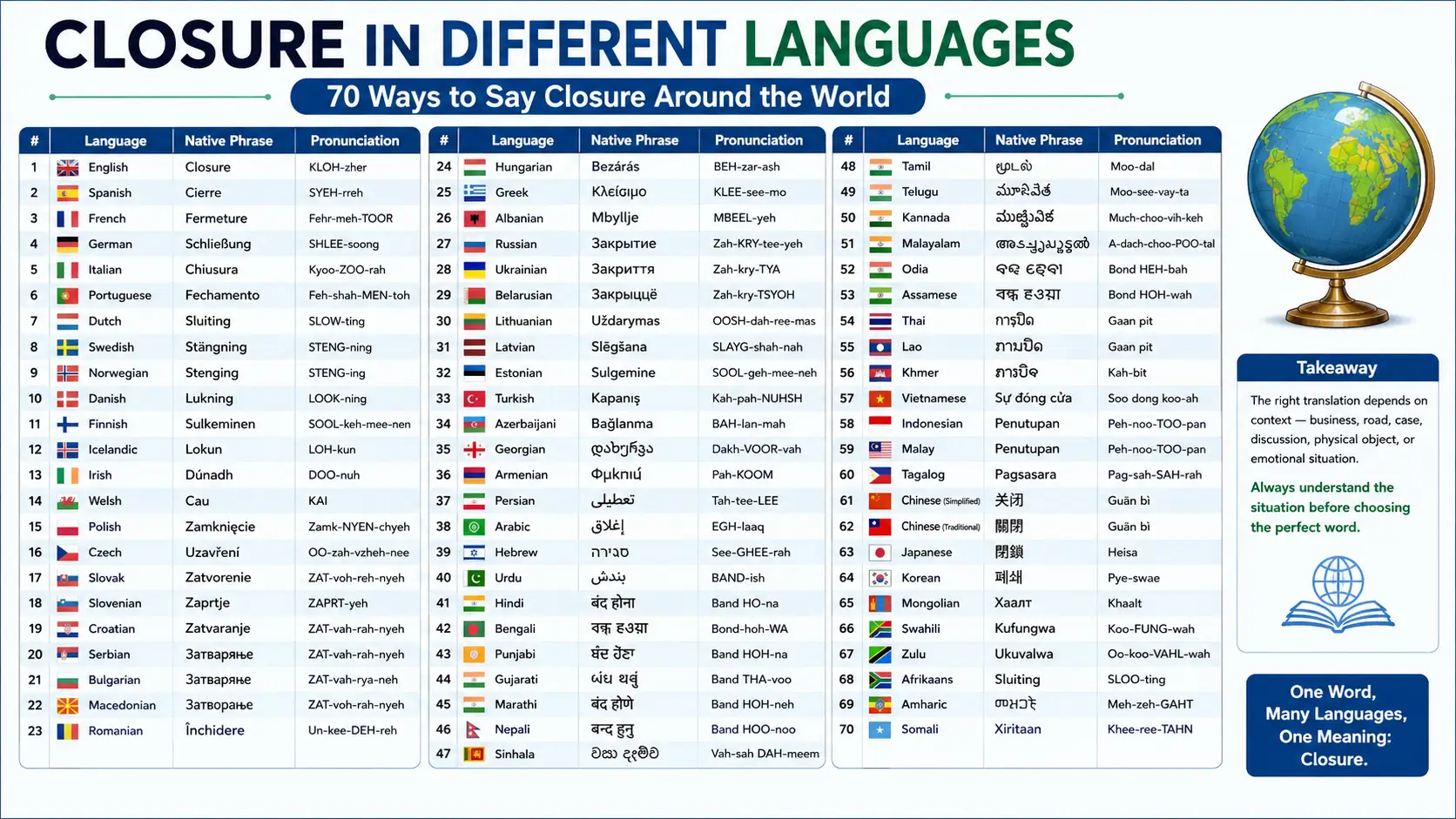
The word closure can describe the act of closing something, ending an activity, bringing a situation to an end, or reaching a sense of resolution. Because its meaning changes slightly with context, learning closure in different languages can help you choose the most natural word for conversations, travel, writing, translation, and multilingual content.
In everyday English, “closure” may refer to the closure of a business, the closure of a road, the closure of a case, or emotional closure after a difficult experience. Other languages may use different words for these situations.
This guide explains how to say closure in different languages using 70 widely spoken languages. Each entry includes the native phrase, an easy English pronunciation, a short real-life sentence, and the English meaning.
Closure in Different Languages: 70 Translations
The table below focuses mainly on the practical meaning of closure as closing, shutting down, or bringing something to an end. For emotional closure or highly specialized meanings, the most natural translation can change according to context.
| # | Language | Native Phrase | Easy English Pronunciation | Example Sentence | English Meaning |
|---|---|---|---|---|---|
| 1 | English | Closure | KLOH-zher | The store announced its closure. | The store announced that it was closing. |
| 2 | Spanish | Cierre | SYEH-rreh | El cierre de la tienda fue inesperado. | The store’s closure was unexpected. |
| 3 | French | Fermeture | Fehr-meh-TOOR | La fermeture du magasin était nécessaire. | The store’s closure was necessary. |
| 4 | German | Schließung | SHLEE-soong | Die Schließung der Fabrik war traurig. | The factory’s closure was sad. |
| 5 | Italian | Chiusura | Kyoo-ZOO-rah | La chiusura del negozio è definitiva. | The store’s closure is permanent. |
| 6 | Portuguese | Fechamento | Feh-shah-MEN-toh | O fechamento da loja foi anunciado. | The store’s closure was announced. |
| 7 | Dutch | Sluiting | SLOW-ting | De sluiting van de winkel was onverwacht. | The store’s closure was unexpected. |
| 8 | Swedish | Stängning | STENG-ning | Butikens stängning överraskade oss. | The store’s closure surprised us. |
| 9 | Norwegian | Stenging | STENG-ing | Stengingen av veien skapte problemer. | The road closure caused problems. |
| 10 | Danish | Lukning | LOOK-ning | Lukningen af butikken var nødvendig. | The store’s closure was necessary. |
| 11 | Finnish | Sulkeminen | SOOL-keh-mee-nen | Liikkeen sulkeminen oli yllättävää. | The shop’s closure was surprising. |
| 12 | Icelandic | Lokun | LOH-kun | Lokun verslunarinnar kom óvænt. | The store’s closure came unexpectedly. |
| 13 | Irish | Dúnadh | DOO-nuh | Fógraíodh dúnadh na scoile. | The school’s closure was announced. |
| 14 | Welsh | Cau | KAI | Cyhoeddwyd cau’r siop. | The shop’s closure was announced. |
| 15 | Polish | Zamknięcie | Zamk-NYEN-chyeh | Zamknięcie sklepu było nagłe. | The shop’s closure was sudden. |
| 16 | Czech | Uzavření | OO-zah-vzheh-nee | Uzavření silnice trvalo dvě hodiny. | The road closure lasted two hours. |
| 17 | Slovak | Zatvorenie | ZAT-voh-reh-nyeh | Zatvorenie obchodu bolo nečakané. | The shop’s closure was unexpected. |
| 18 | Slovenian | Zaprtje | ZAPRT-yeh | Zaprtje trgovine je bilo nepričakovano. | The store’s closure was unexpected. |
| 19 | Croatian | Zatvaranje | ZAT-vah-rah-nyeh | Zatvaranje trgovine je potvrđeno. | The store’s closure was confirmed. |
| 20 | Serbian | Затварање | ZAT-vah-rah-nyeh | Затварање продавнице је потврђено. | The store’s closure was confirmed. |
| 21 | Bulgarian | Затваряне | ZAT-vah-rya-neh | Затварянето на магазина беше внезапно. | The store’s closure was sudden. |
| 22 | Macedonian | Затворање | ZAT-voh-rah-nyeh | Затворањето на продавницата беше неочекувано. | The shop’s closure was unexpected. |
| 23 | Romanian | Închidere | Un-kee-DEH-reh | Închiderea magazinului a fost anunțată. | The store’s closure was announced. |
| 24 | Hungarian | Bezárás | BEH-zar-ash | Az üzlet bezárása váratlan volt. | The shop’s closure was unexpected. |
| 25 | Greek | Κλείσιμο | KLEE-see-mo | Το κλείσιμο του καταστήματος ανακοινώθηκε. | The store’s closure was announced. |
| 26 | Albanian | Mbyllje | MBEEL-yeh | Mbyllja e dyqanit ishte e papritur. | The shop’s closure was unexpected. |
| 27 | Russian | Закрытие | Zah-KRY-tee-yeh | Закрытие магазина было неожиданным. | The store’s closure was unexpected. |
| 28 | Ukrainian | Закриття | Zah-kry-TYA | Закриття магазину було раптовим. | The store’s closure was sudden. |
| 29 | Belarusian | Закрыццё | Zah-kry-TSYOH | Закрыццё крамы было нечаканым. | The shop’s closure was unexpected. |
| 30 | Lithuanian | Uždarymas | OOSH-dah-ree-mas | Parduotuvės uždarymas buvo netikėtas. | The store’s closure was unexpected. |
| 31 | Latvian | Slēgšana | SLAYG-shah-nah | Veikala slēgšana bija negaidīta. | The shop’s closure was unexpected. |
| 32 | Estonian | Sulgemine | SOOL-geh-mee-neh | Poe sulgemine oli ootamatu. | The shop’s closure was unexpected. |
| 33 | Turkish | Kapanış | Kah-pah-NUHSH | Mağazanın kapanışı duyuruldu. | The store’s closure was announced. |
| 34 | Azerbaijani | Bağlanma | BAH-lan-mah | Mağazanın bağlanması gözlənilməz oldu. | The store’s closure was unexpected. |
| 35 | Georgian | დახურვა | Dakh-VOOR-vah | მაღაზიის დახურვა გამოცხადდა. | The store’s closure was announced. |
| 36 | Armenian | Փակում | Pah-KOOM | Խանութի փակումը անսպասելի էր։ | The shop’s closure was unexpected. |
| 37 | Persian | تعطیلی | Tah-tee-LEE | تعطیلی فروشگاه اعلام شد. | The store’s closure was announced. |
| 38 | Arabic | إغلاق | EGH-laaq | تم إعلان إغلاق المتجر. | The store’s closure was announced. |
| 39 | Hebrew | סגירה | See-GHEE-rah | סגירת החנות הייתה פתאומית. | The store’s closure was sudden. |
| 40 | Urdu | بندش | BAND-ish | دکان کی بندش اچانک ہوئی۔ | The shop’s closure happened suddenly. |
| 41 | Hindi | बंद होना | Band HO-na | दुकान का बंद होना अचानक था। | The shop’s closure was sudden. |
| 42 | Bengali | বন্ধ হওয়া | Bond-hoh-WA | দোকানটি বন্ধ হওয়া অপ্রত্যাশিত ছিল। | The shop’s closure was unexpected. |
| 43 | Punjabi | ਬੰਦ ਹੋਣਾ | Band HOH-na | ਦੁਕਾਨ ਦਾ ਬੰਦ ਹੋਣਾ ਅਚਾਨਕ ਸੀ। | The shop’s closure was sudden. |
| 44 | Gujarati | બંધ થવું | Band THA-voo | દુકાનનું બંધ થવું અચાનક હતું. | The shop’s closure was sudden. |
| 45 | Marathi | बंद होणे | Band HOH-neh | दुकान बंद होणे अचानक झाले. | The shop’s closure happened suddenly. |
| 46 | Nepali | बन्द हुनु | Band HOO-noo | पसल बन्द हुनु अप्रत्याशित थियो। | The shop’s closure was unexpected. |
| 47 | Sinhala | වසා දැමීම | Vah-sah DAH-meem | වෙළඳසැල වසා දැමීම හදිසි විය. | The shop’s closure was sudden. |
| 48 | Tamil | மூடல் | Moo-dal | கடையின் மூடல் எதிர்பாராதது. | The shop’s closure was unexpected. |
| 49 | Telugu | మూసివేత | Moo-see-vay-ta | దుకాణం మూసివేత అనుకోకుండా జరిగింది. | The shop’s closure happened unexpectedly. |
| 50 | Kannada | ಮುಚ್ಚುವಿಕೆ | Much-choo-vih-keh | ಅಂಗಡಿಯ ಮುಚ್ಚುವಿಕೆ ಅನಿರೀಕ್ಷಿತವಾಗಿತ್ತು. | The shop’s closure was unexpected. |
| 51 | Malayalam | അടച്ചുപൂട്ടൽ | A-dach-choo-POO-tal | കടയുടെ അടച്ചുപൂട്ടൽ അപ്രതീക്ഷിതമായിരുന്നു. | The shop’s closure was unexpected. |
| 52 | Odia | ବନ୍ଦ ହେବା | Bond HEH-bah | ଦୋକାନ ବନ୍ଦ ହେବା ଅପ୍ରତ୍ୟାଶିତ ଥିଲା। | The shop’s closure was unexpected. |
| 53 | Assamese | বন্ধ হোৱা | Bond HOH-wah | দোকানখন বন্ধ হোৱা আচৰিত আছিল। | The shop’s closure was surprising. |
| 54 | Thai | การปิด | Gaan pit | การปิดร้านถูกประกาศแล้ว | The shop’s closure was announced. |
| 55 | Lao | ການປິດ | Gaan pit | ການປິດຮ້ານຖືກປະກາດແລ້ວ. | The shop’s closure was announced. |
| 56 | Khmer | ការបិទ | Kah-bit | ការបិទហាងត្រូវបានប្រកាស។ | The shop’s closure was announced. |
| 57 | Vietnamese | Sự đóng cửa | Soo dong koo-ah | Sự đóng cửa của cửa hàng đã được thông báo. | The shop’s closure was announced. |
| 58 | Indonesian | Penutupan | Peh-noo-TOO-pan | Penutupan toko itu diumumkan. | The store’s closure was announced. |
| 59 | Malay | Penutupan | Peh-noo-TOO-pan | Penutupan kedai itu diumumkan. | The shop’s closure was announced. |
| 60 | Tagalog | Pagsasara | Pag-sah-SAH-rah | Inanunsyo ang pagsasara ng tindahan. | The store’s closure was announced. |
| 61 | Chinese (Simplified) | 关闭 | Guān bì | 商店的关闭已经宣布了。 | The store’s closure has been announced. |
| 62 | Chinese (Traditional) | 關閉 | Guān bì | 商店的關閉已經宣布了。 | The store’s closure has been announced. |
| 63 | Japanese | 閉鎖 | Heisa | 店の閉鎖が発表されました。 | The store’s closure was announced. |
| 64 | Korean | 폐쇄 | Pye-swae | 가게의 폐쇄가 발표되었습니다. | The store’s closure was announced. |
| 65 | Mongolian | Хаалт | Khaalt | Дэлгүүрийн хаалт зарлагдсан. | The store’s closure was announced. |
| 66 | Swahili | Kufungwa | Koo-FUNG-wah | Kufungwa kwa duka kulitangazwa. | The shop’s closure was announced. |
| 67 | Zulu | Ukuvalwa | Oo-koo-VAHL-wah | Ukuvalwa kwesitolo kumenyezelwe. | The store’s closure was announced. |
| 68 | Afrikaans | Sluiting | SLOO-ting | Die sluiting van die winkel is aangekondig. | The store’s closure was announced. |
| 69 | Amharic | መዘጋት | Meh-zeh-GAHT | የሱቁ መዘጋት ተገለጸ። | The shop’s closure was announced. |
| 70 | Somali | Xiritaan | Khee-ree-TAHN | Xiritaanka dukaanka waa la shaaciyay. | The shop’s closure was announced. |
What Does “Closure” Mean?
Closure generally refers to the act or process of closing something or bringing something to an end.
It can be used in several situations:
- Business closure: A shop, company, factory, or office stops operating.
- Road closure: A road or route is temporarily blocked.
- Official closure: An institution, case, project, or process is formally ended.
- Emotional closure: A person reaches a feeling of acceptance or resolution after an emotional experience.
- Discussion closure: A meeting, debate, or conversation is brought to an end.
- Physical closure: Something is shut, sealed, or closed.
Because these meanings are different, there is not always one perfect word for “closure” in every language.
How to Say Closure in Different Languages
If you are searching for how to say closure in different languages, the best translation depends on what you mean.
For example, Spanish commonly uses cierre for a closing or closure. French often uses fermeture for the closing of a business or place. German uses Schließung, while Italian uses chiusura.
In Asian languages, the same idea may be expressed through a noun meaning “closing,” “being closed,” or “shutdown.” This is why a direct dictionary translation may not always sound natural in a complete sentence.
For professional writing, always consider the situation before choosing a translation.
Closure in All Languages: Why Context Matters
The phrase closure in all languages sounds simple, but translation is rarely a one-word process.
Consider these examples:
Business closure means that a business stops operating.
Road closure means that a road is blocked or unavailable.
Emotional closure refers to psychological or personal resolution.
Case closure means that an investigation, legal matter, or formal process has ended.
A language may use completely different expressions for these meanings. Therefore, the translations in the table are primarily practical equivalents for the common idea of closing or shutting something down.
Emotional Closure in Different Languages
Emotional closure is one of the most common modern uses of the word “closure.”
For example:
“I need closure after the relationship ended.”
Here, closure does not mean physically closing something. It refers to understanding, acceptance, peace, or resolution after an emotionally difficult event.
In another language, the natural expression may be closer to:
- emotional resolution
- peace of mind
- acceptance
- bringing an issue to an end
- putting the past behind you
This distinction is important when looking for closure translations for personal writing, relationships, psychology-related content, or literature.
Business Closure in Different Languages
Business closure is more straightforward because many languages have established words for closing a shop, company, factory, or office.
For example, a sentence such as:
“The company’s closure was announced yesterday.”
can usually be translated using a local word related to shutting down or closing a business.
This meaning is common in news reports, business documents, government announcements, and everyday conversation.
If you are translating business content, make sure the selected word communicates a permanent or official shutdown when that is what the English sentence means.
Road Closure in Different Languages
Road closure is another common use of “closure.”
For example:
“The road closure caused heavy traffic.”
The appropriate translation usually refers to a road being closed or blocked rather than the ending of an emotional situation.
This is especially useful for travelers who need to understand signs, traffic announcements, transportation updates, and public notices in another country.
Closure and the Meaning of “Ending”
Sometimes “closure” is closer to the idea of ending or completion than physical closing.
For example:
“The final meeting gave the project closure.”
In this context, the idea is that the project reached a conclusion.
Depending on the language, a translator may choose a word meaning:
- conclusion
- completion
- ending
- resolution
- finalization
- closing
This is why understanding the sentence is more important than translating the English word by itself.
Closure Around the World
The idea of closure exists in many cultures, but languages organize the concept differently.
Some languages favor nouns that directly describe an act of closing. Others naturally use a verbal form meaning “to close” or “to become closed.” In emotional contexts, a completely different phrase may be preferred.
Learning these differences gives you more than a vocabulary list. It helps you understand how languages express endings, completion, separation, resolution, and change.
Whether you are studying languages, creating multilingual content, writing a story, translating a document, or simply exploring closure around the world, context remains the key.
Common Uses of the Word “Closure”
Here are some useful English expressions containing “closure”:
Closure of a Business
“The company announced the closure of its final branch.”
This means the branch will stop operating.
Road Closure
“The road closure lasted throughout the morning.”
This means the road was unavailable for traffic.
Emotional Closure
“She finally found closure after many years.”
This means she reached a sense of emotional resolution or acceptance.
Case Closure
“The investigation led to the closure of the case.”
This means the formal case was concluded.
Closure of a Meeting
“The chairperson called for closure of the meeting.”
This means the meeting was formally brought to an end.
Tips for Using Closure Translations Correctly
When using one of these 70 translations, keep these practical tips in mind:
1. Identify the context first.
Decide whether you mean a business, road, case, discussion, physical object, or emotional situation.
2. Check whether the word is a noun or verb.
Some languages naturally express “closure” with a noun, while others commonly use a form meaning “closing” or “being closed.”
3. Consider formal and informal language.
A word used in government or business writing may sound unnatural in casual conversation.
4. Avoid translating emotional closure literally.
The emotional meaning often requires a phrase rather than the standard word for physical closure.
5. Use native examples when possible.
A translation can be technically correct while still sounding unnatural in a particular context.
Why Learn Closure in Different Languages?
There are many reasons to learn closure in different languages.
Language learners can expand their everyday vocabulary. Travelers can understand signs and announcements. Writers can use culturally appropriate expressions. Translators can recognize differences between literal and contextual meanings.
It is also useful for multilingual websites and educational content because users may search for phrases such as “closure in all languages”, “how to say closure in different languages”, and “closure translations.”
The more clearly you understand the context, the more useful these translations become.
Frequently Asked Questions About Closure in Different Languages
1. How do you say closure in different languages?
The word varies by language and context. Examples include cierre in Spanish, fermeture in French, Schließung in German, chiusura in Italian, fechamento in Portuguese, and закрытие in Russian.
2. What is the most common meaning of closure?
Closure commonly means the act of closing something or bringing something to an end. It can refer to a business, road, case, meeting, project, or emotional situation.
3. Is emotional closure translated the same way in every language?
No. Emotional closure often requires a context-specific phrase. A literal translation of the physical meaning of “closure” may not sound natural when discussing emotions, relationships, healing, or acceptance.
4. What is closure in Spanish?
The common Spanish word for closure is cierre. It can refer to the closing of a business, place, process, or other situation. The exact expression can change depending on context.
5. Why can closure have different translations in one language?
“Closure” has several meanings in English. It can mean shutting something down, ending a process, concluding a discussion, or reaching emotional resolution. Because these concepts are not identical, languages may use different words for each meaning.
Conclusion
Learning closure in different languages shows how one English word can represent several related ideas. From business and road closures to emotional resolution and final conclusions, the right translation depends heavily on context.
The 70 translations above provide a practical starting point for understanding closure around the world. If you are learning a new language, translating content, traveling, or creating multilingual material, always look beyond the single dictionary word and consider how native speakers would express the complete idea.

I am Ava Jones, a language enthusiast and author passionate about exploring different languages, sharing useful phrases, explaining meanings, and helping readers communicate confidently across cultures and countries.