A cloak is a loose outer garment that usually hangs from the shoulders and covers much of the body. Cloaks have appeared in many cultures throughout history, from practical clothing used for warmth and protection to ceremonial, royal, religious, and fantasy-inspired garments.
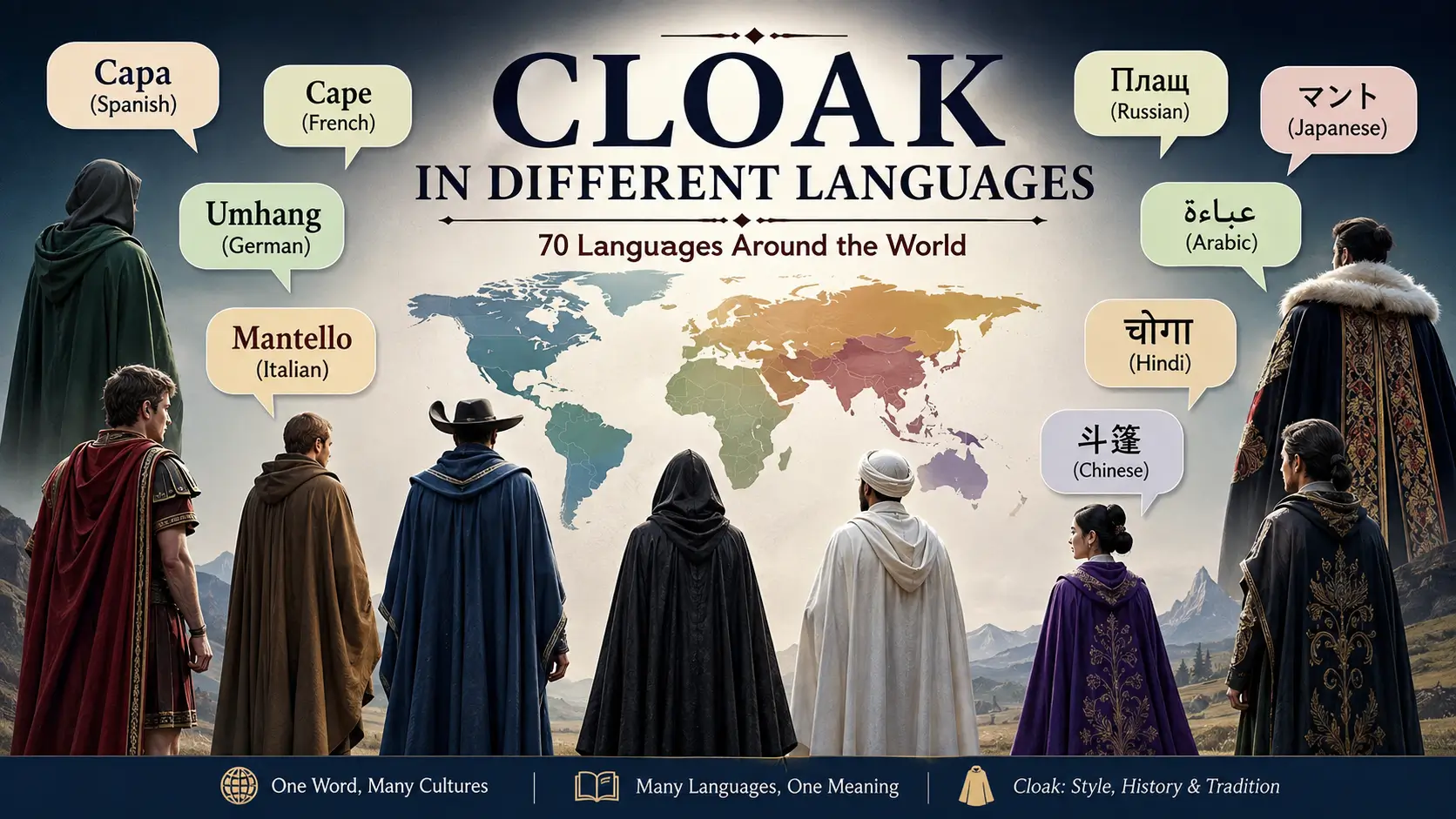
If you are looking for cloak in different languages, this guide gives you 70 translations in a simple, easy-to-use format. Each entry includes the native word or phrase, an easy English pronunciation, a short example sentence, and the English meaning.
Whether you are studying languages, writing fiction, researching traditional clothing, or simply curious about how to say cloak in different languages, the table below provides a useful global reference.
Cloak in Different Languages at a Glance
The word “cloak” can refer to several related garments depending on the language and culture. Some languages have a direct equivalent, while others use a word meaning cape, mantle, robe, or hooded outer garment.
Here are cloak translations in 70 languages:
| # | Language | Native Translation | Easy English Pronunciation | Example Sentence | English Meaning |
|---|---|---|---|---|---|
| 1 | English | Cloak | klohk | He wore a dark cloak. | He wore a dark cloak. |
| 2 | Spanish | Capa | KAH-pah | Lleva una capa negra. | He wears a black cloak. |
| 3 | French | Cape | kahp | Il porte une cape noire. | He wears a black cloak. |
| 4 | German | Umhang | OOM-hahng | Er trägt einen Umhang. | He is wearing a cloak. |
| 5 | Italian | Mantello | mahn-TEL-loh | Indossa un mantello. | He is wearing a cloak. |
| 6 | Portuguese | Capa | KAH-pah | Ele usa uma capa. | He wears a cloak. |
| 7 | Dutch | Mantel | MAHN-tel | Hij draagt een mantel. | He wears a cloak. |
| 8 | Swedish | Mantel | MAN-tel | Han bär en mantel. | He wears a cloak. |
| 9 | Norwegian | Kappe | KAP-peh | Han har på seg en kappe. | He is wearing a cloak. |
| 10 | Danish | Kappe | KAP-peh | Han bærer en kappe. | He is wearing a cloak. |
| 11 | Finnish | Viitta | VEE-tah | Hän käyttää viittaa. | He wears a cloak. |
| 12 | Icelandic | Skikkja | SKIT-kya | Hann klæðist skikkju. | He wears a cloak. |
| 13 | Irish | Clóca | KLOH-kah | Tá clóca air. | He is wearing a cloak. |
| 14 | Welsh | Mantell | MAN-thel | Mae ganddo fantell. | He has a cloak. |
| 15 | Scottish Gaelic | Brat | braht | Tha brat air. | He is wearing a cloak. |
| 16 | Latin | Pallium | PAL-lee-oom | Pallium gerit. | He wears a cloak. |
| 17 | Greek | Μανδύας | man-THEE-as | Φοράει μανδύα. | He is wearing a cloak. |
| 18 | Russian | Плащ | plashch | Он носит плащ. | He wears a cloak. |
| 19 | Ukrainian | Плащ | plashch | Він носить плащ. | He wears a cloak. |
| 20 | Belarusian | Плашч | plashch | Ён носіць плашч. | He wears a cloak. |
| 21 | Polish | Płaszcz | pwahshch | On nosi płaszcz. | He wears a cloak. |
| 22 | Czech | Plášť | plahshť | Nosí plášť. | He wears a cloak. |
| 23 | Slovak | Plášť | plahshť | Nosí plášť. | He wears a cloak. |
| 24 | Slovenian | Plašč | plahshch | Nosi plašč. | He wears a cloak. |
| 25 | Croatian | Plašt | plah-sht | Nosi plašt. | He wears a cloak. |
| 26 | Serbian | Плашт | plasht | Он носи плашт. | He wears a cloak. |
| 27 | Bulgarian | Плащ | plasht | Той носи плащ. | He wears a cloak. |
| 28 | Macedonian | Плашт | plasht | Тој носи плашт. | He wears a cloak. |
| 29 | Romanian | Mantie | MAHN-tyeh | Poartă o mantie. | He wears a cloak. |
| 30 | Hungarian | Köpeny | KUR-peny | Köpenyt visel. | He wears a cloak. |
| 31 | Albanian | Mantel | MAN-tel | Ai vesh një mantel. | He wears a cloak. |
| 32 | Lithuanian | Apsiaustas | ap-SYOW-stas | Jis dėvi apsiaustą. | He wears a cloak. |
| 33 | Latvian | Apmetnis | ap-MET-nis | Viņš valkā apmetni. | He wears a cloak. |
| 34 | Estonian | Keep | keh-ehp | Ta kannab keepi. | He wears a cloak. |
| 35 | Georgian | მოსასხამი | moh-SAS-khah-mee | მას მოსასხამი აცვია. | He is wearing a cloak. |
| 36 | Armenian | Թիկնոց | tik-NOTS | Նա թիկնոց է կրում։ | He wears a cloak. |
| 37 | Persian | شنل | shen-EL | او یک شنل پوشیده است. | He is wearing a cloak. |
| 38 | Arabic | عباءة | a-BAH-ah | هو يرتدي عباءة. | He is wearing a cloak. |
| 39 | Hebrew | גלימה | gee-LEE-mah | הוא לובש גלימה. | He is wearing a cloak. |
| 40 | Turkish | Pelerin | peh-leh-REEN | Bir pelerin giyiyor. | He is wearing a cloak. |
| 41 | Azerbaijani | Plaş | plash | O, plaş geyinir. | He wears a cloak. |
| 42 | Kazakh | Шапан | shah-PAHN | Ол шапан киеді. | He wears a cloak. |
| 43 | Uzbek | Chopon | cho-PON | U chopon kiygan. | He is wearing a cloak. |
| 44 | Hindi | चोगा | CHOH-gah | वह चोगा पहनता है। | He wears a cloak. |
| 45 | Urdu | چغہ | CHU-gha | وہ چغہ پہنتا ہے۔ | He wears a cloak. |
| 46 | Bengali | আলখাল্লা | al-khal-LA | সে আলখাল্লা পরে। | He wears a cloak. |
| 47 | Punjabi | ਚੋਗਾ | CHOH-gah | ਉਹ ਚੋਗਾ ਪਹਿਨਦਾ ਹੈ। | He wears a cloak. |
| 48 | Gujarati | ઝભ્ભો | JHAH-bhoh | તે ઝભ્ભો પહેરે છે. | He wears a cloak. |
| 49 | Marathi | झगा | JHAH-gah | तो झगा घालतो. | He wears a cloak. |
| 50 | Nepali | चोगा | CHOH-gah | उसले चोगा लगाउँछ। | He wears a cloak. |
| 51 | Sinhala | සළුව | SAH-loo-vah | ඔහු සළුවක් අඳියි. | He wears a cloak. |
| 52 | Tamil | அங்கி | AN-gee | அவர் அங்கி அணிகிறார். | He wears a cloak. |
| 53 | Telugu | అంగీ | AN-gee | అతను అంగీ ధరిస్తాడు. | He wears a cloak. |
| 54 | Kannada | ಅಂಗಿ | AN-gee | ಅವನು ಅಂಗಿ ಧರಿಸುತ್ತಾನೆ. | He wears a cloak. |
| 55 | Malayalam | അങ്കി | ANG-kee | അവൻ അങ്കി ധരിക്കുന്നു. | He wears a cloak. |
| 56 | Chinese (Mandarin) | 斗篷 | dòu peng | 他穿着斗篷。 | He is wearing a cloak. |
| 57 | Japanese | マント | man-toh | 彼はマントを着ている。 | He is wearing a cloak. |
| 58 | Korean | 망토 | mang-toh | 그는 망토를 입고 있다. | He is wearing a cloak. |
| 59 | Vietnamese | Áo choàng | ow chahng | Anh ấy mặc áo choàng. | He is wearing a cloak. |
| 60 | Thai | เสื้อคลุม | sêua khlum | เขาสวมเสื้อคลุม | He is wearing a cloak. |
| 61 | Indonesian | Jubah | JOO-bah | Dia memakai jubah. | He wears a cloak. |
| 62 | Malay | Jubah | JOO-bah | Dia memakai jubah. | He wears a cloak. |
| 63 | Filipino | Balabal | bah-lah-BAHL | Nagsuot siya ng balabal. | He wore a cloak. |
| 64 | Mongolian | Нөмрөг | NUM-rog | Тэр нөмрөг өмсдөг. | He wears a cloak. |
| 65 | Swahili | Joho | JOH-hoh | Amevaa joho. | He is wearing a cloak. |
| 66 | Zulu | Ijazi | ee-YAH-zee | Ugqoke ijazi. | He is wearing a cloak. |
| 67 | Xhosa | Ingubo | een-GOO-boh | Unxibe ingubo. | He is wearing a cloak. |
| 68 | Afrikaans | Mantel | MAN-tel | Hy dra ‘n mantel. | He wears a cloak. |
| 69 | Haitian Creole | Kap | kahp | Li mete yon kap. | He is wearing a cloak. |
| 70 | Esperanto | Mantelo | man-TEH-loh | Li portas mantelon. | He wears a cloak. |
What Does “Cloak” Mean?
A cloak is traditionally a loose piece of clothing worn over other garments. It generally hangs from the shoulders and may be fastened around the neck.
Unlike a fitted coat or jacket, a cloak usually has a flowing shape. Some cloaks also have hoods, making them useful for protection from rain, wind, or cold weather.
The meaning can vary slightly across languages. A translation may describe a traditional cloak, cape, mantle, robe, or another similar outer garment.
Cloak vs. Cape: Are They the Same?
The words cloak and cape are sometimes used interchangeably, but they are not always identical.
A cape is usually a shorter outer garment that covers the back and shoulders. A cloak is often longer and may cover most or all of the body. However, the distinction depends on the culture, historical period, and language.
This is why different cloak translations can refer to slightly different types of clothing.
How to Say Cloak in Different Languages
If you want to know how to say cloak in different languages, the exact translation depends on the type of garment you mean.
For a historical European cloak, words such as mantello, Umhang, mantel, and mantie are common choices in their respective languages. In other cultures, a traditional robe-like garment may be the closest equivalent.
For modern fantasy clothing, words translated as “cape,” “cloak,” or “mantle” may all be appropriate depending on the context.
Cloak Around the World
Cloaks have a long history across different regions. They have been used as practical clothing, ceremonial dress, military garments, religious clothing, and symbols of status.
In European history, long cloaks were commonly associated with travelers, nobles, soldiers, and formal wear. In South and Central Asia, various loose outer garments have served similar practical and cultural purposes.
Today, cloaks are also strongly associated with fantasy stories, historical costumes, theater, festivals, and reenactments. This broader cultural use explains why the idea of a cloak remains familiar around the world.
Common Uses of the Word “Cloak”
The word “cloak” can be used in both literal and figurative ways.
Literal use
A literal cloak is an item of clothing:
- She wore a warm cloak during the journey.
- The traveler pulled his cloak around his shoulders.
- The character entered wearing a long black cloak.
Figurative use
“Cloak” can also mean to hide or cover something:
- The village was cloaked in fog.
- The organization operated under a cloak of secrecy.
In these cases, the word does not refer to clothing. Instead, it describes something being concealed or surrounded by something that hides it.
Cloak Translations for Travel and Language Learning
Learning clothing words can be useful when studying a new language because clothing vocabulary appears in everyday conversations, books, movies, museums, and historical descriptions.
When using a translation, pay attention to context. A word for “cloak” may describe a traditional garment rather than a modern coat. If you are speaking about a fantasy character, historical costume, or traditional clothing, the most natural translation may differ.
The table above is therefore best used as a starting point for understanding cloak in all languages, while context determines the most appropriate word.
Frequently Asked Questions About Cloak in Different Languages
1. What is cloak in Spanish?
“Cloak” in Spanish is capa. It can describe a cape or cloak depending on the context.
2. What is cloak in French?
“Cloak” in French is commonly translated as cape. The word can refer to a cape or similar flowing outer garment.
3. What is cloak in German?
“Cloak” in German is Umhang. It refers to a loose outer garment worn over other clothing.
4. What is cloak in Japanese?
“Cloak” in Japanese is commonly マント (manto). It is used for a cape or cloak-like garment.
5. What is cloak in Chinese?
“Cloak” in Mandarin Chinese is 斗篷 (dòu peng), a word used for a cloak or cape-like outer garment.
Conclusion
Learning cloak in different languages reveals more than simple word-for-word translations. The concept of a cloak connects clothing, history, culture, storytelling, and everyday language across many regions.
Whether you need cloak translations for language learning, travel, creative writing, historical research, or general curiosity, these 70 languages provide a useful starting point. Remember that the best translation can change depending on whether you mean a historical cloak, modern cape, traditional garment, or fantasy costume.

I am Ricardo Hunter, Administrator at LingoBuz, passionate about languages, translations, and global communication. I help create useful, clear content that makes exploring different languages simple, enjoyable, and accessible.