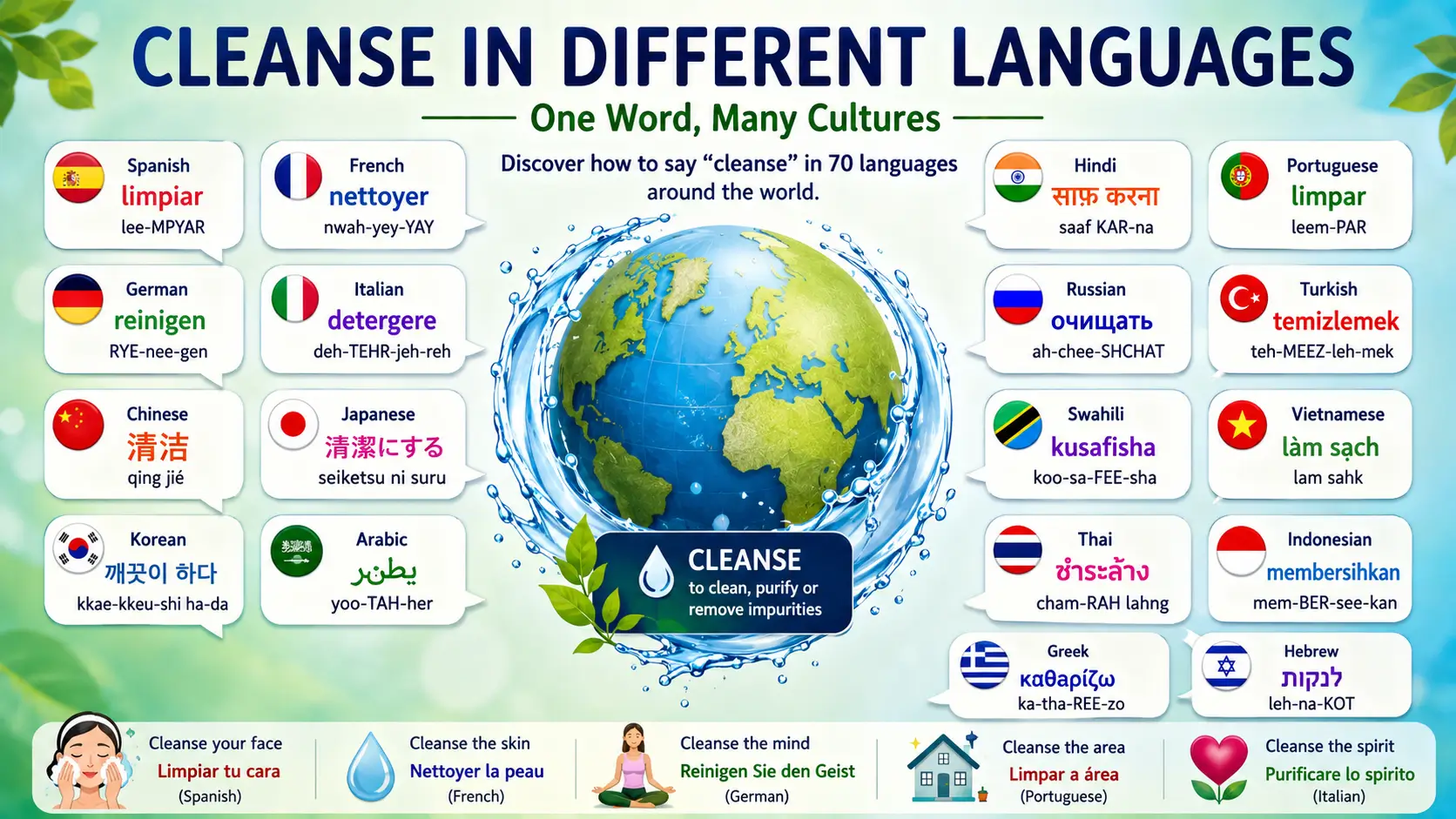
The word “cleanse” describes the act of cleaning, washing, purifying, or removing something unwanted. Depending on the context, it can refer to cleansing the body, cleaning a surface, purifying something, or removing impurities.
Learning how to say cleanse in different languages is useful for travelers, language learners, writers, translators, and anyone interested in how everyday ideas are expressed around the world.
Below, you will find cleanse translations in 70 languages, including the native word or phrase, an easy English pronunciation, and a simple real-life example. This guide makes it easy to understand how to say cleanse in different languages while seeing how the word is naturally used.
Cleanse in Different Languages
| # | Language | Native Phrase | Easy English Pronunciation | Example Sentence | English Meaning |
|---|---|---|---|---|---|
| 1 | English | cleanse | klenz | I cleanse my face every night. | I clean my face every night. |
| 2 | Spanish | limpiar | lee-MPYAR | Necesito limpiar mi cara. | I need to cleanse my face. |
| 3 | French | nettoyer | nwah-yay-YAY | Je dois nettoyer ma peau. | I need to cleanse my skin. |
| 4 | German | reinigen | RYE-nee-gen | Ich muss meine Haut reinigen. | I need to cleanse my skin. |
| 5 | Italian | detergere | deh-TEHR-jeh-reh | Devo detergere la pelle. | I need to cleanse the skin. |
| 6 | Portuguese | limpar | leem-PAR | Preciso limpar minha pele. | I need to cleanse my skin. |
| 7 | Dutch | reinigen | RY-nih-gen | Ik moet mijn huid reinigen. | I need to cleanse my skin. |
| 8 | Swedish | rengöra | RENG-yur-ah | Jag behöver rengöra huden. | I need to cleanse the skin. |
| 9 | Norwegian | rense | REN-seh | Jeg må rense huden. | I need to cleanse the skin. |
| 10 | Danish | rense | REN-seh | Jeg skal rense min hud. | I am going to cleanse my skin. |
| 11 | Finnish | puhdistaa | POOH-dis-taa | Haluan puhdistaa ihoni. | I want to cleanse my skin. |
| 12 | Icelandic | hreinsa | HRYN-sah | Ég þarf að hreinsa húðina. | I need to cleanse the skin. |
| 13 | Irish | glan | glan | Caithfidh mé mo chraiceann a ghlanadh. | I need to cleanse my skin. |
| 14 | Welsh | glanhau | GLAN-hye | Rhaid i mi lanhau fy nghroen. | I need to cleanse my skin. |
| 15 | Polish | oczyszczać | oh-CHISH-chatch | Muszę oczyszczać skórę. | I need to cleanse the skin. |
| 16 | Czech | čistit | CHIS-tit | Musím si čistit pleť. | I need to cleanse my skin. |
| 17 | Slovak | čistiť | CHIS-teet | Musím si čistiť pleť. | I need to cleanse my skin. |
| 18 | Slovenian | očistiti | oh-CHIS-tee-tee | Moram očistiti kožo. | I need to cleanse the skin. |
| 19 | Croatian | čistiti | CHIS-tee-tee | Trebam očistiti kožu. | I need to cleanse the skin. |
| 20 | Serbian | очистити | oh-CHIS-tee-tee | Moram očistiti kožu. | I need to cleanse the skin. |
| 21 | Bulgarian | почиствам | poh-CHIST-vam | Трябва да почистя кожата. | I need to cleanse the skin. |
| 22 | Russian | очищать | ah-chee-SHCHAT | Мне нужно очищать кожу. | I need to cleanse the skin. |
| 23 | Ukrainian | очищати | oh-chee-CHA-tee | Мені потрібно очищати шкіру. | I need to cleanse the skin. |
| 24 | Belarusian | ачышчаць | ah-chish-CHATZ | Мне трэба ачышчаць скуру. | I need to cleanse the skin. |
| 25 | Lithuanian | valyti | vah-LEE-tee | Turiu valyti odą. | I need to cleanse the skin. |
| 26 | Latvian | tīrīt | TEE-reet | Man jānotīra āda. | I need to cleanse the skin. |
| 27 | Estonian | puhastama | POO-has-tah-ma | Ma pean nahka puhastama. | I need to cleanse the skin. |
| 28 | Romanian | curăța | koo-ruh-TSA | Trebuie să-mi curăț pielea. | I need to cleanse my skin. |
| 29 | Hungarian | megtisztít | meg-TIS-teet | Meg kell tisztítanom a bőröm. | I need to cleanse my skin. |
| 30 | Greek | καθαρίζω | ka-tha-REE-zo | Πρέπει να καθαρίσω το δέρμα μου. | I need to cleanse my skin. |
| 31 | Albanian | pastroj | PAS-troy | Duhet të pastroj lëkurën. | I need to cleanse the skin. |
| 32 | Macedonian | чистам | CHEE-stam | Треба да ја исчистам кожата. | I need to cleanse the skin. |
| 33 | Turkish | temizlemek | teh-MEEZ-leh-mek | Cildimi temizlemeliyim. | I should cleanse my skin. |
| 34 | Azerbaijani | təmizləmək | teh-MEEZ-leh-mek | Dərimi təmizləməliyəm. | I should cleanse my skin. |
| 35 | Georgian | გაწმენდა | gah-TSMEN-dah | კანი უნდა გავიწმინდო. | I need to cleanse my skin. |
| 36 | Armenian | մաքրել | mah-KREL | Ես պետք է մաքրեմ մաշկս։ | I need to cleanse my skin. |
| 37 | Arabic | يطهّر | yoo-TAH-her | أحتاج إلى تطهير بشرتي. | I need to cleanse my skin. |
| 38 | Hebrew | לנקות | leh-na-KOT | אני צריך לנקות את העור שלי. | I need to cleanse my skin. |
| 39 | Persian | پاک کردن | paak KARD-an | باید پوستم را پاک کنم. | I need to cleanse my skin. |
| 40 | Urdu | صاف کرنا | saaf KAR-na | مجھے اپنی جلد صاف کرنی ہے۔ | I need to cleanse my skin. |
| 41 | Hindi | साफ़ करना | saaf KAR-na | मुझे अपनी त्वचा साफ़ करनी है। | I need to cleanse my skin. |
| 42 | Bengali | পরিষ্কার করা | porish-KAR kora | আমাকে আমার ত্বক পরিষ্কার করতে হবে। | I need to cleanse my skin. |
| 43 | Punjabi | ਸਾਫ਼ ਕਰਨਾ | saaf KAR-na | ਮੈਨੂੰ ਆਪਣੀ ਚਮੜੀ ਸਾਫ਼ ਕਰਨੀ ਹੈ। | I need to cleanse my skin. |
| 44 | Gujarati | સાફ કરવું | saaf KAR-vun | મારે મારી ત્વચા સાફ કરવી છે. | I need to cleanse my skin. |
| 45 | Marathi | स्वच्छ करणे | swachh KAR-ne | मला माझी त्वचा स्वच्छ करायची आहे. | I need to cleanse my skin. |
| 46 | Nepali | सफा गर्नु | sa-FA GAR-nu | मैले आफ्नो छाला सफा गर्नुपर्छ। | I need to cleanse my skin. |
| 47 | Sinhala | පිරිසිදු කරනවා | pee-ree-see-DOO kar-na-WA | මට මගේ සම පිරිසිදු කරන්න ඕනේ. | I want to cleanse my skin. |
| 48 | Tamil | சுத்தம் செய்ய | SOOTH-tham SEY-ya | நான் என் தோலை சுத்தம் செய்ய வேண்டும். | I need to cleanse my skin. |
| 49 | Telugu | శుభ్రం చేయడం | SHOOB-ram CHAY-yadam | నేను నా చర్మాన్ని శుభ్రం చేయాలి. | I need to cleanse my skin. |
| 50 | Kannada | ಸ್ವಚ್ಛಗೊಳಿಸು | SWACH-ha-go-li-soo | ನಾನು ನನ್ನ ಚರ್ಮವನ್ನು ಸ್ವಚ್ಛಗೊಳಿಸಬೇಕು. | I need to cleanse my skin. |
| 51 | Malayalam | വൃത്തിയാക്കുക | VRIT-ti-yaa-kuka | ഞാൻ എന്റെ ചർമ്മം വൃത്തിയാക്കണം. | I need to cleanse my skin. |
| 52 | Thai | ชำระล้าง | cham-RAH lahng | ฉันต้องชำระล้างผิว | I need to cleanse my skin. |
| 53 | Vietnamese | làm sạch | lam sahk | Tôi cần làm sạch da. | I need to cleanse my skin. |
| 54 | Indonesian | membersihkan | mem-BER-see-kan | Saya perlu membersihkan kulit saya. | I need to cleanse my skin. |
| 55 | Malay | membersihkan | mem-BER-see-kan | Saya perlu membersihkan kulit saya. | I need to cleanse my skin. |
| 56 | Tagalog | linisin | lee-NEE-sin | Kailangan kong linisin ang aking balat. | I need to cleanse my skin. |
| 57 | Chinese | 清洁 | qīng jié | 我需要清洁皮肤。 | I need to cleanse my skin. |
| 58 | Japanese | 清潔にする | seiketsu ni suru | 肌を清潔にします。 | I cleanse my skin. |
| 59 | Korean | 깨끗이 하다 | kkae-kkeu-shi ha-da | 피부를 깨끗이 해야 해요. | I need to cleanse my skin. |
| 60 | Mongolian | цэвэрлэх | tse-ver-lekh | Би арьсаа цэвэрлэх хэрэгтэй. | I need to cleanse my skin. |
| 61 | Swahili | kusafisha | koo-sa-FEE-sha | Ninahitaji kusafisha ngozi yangu. | I need to cleanse my skin. |
| 62 | Amharic | ማጽዳት | ma-tsi-DAT | ቆዳዬን ማጽዳት አለብኝ። | I need to cleanse my skin. |
| 63 | Somali | nadiifin | na-DEEF-in | Waxaan rabaa inaan maqaarkayga nadiifiyo. | I want to cleanse my skin. |
| 64 | Zulu | hlanza | HLAN-za | Ngifuna ukuhlanza isikhumba sami. | I want to cleanse my skin. |
| 65 | Xhosa | coca | KOH-tsa | Ndifuna ukucoca ulusu lwam. | I want to cleanse my skin. |
| 66 | Afrikaans | reinig | RAY-nikh | Ek moet my vel reinig. | I need to cleanse my skin. |
| 67 | Haitian Creole | netwaye | neh-twa-YEH | Mwen bezwen netwaye po mwen. | I need to cleanse my skin. |
| 68 | Malagasy | manadio | ma-nee-OW | Mila manadio ny hoditro aho. | I need to cleanse my skin. |
| 69 | Esperanto | purigi | poo-REE-gee | Mi volas purigi mian haŭton. | I want to cleanse my skin. |
| 70 | Latin | purgare | poor-GAR-eh | Cutem purgare debeo. | I need to cleanse the skin. |
What Does “Cleanse” Mean?
Cleanse generally means to make something clean by removing dirt, impurities, unwanted substances, or contamination. It can be used as a verb in everyday, cosmetic, spiritual, and figurative contexts.
For example:
- Cleanse your face means to wash or clean your face.
- Cleanse the skin means to remove dirt, oil, or other buildup.
- Cleanse the area means to clean an area thoroughly.
- Cleanse the body can refer to cleaning the body, although the exact meaning depends on context.
- Cleanse the mind is often used figuratively to describe removing negative thoughts or emotional burdens.
The most natural translation therefore depends on what is being cleansed.
How to Say “Cleanse” in Different Languages
There is no single translation that works perfectly in every situation. In many languages, the closest everyday equivalent is a verb meaning “to clean” or “to purify.”
For example, Spanish commonly uses limpiar, while French uses nettoyer. German uses reinigen, and Italian can use detergere, especially when discussing cleansing the skin.
In languages such as Chinese, Japanese, and Korean, the most natural choice can change depending on whether you are talking about skin care, ordinary cleaning, or purification.
This is why understanding the sentence around the word is important when looking at cleanse translations.
Cleanse in All Languages: Common Contexts
The English word “cleanse” has several meanings, so context matters.
Skin Care
In beauty and skin-care writing, “cleanse” usually means washing the skin to remove dirt, oil, makeup, sweat, or other buildup.
Example:
I cleanse my face every evening.
This usage is often translated using the ordinary verb for cleaning or washing.
Cleaning Something
“Cleanse” can also have a more formal meaning similar to clean or purify.
Example:
The workers cleansed the area before use.
In this context, a language may use a stronger verb associated with thorough cleaning or purification.
Spiritual or Figurative Meaning
The word can also have a figurative meaning.
Example:
The ritual was believed to cleanse the spirit.
Here, a translation may use a word meaning purify, rather than simply wash.
Cleanse vs. Clean
Although cleanse and clean are closely related, they are not always interchangeable.
Clean is the more common everyday word. It can describe removing dirt from almost anything.
Cleanse often sounds more deliberate, thorough, formal, cosmetic, or figurative.
For example:
- Clean the table.
- Cleanse the skin.
- Cleanse the spirit.
- Cleanse the area.
The exact distinction changes from language to language, which is one reason translations should be chosen according to context.
Cleanse Translations for Travel and Everyday Conversation
If you are learning a new language, it is usually more useful to learn “cleanse” inside a complete phrase rather than memorizing the isolated word.
For example, someone traveling abroad might need expressions related to:
- cleansing the face
- cleansing the skin
- cleaning a wound
- cleaning a surface
- purifying water
- removing impurities
The correct local verb may be different for each situation.
Why “Cleanse” Has Different Translations Around the World
Languages organize concepts differently. A single English word may correspond to several words in another language depending on the object and situation.
For instance, the English word “cleanse” can overlap with concepts such as:
- clean
- wash
- purify
- disinfect
- remove impurities
- make clean
Because of this, the cleanse around the world translations in the table should be understood as practical equivalents rather than claims that every language has one exact word matching every English use.
Tips for Learning “Cleanse” in Another Language
If you want to remember the word more easily, try these simple methods:
- Learn it in a sentence. A sentence gives the word useful context.
- Practice the pronunciation. Say the native phrase several times.
- Connect it with an action. Use the word while actually cleaning or washing something.
- Learn related vocabulary. Words for skin, water, soap, washing, and cleaning can make the phrase easier to remember.
- Check the context. A word for ordinary cleaning may not be the best choice for spiritual or medical contexts.
Frequently Asked Questions
1. How do you say “cleanse” in different languages?
“Cleanse” can be translated in many ways depending on the language and context. Common equivalents include limpiar in Spanish, nettoyer in French, reinigen in German, limpar in Portuguese, 清洁 (qīng jié) in Chinese, and 청결하게 하다 / 깨끗이 하다 in Korean.
2. What is the most common meaning of “cleanse”?
The most common meaning is to clean or purify something by removing dirt, impurities, or unwanted substances. In skin care, it commonly means washing the skin to remove buildup.
3. Is “cleanse” the same as “clean”?
They have similar meanings, but “cleanse” can sound more formal, thorough, cosmetic, or figurative. “Clean” is generally more common in ordinary everyday English.
4. How do you say “cleanse your skin” in other languages?
The phrase varies by language. Spanish commonly uses a form of limpiar, French uses nettoyer, German uses reinigen, and several Asian languages use their respective everyday expressions for cleaning or keeping the skin clean.
5. Can “cleanse” mean “purify”?
Yes. In some contexts, cleanse can mean purify, especially when talking about the body, spirit, emotions, or something that needs impurities removed. The best translation depends on the specific sentence.
Conclusion
Learning cleanse in different languages is a useful way to understand how languages express the ideas of cleaning, washing, and purification. Although the English word has several meanings, the 70 translations above provide practical equivalents for everyday communication and language learning.
When searching for cleanse in all languages, remember that context is important. A translation used for skin care may differ from one used for spiritual purification or thorough cleaning. Learning the word together with a natural example sentence is one of the best ways to use it correctly.

I am Scarlett Wilson, a passionate language writer who loves exploring different languages, words, meanings, translations, and useful phrases. I enjoy making language learning simple, clear, and interesting for everyone.