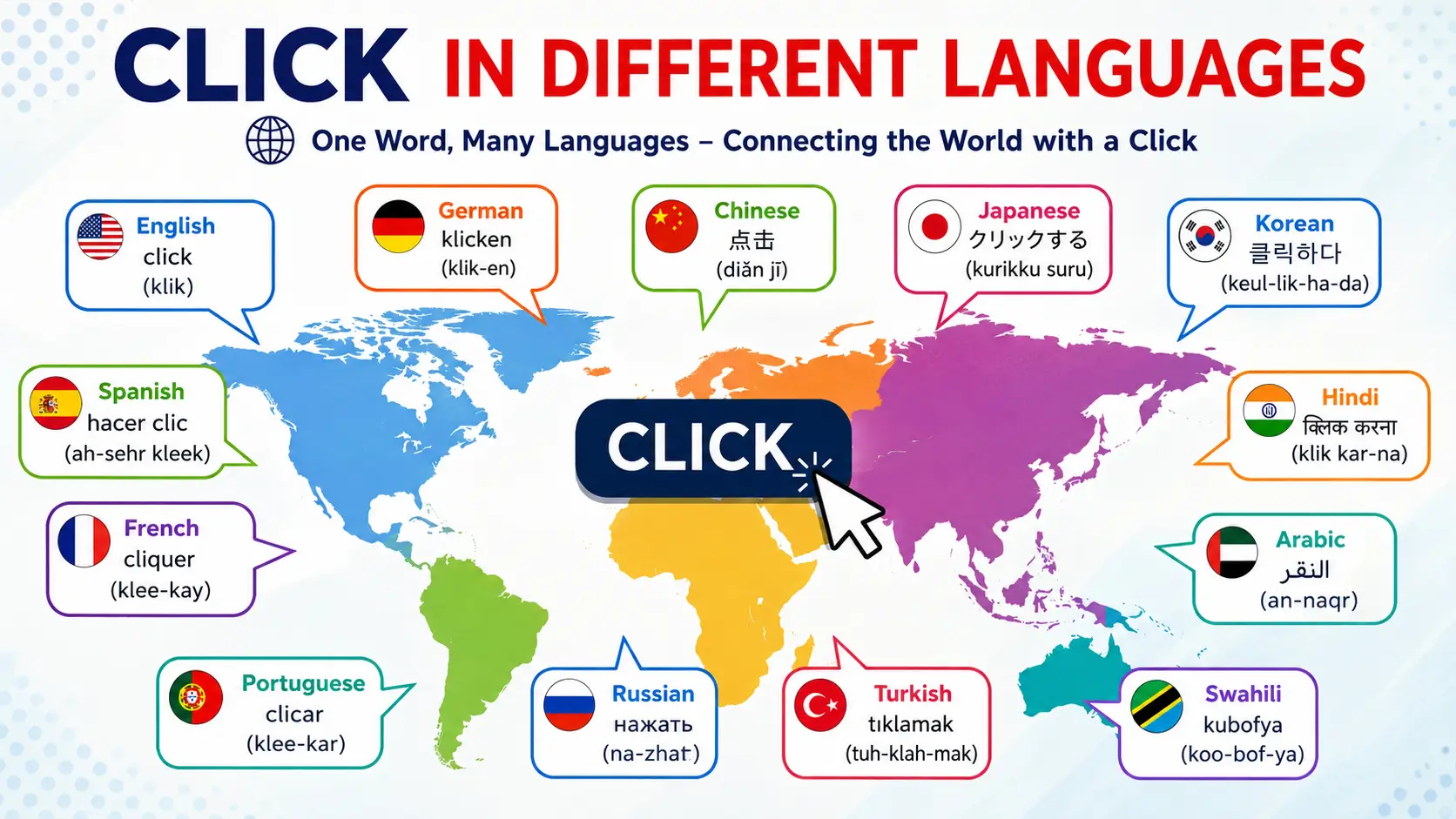
The word “click” is one of the most common terms in modern digital communication. You see it on websites, apps, computers, phones, and online instructions every day. But how do you say click in different languages?
Whether you are learning languages, creating multilingual content, traveling, or simply curious about click translations, this guide gives you 70 useful equivalents. Each entry includes the native phrase, an easy pronunciation guide, a short real-life example, and its English meaning.
In most entries below, “click” means pressing a mouse button or selecting something on a screen. Some languages naturally use a phrase such as “press,” “select,” or “click on,” depending on context.
How to Say “Click” in Different Languages
Here is a practical list showing click in all languages. The examples are written naturally so you can understand how the word or phrase is used in everyday digital situations.
| # | Language | Native Phrase | Easy English Pronunciation | Example Sentence | English Meaning |
|---|---|---|---|---|---|
| 1 | English | click | klik | Click the button. | Click the button. |
| 2 | Spanish | hacer clic | ah-SEHR kleek | Haz clic en el botón. | Click the button. |
| 3 | French | cliquer | klee-KAY | Cliquez sur le lien. | Click the link. |
| 4 | German | klicken | KLIK-en | Klicken Sie auf den Link. | Click the link. |
| 5 | Italian | cliccare | klee-KAH-reh | Clicca sul pulsante. | Click the button. |
| 6 | Portuguese | clicar | klee-KAR | Clique no botão. | Click the button. |
| 7 | Dutch | klikken | KLIK-en | Klik op de knop. | Click the button. |
| 8 | Afrikaans | klik | klik | Klik op die skakel. | Click the link. |
| 9 | Swedish | klicka | KLIK-ka | Klicka på länken. | Click the link. |
| 10 | Norwegian | klikke | KLIK-keh | Klikk på knappen. | Click the button. |
| 11 | Danish | klikke | KLIK-keh | Klik på knappen. | Click the button. |
| 12 | Finnish | napsauttaa | NAP-sowt-taa | Napsauta painiketta. | Click the button. |
| 13 | Icelandic | smella | SMET-la | Smelltu á hnappinn. | Click the button. |
| 14 | Irish | cliceáil | KLIKH-ale | Cliceáil ar an nasc. | Click the link. |
| 15 | Welsh | clicio | KLIK-yo | Cliciwch ar y botwm. | Click the button. |
| 16 | Scottish Gaelic | cliog | KLEE-og | Cliog air a’ cheangal. | Click the link. |
| 17 | Polish | kliknąć | KLIK-nonch | Kliknij przycisk. | Click the button. |
| 18 | Czech | kliknout | KLIK-noot | Klikněte na tlačítko. | Click the button. |
| 19 | Slovak | kliknúť | KLIK-noot | Kliknite na tlačidlo. | Click the button. |
| 20 | Slovenian | klikniti | KLIK-nee-tee | Kliknite gumb. | Click the button. |
| 21 | Croatian | kliknuti | KLIK-noo-tee | Kliknite gumb. | Click the button. |
| 22 | Serbian | кликнути | KLIK-noo-tee | Kliknite na dugme. | Click the button. |
| 23 | Bosnian | kliknuti | KLIK-noo-tee | Kliknite na dugme. | Click the button. |
| 24 | Bulgarian | щракна | SHRAK-na | Щракнете върху бутона. | Click the button. |
| 25 | Macedonian | кликне | KLIK-neh | Кликнете на копчето. | Click the button. |
| 26 | Russian | нажать | na-ZHAT | Нажмите кнопку. | Press/click the button. |
| 27 | Ukrainian | натиснути | na-TYS-noo-ty | Натисніть кнопку. | Click/press the button. |
| 28 | Belarusian | націснуць | na-TSIS-noots | Націсніце кнопку. | Click the button. |
| 29 | Lithuanian | spustelėti | SPOOS-teh-leh-tee | Spustelėkite mygtuką. | Click the button. |
| 30 | Latvian | noklikšķināt | no-KLIK-shkee-naat | Noklikšķiniet uz pogas. | Click the button. |
| 31 | Estonian | klõpsama | KLOP-sa-ma | Klõpsake nuppu. | Click the button. |
| 32 | Hungarian | kattintani | KAT-tin-ta-nee | Kattintson a gombra. | Click the button. |
| 33 | Romanian | a face clic | ah FA-cheh klik | Faceți clic pe buton. | Click the button. |
| 34 | Albanian | klikoj | klee-KOY | Klikoni butonin. | Click the button. |
| 35 | Greek | κάνω κλικ | KA-no klik | Κάντε κλικ στο κουμπί. | Click the button. |
| 36 | Turkish | tıklamak | tuhklah-MAK | Düğmeye tıklayın. | Click the button. |
| 37 | Azerbaijani | klikləmək | klik-leh-MEK | Düyməyə klikləyin. | Click the button. |
| 38 | Georgian | დაჭერა | da-CHE-ra | დააჭირეთ ღილაკს. | Click/press the button. |
| 39 | Armenian | սեղմել | seh-MEL | Սեղմեք կոճակը։ | Click/press the button. |
| 40 | Persian | کلیک کردن | ke-LEEK KARD-an | روی دکمه کلیک کنید. | Click the button. |
| 41 | Arabic | النقر | an-NAQR | انقر على الزر. | Click the button. |
| 42 | Hebrew | ללחוץ | lil-KHOTS | לחץ על הכפתור. | Click the button. |
| 43 | Hindi | क्लिक करना | klik KAR-na | बटन पर क्लिक करें। | Click the button. |
| 44 | Urdu | کلک کرنا | klik KAR-na | بٹن پر کلک کریں۔ | Click the button. |
| 45 | Bengali | ক্লিক করা | klik KOR-a | বোতামে ক্লিক করুন। | Click the button. |
| 46 | Punjabi | ਕਲਿੱਕ ਕਰਨਾ | klik KAR-na | ਬਟਨ ‘ਤੇ ਕਲਿੱਕ ਕਰੋ। | Click the button. |
| 47 | Gujarati | ક્લિક કરવું | klik KAR-voo | બટન પર ક્લિક કરો. | Click the button. |
| 48 | Marathi | क्लिक करणे | klik KAR-ne | बटणावर क्लिक करा. | Click the button. |
| 49 | Nepali | क्लिक गर्नु | klik GAR-noo | बटनमा क्लिक गर्नुहोस्। | Click the button. |
| 50 | Sinhala | ක්ලික් කරන්න | klik KAR-an-na | බොත්තම ක්ලික් කරන්න. | Click the button. |
| 51 | Tamil | கிளிக் செய்ய | klik SEY-ya | பொத்தானைக் கிளிக் செய்யவும். | Click the button. |
| 52 | Telugu | క్లిక్ చేయండి | klik CHEY-an-dee | బటన్ను క్లిక్ చేయండి. | Click the button. |
| 53 | Kannada | ಕ್ಲಿಕ್ ಮಾಡಿ | klik MA-dee | ಬಟನ್ ಕ್ಲಿಕ್ ಮಾಡಿ. | Click the button. |
| 54 | Malayalam | ക്ലിക്ക് ചെയ്യുക | klik CHEY-yoo-ka | ബട്ടണിൽ ക്ലിക്ക് ചെയ്യുക. | Click the button. |
| 55 | Thai | คลิก | klik | คลิกปุ่ม | Click the button. |
| 56 | Vietnamese | nhấp | nyup | Nhấp vào nút. | Click the button. |
| 57 | Indonesian | klik | klik | Klik tombolnya. | Click the button. |
| 58 | Malay | klik | klik | Klik butang itu. | Click that button. |
| 59 | Filipino | i-click | ee-KLIK | I-click ang button. | Click the button. |
| 60 | Javanese | ngeklik | ngeh-KLIK | Klik tombol kuwi. | Click that button. |
| 61 | Chinese (Mandarin) | 点击 | diǎn jī | 点击按钮。 | Click the button. |
| 62 | Japanese | クリックする | kurikku suru | ボタンをクリックしてください。 | Please click the button. |
| 63 | Korean | 클릭하다 | keul-lik-ha-da | 버튼을 클릭하세요. | Click the button. |
| 64 | Mongolian | дарах | da-rakh | Товчийг дарна уу. | Click/press the button. |
| 65 | Kazakh | басу | ba-soo | Түймені басыңыз. | Click/press the button. |
| 66 | Uzbek | bosmoq | BOS-mok | Tugmani bosing. | Click/press the button. |
| 67 | Swahili | kubofya | koo-BOF-ya | Bofya kitufe. | Click the button. |
| 68 | Zulu | chofoza | cho-FO-za | Chofoza inkinobho. | Click the button. |
| 69 | Xhosa | cofa | KOH-fa | Cofa iqhosha. | Click the button. |
| 70 | Haitian Creole | klike | klee-KEH | Klike sou bouton an. | Click the button. |
What Does “Click” Mean?
In everyday English, click can have several meanings.
The most common modern meaning is to press a mouse button or select something on a digital screen. For example, you might click a link, click a button, or click an icon.
The word can also describe a short sharp sound, such as the click of a camera or a door lock. In another informal use, people can say that two people “click,” meaning they get along well.
For language-learning and technology-related searches, however, click usually refers to the action performed with a computer mouse, trackpad, or touchscreen.
Click Translations for Websites and Apps
When translating software, websites, menus, or instructions, context matters.
English often uses “click” even when a person is using a touchscreen. Some languages instead prefer words equivalent to press, tap, or select.
For example, Russian, Ukrainian, Georgian, Armenian, Mongolian, and Kazakh commonly use words associated with pressing. This does not necessarily mean the translation is incorrect. It reflects the natural terminology used in that language.
If you are localizing a website, always consider whether the user is using a mouse, keyboard, trackpad, or touchscreen.
How to Say “Click” in Different Languages for Digital Instructions
For simple computer instructions, these patterns are especially useful:
- Click the button
- Click the link
- Click here
- Click the icon
- Click to continue
The exact grammatical structure changes from language to language. Some languages use an infinitive, while others use a polite imperative form.
This is why direct word-for-word translation is not always the best approach. A natural instruction should sound like something a native speaker would actually see in an app or website.
Click Around the World
The widespread use of computers and smartphones has made click a familiar digital concept around the world. Many languages have adopted a variation of the English-derived word, while others use an established native verb.
Languages such as French, German, Italian, Portuguese, Dutch, Turkish, and several Asian languages have recognizable forms associated with clicking. Other languages commonly describe the action as pressing or selecting.
This makes click around the world an interesting example of how technology influences modern vocabulary.
Common Uses of “Click”
Here are several common expressions you may encounter:
Click a Button
This means selecting a button on a website, application, or computer interface.
Click a Link
This means selecting a hyperlink to open another page or resource.
Click an Icon
This means selecting a small graphical symbol representing an application, file, feature, or command.
Click Here
This is a common instruction used to direct someone to a particular interactive element.
Double-Click
A double-click means pressing the mouse button twice quickly. It is commonly used to open files or applications on desktop computers.
Right-Click
A right-click means pressing the right mouse button, usually to open a context menu.
Why Learning “Click” in Other Languages Is Useful
Knowing how to say click in different languages can be useful for travelers, students, translators, software developers, website owners, and multilingual content creators.
It is particularly helpful when working with:
- Multilingual websites
- Software localization
- Online tutorials
- Computer instructions
- Language-learning materials
- User-interface translations
- International customer support
Learning a single practical technology word can also help you recognize related instructions when navigating websites or applications in another language.
Tips for Using “Click” Naturally
A good translation should match the situation rather than simply copying the English word.
First, identify what the user is actually doing. If they are using a mouse, “click” may be the most accurate concept. If they are using a phone, “tap” may be more natural in some languages.
Second, consider the level of formality. Software interfaces often use concise commands, while help guides may use polite instructions.
Finally, remember that borrowed technology vocabulary can vary between countries and regions. A word that is common in one language community may sound less natural in another.
Frequently Asked Questions
1. How do you say “click” in different languages?
“Click” has different translations depending on the language. Examples include hacer clic in Spanish, cliquer in French, klicken in German, cliccare in Italian, кликнуть in Russian, 点击 in Mandarin Chinese, and クリックする in Japanese.
2. What is “click” in Spanish?
The common Spanish expression is hacer clic, while the imperative form can be haz clic. For example, “Haz clic en el botón” means “Click the button.”
3. What is “click” in French?
The French verb is cliquer. A common instruction is Cliquez sur le lien, meaning “Click the link.”
4. Is “click” the same as “tap” in every language?
No. In some languages, the normal computer term refers to clicking, while mobile interfaces may use a word meaning “tap” or “press.” The best translation depends on the device and context.
5. Why do some languages use a word meaning “press” for “click”?
Digital terminology does not develop identically in every language. Some languages describe the physical action of pressing a button rather than borrowing the English word “click.” Both can communicate the intended action when used naturally.
Conclusion
Learning click in different languages is a simple but useful way to expand your practical vocabulary. From Spanish hacer clic and French cliquer to Mandarin 点击 and Japanese クリックする, languages around the world express this everyday digital action in different ways.
Whether you searched for click in all languages, click translations, or how to say click in different languages, this 70-language list provides a practical starting point for communication, translation, and language learning.

I am Ava Jones, a language enthusiast and author passionate about exploring different languages, sharing useful phrases, explaining meanings, and helping readers communicate confidently across cultures and countries.