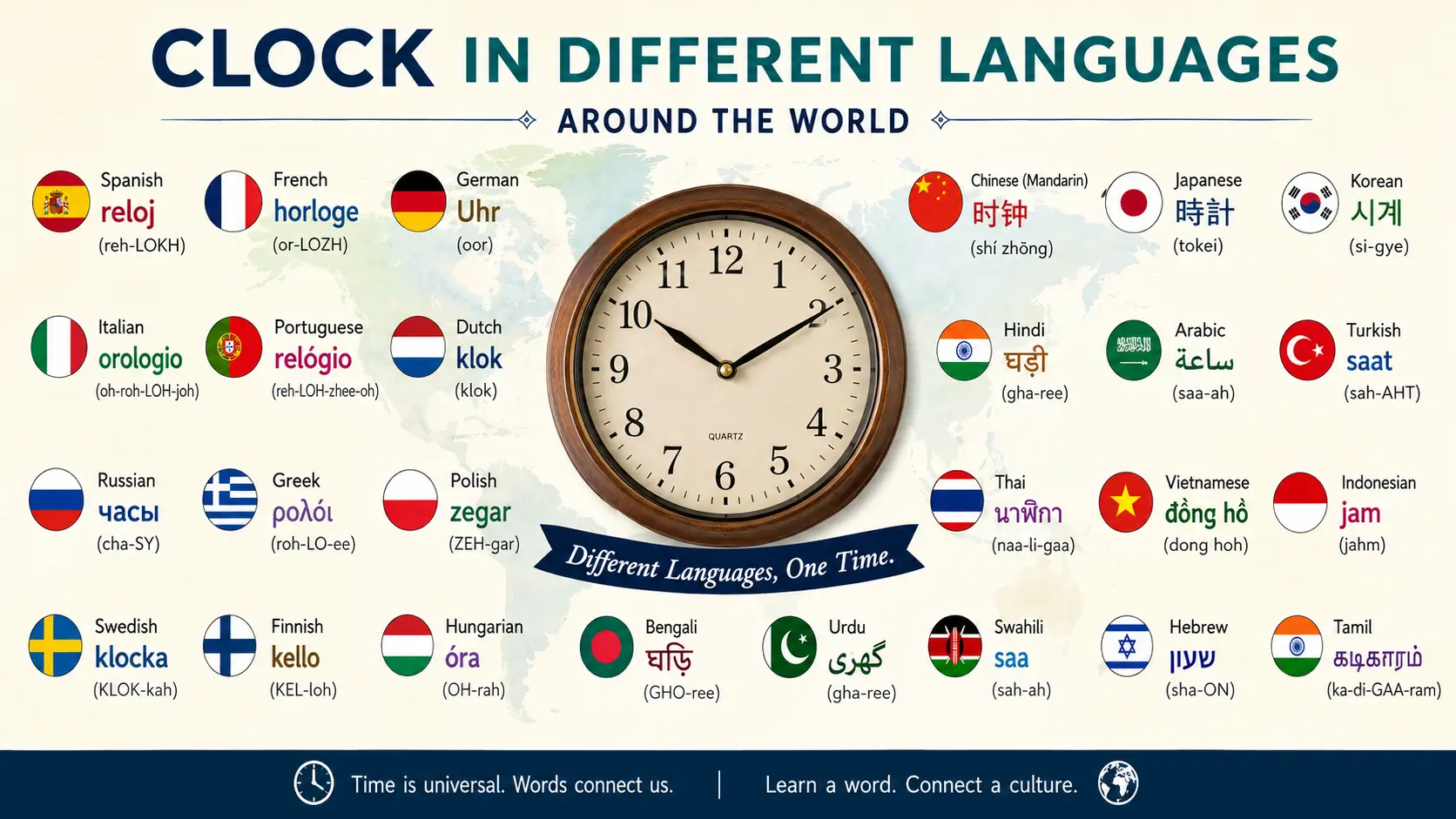
A clock is one of the most familiar objects in everyday life, but its name changes significantly from one language to another. Learning how to say “clock” in different languages is useful for travelers, language learners, students, translators, and anyone interested in how languages describe everyday objects.
In English, clock usually refers to a device that shows the time, especially a wall clock, desk clock, or other non-portable timepiece. In some languages, the same word may cover both “clock” and “watch,” while others use separate terms.
Below, you will find 70 clock translations with the native word, an easy pronunciation guide, and a practical example sentence. This makes the list useful for anyone searching for “clock in all languages,” “how to say clock in different languages,” “clock translations,” or “clock around the world.”
Clock in Different Languages: 70 Translations
The table below includes exactly 70 languages. Pronunciations are simplified for English speakers, so they are intended as helpful guides rather than exact phonetic transcriptions.
| # | Language | Native phrase | Easy English pronunciation | Example sentence | English meaning |
|---|---|---|---|---|---|
| 1 | Spanish | reloj | reh-LOKH | El reloj está en la pared. | The clock is on the wall. |
| 2 | French | horloge | or-LOZH | L’horloge est ancienne. | The clock is old. |
| 3 | German | Uhr | oor | Die Uhr hängt an der Wand. | The clock hangs on the wall. |
| 4 | Italian | orologio | oh-roh-LOH-joh | L’orologio è sulla parete. | The clock is on the wall. |
| 5 | Portuguese | relógio | reh-LOH-zhee-oh | O relógio está na parede. | The clock is on the wall. |
| 6 | Dutch | klok | klok | De klok hangt aan de muur. | The clock hangs on the wall. |
| 7 | Swedish | klocka | KLOK-kah | Klockan hänger på väggen. | The clock hangs on the wall. |
| 8 | Norwegian | klokke | KLOK-keh | Klokken står på bordet. | The clock is on the table. |
| 9 | Danish | ur | oor | Uret hænger på væggen. | The clock hangs on the wall. |
| 10 | Finnish | kello | KEL-loh | Kello on seinällä. | The clock is on the wall. |
| 11 | Icelandic | klukka | KLOOK-kah | Klukkan er á veggnum. | The clock is on the wall. |
| 12 | Irish | clog | klug | Tá an clog ar an mballa. | The clock is on the wall. |
| 13 | Welsh | cloc | klok | Mae’r cloc ar y wal. | The clock is on the wall. |
| 14 | Scottish Gaelic | gleoc | glyok | Tha an gleoc air a’ bhalla. | The clock is on the wall. |
| 15 | Polish | zegar | ZEH-gar | Zegar jest na ścianie. | The clock is on the wall. |
| 16 | Czech | hodiny | HOH-dih-nee | Hodiny jsou na zdi. | The clock is on the wall. |
| 17 | Slovak | hodiny | HOH-dih-nee | Hodiny visia na stene. | The clock hangs on the wall. |
| 18 | Slovenian | ura | OO-rah | Ura je na steni. | The clock is on the wall. |
| 19 | Croatian | sat | saht | Sat je na zidu. | The clock is on the wall. |
| 20 | Serbian | sat | saht | Sat je na zidu. | The clock is on the wall. |
| 21 | Bulgarian | часовник | chas-ov-NEEK | Часовникът е на стената. | The clock is on the wall. |
| 22 | Macedonian | часовник | chas-OV-neek | Часовникот е на ѕидот. | The clock is on the wall. |
| 23 | Russian | часы | cha-SY | Часы висят на стене. | The clock hangs on the wall. |
| 24 | Ukrainian | годинник | ho-DYN-nyk | Годинник висить на стіні. | The clock hangs on the wall. |
| 25 | Belarusian | гадзіннік | ha-DZEE-nik | Гадзіннік вісіць на сцяне. | The clock hangs on the wall. |
| 26 | Lithuanian | laikrodis | like-ROH-dis | Laikrodis yra ant sienos. | The clock is on the wall. |
| 27 | Latvian | pulkstenis | poolk-STEH-nis | Pulkstenis ir pie sienas. | The clock is by the wall. |
| 28 | Estonian | kell | kell | Kell on seinal. | The clock is on the wall. |
| 29 | Hungarian | óra | OH-rah | Az óra a falon van. | The clock is on the wall. |
| 30 | Romanian | ceas | chas | Ceasul este pe perete. | The clock is on the wall. |
| 31 | Albanian | orë | OH-reh | Ora është në mur. | The clock is on the wall. |
| 32 | Greek | ρολόι | roh-LO-ee | Το ρολόι είναι στον τοίχο. | The clock is on the wall. |
| 33 | Turkish | saat | sah-AHT | Saat duvarda. | The clock is on the wall. |
| 34 | Arabic | ساعة | saa-ah | الساعة على الحائط. | The clock is on the wall. |
| 35 | Hebrew | שעון | sha-ON | השעון על הקיר. | The clock is on the wall. |
| 36 | Persian | ساعت | saa-AT | ساعت روی دیوار است. | The clock is on the wall. |
| 37 | Urdu | گھڑی | gha-ree | گھڑی دیوار پر ہے۔ | The clock is on the wall. |
| 38 | Hindi | घड़ी | gha-ree | घड़ी दीवार पर है। | The clock is on the wall. |
| 39 | Bengali | ঘড়ি | GHO-ree | ঘড়িটি দেয়ালে আছে। | The clock is on the wall. |
| 40 | Punjabi | ਘੜੀ | gha-ree | ਘੜੀ ਕੰਧ ਉੱਤੇ ਹੈ। | The clock is on the wall. |
| 41 | Gujarati | ઘડિયાળ | gha-di-yaal | ઘડિયાળ દિવાલ પર છે. | The clock is on the wall. |
| 42 | Marathi | घड्याळ | gha-DYAL | घड्याळ भिंतीवर आहे. | The clock is on the wall. |
| 43 | Nepali | घडी | gha-dee | घडी भित्तामा छ। | The clock is on the wall. |
| 44 | Sinhala | ඔරලෝසුව | oh-ra-LOH-soo-va | ඔරලෝසුව බිත්තියේ ඇත. | The clock is on the wall. |
| 45 | Tamil | கடிகாரம் | ka-di-GAA-ram | கடிகாரம் சுவரில் உள்ளது. | The clock is on the wall. |
| 46 | Telugu | గడియారం | ga-di-YAA-ram | గడియారం గోడపై ఉంది. | The clock is on the wall. |
| 47 | Kannada | ಗಡಿಯಾರ | ga-di-YAA-ra | ಗಡಿಯಾರ ಗೋಡೆಯ ಮೇಲೆ ಇದೆ. | The clock is on the wall. |
| 48 | Malayalam | ഘടികാരം | gha-di-KAA-ram | ഘടികാരം ചുമരിലാണ്. | The clock is on the wall. |
| 49 | Odia | ଘଡ଼ି | gha-di | ଘଡ଼ି କାନ୍ଥରେ ଅଛି। | The clock is on the wall. |
| 50 | Assamese | ঘড়ী | GHO-ree | ঘড়ীখন বেৰত আছে। | The clock is on the wall. |
| 51 | Chinese (Mandarin) | 时钟 | shí zhōng | 时钟在墙上。 | The clock is on the wall. |
| 52 | Japanese | 時計 | tokei | 時計は壁にあります。 | The clock is on the wall. |
| 53 | Korean | 시계 | si-gye | 시계가 벽에 있어요. | The clock is on the wall. |
| 54 | Vietnamese | đồng hồ | dong hoh | Đồng hồ ở trên tường. | The clock is on the wall. |
| 55 | Thai | นาฬิกา | naa-li-gaa | นาฬิกาอยู่บนผนัง | The clock is on the wall. |
| 56 | Indonesian | jam | jahm | Jam itu ada di dinding. | The clock is on the wall. |
| 57 | Malay | jam | jahm | Jam itu di dinding. | The clock is on the wall. |
| 58 | Filipino | orasan | oh-rah-SAHN | Ang orasan ay nasa dingding. | The clock is on the wall. |
| 59 | Javanese | jam | jahm | Jam iku ana ing tembok. | The clock is on the wall. |
| 60 | Burmese | နာရီ | naa-yee | နာရီက နံရံပေါ်မှာ ရှိတယ်။ | The clock is on the wall. |
| 61 | Khmer | នាឡិកា | naa-li-kaa | នាឡិកានៅលើជញ្ជាំង។ | The clock is on the wall. |
| 62 | Lao | ໂມງ | mohng | ໂມງຢູ່ເທິງຝາ. | The clock is on the wall. |
| 63 | Mongolian | цаг | tsahg | Цаг ханан дээр байна. | The clock is on the wall. |
| 64 | Kazakh | сағат | sa-GHAT | Сағат қабырғада тұр. | The clock is on the wall. |
| 65 | Uzbek | soat | soh-AHT | Soat devorda turibdi. | The clock is on the wall. |
| 66 | Azerbaijani | saat | saa-AHT | Saat divardadır. | The clock is on the wall. |
| 67 | Georgian | საათი | saa-ti | საათი კედელზეა. | The clock is on the wall. |
| 68 | Armenian | ժամացույց | zha-ma-TSOOTS | Ժամացույցը պատին է։ | The clock is on the wall. |
| 69 | Swahili | saa | sah-ah | Saa iko ukutani. | The clock is on the wall. |
| 70 | Afrikaans | horlosie | hor-loh-SEE | Die horlosie is aan die muur. | The clock is on the wall. |
What Does “Clock” Mean?
The word clock refers to an instrument designed to show or measure the current time. Common examples include wall clocks, alarm clocks, digital clocks, grandfather clocks, and table clocks.
The word can have a slightly different meaning depending on the language. For example, some languages use one general term for both a clock and a watch, while others distinguish between a clock that stays in one place and a watch worn on the body.
This difference is important when learning clock translations because a direct dictionary translation does not always capture every usage.
Clock vs. Watch in Different Languages
English clearly separates clock and watch in everyday vocabulary.
- Clock: generally stays in a fixed location.
- Watch: normally worn on the wrist or carried as a personal timepiece.
- Alarm clock: a clock designed to wake someone at a chosen time.
- Wall clock: a clock mounted on a wall.
- Digital clock: a clock that displays time using digits.
In several languages, however, the same basic word can refer to both a clock and a watch. Context helps listeners understand which type of timepiece is meant.
How to Say “Clock” in Different Languages
If you are learning vocabulary, start by remembering a few common forms. Spanish uses reloj, French uses horloge, German uses Uhr, Italian uses orologio, and Portuguese uses relógio.
In many South Asian languages, words such as Hindi घड़ी, Urdu گھڑی, Punjabi ਘੜੀ, and Bengali ঘড়ি are common ways to refer to a clock or watch depending on context.
In East and Southeast Asia, you will encounter very different forms. Mandarin Chinese uses 时钟, Japanese uses 時計, Korean uses 시계, Vietnamese uses đồng hồ, and Thai uses นาฬิกา.
Clock Around the World
The variety of words for “clock” shows how everyday vocabulary develops differently across cultures. Some words are connected historically to concepts of time, bells, hours, or timekeeping devices, while others have developed through local linguistic traditions.
Learning these words can also make travel easier. Knowing the local word for a clock may help when asking about the time, finding a clock in a public place, or understanding signs and conversations.
Why Learn Clock Translations?
Learning everyday words such as clock is an effective way to build practical vocabulary. You do not need to memorize hundreds of unusual terms before you can start communicating. Familiar objects provide useful vocabulary that can be practiced repeatedly.
Knowing clock in all languages can be particularly useful for:
- Language students
- Travelers
- Teachers
- Translators
- Parents teaching children languages
- Multilingual content creators
- Cultural and linguistic researchers
Tips for Remembering “Clock” in 70 Languages
Instead of memorizing all 70 words at once, divide them into groups.
First, learn the languages you are most likely to use. Then practice the native word together with a short sentence. Context makes vocabulary easier to remember than isolated words.
You can also compare similar forms. For example, sat appears in several Balkan languages, while saat occurs in Turkish and several languages of Central and South Asia. Recognizing these similarities can make new vocabulary easier to learn.
Frequently Asked Questions
1. How do you say “clock” in different languages?
“Clock” has different translations depending on the language. For example, it is reloj in Spanish, horloge in French, Uhr in German, 時計 in Japanese, 시계 in Korean, and घड़ी in Hindi.
2. What is the most common translation of clock in European languages?
There is no single most common European translation because every language has its own vocabulary. Common examples include reloj in Spanish, horloge in French, Uhr in German, orologio in Italian, and relógio in Portuguese.
3. Is “clock” the same as “watch” in every language?
No. Some languages use different words for clocks and watches, while others use the same or closely related word for both. Context often determines whether a fixed clock or personal watch is intended.
4. How do you say “clock” in Asian languages?
The translation varies widely. Examples include 时钟 in Mandarin Chinese, 時計 in Japanese, 시계 in Korean, घड़ी in Hindi, گھڑی in Urdu, đồng hồ in Vietnamese, and นาฬิกา in Thai.
5. Why are clock translations different around the world?
Languages develop their own vocabulary through history, culture, contact with other languages, and changes in technology. As a result, the same everyday object can have completely different names in different linguistic communities.
Conclusion
Learning clock in different languages is a simple way to explore everyday vocabulary across cultures. From Spanish reloj and French horloge to Japanese 時計 and Arabic ساعة, each language offers its own way to describe this familiar timekeeping object.
Whether you are studying languages, preparing for travel, or researching clock around the world, these 70 translations provide a practical starting point for understanding how people refer to clocks in different parts of the world.

I’m Jesse Crawford, a language enthusiast and writer passionate about exploring different languages. I create helpful content that makes words, meanings, translations, and language learning simple, useful, and enjoyable for everyone.