The word “aunt” is used for a female relative who is usually the sister of your mother or father, or the wife of your uncle. While English uses one common word, many languages have different words depending on family relationships, age, formality, or whether the aunt is related through the mother or father.
Learning how to say aunt in different languages is a useful way to understand family vocabulary and cultural traditions. In some languages, there are separate terms for a maternal aunt and a paternal aunt. In others, the same word can refer to several kinds of female relatives.
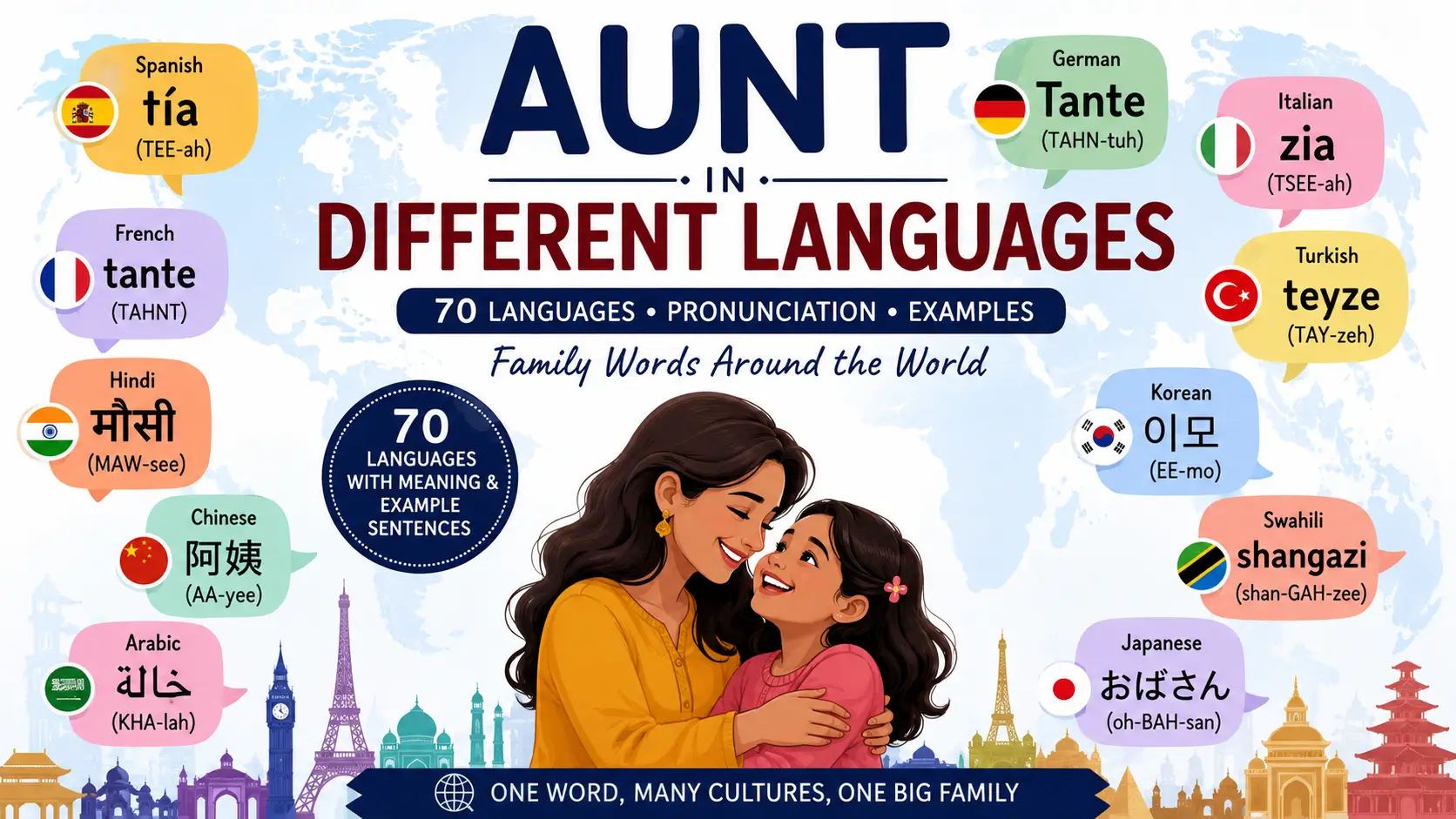
If you are looking for aunt in all languages, this guide provides 70 translations with simple English pronunciations and practical example sentences. It is useful for language learners, travelers, students, writers, and anyone curious about how family relationships are described around the world.
Aunt in Different Languages at a Glance
Here is a quick answer to how to say aunt in different languages:
| # | Language | Native Word for Aunt | Easy Pronunciation | Example Sentence | English Meaning |
|---|---|---|---|---|---|
| 1 | Spanish | tía | TEE-ah | Mi tía vive cerca. | My aunt lives nearby. |
| 2 | French | tante | TAHNT | Ma tante arrive demain. | My aunt arrives tomorrow. |
| 3 | German | Tante | TAHN-tuh | Meine Tante kommt heute. | My aunt is coming today. |
| 4 | Italian | zia | TSEE-ah | Mia zia cucina bene. | My aunt cooks well. |
| 5 | Portuguese | tia | TEE-ah | Minha tia mora aqui. | My aunt lives here. |
| 6 | Dutch | tante | TAHN-tuh | Mijn tante woont hier. | My aunt lives here. |
| 7 | Swedish | moster / faster | MOOS-ter / FAHS-ter | Min moster bor i Stockholm. | My maternal aunt lives in Stockholm. |
| 8 | Norwegian | tante | TAHN-tuh | Tanten min kommer i morgen. | My aunt is coming tomorrow. |
| 9 | Danish | tante | TAHN-tuh | Min tante kommer i dag. | My aunt is coming today. |
| 10 | Finnish | täti | TAE-tee | Tätini asuu täällä. | My aunt lives here. |
| 11 | Icelandic | frænka | FRAIN-ka | Frænka mín býr hér. | My aunt lives here. |
| 12 | Irish | aint | ANT | Tá m’aint anseo. | My aunt is here. |
| 13 | Welsh | modryb | MOD-rib | Mae fy modryb yma. | My aunt is here. |
| 14 | Scottish Gaelic | piuthar-athar / piuthar-màthar | POO-ar AH-har / POO-ar VAH-har | Tha mo phiuthar-màthar an seo. | My maternal aunt is here. |
| 15 | Polish | ciocia | CHOH-cha | Moja ciocia mieszka tutaj. | My aunt lives here. |
| 16 | Czech | teta | TEH-ta | Moje teta bydlí tady. | My aunt lives here. |
| 17 | Slovak | teta | TEH-ta | Moja teta býva tu. | My aunt lives here. |
| 18 | Slovenian | teta | TEH-ta | Moja teta živi tukaj. | My aunt lives here. |
| 19 | Croatian | teta | TEH-ta | Moja teta živi ovdje. | My aunt lives here. |
| 20 | Serbian | tetka | TET-ka | Moja tetka živi ovde. | My aunt lives here. |
| 21 | Bosnian | tetka | TET-ka | Moja tetka živi ovdje. | My aunt lives here. |
| 22 | Bulgarian | леля | LEH-lya | Леля ми живее тук. | My aunt lives here. |
| 23 | Macedonian | тетка | TET-ka | Мојата тетка е тука. | My aunt is here. |
| 24 | Romanian | mătușă | muh-TOOSH-uh | Mătușa mea locuiește aici. | My aunt lives here. |
| 25 | Albanian | teze / hallë | TEH-zeh / HAHL-uh | Tezja ime jeton këtu. | My maternal aunt lives here. |
| 26 | Greek | θεία | thee-AH | Η θεία μου μένει εδώ. | My aunt lives here. |
| 27 | Russian | тётя | TYOH-tya | Моя тётя живёт здесь. | My aunt lives here. |
| 28 | Ukrainian | тітка | TEET-ka | Моя тітка живе тут. | My aunt lives here. |
| 29 | Belarusian | цётка | TSYOT-ka | Мая цётка жыве тут. | My aunt lives here. |
| 30 | Lithuanian | teta | TEH-ta | Mano teta gyvena čia. | My aunt lives here. |
| 31 | Latvian | tante | TAHN-teh | Mana tante dzīvo šeit. | My aunt lives here. |
| 32 | Estonian | tädi | TAE-dee | Mu tädi elab siin. | My aunt lives here. |
| 33 | Hungarian | nagynéni | NAHJ-nay-nee | A nagynéném itt lakik. | My aunt lives here. |
| 34 | Maltese | zija | ZEE-ya | Iz-zija tiegħi tinsab hawn. | My aunt is here. |
| 35 | Turkish | teyze / hala | TAY-zeh / HA-la | Teyzem burada yaşıyor. | My maternal aunt lives here. |
| 36 | Azerbaijani | xala / bibi | KHA-la / BEE-bee | Xalam burada yaşayır. | My maternal aunt lives here. |
| 37 | Persian | خاله / عمه | KHA-leh / AM-meh | خالهام اینجا زندگی میکند. | My maternal aunt lives here. |
| 38 | Arabic | عمة / خالة | AM-mah / KHA-lah | خالتي تعيش هنا. | My maternal aunt lives here. |
| 39 | Hebrew | דודה | DO-da | דודה שלי גרה כאן. | My aunt lives here. |
| 40 | Armenian | մորաքույր / հորաքույր | MO-ra-kooyr / ho-ra-kooyr | Իմ մորաքույրը այստեղ է։ | My maternal aunt is here. |
| 41 | Georgian | დეიდა / მამიდა | DAY-da / ma-mee-da | ჩემი დეიდა აქ ცხოვრობს. | My maternal aunt lives here. |
| 42 | Hindi | चाची / मौसी | CHAA-chee / MAW-see | मेरी मौसी यहाँ रहती हैं। | My maternal aunt lives here. |
| 43 | Urdu | خالہ / پھوپھی | KHA-la / PHOO-phee | میری خالہ یہاں رہتی ہیں۔ | My maternal aunt lives here. |
| 44 | Bengali | খালা / পিসি | KHA-la / PEE-see | আমার খালা এখানে থাকেন। | My maternal aunt lives here. |
| 45 | Punjabi | ਮਾਸੀ / ਭੂਆ | MAA-see / BHOO-aa | ਮੇਰੀ ਮਾਸੀ ਇੱਥੇ ਰਹਿੰਦੀ ਹੈ। | My maternal aunt lives here. |
| 46 | Gujarati | માસી / ફોઈ | MAA-see / FOY | મારી માસી અહીં રહે છે. | My maternal aunt lives here. |
| 47 | Marathi | मावशी / आत्या | MAA-vuh-shee / AAT-tya | माझी मावशी इथे राहते. | My maternal aunt lives here. |
| 48 | Nepali | माइजू / फुपू | MY-joo / FOO-poo | मेरी फुपू यहाँ बस्नुहुन्छ। | My paternal aunt lives here. |
| 49 | Sinhala | නැන්දා | NAN-daa | මගේ නැන්දා මෙහි ජීවත් වෙනවා. | My aunt lives here. |
| 50 | Tamil | அத்தை / சித்தி | AT-thai / SIT-thee | என் அத்தை இங்கே வசிக்கிறார். | My paternal aunt lives here. |
| 51 | Telugu | అత్త / పిన్ని | AT-ta / PIN-nee | నా అత్త ఇక్కడ నివసిస్తుంది. | My paternal aunt lives here. |
| 52 | Kannada | ಅತ್ತೆ / ಚಿಕ್ಕಮ್ಮ | AT-teh / CHIK-kam-ma | ನನ್ನ ಅತ್ತೆ ಇಲ್ಲಿ ವಾಸಿಸುತ್ತಾರೆ. | My aunt lives here. |
| 53 | Malayalam | അമ്മായി | AM-ma-yee | എന്റെ അമ്മായി ഇവിടെ താമസിക്കുന്നു. | My aunt lives here. |
| 54 | Odia | ମାଉସୀ / ପିଉସୀ | MOW-see / PEE-oo-see | ମୋ ମାଉସୀ ଏଠାରେ ରହନ୍ତି। | My maternal aunt lives here. |
| 55 | Assamese | খুৰী / মাহী | KHOO-ree / MAA-hee | মোৰ মাহী ইয়াত থাকে। | My maternal aunt lives here. |
| 56 | Chinese (Mandarin) | 阿姨 / 姑姑 | AA-yee / GOO-goo | 我的阿姨住在这里。 | My maternal aunt lives here. |
| 57 | Japanese | おばさん | oh-BAH-san | おばさんはここに住んでいます。 | My aunt lives here. |
| 58 | Korean | 이모 / 고모 | EE-mo / GO-mo | 이모는 여기 살아요. | My maternal aunt lives here. |
| 59 | Vietnamese | cô / dì | KOH / ZEE | Dì tôi sống ở đây. | My maternal aunt lives here. |
| 60 | Thai | ป้า / น้า | BPÂA / NÁA | ป้าของฉันอยู่ที่นี่ | My aunt is here. |
| 61 | Indonesian | bibi / tante | BEE-bee / TAHN-teh | Bibi saya tinggal di sini. | My aunt lives here. |
| 62 | Malay | mak cik / ibu saudara | MAK cheek / EE-boo sow-DA-ra | Mak cik saya tinggal di sini. | My aunt lives here. |
| 63 | Tagalog | tiyahin | tee-YAH-heen | Nandito ang tiyahin ko. | My aunt is here. |
| 64 | Swahili | shangazi | shan-GAH-zee | Shangazi yangu yuko hapa. | My aunt is here. |
| 65 | Afrikaans | tante | TAHN-tuh | My tante woon hier. | My aunt lives here. |
| 66 | Amharic | አክስት | AK-ist | አክስቴ እዚህ ትኖራለች። | My aunt lives here. |
| 67 | Somali | eeddo / habaryar | AY-doh / ha-ba-RYAR | Eeddaday halkan ayay degan tahay. | My aunt lives here. |
| 68 | Zulu | u-anti | oo-AHN-tee | U-anti wami ulapha. | My aunt is here. |
| 69 | Xhosa | u-anti | oo-AHN-tee | U-anti wam ulapha. | My aunt is here. |
| 70 | Māori | whaea kēkē | FAI-ah KAY-kay | Kei konei taku whaea kēkē. | My aunt is here. |
Why “Aunt” Has Different Translations
Family vocabulary can be more detailed in some languages than in English. English normally uses aunt for both the sister of your mother and the sister of your father.
Other languages make this distinction directly.
For example, Hindi uses different words for several aunt relationships. Mausi generally refers to your mother’s sister, while chachi refers to your father’s younger brother’s wife and taai can refer to your father’s elder brother’s wife.
Similarly, Arabic commonly distinguishes between khālah for a maternal aunt and ʿammah for a paternal aunt. Persian also distinguishes between khāleh and ammeh.
This means that aunt translations are not always simple one-to-one equivalents.
Maternal and Paternal Aunt in Different Languages
One of the most interesting parts of learning aunt in different languages is discovering how cultures describe the mother’s and father’s sides of a family.
Some examples include:
- Turkish: teyze = maternal aunt; hala = paternal aunt
- Arabic: خالة (khālah) = maternal aunt; عمة (ʿammah) = paternal aunt
- Persian: خاله (khāleh) = maternal aunt; عمه (ammeh) = paternal aunt
- Hindi: मौसी (mausi) = maternal aunt
- Chinese: 阿姨 (āyí) = maternal aunt; 姑姑 (gūgu) = father’s sister
- Korean: 이모 (imo) = maternal aunt; 고모 (gomo) = father’s sister
- Vietnamese: dì commonly refers to a maternal aunt; cô can refer to a paternal aunt or an older female relative depending on context
- Swedish: moster = maternal aunt; faster = paternal aunt
- Georgian: deida = maternal aunt; mamida = paternal aunt
- Armenian: morakuyr = maternal aunt; horakuyr = paternal aunt
These distinctions can be important when speaking naturally with family members.
How to Say “Aunt” in European Languages
European languages offer a wide range of forms for the word aunt.
In Spanish, the word is tía, while Italian uses zia. French uses tante, German uses Tante, and Dutch also uses tante.
Slavic languages have their own variations. Polish uses ciocia, Czech uses teta, Russian uses тётя, Ukrainian uses тітка, Bulgarian uses леля, and Serbian uses tetka.
Several Northern European languages also have specialized family terms. Swedish distinguishes moster and faster, depending on which side of the family the aunt belongs to.
This shows that aunt around the world can be expressed with either a general word or a highly specific family term.
How to Say Aunt in Asian Languages
Asian languages often provide especially detailed vocabulary for family relationships.
In Hindi, Urdu, Punjabi, Bengali, Gujarati, Marathi, and other South Asian languages, different words can identify relatives according to the mother’s or father’s side and sometimes the relative’s position in the family.
For example:
- Hindi: mausi means maternal aunt.
- Urdu: khala means maternal aunt.
- Punjabi: maasi means maternal aunt.
- Bengali: khala can refer to a maternal aunt.
- Marathi: maavshi means maternal aunt.
- Gujarati: maasi means maternal aunt.
- Tamil: aththai can refer to a paternal aunt.
- Telugu: atta can refer to a paternal aunt.
- Kannada: atte is used for certain aunt relationships.
- Nepali: phupu commonly refers to a paternal aunt.
East Asian languages also make important family distinctions. Mandarin Chinese, Korean, and Japanese have family terms that can depend heavily on the exact relationship.
Aunt in Chinese, Japanese, and Korean
Chinese family vocabulary is particularly specific.
In Mandarin Chinese, 阿姨 (āyí) is commonly used for a maternal aunt, while 姑姑 (gūgu) means a father’s sister. There are also additional terms for different relatives and age relationships.
Korean similarly distinguishes 이모 (imo) for a mother’s sister and 고모 (gomo) for a father’s sister.
Japanese commonly uses おばさん (obasan) for aunt. The exact written form can vary depending on whether the aunt is older or younger than a parent when written with kanji, although the spoken word is commonly pronounced obasan.
These examples demonstrate why looking at aunt in all languages can reveal much more than simple vocabulary differences.
Aunt in Middle Eastern Languages
Many Middle Eastern languages distinguish maternal and paternal aunts.
In Arabic:
- خالة (khālah) = maternal aunt
- عمة (ʿammah) = paternal aunt
Persian follows a similar pattern:
- خاله (khāleh) = maternal aunt
- عمه (ammeh) = paternal aunt
Armenian and Georgian also distinguish between the two sides of the family.
These differences can help learners understand how family structures are represented in language.
Aunt in African Languages
African languages also have a rich variety of terms for aunt.
Swahili uses shangazi for a paternal aunt, while other family terms identify relatives on different sides of the family.
Somali has terms such as eeddo and habaryar, which identify different aunt relationships. Amharic uses አክስት (akist) as a general term for aunt.
In Southern African languages such as Zulu and Xhosa, u-anti is commonly used for aunt, reflecting the influence of the English loanword while fitting it into local grammatical patterns.
Aunt in Different Languages: Pronunciation Tips
Pronunciation can be just as important as spelling.
A few simple tips can make these translations easier to say:
Tía in Spanish sounds roughly like “TEE-ah.”
Zia in Italian is approximately “TSEE-ah.”
Ciocia in Polish is roughly “CHOH-cha.”
Mătușă in Romanian is approximately “muh-TOOSH-uh.”
Teyze in Turkish sounds similar to “TAY-zeh.”
Khālah in Arabic contains a stronger “kh” sound than the English word “aunt.”
Shangazi in Swahili is approximately “shan-GAH-zee.”
Pronunciations in this article are simplified for English speakers, so they are intended as practical guides rather than exact phonetic transcriptions.
Why Family Words Matter When Learning a Language
Family vocabulary is one of the first useful groups of words for language learners.
Knowing how to say aunt, uncle, mother, father, sister, brother, cousin, grandmother, and grandfather can make everyday conversations easier.
Family terms are also useful when:
- Introducing your relatives
- Talking about your childhood
- Describing family traditions
- Traveling abroad
- Writing personal stories
- Learning conversational vocabulary
- Understanding movies and books
- Speaking with relatives who use another language
Learning these words also gives you insight into how different cultures organize family relationships.
Common Mistakes When Translating “Aunt”
A common mistake is assuming that the English word aunt always has one direct equivalent.
That is not necessarily true.
In languages with detailed kinship systems, you may need to know whether the person is related through your mother or father. In some languages, the age or position of the relative can also matter.
Another mistake is using a formal dictionary translation in a casual family conversation. Some languages use different terms when addressing relatives directly compared with describing them to someone else.
When in doubt, learn the general family term first and then study the more specific relationship terms.
Aunt Translations for Language Learners
If your goal is simply to memorize aunt translations, start with the most common forms:
- Spanish — tía
- French — tante
- German — Tante
- Italian — zia
- Portuguese — tia
- Dutch — tante
- Polish — ciocia
- Russian — тётя
- Greek — θεία
- Turkish — teyze / hala
- Arabic — خالة / عمة
- Persian — خاله / عمه
- Hindi — मौसी
- Urdu — خالہ
- Chinese — 阿姨 / 姑姑
- Japanese — おばさん
- Korean — 이모 / 고모
- Swahili — shangazi
These are useful starting points before exploring more specific kinship vocabulary.
Frequently Asked Questions About Aunt in Different Languages
1. How do you say aunt in different languages?
The word for aunt varies widely. Some common translations include tía in Spanish, tante in French and German, zia in Italian, ciocia in Polish, teyze or hala in Turkish, khala or amma in Urdu and Arabic-related vocabulary, āyí in Mandarin Chinese, and imo in Korean.
2. What is the word for aunt in 10 languages?
In 10 commonly studied languages, aunt can be translated as Spanish tía, French tante, German Tante, Italian zia, Portuguese tia, Dutch tante, Polish ciocia, Russian тётя, Greek θεία, and Finnish täti.
3. Which languages have different words for maternal and paternal aunt?
Many languages distinguish between maternal and paternal aunts. Examples include Turkish, Arabic, Persian, Chinese, Korean, Swedish, Georgian, Armenian, and several South Asian languages. The exact terms differ from language to language.
4. How do you say aunt in Chinese?
In Mandarin Chinese, 阿姨 (āyí) commonly refers to a maternal aunt, while 姑姑 (gūgu) refers to a father’s sister. Chinese kinship vocabulary can be more specific than the single English word “aunt.”
5. What is the most common translation of aunt?
There is no single universal translation. Words such as tía, tante, zia, teta, ciocia, and täti are common in different languages, while languages such as Arabic, Turkish, Chinese, and Korean may use different terms depending on the exact family relationship.
Conclusion
Learning aunt in different languages is a simple but fascinating way to explore global languages and family traditions. While English generally uses one word, many languages distinguish between maternal and paternal aunts or provide additional terms based on family position.
From tía in Spanish and zia in Italian to khala in Urdu, āyí in Mandarin, imo in Korean, and shangazi in Swahili, these aunt translations show how languages reflect the way people understand family.
Whether you are studying a new language, researching family vocabulary, or simply wondering how to say aunt in different languages, these examples provide a useful starting point for discovering family words around the world.

I am Scarlett Wilson, a passionate language writer who loves exploring different languages, words, meanings, translations, and useful phrases. I enjoy making language learning simple, clear, and interesting for everyone.