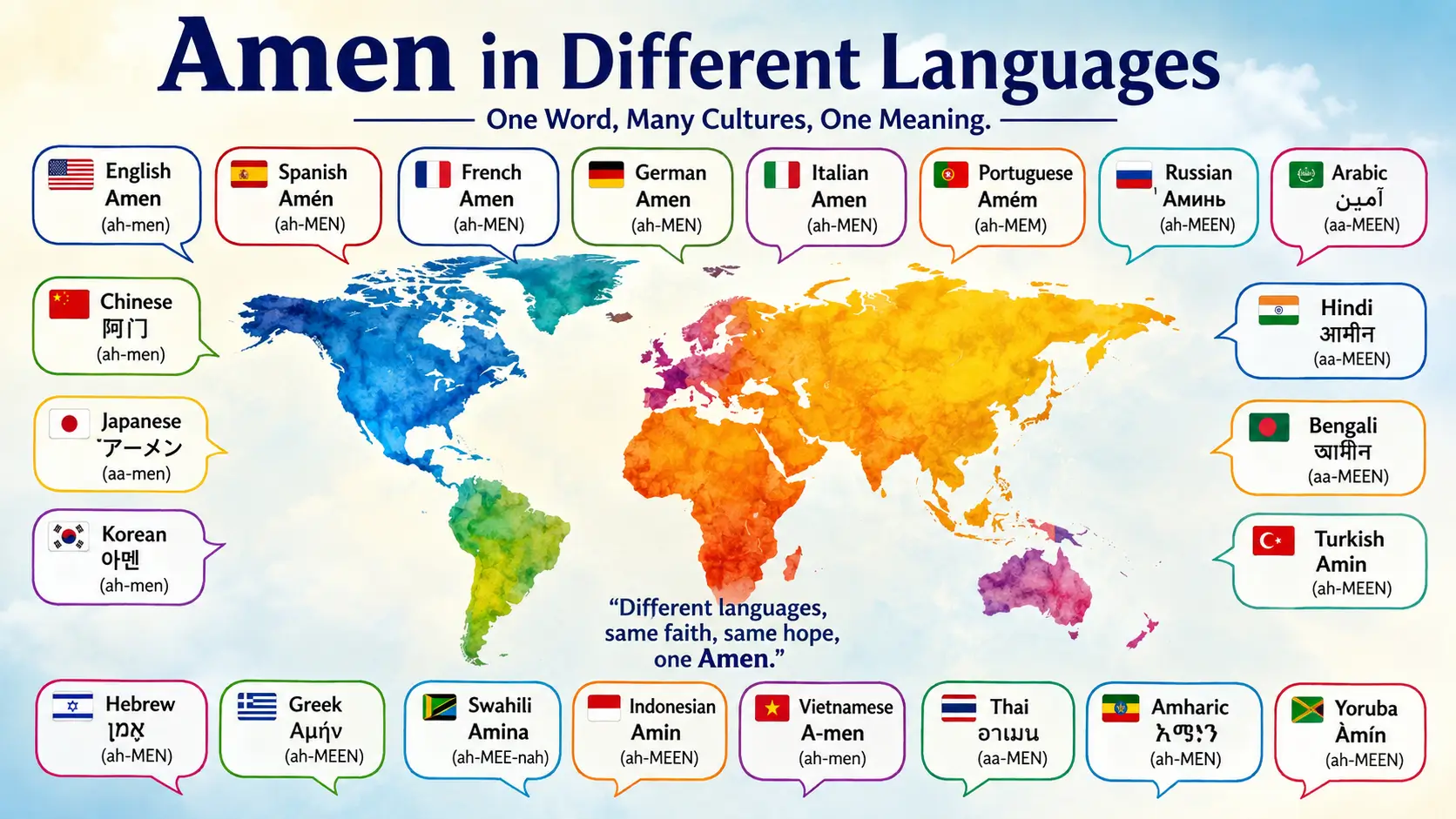
The word “Amen” is one of the most widely recognized religious expressions in the world. It is commonly used at the end of prayers to express agreement, affirmation, faith, or acceptance of what has been said. Although its historical roots are connected to ancient Hebrew, the word has traveled across cultures and languages and is now used in many different forms.
If you are searching for amen in different languages, this guide gives you 70 translations, along with simple pronunciations and real-life examples. Whether you are studying languages, exploring religious traditions, traveling, or simply curious about how people say amen around the world, this list makes the differences easy to understand.
What Does “Amen” Mean?
“Amen” is traditionally understood as an expression meaning “truly,” “certainly,” “so be it,” or “let it be so.” It is frequently spoken after prayers and religious statements as a way of expressing agreement or affirmation.
The word is especially associated with Jewish, Christian, and Islamic religious traditions, although its use and pronunciation can vary between cultures.
Because Amen is an ancient religious term, many languages use a form that is very similar to the original word rather than translating it into a completely different expression.
Amen in Different Languages: 70 Translations
The table below shows how to say amen in different languages, including the native form, an easy English pronunciation, and a short example sentence.
| # | Language | Native Phrase | Easy English Pronunciation | Example Sentence | English Meaning |
|---|---|---|---|---|---|
| 1 | English | Amen | ah-men | We ended the prayer with “Amen.” | We ended the prayer with “Amen.” |
| 2 | Spanish | Amén | ah-MEN | Todos dijeron: “Amén.” | Everyone said, “Amen.” |
| 3 | French | Amen | ah-MEN | Nous avons dit « Amen » après la prière. | We said “Amen” after the prayer. |
| 4 | German | Amen | ah-MEN | Alle sagten gemeinsam: „Amen.“ | Everyone said “Amen” together. |
| 5 | Italian | Amen | ah-MEN | La preghiera si concluse con “Amen”. | The prayer ended with “Amen.” |
| 6 | Portuguese | Amém | ah-MEM | Todos responderam: “Amém.” | Everyone responded, “Amen.” |
| 7 | Dutch | Amen | ah-MEN | De gemeente zei samen: “Amen.” | The congregation said “Amen” together. |
| 8 | Afrikaans | Amen | ah-MEN | Ons het die gebed met “Amen” afgesluit. | We ended the prayer with “Amen.” |
| 9 | Swedish | Amen | ah-MEN | Alla sa: “Amen.” | Everyone said, “Amen.” |
| 10 | Norwegian | Amen | ah-MEN | Vi avsluttet bønnen med “Amen.” | We ended the prayer with “Amen.” |
| 11 | Danish | Amen | ah-MEN | Alle sagde: “Amen.” | Everyone said, “Amen.” |
| 12 | Finnish | Aamen | AH-men | Kaikki sanoivat: “Aamen.” | Everyone said, “Amen.” |
| 13 | Icelandic | Amen | ah-MEN | Öll sögðu: „Amen.“ | Everyone said, “Amen.” |
| 14 | Irish | Amen | ah-MEN | Dúirt gach duine, “Amen.” | Everyone said, “Amen.” |
| 15 | Welsh | Amen | AH-men | Dywedodd pawb, “Amen.” | Everyone said, “Amen.” |
| 16 | Scottish Gaelic | Amen | AH-men | Dyirt a h-uile duine, “Amen.” | Everyone said, “Amen.” |
| 17 | Polish | Amen | AH-men | Wszyscy powiedzieli: „Amen”. | Everyone said, “Amen.” |
| 18 | Czech | Amen | AH-men | Všichni řekli: „Amen.“ | Everyone said, “Amen.” |
| 19 | Slovak | Amen | AH-men | Všetci povedali: „Amen.“ | Everyone said, “Amen.” |
| 20 | Slovenian | Amen | ah-MEN | Vsi so rekli: »Amen.« | Everyone said, “Amen.” |
| 21 | Croatian | Amen | ah-MEN | Svi su rekli: “Amen.” | Everyone said, “Amen.” |
| 22 | Serbian | Амин | AH-meen | Svi su rekli: „Amin.“ | Everyone said, “Amen.” |
| 23 | Bulgarian | Амин | AH-meen | Всички казаха: „Амин.“ | Everyone said, “Amen.” |
| 24 | Macedonian | Амин | AH-meen | Сите рекоа: „Амин.“ | Everyone said, “Amen.” |
| 25 | Russian | Амин | ah-MEEN | Все сказали: «Аминь». | Everyone said, “Amen.” |
| 26 | Ukrainian | Амінь | ah-MEEN | Усі сказали: «Амінь». | Everyone said, “Amen.” |
| 27 | Belarusian | Амін | ah-MEEN | Усе сказалі: «Амін». | Everyone said, “Amen.” |
| 28 | Lithuanian | Amen | AH-men | Visi pasakė: „Amen.“ | Everyone said, “Amen.” |
| 29 | Latvian | Āmen | AH-men | Visi teica: “Āmen.” | Everyone said, “Amen.” |
| 30 | Estonian | Aamen | AH-men | Kõik ütlesid: “Aamen.” | Everyone said, “Amen.” |
| 31 | Hungarian | Ámen | AH-men | Mindenki azt mondta: „Ámen.” | Everyone said, “Amen.” |
| 32 | Romanian | Amin | ah-MEEN | Toți au spus: „Amin.” | Everyone said, “Amen.” |
| 33 | Albanian | Amin | ah-MEEN | Të gjithë thanë: “Amin.” | Everyone said, “Amen.” |
| 34 | Greek | Αμήν | ah-MEEN | Όλοι είπαν: «Αμήν». | Everyone said, “Amen.” |
| 35 | Turkish | Amin | ah-MEEN | Herkes “Amin” dedi. | Everyone said, “Amen.” |
| 36 | Azerbaijani | Amin | ah-MEEN | Hamı “Amin” dedi. | Everyone said, “Amen.” |
| 37 | Armenian | Ամեն | ah-MEN | Բոլորը ասացին՝ «Ամեն»։ | Everyone said, “Amen.” |
| 38 | Georgian | ამინ | ah-MEEN | ყველამ თქვა: „ამინ“. | Everyone said, “Amen.” |
| 39 | Persian | آمین | aa-MEEN | همه گفتند: «آمین». | Everyone said, “Amen.” |
| 40 | Arabic | آمين | aa-MEEN | قال الجميع: «آمين». | Everyone said, “Amen.” |
| 41 | Hebrew | אָמֵן | ah-MEN | כולם אמרו: „אָמֵן“. | Everyone said, “Amen.” |
| 42 | Urdu | آمین | aa-MEEN | سب نے کہا، “آمین۔” | Everyone said, “Amen.” |
| 43 | Hindi | आमीन | aa-MEEN | सबने कहा, “आमीन।” | Everyone said, “Amen.” |
| 44 | Bengali | আমিন | aa-MEEN | সবাই বলল, “আমিন।” | Everyone said, “Amen.” |
| 45 | Punjabi | ਆਮੀਨ | aa-MEEN | ਸਾਰਿਆਂ ਨੇ ਕਿਹਾ, “ਆਮੀਨ।” | Everyone said, “Amen.” |
| 46 | Gujarati | આમીન | aa-MEEN | બધાએ કહ્યું, “આમીન.” | Everyone said, “Amen.” |
| 47 | Marathi | आमेन | AA-men | सर्वांनी म्हटले, “आमेन.” | Everyone said, “Amen.” |
| 48 | Nepali | आमेन | AA-men | सबैले भने, “आमेन।” | Everyone said, “Amen.” |
| 49 | Sinhala | ආමෙන් | AA-men | සියලු දෙනා “ආමෙන්” කිව්වා. | Everyone said, “Amen.” |
| 50 | Tamil | ஆமென் | AA-men | அனைவரும் “ஆமென்” என்றார்கள். | Everyone said, “Amen.” |
| 51 | Telugu | ఆమేన్ | AA-men | అందరూ “ఆమేన్” అన్నారు. | Everyone said, “Amen.” |
| 52 | Kannada | ಆಮೆನ್ | AA-men | ಎಲ್ಲರೂ “ಆಮೆನ್” ಎಂದರು. | Everyone said, “Amen.” |
| 53 | Malayalam | ആമേൻ | AA-men | എല്ലാവരും “ആമേൻ” പറഞ്ഞു. | Everyone said, “Amen.” |
| 54 | Odia | ଆମେନ | AA-men | ସମସ୍ତେ “ଆମେନ” କହିଲେ। | Everyone said, “Amen.” |
| 55 | Chinese | 阿门 | ah-men | 大家都说:“阿门。” | Everyone said, “Amen.” |
| 56 | Japanese | アーメン | AA-men | みんなで「アーメン」と言いました。 | Everyone said, “Amen.” |
| 57 | Korean | 아멘 | ah-men | 모두 “아멘”이라고 말했습니다. | Everyone said, “Amen.” |
| 58 | Vietnamese | A-men | ah-men | Mọi người đều nói: “A-men.” | Everyone said, “Amen.” |
| 59 | Thai | อาเมน | aa-MEN | ทุกคนพูดว่า “อาเมน” | Everyone said, “Amen.” |
| 60 | Indonesian | Amin | ah-MEEN | Semua orang berkata, “Amin.” | Everyone said, “Amen.” |
| 61 | Malay | Amin | ah-MEEN | Semua orang berkata, “Amin.” | Everyone said, “Amen.” |
| 62 | Filipino | Amen | ah-MEN | Sinabi ng lahat, “Amen.” | Everyone said, “Amen.” |
| 63 | Swahili | Amina | ah-MEE-nah | Kila mtu alisema, “Amina.” | Everyone said, “Amen.” |
| 64 | Amharic | አሜን | ah-MEN | ሁሉም “አሜን” አሉ። | Everyone said, “Amen.” |
| 65 | Somali | Aamiin | aa-MEEN | Qof walba wuxuu yiri, “Aamiin.” | Everyone said, “Amen.” |
| 66 | Hausa | Amin | ah-MEEN | Kowa ya ce, “Amin.” | Everyone said, “Amen.” |
| 67 | Yoruba | Àmín | ah-MEEN | Gbogbo wọn sọ, “Àmín.” | They all said, “Amen.” |
| 68 | Igbo | Amen | ah-MEN | Ha niile kwuru, “Amen.” | They all said, “Amen.” |
| 69 | Zulu | Amen | ah-MEN | Bonke bathi, “Amen.” | Everyone said, “Amen.” |
| 70 | Xhosa | Amen | ah-MEN | Bonke bathi, “Amen.” | Everyone said, “Amen.” |
Why Is “Amen” Similar in So Many Languages?
One interesting feature of Amen translations is that the word often remains recognizable across languages. Unlike ordinary vocabulary, religious terms can be preserved when they move between cultures.
“Amen” has ancient roots and has been transmitted through major religious traditions and historical languages. As religious texts and practices spread, the word was adopted into many languages with only small changes in spelling or pronunciation.
This explains why forms such as Amen, Amén, Amém, Aamen, Amin, Aamiin, Ameen, and Амин can look and sound related.
How to Say “Amen” in Different Languages
If your goal is simply to learn how to say amen in different languages, the easiest approach is to notice the pronunciation patterns.
In many European languages, the pronunciation is close to “ah-men.” In several Middle Eastern and Asian languages, forms such as Amin, Ameen, or Aamiin are commonly pronounced closer to “ah-meen.”
The exact pronunciation can depend on the religious tradition, region, and local language. Therefore, a pronunciation guide is useful for beginners, but listening to native speakers is the best way to learn the natural sound.
Amen in All Languages: What Changes?
There is no single universal translation of Amen. Instead, languages generally use one of several related forms.
Common variations include:
- Amen — common in English and many European languages
- Amén — Spanish
- Amém — Portuguese
- Aamen — Finnish and Estonian
- Amin — common in Turkish, Romanian, Indonesian, and other languages
- Aamiin — commonly found in Somali
- Амин / Амінь — Slavic forms
- آمين — Arabic, Persian, and Urdu script
- אמן — Hebrew
- 아멘 — Korean
- アーメン — Japanese
- 阿门 — Chinese
These differences are mostly related to pronunciation, spelling conventions, and the way each writing system represents the word.
The Meaning of Amen Around the World
Although pronunciation varies, the basic function of Amen around the world is often similar: it expresses agreement, affirmation, or a wish that something expressed in prayer should come to pass.
For example, after someone leads a prayer, other people may say “Amen” together. In this setting, it can communicate a shared acceptance of the prayer.
In everyday speech, especially in English, “amen” can sometimes be used figuratively. Someone may say “Amen” to strongly agree with a statement, even outside a formal religious service.
Is Amen a Translation or a Transliteration?
This is an important distinction when studying Amen translations.
In many languages, “Amen” is not translated into a completely different word. Instead, it is transliterated or adapted to fit the local writing system and pronunciation.
For example:
- Hebrew uses אָמֵן
- Arabic uses آمين
- Greek uses Αμήν
- Russian uses Аминь
- Japanese uses アーメン
- Korean uses 아멘
The underlying religious expression remains recognizable even though the writing systems are very different.
Where Did the Word Amen Come From?
The word Amen has ancient Semitic roots and is traditionally associated with Hebrew. It is related to a root connected with ideas such as firmness, reliability, faithfulness, and certainty.
Through the development and spread of Jewish and Christian scriptures, the word became established in many languages. It is also familiar in Islamic contexts, particularly in the expression said after reciting Al-Fatiha, although the religious context and usage differ from Christian and Jewish prayer traditions.
Its long history helps explain why Amen in different languages often looks remarkably similar.
When Should You Say Amen?
The appropriate use of “Amen” depends on the cultural and religious setting.
Common situations include:
- At the end of a prayer — to express agreement or affirmation.
- During a religious service — when responding to a prayer or statement.
- After a blessing — to affirm the blessing.
- In personal prayer — as a closing expression.
- In informal English conversation — sometimes to show strong agreement.
When speaking with people from another religious or cultural background, it is helpful to understand how they use the expression before assuming that its meaning or pronunciation is identical.
How to Learn Amen in Different Languages Easily
Learning this word is relatively simple because many languages have a similar form.
Start by memorizing the most common variations:
Amen → Amén → Amém → Aamen → Amin → Aamiin → Ameen
Then learn how the word appears in different writing systems, such as:
אָמֵן → آمين → Αμήν → Аминь → アーメン → 아멘 → 阿门
This gives you a useful introduction to both language and religious vocabulary around the world.
Common Questions About Amen in Different Languages
1. What is “Amen” in Spanish?
In Spanish, “Amen” is written “Amén.” It is pronounced approximately “ah-MEN” and is commonly used at the end of prayers.
2. What is “Amen” in Arabic?
In Arabic, “Amen” is commonly written آمين and pronounced approximately “aa-MEEN.” It is widely used after prayers and supplications.
3. What is “Amen” in Hebrew?
In Hebrew, the word is written אָמֵן and is pronounced approximately “ah-MEN.” Hebrew is especially important when discussing the ancient origins of the term.
4. Is “Amen” the same in every language?
No. Many languages use a form that is very similar to “Amen,” but spelling and pronunciation can differ. Some languages use Amin, Aamen, Aamiin, Amén, or another adapted form.
5. Why is “Amen” used in so many languages?
“Amen” spread through major religious traditions and historical religious texts. Because it is an established religious expression, many languages retained a form of the original word instead of replacing it with an unrelated translation.
Conclusion
Learning amen in different languages reveals how a very short word can connect languages, cultures, and religious traditions across centuries. Although the spelling and pronunciation may change, the expression generally carries the idea of affirmation, agreement, faith, or acceptance.
From Amén in Spanish and Amin in Turkish to آمين in Arabic, אָמֵן in Hebrew, アーメン in Japanese, and 아멘 in Korean, the word remains recognizable in many parts of the world.
Whether you are researching amen in all languages, learning how to say amen in different languages, or exploring Amen translations around the world, these 70 examples provide a practical starting point.

I am Ricardo Hunter, Administrator at LingoBuz, passionate about languages, translations, and global communication. I help create useful, clear content that makes exploring different languages simple, enjoyable, and accessible.