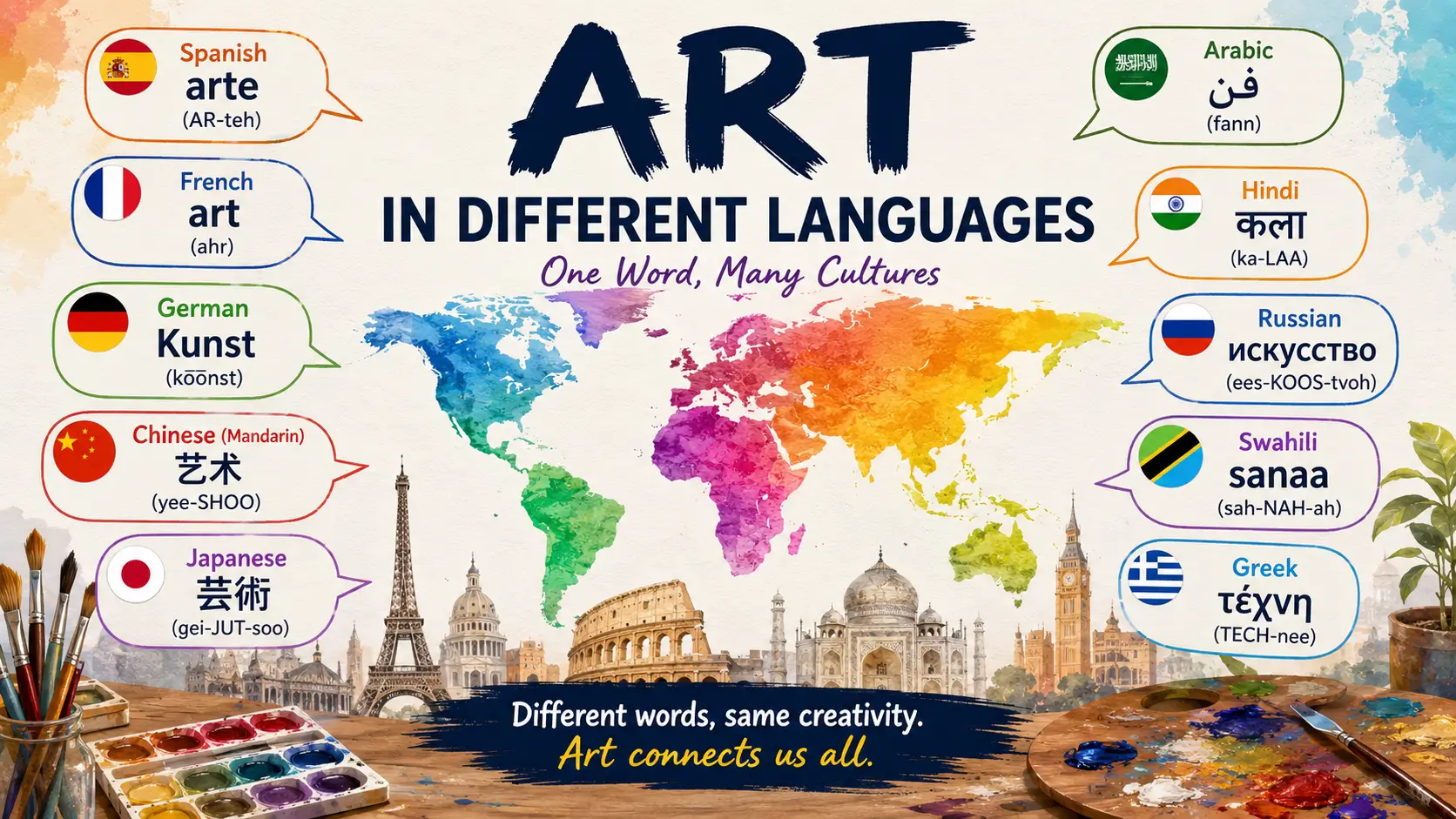
Art is a universal form of human expression, but the word “art” sounds different across languages and cultures. Learning how to say art in different languages can help you understand international culture, communicate while traveling, study foreign languages, or simply explore how people around the world describe creativity.
Below, you will find art in all languages featured in this guide, including the native word, an easy English pronunciation, and a short example sentence. These art translations focus on the common noun meaning of art, such as painting, sculpture, music, visual creativity, and artistic expression.
Whether you are searching for how to say art in different languages or exploring the meaning of art around the world, this list provides a simple reference.
Art in Different Languages: 70 Translations
| # | Language | Native Phrase | Easy English Pronunciation | Example Sentence | English Meaning |
|---|---|---|---|---|---|
| 1 | English | art | aart | Art inspires people. | Art inspires people. |
| 2 | Spanish | arte | AR-teh | El arte inspira a todos. | Art inspires everyone. |
| 3 | French | art | ahr | J’aime l’art moderne. | I like modern art. |
| 4 | German | Kunst | koonst | Kunst verbindet Menschen. | Art connects people. |
| 5 | Italian | arte | AR-teh | L’arte è importante. | Art is important. |
| 6 | Portuguese | arte | AR-teh | A arte muda vidas. | Art changes lives. |
| 7 | Dutch | kunst | koonst | Kunst maakt ons blij. | Art makes us happy. |
| 8 | Swedish | konst | konst | Konst berättar historier. | Art tells stories. |
| 9 | Danish | kunst | koonst | Kunst kan berøre os. | Art can move us. |
| 10 | Norwegian | kunst | koonst | Kunst er overalt. | Art is everywhere. |
| 11 | Finnish | taide | TAI-deh | Taide kertoo tarinoita. | Art tells stories. |
| 12 | Icelandic | list | list | List er mikilvæg. | Art is important. |
| 13 | Irish | ealaín | uh-LAWN | Is breá liom an ealaín. | I love art. |
| 14 | Welsh | celf | kelv | Mae celf ym mhobman. | Art is everywhere. |
| 15 | Scottish Gaelic | ealain | YEE-lin | Tha ealain tábhachtach. | Art is important. |
| 16 | Latin | ars | ars | Ars homines inspirat. | Art inspires people. |
| 17 | Esperanto | arto | AR-toh | Arto estas potenca. | Art is powerful. |
| 18 | Polish | sztuka | SHTOO-kah | Sztuka łączy ludzi. | Art connects people. |
| 19 | Czech | umění | OO-myeh-nee | Umění nás inspiruje. | Art inspires us. |
| 20 | Slovak | umenie | OO-meh-nyeh | Umenie je krásne. | Art is beautiful. |
| 21 | Slovenian | umetnost | oo-met-NOST | Umetnost nas navdihuje. | Art inspires us. |
| 22 | Croatian | umjetnost | oo-MYET-nost | Umjetnost je svuda. | Art is everywhere. |
| 23 | Serbian | уметност | oo-MET-nost | Уметност нас инспирише. | Art inspires us. |
| 24 | Bosnian | umjetnost | oo-MYET-nost | Umjetnost spaja ljude. | Art brings people together. |
| 25 | Bulgarian | изкуство | ees-KOOS-tvoh | Изкуството е красиво. | Art is beautiful. |
| 26 | Macedonian | уметност | oo-MET-nost | Уметноста е важна. | Art is important. |
| 27 | Russian | искусство | ees-KOOS-tvoh | Искусство вдохновляет людей. | Art inspires people. |
| 28 | Ukrainian | мистецтво | mees-TET-stvoh | Мистецтво об’єднує людей. | Art unites people. |
| 29 | Belarusian | мастацтва | mah-TSATS-tvah | Мастацтва натхняе людзей. | Art inspires people. |
| 30 | Lithuanian | menas | MEH-nas | Menas įkvepia žmones. | Art inspires people. |
| 31 | Latvian | māksla | MAHK-slah | Māksla ir visur. | Art is everywhere. |
| 32 | Estonian | kunst | koonst | Kunst inspireerib inimesi. | Art inspires people. |
| 33 | Hungarian | művészet | MOO-vay-set | A művészet gyönyörű. | Art is beautiful. |
| 34 | Romanian | artă | AR-tuh | Arta ne inspiră. | Art inspires us. |
| 35 | Albanian | art | art | Arti na frymëzon. | Art inspires us. |
| 36 | Greek | τέχνη | TECH-nee | Η τέχνη ενώνει ανθρώπους. | Art unites people. |
| 37 | Turkish | sanat | sah-NAT | Sanat insanları birleştirir. | Art brings people together. |
| 38 | Azerbaijani | sənət | seh-NET | Sənət insanları birləşdirir. | Art brings people together. |
| 39 | Armenian | արվեստ | ar-VEST | Արվեստը գեղեցիկ է։ | Art is beautiful. |
| 40 | Georgian | ხელოვნება | khe-loh-VNEH-bah | ხელოვნება ყველას შთააგონებს. | Art inspires everyone. |
| 41 | Arabic | فن | fann | الفن جميل. | Art is beautiful. |
| 42 | Hebrew | אמנות | ah-ma-NOOT | אמנות מעוררת השראה. | Art is inspiring. |
| 43 | Persian | هنر | ho-NAR | هنر زندگی را زیباتر میکند. | Art makes life more beautiful. |
| 44 | Urdu | فن | funn | فن لوگوں کو متاثر کرتا ہے۔ | Art inspires people. |
| 45 | Hindi | कला | ka-LAA | कला हमें प्रेरित करती है। | Art inspires us. |
| 46 | Bengali | শিল্প | SHIL-po | শিল্প মানুষকে অনুপ্রাণিত করে। | Art inspires people. |
| 47 | Punjabi | ਕਲਾ | ka-LAA | ਕਲਾ ਲੋਕਾਂ ਨੂੰ ਪ੍ਰੇਰਿਤ ਕਰਦੀ ਹੈ। | Art inspires people. |
| 48 | Gujarati | કલા | ka-LAA | કલા લોકોને પ્રેરણા આપે છે. | Art inspires people. |
| 49 | Marathi | कला | ka-LAA | कला आपल्याला प्रेरणा देते. | Art inspires us. |
| 50 | Nepali | कला | ka-LAA | कलाले मानिसलाई प्रेरणा दिन्छ। | Art inspires people. |
| 51 | Sinhala | කලාව | ka-LAA-va | කලාව අපව දිරිමත් කරයි. | Art inspires us. |
| 52 | Tamil | கலை | ka-LAI | கலை மக்களை ஊக்குவிக்கிறது. | Art inspires people. |
| 53 | Telugu | కళ | ka-LA | కళ మనల్ని ప్రేరేపిస్తుంది. | Art inspires us. |
| 54 | Kannada | ಕಲೆ | ka-LEH | ಕಲೆ ಜನರನ್ನು ಪ್ರೇರೇಪಿಸುತ್ತದೆ. | Art inspires people. |
| 55 | Malayalam | കല | ka-LA | കല നമ്മെ പ്രചോദിപ്പിക്കുന്നു. | Art inspires us. |
| 56 | Thai | ศิลปะ | sin-LA-pa | ศิลปะสวยงามมาก | Art is very beautiful. |
| 57 | Vietnamese | nghệ thuật | ngeh THOOT | Nghệ thuật truyền cảm hứng. | Art inspires people. |
| 58 | Indonesian | seni | SEH-nee | Seni menginspirasi orang. | Art inspires people. |
| 59 | Malay | seni | SEH-nee | Seni menyatukan manusia. | Art unites people. |
| 60 | Filipino | sining | SEE-ning | Ang sining ay mahalaga. | Art is important. |
| 61 | Javanese | seni | SEH-nee | Seni iku penting. | Art is important. |
| 62 | Chinese (Mandarin) | 艺术 | yee-SHOO | 艺术让生活更美好。 | Art makes life better. |
| 63 | Japanese | 芸術 | gei-JUT-soo | 芸術は人を感動させます。 | Art moves people. |
| 64 | Korean | 예술 | yeh-SOOL | 예술은 사람들에게 영감을 줍니다. | Art inspires people. |
| 65 | Mongolian | урлаг | oor-LAHG | Урлаг хүмүүсийг урамшуулдаг. | Art inspires people. |
| 66 | Swahili | sanaa | sah-NAH-ah | Sanaa huunganisha watu. | Art connects people. |
| 67 | Zulu | ubuciko | oo-boo-SEE-koh | Ubuciko buyakhuthaza. | Art inspires. |
| 68 | Xhosa | ubugcisa | oo-boo-GEE-sah | Ubugcisa buyakhuthaza abantu. | Art inspires people. |
| 69 | Afrikaans | kuns | koons | Kuns vertel stories. | Art tells stories. |
| 70 | Amharic | ጥበብ | tseh-BEB | ጥበብ ሰዎችን ያነሳሳል። | Art inspires people. |
How to Say Art in Different Languages
The word art has many forms because languages reflect the history and culture of the communities that speak them. For example, Spanish uses arte, French uses art, German uses Kunst, Arabic uses فن (fann), Hindi uses कला (kalaa), and Japanese uses 芸術 (geijutsu).
Some languages use a word closely related to concepts such as skill, craft, or creative ability. Others use a term that specifically describes artistic expression.
When learning art in different languages, pronunciation is just as important as spelling. The pronunciation column above is designed as a simple English guide rather than a precise phonetic transcription.
Art Translations Across Europe
European languages show considerable variety in their words for art. Romance languages often have forms related to the Latin ars, which can be seen in words such as Spanish arte, Italian arte, Portuguese arte, Romanian artă, and French art.
Germanic languages commonly use different forms. German has Kunst, while Dutch, Swedish, Danish, Norwegian, and Estonian use closely related forms such as kunst or konst.
Slavic languages also have distinctive vocabulary. Russian uses искусство, Polish uses sztuka, Czech uses umění, and Ukrainian uses мистецтво.
Art Around the World
Art around the world includes painting, drawing, sculpture, photography, architecture, music, theater, dance, crafts, and many other forms of creative expression.
Although the word changes from one language to another, the basic idea is familiar across cultures: people use art to communicate ideas, record experiences, express emotions, preserve traditions, and explore new possibilities.
This is why learning art in all languages can be more than a vocabulary exercise. It can also introduce you to different ways cultures understand creativity.
Art in Asian Languages
Asian languages offer a fascinating range of translations for art. Hindi uses कला, Bengali uses শিল্প, Tamil uses கலை, and Telugu uses కళ.
In East Asia, Mandarin Chinese uses 艺术, Japanese uses 芸術, and Korean uses 예술. These terms are commonly associated with artistic or creative disciplines.
In Southeast Asia, Indonesian and Malay use seni, while Filipino uses sining, and Vietnamese uses nghệ thuật.
Art in Arabic, Persian, and South Asian Languages
In Arabic, فن (fann) is a common word for art. Persian uses هنر (honar), while Urdu also uses فن (fun).
Hindi, Punjabi, Marathi, Gujarati, and Nepali commonly use forms based on कला / ਕਲਾ, referring to art or artistic expression.
These translations show why context matters when learning vocabulary. Depending on the language and situation, a word can refer broadly to art or more specifically to artistic skill, craft, or a particular creative discipline.
Art in African Languages
African languages also have rich vocabulary for creative expression. Swahili uses sanaa, Afrikaans uses kuns, Zulu uses ubuciko, and Xhosa uses ubugcisa.
Art plays an important role in many communities through traditional crafts, visual design, storytelling, music, dance, performance, and cultural ceremonies.
Learning these art translations can therefore provide a small window into the linguistic diversity of Africa.
Why Learn the Word Art in Different Languages?
There are several practical reasons to learn this vocabulary:
- Travel: You may encounter art museums, galleries, exhibitions, and cultural events abroad.
- Language learning: Simple nouns are useful building blocks for expanding vocabulary.
- Education: Students studying international art and culture can use these translations as a reference.
- Creative projects: Artists and designers may find multilingual terminology useful for naming projects or exploring themes.
- Cultural understanding: Language can reveal how different societies describe creativity and artistic expression.
- Communication: Knowing a basic word can make conversations with international speakers easier.
Tips for Remembering Art Translations
A good way to remember new vocabulary is to connect each word with something visual.
For example, associate arte with a painting in Spanish, Kunst with a German gallery, or sanaa with an African art exhibition. Speaking the word aloud several times can also help reinforce pronunciation.
You can also learn the word alongside a short phrase rather than memorizing it alone. For example, learning “I love art” or “Art is beautiful” gives the vocabulary a practical context.
Common Uses of the Word Art
The English word art can describe many different things. It may refer to visual art such as painting and sculpture, artistic creativity in general, or creative disciplines such as theater and photography.
The exact meaning of its translation can vary by language. For this reason, learners should consider the surrounding sentence and cultural context rather than assuming that every translation has exactly the same range of meanings.
Frequently Asked Questions
1. How do you say “art” in different languages?
The word “art” changes across languages. Examples include arte in Spanish and Italian, Kunst in German and Dutch, sztuka in Polish, فن in Arabic, कला in Hindi, 艺术 in Mandarin Chinese, and 芸術 in Japanese.
2. What is the most common translation of art in European languages?
There is no single translation used throughout Europe. Romance languages frequently use forms such as arte or art, while Germanic and Slavic languages often use different words, such as Kunst, konst, sztuka, and umění.
3. How do you say art in Spanish?
In Spanish, art is arte. It is pronounced approximately AR-teh. For example, “El arte inspira a todos” means “Art inspires everyone.”
4. How do you say art in Japanese?
In Japanese, art is commonly 芸術 (芸術), pronounced approximately gei-JUT-soo. It is used when referring to art or artistic expression.
5. Why are there different words for art around the world?
Languages developed within different historical and cultural environments. As a result, their words for art may emphasize creativity, skill, craftsmanship, beauty, or artistic expression in different ways.
Conclusion
The word art may be short, but its translations reveal remarkable linguistic and cultural diversity. From arte in Spanish and Italian to Kunst in German, فن in Arabic, कला in Hindi, sanaa in Swahili, and 芸術 in Japanese, every language gives creative expression its own linguistic identity.
This list of 70 translations makes it easier to discover how to say art in different languages, compare art translations, and explore the idea of art around the world. Whether you are learning a language, traveling, studying culture, or simply curious about global vocabulary, these words are a useful starting point.

I am Ava Jones, a language enthusiast and author passionate about exploring different languages, sharing useful phrases, explaining meanings, and helping readers communicate confidently across cultures and countries.