The word “alone” is simple, but it can express different ideas depending on the situation. It may describe being by yourself, without other people, or spending time independently. Learning how to say alone in different languages is useful for travelers, language learners, writers, students, and anyone interested in cultures around the world.
In some languages, the most natural translation changes depending on whether you mean physically alone, by yourself, or feeling lonely. The translations below focus mainly on the idea of being alone or by oneself.
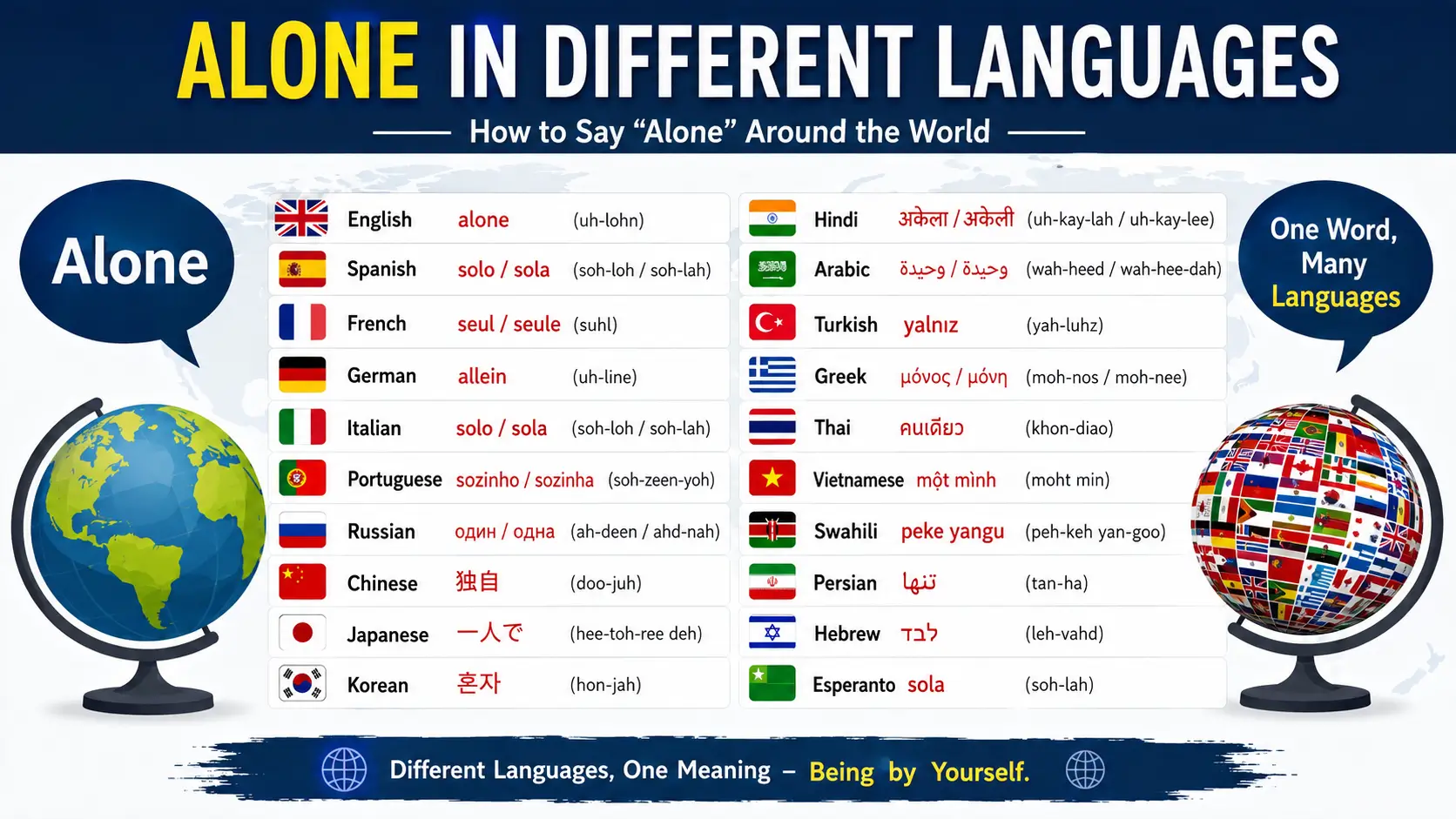
This guide covers 70 languages, including the native word or phrase, an easy English pronunciation, and a short real-life example. If you are searching for “alone in all languages”, these translations provide a practical starting point.
Alone in Different Languages: 70 Translations
| # | Language | Native Phrase | Easy English Pronunciation | Example Sentence | English Meaning |
|---|---|---|---|---|---|
| 1 | English | alone | uh-LOHN | I like being alone sometimes. | I like being by myself sometimes. |
| 2 | Spanish | solo / sola | SOH-loh / SOH-lah | Estoy solo en casa. | I am alone at home. |
| 3 | French | seul / seule | suhl | Je suis seul ce soir. | I am alone tonight. |
| 4 | German | allein | uh-LINE | Ich bin heute allein. | I am alone today. |
| 5 | Italian | solo / sola | SOH-loh / SOH-lah | Sono solo a casa. | I am alone at home. |
| 6 | Portuguese | sozinho / sozinha | soh-ZEEN-yoh / soh-ZEEN-yah | Estou sozinho hoje. | I am alone today. |
| 7 | Dutch | alleen | ah-LAYN | Ik ben alleen thuis. | I am alone at home. |
| 8 | Afrikaans | alleen | ah-LAYN | Ek is alleen vandag. | I am alone today. |
| 9 | Swedish | ensam | EN-sam | Jag är ensam hemma. | I am alone at home. |
| 10 | Danish | alene | uh-LAY-nuh | Jeg er alene hjemme. | I am alone at home. |
| 11 | Norwegian | alene | ah-LEH-neh | Jeg er alene nå. | I am alone now. |
| 12 | Icelandic | einn / ein | ayn | Ég er einn heima. | I am alone at home. |
| 13 | Finnish | yksin | OOK-sin | Olen yksin kotona. | I am alone at home. |
| 14 | Estonian | üksi | OOK-see | Ma olen üksi kodus. | I am alone at home. |
| 15 | Latvian | viens / viena | vyens / VYEH-nah | Es esmu viena mājās. | I am alone at home. |
| 16 | Lithuanian | vienas / viena | VYEH-nas / VYEH-nah | Aš esu viena namuose. | I am alone at home. |
| 17 | Polish | sam / sama | sahm / SAH-mah | Jestem sama w domu. | I am alone at home. |
| 18 | Czech | sám / sama | sahm / SAH-mah | Jsem sám doma. | I am alone at home. |
| 19 | Slovak | sám / sama | sahm / SAH-mah | Som sám doma. | I am alone at home. |
| 20 | Slovenian | sam / sama | sahm / SAH-mah | Danes sem sama. | I am alone today. |
| 21 | Croatian | sam / sama | sahm / SAH-mah | Danas sam sama. | I am alone today. |
| 22 | Serbian | sam / sama | sahm / SAH-mah | Danas sam sam. | I am alone today. |
| 23 | Bosnian | sam / sama | sahm / SAH-mah | Danas sam sama. | I am alone today. |
| 24 | Bulgarian | сам / сама | sahm / sah-MAH | Аз съм сам. | I am alone. |
| 25 | Macedonian | сам / сама | sahm / sah-MAH | Јас сум сам. | I am alone. |
| 26 | Russian | один / одна | ah-DEEN / ahd-NAH | Я один дома. | I am alone at home. |
| 27 | Ukrainian | один / одна | ah-DEEN / ahd-NAH | Я одна вдома. | I am alone at home. |
| 28 | Belarusian | адзін / адна | ah-DZEEN / ah-NAH | Я адна дома. | I am alone at home. |
| 29 | Greek | μόνος / μόνη | MOH-nos / MOH-nee | Είμαι μόνος στο σπίτι. | I am alone at home. |
| 30 | Albanian | vetëm | VEH-tuhm | Jam vetëm në shtëpi. | I am alone at home. |
| 31 | Romanian | singur / singură | SEEN-goor / SEEN-goo-ruh | Sunt singur acasă. | I am alone at home. |
| 32 | Hungarian | egyedül | ED-yed-ool | Egyedül vagyok otthon. | I am alone at home. |
| 33 | Turkish | yalnız | yah-LUHZ | Evde yalnızım. | I am alone at home. |
| 34 | Azerbaijani | tək | tek | Mən təkəm. | I am alone. |
| 35 | Armenian | մենակ | meh-NAHK | Ես մենակ եմ։ | I am alone. |
| 36 | Georgian | მარტო | MAR-toh | მე მარტო ვარ. | I am alone. |
| 37 | Persian | تنها | tan-HA | من تنها هستم. | I am alone. |
| 38 | Kurdish (Kurmanji) | tenê | teh-NEH | Ez tenê me. | I am alone. |
| 39 | Arabic | وحيد / وحيدة | wah-HEED / wah-HEE-dah | أنا وحيد في البيت. | I am alone at home. |
| 40 | Hebrew | לבד | leh-VAHD | אני לבד בבית. | I am alone at home. |
| 41 | Hindi | अकेला / अकेली | uh-KAY-lah / uh-KAY-lee | मैं घर पर अकेला हूँ। | I am alone at home. |
| 42 | Urdu | اکیلا / اکیلی | uh-KAY-lah / uh-KAY-lee | میں گھر پر اکیلا ہوں۔ | I am alone at home. |
| 43 | Bengali | একা | EH-kah | আমি একা আছি। | I am alone. |
| 44 | Punjabi | ਇਕੱਲਾ / ਇਕੱਲੀ | ih-KALL-ah / ih-KALL-ee | ਮੈਂ ਘਰ ਵਿੱਚ ਇਕੱਲਾ ਹਾਂ। | I am alone at home. |
| 45 | Gujarati | એકલો / એકલી | EH-kloh / EH-klee | હું ઘરે એકલો છું. | I am alone at home. |
| 46 | Marathi | एकटा / एकटी | EH-kah-tah / EH-kah-tee | मी घरी एकटा आहे. | I am alone at home. |
| 47 | Nepali | एक्लै | EK-lai | म घरमा एक्लै छु। | I am alone at home. |
| 48 | Sinhala | තනියම | tah-nee-yah-mah | මම තනියම ඉන්නවා. | I am alone. |
| 49 | Tamil | தனியாக | tah-nee-YAH-gah | நான் தனியாக இருக்கிறேன். | I am alone. |
| 50 | Telugu | ఒంటరిగా | on-tah-ree-GAH | నేను ఒంటరిగా ఉన్నాను. | I am alone. |
| 51 | Kannada | ಒಬ್ಬಂಟಿಯಾಗಿ | ob-bahn-TEE-yah-gee | ನಾನು ಒಬ್ಬಂಟಿಯಾಗಿ ಇದ್ದೇನೆ. | I am alone. |
| 52 | Malayalam | ഒറ്റയ്ക്ക് | OT-tah-yek | ഞാൻ ഒറ്റയ്ക്കാണ്. | I am alone. |
| 53 | Odia | ଏକୁଟିଆ | eh-koo-TEE-ah | ମୁଁ ଏକୁଟିଆ ଅଛି। | I am alone. |
| 54 | Assamese | অকলশৰীয়া | oh-kol-shoh-REE-yah | মই অকলশৰীয়া হৈ আছোঁ। | I am alone. |
| 55 | Chinese (Mandarin) | 独自 | doo-JUH | 我独自在家。 | I am alone at home. |
| 56 | Japanese | 一人で | hee-TOH-ree deh | 一人で家にいます。 | I am alone at home. |
| 57 | Korean | 혼자 | hon-JAH | 저는 혼자예요. | I am alone. |
| 58 | Vietnamese | một mình | moht MIN | Tôi ở một mình. | I live alone. |
| 59 | Thai | คนเดียว | khon-diao | ฉันอยู่คนเดียว | I am alone. |
| 60 | Indonesian | sendirian | sen-DEE-ree-an | Saya sendirian di rumah. | I am alone at home. |
| 61 | Malay | bersendirian | ber-sen-dee-REE-an | Saya bersendirian di rumah. | I am alone at home. |
| 62 | Filipino | mag-isa | mag-ee-SAH | Mag-isa ako sa bahay. | I am alone at home. |
| 63 | Mongolian | ганцаараа | gants-TSAH-rah | Би ганцаараа байна. | I am alone. |
| 64 | Swahili | peke yangu | PEH-keh YAHN-goo | Niko peke yangu. | I am alone. |
| 65 | Zulu | ngedwa | ngeh-DWEH | Ngisedwa ekhaya. | I am alone at home. |
| 66 | Xhosa | ndedwa | ndeh-DWEH | Ndisekhaya ndedwa. | I am alone at home. |
| 67 | Yoruba | nikan | NEE-kahn | Mo wa nikan. | I am alone. |
| 68 | Igbo | naanị | nah-NEE-yeh | Anọ m naanị m. | I am alone. |
| 69 | Hausa | ni kaɗai | nee kah-DYE | Ni kaɗai nake. | I am alone. |
| 70 | Esperanto | sola | SOH-lah | Mi estas sola hejme. | I am alone at home. |
What Does “Alone” Mean?
Alone generally means being by yourself, without other people around you. It can describe a physical situation, such as staying home alone, or a personal choice, such as wanting some time alone.
For example:
- I am alone at home.
- She likes to travel alone.
- He wants to be alone for a while.
It is important to distinguish alone from lonely. Being alone describes a situation, while being lonely describes an emotional feeling. Someone can enjoy being alone without feeling lonely.
How to Say “Alone” in Different Languages
The translation of alone changes considerably from one language to another.
For example, Spanish uses solo or sola, German uses allein, French uses seul or seule, and Japanese commonly uses 一人で (hitori de) when expressing the idea of doing something alone.
Some languages change the word according to gender, while others use one general expression. This is why learning the phrase in context is often more useful than memorizing a single dictionary translation.
Alone in All Languages: Important Translation Differences
There is not always a perfect one-word equivalent for “alone.”
In English, “alone” can mean:
- Being physically by yourself.
- Doing something without assistance.
- Wanting privacy.
- Existing without something else.
Other languages may use different words or grammatical structures for these meanings.
For example, a phrase meaning “I am alone” may be different from a phrase meaning “I did it alone.” Context matters when choosing the most natural translation.
Alone vs. Lonely
These two English words are often confused.
Alone describes being by yourself:
I am alone in my room.
Lonely describes feeling sad because of a lack of companionship:
I feel lonely tonight.
Therefore, when looking for alone translations, avoid automatically translating it as “lonely.” The two words can have different meanings and may have different translations in other languages.
How to Use “Alone” in Everyday Conversation
The word “alone” appears in many everyday expressions.
I am alone.
This simply tells someone that you are by yourself.
Leave me alone.
This means you want someone to stop bothering you or give you privacy.
I want to be alone.
This usually means you want some private or quiet time.
I live alone.
This means you live without other people in your home.
I traveled alone.
This means you traveled without companions.
Are you alone?
This question asks whether someone is currently by themselves.
When translating these expressions, do not always translate “alone” separately. The complete sentence may require a different grammatical structure in the target language.
“Alone” Around the World
The concept of spending time alone exists in every culture, but the way it is expressed can vary.
European languages often use words that function as adjectives, such as allein in German or seul/seule in French. Several Slavic languages change the form depending on gender.
Asian languages frequently use expressions that communicate the idea of being by oneself. Mandarin Chinese uses 独自 (dúzì), while Korean uses 혼자 (honja) and Japanese commonly uses 一人で (hitori de).
South Asian languages also show interesting differences. Hindi and Urdu use gendered forms such as अकेला/अकेली and اکیلا/اکیلی, while Bengali commonly uses একা (eka).
These differences make learning how to say alone in different languages an interesting way to understand how languages describe people, actions, and relationships.
Tips for Learning “Alone” in Another Language
If you want to remember these translations more easily, focus on complete sentences rather than isolated vocabulary.
Try these steps:
- Learn the native phrase.
- Practice the pronunciation slowly.
- Memorize the example sentence.
- Create a sentence about your own life.
- Check whether the word changes according to gender or grammar.
- Practice saying it aloud.
For example, instead of only memorizing allein, learn:
Ich bin heute allein.
“I am alone today.”
This gives you vocabulary and grammar together.
Common Questions About Alone Translations
Is “alone” the same as “lonely” in every language?
No. The two concepts can be different. Alone usually describes being by yourself, while lonely describes an emotional feeling of isolation or sadness.
What is “alone” in Spanish?
“Alone” is commonly translated as solo for masculine forms and sola for feminine forms. The exact usage depends on the sentence and context.
What is “alone” in French?
“Alone” is commonly seul for masculine forms and seule for feminine forms.
What is “alone” in Japanese?
A common expression is 一人で (hitori de), especially when describing doing something by oneself, such as going somewhere alone.
What is the easiest way to learn “alone” in different languages?
The easiest method is to learn each translation together with a short everyday sentence. This helps you understand pronunciation, grammar, and context instead of memorizing a word without knowing how to use it.
Conclusion
Learning how to say alone in different languages reveals how different cultures and languages express the idea of being by yourself. While some languages use a single word, others use a phrase or change the form depending on gender, grammar, or context.
This list of 70 alone translations gives you a useful foundation for language learning, travel, communication, writing, and cultural exploration. Remember that the most accurate translation depends on what you mean by “alone” and how the word is being used in a sentence.

I am Ava Jones, a language enthusiast and author passionate about exploring different languages, sharing useful phrases, explaining meanings, and helping readers communicate confidently across cultures and countries.