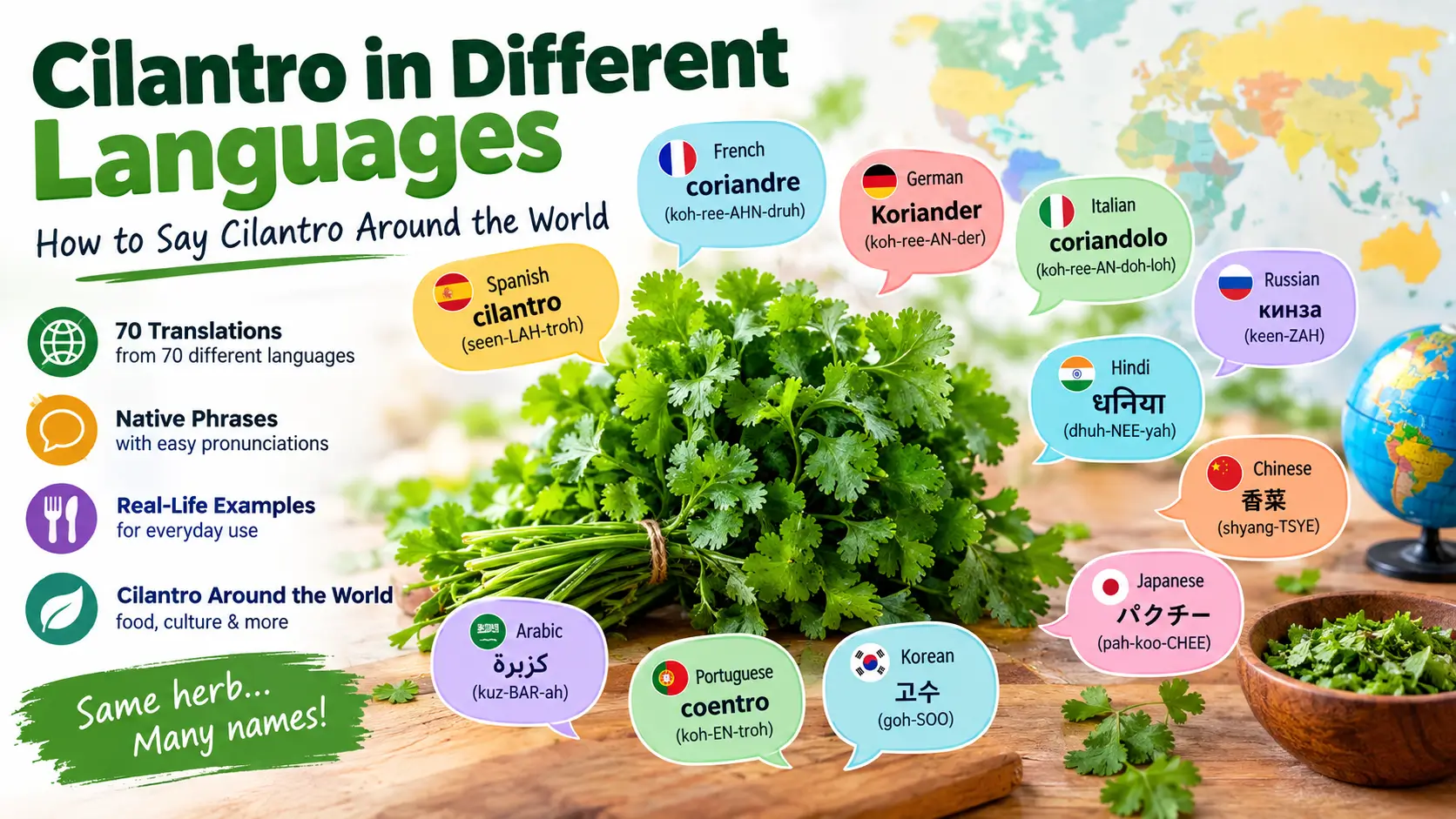
Cilantro is one of the world’s most recognizable fresh herbs, adding a bright, fresh flavor to dishes such as salsa, curries, soups, salads, chutneys, and tacos. But what do people call cilantro in different parts of the world?
In English, cilantro usually means the fresh leaves and stems of the coriander plant. In many other languages, the same herb is described using a word related to coriander, while some languages have a more specific term for the fresh leaves.
If you want to learn how to say cilantro in different languages, this guide gives you 70 cilantro translations, easy English pronunciations, and short real-life examples.
Whether you are traveling, cooking an international recipe, learning a new language, or simply curious about cilantro around the world, this list makes the vocabulary easy to understand.
What Does Cilantro Mean?
Cilantro refers to the fresh green leaves and tender stems of the coriander plant, scientifically known as Coriandrum sativum. It has a fresh, citrusy, herbal flavor and is widely used in Asian, Latin American, Middle Eastern, and other cuisines.
One important language difference is that American English commonly uses “cilantro” for the fresh leaves, while British English generally uses “coriander” for the same part of the plant.
The dried seeds are usually called coriander seeds, which are different from the fresh herb.
Cilantro in Different Languages: 70 Translations
The table below shows how to say cilantro in 70 different languages. Pronunciations are simplified for English speakers, so they are intended as practical learning aids rather than exact phonetic transcriptions.
| # | Language | Native Phrase | Easy English Pronunciation | Example Sentence | English Meaning |
|---|---|---|---|---|---|
| 1 | English | cilantro | sih-LAHN-troh | I added cilantro to the salsa. | I added cilantro to the salsa. |
| 2 | Spanish | cilantro | seen-LAH-troh | Añadí cilantro a la salsa. | I added cilantro to the salsa. |
| 3 | French | coriandre | koh-ree-AHN-druh | J’ajoute de la coriandre à la soupe. | I add cilantro to the soup. |
| 4 | German | Koriander | koh-ree-AN-der | Ich gebe Koriander in den Salat. | I add cilantro to the salad. |
| 5 | Italian | coriandolo | koh-ree-AN-doh-loh | Aggiungo il coriandolo all’insalata. | I add cilantro to the salad. |
| 6 | Portuguese | coentro | koh-EN-troh | Eu coloquei coentro na sopa. | I put cilantro in the soup. |
| 7 | Dutch | koriander | koh-ree-AHN-der | Ik doe koriander in de salade. | I put cilantro in the salad. |
| 8 | Swedish | koriander | koh-ree-AN-der | Jag lägger koriander i soppan. | I add cilantro to the soup. |
| 9 | Norwegian | koriander | koh-ree-AN-der | Jeg bruker koriander i maten. | I use cilantro in the food. |
| 10 | Danish | koriander | koh-ree-AN-der | Jeg tilsætter koriander til retten. | I add cilantro to the dish. |
| 11 | Finnish | korianteri | koh-ree-AN-teh-ree | Lisään korianteria salaattiin. | I add cilantro to the salad. |
| 12 | Icelandic | kóríander | KOH-ree-ahn-der | Ég set kóríander í salatið. | I put cilantro in the salad. |
| 13 | Polish | kolendra | koh-LEN-drah | Dodaję kolendrę do sałatki. | I add cilantro to the salad. |
| 14 | Czech | koriandr | koh-ree-AHN-dr | Přidávám koriandr do polévky. | I add cilantro to the soup. |
| 15 | Slovak | koriander | koh-ree-AN-der | Pridávam koriander do jedla. | I add cilantro to the food. |
| 16 | Slovenian | koriander | koh-ree-AN-der | Dodam koriander v solato. | I add cilantro to the salad. |
| 17 | Croatian | korijander | koh-ree-YAN-der | Dodajem korijander u juhu. | I add cilantro to the soup. |
| 18 | Serbian | korijander | koh-ree-YAN-der | Dodajem korijander u salatu. | I add cilantro to the salad. |
| 19 | Bosnian | korijander | koh-ree-YAN-der | Dodajem korijander u jelo. | I add cilantro to the dish. |
| 20 | Bulgarian | кориандър | koh-ree-AN-dur | Добавям кориандър към салатата. | I add cilantro to the salad. |
| 21 | Macedonian | коријандер | koh-ree-YAN-der | Додавам коријандер во салатата. | I add cilantro to the salad. |
| 22 | Romanian | coriandru | koh-ree-AHN-droo | Adaug coriandru în supă. | I add cilantro to the soup. |
| 23 | Hungarian | koriander | koh-ree-AN-der | Koriandert teszek a levesbe. | I put cilantro in the soup. |
| 24 | Greek | κόλιανδρος | KOH-lee-an-dros | Βάζω κόλιανδρο στη σαλάτα. | I put cilantro in the salad. |
| 25 | Russian | кинза | keen-ZAH | Я добавляю кинзу в суп. | I add cilantro to the soup. |
| 26 | Ukrainian | кінза | KEEN-zah | Я додаю кінзу до салату. | I add cilantro to the salad. |
| 27 | Belarusian | кінза | KEEN-zah | Я дадаю кінзу ў суп. | I add cilantro to the soup. |
| 28 | Lithuanian | kalendra | kah-LEN-drah | Dedù kalendros į salotas. | I add cilantro to the salad. |
| 29 | Latvian | koriandrs | koh-ree-AHN-drs | Es pievienoju koriandru salātiem. | I add cilantro to the salad. |
| 30 | Estonian | koriander | koh-ree-AN-der | Lisan salatile koriandrit. | I add cilantro to the salad. |
| 31 | Albanian | koriandër | koh-ree-AHN-der | Shtoj koriandër në sallatë. | I add cilantro to the salad. |
| 32 | Armenian | համեմ | hah-MEM | Ես համեմ եմ ավելացնում աղցանին։ | I add cilantro to the salad. |
| 33 | Georgian | ქინძი | KEEN-dzee | სალათს ქინძს ვამატებ. | I add cilantro to the salad. |
| 34 | Turkish | kişniş | kish-NEESH | Salataya kişniş ekliyorum. | I add cilantro to the salad. |
| 35 | Azerbaijani | keşniş | kesh-NEESH | Mən yeməyə keşniş əlavə edirəm. | I add cilantro to the food. |
| 36 | Persian | گشنیز | gosh-NEEZ | من به سوپ گشنیز اضافه میکنم. | I add cilantro to the soup. |
| 37 | Arabic | كزبرة | kuz-BAR-ah | أضيف الكزبرة إلى السلطة. | I add cilantro to the salad. |
| 38 | Hebrew | כוסברה | koos-BAH-rah | אני מוסיף כוסברה לסלט. | I add cilantro to the salad. |
| 39 | Hindi | धनिया | dhuh-NEE-yah | मैं सलाद में धनिया डालता हूँ। | I add cilantro to the salad. |
| 40 | Urdu | دھنیا | dhuh-NEE-yah | میں سلاد میں دھنیا ڈالتا ہوں۔ | I add cilantro to the salad. |
| 41 | Bengali | ধনেপাতা | dhon-eh-PAH-tah | আমি স্যুপে ধনেপাতা দিই। | I add cilantro to the soup. |
| 42 | Punjabi | ਧਨੀਆ | dhuh-NEE-yah | ਮੈਂ ਸਲਾਦ ਵਿੱਚ ਧਨੀਆ ਪਾਉਂਦਾ ਹਾਂ। | I add cilantro to the salad. |
| 43 | Gujarati | ધાણા | DHAH-nah | હું શાકમાં ધાણા ઉમેરું છું. | I add cilantro to the dish. |
| 44 | Marathi | कोथिंबीर | koh-thim-BEER | मी कोशिंबिरीत कोथिंबीर घालतो. | I add cilantro to the salad. |
| 45 | Nepali | धनियाँ | dhuh-NEE-yah | म सलादमा धनियाँ हाल्छु। | I add cilantro to the salad. |
| 46 | Tamil | கொத்தமல்லி | koth-thuh-MAHL-lee | நான் சூப்பில் கொத்தமல்லி சேர்க்கிறேன். | I add cilantro to the soup. |
| 47 | Telugu | కొత్తిమీర | koth-thuh-MEE-rah | నేను సలాడ్లో కొత్తిమీర వేస్తాను. | I add cilantro to the salad. |
| 48 | Kannada | ಕೊತ್ತಂಬರಿ | koth-tham-BAH-ree | ನಾನು ಸಲಾಡ್ಗೆ ಕೊತ್ತಂಬರಿ ಹಾಕುತ್ತೇನೆ. | I add cilantro to the salad. |
| 49 | Malayalam | മല്ലിയില | mal-lee-YIL | ഞാൻ സൂപ്പിൽ മല്ലിയില ചേർക്കുന്നു. | I add cilantro to the soup. |
| 50 | Sinhala | කොත්තමල්ලි කොළ | koth-tha-MAL-lee kola | මම සලාදයට කොත්තමල්ලි කොළ දමමි. | I add cilantro leaves to the salad. |
| 51 | Chinese | 香菜 | shyang-TSYE | 我在汤里加香菜。 | I add cilantro to the soup. |
| 52 | Japanese | パクチー | pah-koo-CHEE | スープにパクチーを入れます。 | I add cilantro to the soup. |
| 53 | Korean | 고수 | goh-SOO | 저는 샐러드에 고수를 넣어요. | I add cilantro to the salad. |
| 54 | Vietnamese | rau mùi | zow moo-ee | Tôi thêm rau mùi vào súp. | I add cilantro to the soup. |
| 55 | Thai | ผักชี | phak-CHEE | ฉันใส่ผักชีในซุป | I add cilantro to the soup. |
| 56 | Indonesian | daun ketumbar | dah-oon keh-TOOM-bar | Saya menambahkan daun ketumbar ke sup. | I add cilantro leaves to the soup. |
| 57 | Malay | daun ketumbar | dah-oon keh-TOOM-bar | Saya tambah daun ketumbar dalam sup. | I add cilantro leaves to the soup. |
| 58 | Filipino | kulantro | koo-LAN-troh | Naglagay ako ng kulantro sa salsa. | I added cilantro to the salsa. |
| 59 | Swahili | giligilani | gee-lee-gee-LAH-nee | Ninaongeza giligilani kwenye saladi. | I add cilantro to the salad. |
| 60 | Amharic | ቆስጣ | KOH-stah | ቆስጣ በሰላጣው ውስጥ እጨምራለሁ። | I add cilantro to the salad. |
| 61 | Afrikaans | koljander | koh-lee-YAN-der | Ek voeg koljander by die slaai. | I add cilantro to the salad. |
| 62 | Malagasy | koriandra | koh-ree-AN-drah | Manampy koriandra amin’ny salady aho. | I add cilantro to the salad. |
| 63 | Māori | kāriana | KAH-ree-ah-nah | Ka tāpiri ahau i te kāriana ki te kai. | I add cilantro to the food. |
| 64 | Esperanto | koriandro | koh-ree-AHN-droh | Mi aldonas koriandron al la salato. | I add cilantro to the salad. |
| 65 | Latin | coriandrum | koh-ree-AHN-droo | Coriandrum in pulmentum addo. | I add cilantro to the stew. |
| 66 | Basque | martorri | mar-TOR-ree | Martorria entsaladari gehitzen diot. | I add cilantro to the salad. |
| 67 | Catalan | coriandre | koh-ree-AHN-druh | Afegeixo coriandre a l’amanida. | I add cilantro to the salad. |
| 68 | Galician | coentro | koh-EN-troh | Engado coentro á sopa. | I add cilantro to the soup. |
| 69 | Welsh | coriander | kor-ee-AN-der | Rwy’n ychwanegu coriander at y salad. | I add cilantro to the salad. |
| 70 | Irish | lus an choire | luss un KHIR-eh | Cuirim lus an choire sa sailéad. | I put cilantro in the salad. |
Why Is Cilantro Called Different Names?
The names for cilantro vary because languages developed their own words for the plant, often influenced by regional cooking traditions and older botanical vocabulary.
In many European languages, the word is closely related to coriander. Examples include French coriandre, Italian coriandolo, German Koriander, Dutch koriander, and Polish kolendra.
Other languages use completely different everyday names. Russian uses kinza, while Georgian uses kindzi and Japanese commonly uses pakuchī.
South Asian languages also have distinctive terms. Hindi and Urdu commonly use dhaniya, while Bengali specifically uses dhonepata for coriander leaves.
Cilantro vs. Coriander: What Is the Difference?
The difference is mainly regional.
In the United States and some other English-speaking regions, cilantro commonly refers to the fresh leaves and stems of the coriander plant. The seeds are called coriander seeds.
In the United Kingdom, Ireland, Australia, and several other places, coriander can refer to both the fresh herb and the seeds, depending on context.
This means that when reading an international recipe, it is useful to check whether “coriander” means fresh leaves or dried seeds.
How to Say Cilantro in Spanish
In Spanish, cilantro is generally cilantro. It is widely used in Mexican, Central American, Caribbean, and South American cooking.
For example, you might see cilantro mentioned in recipes for salsa, guacamole, soups, rice, beans, and various meat dishes.
The word is easy for English speakers to recognize because the spelling is almost identical to the English word.
How to Say Cilantro in Hindi and Urdu
Hindi and Urdu commonly use धनिया / دھنیا, pronounced approximately like “dhaniya.”
The word is strongly associated with South Asian cooking. Fresh coriander leaves are commonly used in chutneys, curries, dals, salads, raita, and garnishes.
In English-language Indian recipes, you may see both “cilantro” and “fresh coriander” used for the same herb.
How to Say Cilantro in Chinese, Japanese, and Korean
East Asian languages have their own common terms for cilantro.
In Mandarin Chinese, cilantro is commonly called 香菜, a word associated with fragrant greens.
Japanese commonly uses パクチー, especially in modern food and restaurant contexts. The term is strongly associated with Southeast Asian-style cuisine.
Korean commonly uses 고수 for cilantro.
These terms are particularly useful when reading restaurant menus, grocery labels, or international recipes.
How to Say Cilantro in Arabic and Persian
Arabic commonly uses كزبرة for coriander/cilantro, while Persian uses گشنیز.
Fresh coriander is an important ingredient in many Middle Eastern and Persian dishes. It can be used in salads, stews, sauces, rice dishes, and herb mixtures.
When shopping in an international market, knowing these words can make it easier to identify fresh cilantro.
Cilantro Around the World
Cilantro is especially common in cuisines across Mexico and Latin America, South Asia, Southeast Asia, China, the Middle East, and parts of Europe and Africa.
Its uses vary from region to region.
In Mexican cooking, cilantro is frequently used in salsa, tacos, guacamole, beans, and soups. In South Asian cooking, fresh coriander is often used in chutneys, curries, dals, and garnishes.
In Southeast Asia, cilantro can appear in noodle dishes, soups, salads, curries, and fresh herb combinations.
This wide culinary range explains why cilantro has so many names around the world.
Tips for Using Cilantro in Different Cuisines
Cilantro is usually added fresh because cooking it for a long time can reduce its bright herbal flavor.
Here are a few practical tips:
- Add fresh cilantro near the end of cooking for a stronger fresh flavor.
- Use both leaves and tender stems when appropriate.
- Wash the herb thoroughly before using it.
- Store fresh cilantro in the refrigerator to help maintain freshness.
- Add chopped cilantro to salsa, salads, soups, curries, rice, and sauces.
- Check international recipes carefully because “coriander” may refer to either the leaves or seeds.
Why Does Cilantro Taste So Different to Some People?
Cilantro has a distinctive flavor, and people can experience it differently.
Some people describe it as fresh, citrusy, herbal, or slightly peppery. Others perceive a soapy or unpleasant flavor.
Genetic differences can influence how people perceive certain aroma compounds in cilantro. This is one reason why the herb can be a favorite ingredient for one person and strongly disliked by another.
Common Cilantro Translation Mistakes
One common mistake is assuming that every language has a separate word specifically for the fresh leaves.
In many languages, the same word can refer broadly to coriander as a plant or spice. Context determines whether the speaker means fresh leaves, dried seeds, or the plant generally.
Another mistake is confusing cilantro with parsley. Although both are green herbs and can look similar, they have different flavors and are not interchangeable in every recipe.
When translating recipes, it is best to consider the entire sentence rather than translating the word in isolation.
How to Learn Cilantro in All Languages
If you are studying food vocabulary, start with the languages you use most often.
A simple method is to learn the native word, practice its pronunciation, and then use it in a short sentence. This makes the word easier to remember than memorizing a translation alone.
You can also group languages by region. For example, learn European cilantro translations together, followed by South Asian, Middle Eastern, East Asian, and African terms.
This approach makes it easier to remember patterns between related languages.
Frequently Asked Questions About Cilantro in Different Languages
1. What is cilantro called in different languages?
Cilantro has many different names around the world. Spanish uses cilantro, Russian uses кинза, Hindi and Urdu commonly use धनिया / دھنیا, Chinese uses 香菜, Japanese commonly uses パクチー, Korean uses 고수, and Arabic uses كزبرة.
2. How do you say cilantro in Spanish?
Cilantro in Spanish is cilantro. The word is commonly used throughout Spanish-speaking countries, especially in recipes and everyday cooking.
3. What is cilantro called in India?
The name varies by Indian language. Hindi and Urdu commonly use dhaniya, Bengali uses dhonepata, Marathi uses kothimbir, Tamil uses kothamalli, Telugu uses kothimeera, and Kannada uses kothambari.
4. Is cilantro the same as coriander?
Cilantro and coriander come from the same plant. In American English, cilantro usually means the fresh leaves and stems, while coriander generally refers to the seeds. In British English and some other varieties of English, “coriander” can refer to the fresh herb as well.
5. Why are cilantro translations different around the world?
Languages develop their own vocabulary through history, culture, geography, and contact with other languages. Because coriander has been used in many culinary traditions for centuries, different regions developed different names for the herb.
Conclusion
Learning how to say cilantro in different languages is a simple way to explore food, culture, and international vocabulary. From Spanish cilantro and Russian кинза to Hindi धनिया, Chinese 香菜, Japanese パクチー, and Korean 고수, the herb has a fascinating range of names around the world.
These 70 cilantro translations can be useful for language learners, travelers, cooks, food lovers, and anyone interested in how everyday ingredients are named across cultures.
Whether you are searching for cilantro in all languages, comparing cilantro translations, or learning how to say cilantro in different languages, understanding the regional vocabulary can make international cooking and communication much easier.

I am Scarlett Wilson, a passionate language writer who loves exploring different languages, words, meanings, translations, and useful phrases. I enjoy making language learning simple, clear, and interesting for everyone.