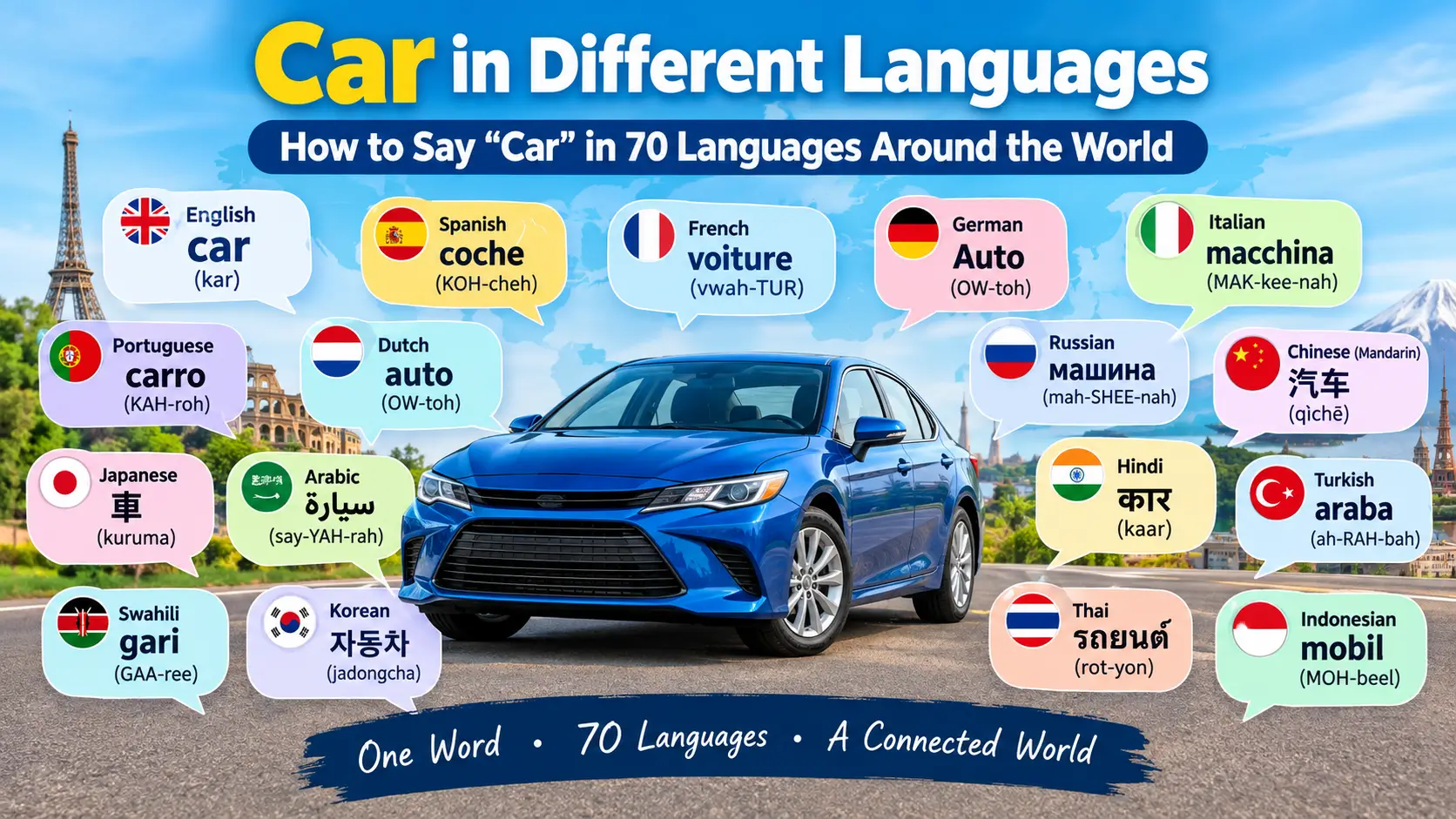
A car is one of the most familiar forms of transportation worldwide, but the word used for it changes from language to language. Learning how to say “car” in different languages is useful for travelers, language learners, students, translators, and anyone interested in global vocabulary.
In some languages, the word for car is closely related to terms for automobiles or vehicles, while others have their own everyday expression. Below, you’ll find car translations in 70 languages, including the native word, an easy English pronunciation, and a practical example sentence.
Whether you are searching for car in all languages, wondering how to say car in different languages, or exploring how people refer to cars around the world, this guide provides a convenient reference.
Car in Different Languages
The table below contains 70 widely spoken or culturally significant languages. Pronunciations are simplified for English speakers and are intended as practical learning aids rather than exact phonetic transcriptions.
| # | Language | Native phrase | Easy English pronunciation | Example sentence | English meaning |
|---|---|---|---|---|---|
| 1 | English | car | kar | My car is outside. | My car is outside. |
| 2 | Spanish | coche | KOH-cheh | Mi coche está aquí. | My car is here. |
| 3 | French | voiture | vwah-TUR | Ma voiture est neuve. | My car is new. |
| 4 | German | Auto | OW-toh | Mein Auto ist schnell. | My car is fast. |
| 5 | Italian | macchina | MAK-kee-nah | La mia macchina è nuova. | My car is new. |
| 6 | Portuguese | carro | KAH-roh | Meu carro está lá fora. | My car is outside. |
| 7 | Dutch | auto | OW-toh | Mijn auto staat buiten. | My car is outside. |
| 8 | Swedish | bil | beel | Min bil är ny. | My car is new. |
| 9 | Norwegian | bil | beel | Bilen står utenfor. | The car is outside. |
| 10 | Danish | bil | beel | Min bil er ny. | My car is new. |
| 11 | Finnish | auto | OW-toh | Autoni on uusi. | My car is new. |
| 12 | Icelandic | bíll | beetl | Bíllinn minn er nýr. | My car is new. |
| 13 | Irish | carr | kar | Tá carr agam. | I have a car. |
| 14 | Welsh | car | kar | Mae fy nghar yno. | My car is there. |
| 15 | Scottish Gaelic | càr | kaar | Tha càr agam. | I have a car. |
| 16 | Polish | samochód | sah-moh-HOOT | Mój samochód jest nowy. | My car is new. |
| 17 | Czech | auto | OW-toh | Moje auto je nové. | My car is new. |
| 18 | Slovak | auto | OW-toh | Moje auto je nové. | My car is new. |
| 19 | Slovenian | avto | AHF-toh | Moj avto je nov. | My car is new. |
| 20 | Croatian | auto | OW-toh | Moj auto je nov. | My car is new. |
| 21 | Serbian | automobil | ow-toh-moh-BEEL | Moj automobil je nov. | My car is new. |
| 22 | Bosnian | auto | OW-toh | Moj auto je nov. | My car is new. |
| 23 | Bulgarian | кола | koh-LAH | Моята кола е нова. | My car is new. |
| 24 | Macedonian | автомобил | ahv-toh-moh-BEEL | Мојот автомобил е нов. | My car is new. |
| 25 | Russian | машина | mah-SHEE-nah | Моя машина новая. | My car is new. |
| 26 | Ukrainian | автомобіль | ahv-toh-moh-BEEL | Мій автомобіль новий. | My car is new. |
| 27 | Belarusian | аўтамабіль | ow-tah-mah-BEEL | Мой аўтамабіль новы. | My car is new. |
| 28 | Lithuanian | automobilis | ow-toh-moh-BEE-lis | Mano automobilis naujas. | My car is new. |
| 29 | Latvian | automašīna | ow-toh-mah-SHEE-nah | Mana automašīna ir jauna. | My car is new. |
| 30 | Estonian | auto | OW-toh | Minu auto on uus. | My car is new. |
| 31 | Romanian | mașină | mah-SHEE-nuh | Mașina mea este nouă. | My car is new. |
| 32 | Hungarian | autó | OW-toh | Az autóm új. | My car is new. |
| 33 | Greek | αυτοκίνητο | af-toh-KEE-nee-toh | Το αυτοκίνητό μου είναι καινούριο. | My car is new. |
| 34 | Albanian | makinë | mah-KEEN-uh | Makina ime është e re. | My car is new. |
| 35 | Turkish | araba | ah-RAH-bah | Arabam yeni. | My car is new. |
| 36 | Azerbaijani | maşın | mah-SHIN | Maşınım yenidir. | My car is new. |
| 37 | Armenian | մեքենա | meh-keh-NAH | Իմ մեքենան նոր է։ | My car is new. |
| 38 | Georgian | მანქანა | MAN-kah-nah | ჩემი მანქანა ახალია. | My car is new. |
| 39 | Arabic | سيارة | say-YAH-rah | سيارتي جديدة. | My car is new. |
| 40 | Hebrew | מכונית | meh-khoh-NEET | המכונית שלי חדשה. | My car is new. |
| 41 | Persian | ماشین | mah-SHEEN | ماشین من نو است. | My car is new. |
| 42 | Urdu | گاڑی | GAA-ree | میری گاڑی نئی ہے۔ | My car is new. |
| 43 | Hindi | कार | kaar | मेरी कार नई है। | My car is new. |
| 44 | Bengali | গাড়ি | GAA-ri | আমার গাড়ি নতুন। | My car is new. |
| 45 | Punjabi | ਕਾਰ | kaar | ਮੇਰੀ ਕਾਰ ਨਵੀਂ ਹੈ। | My car is new. |
| 46 | Gujarati | કાર | kaar | મારી કાર નવી છે. | My car is new. |
| 47 | Marathi | गाडी | GAA-dee | माझी गाडी नवीन आहे. | My car is new. |
| 48 | Nepali | गाडी | GAA-dee | मेरो गाडी नयाँ छ। | My car is new. |
| 49 | Sinhala | කාර් | kaar | මගේ කාර් එක අලුත්. | My car is new. |
| 50 | Tamil | கார் | kaar | என் கார் புதியது. | My car is new. |
| 51 | Telugu | కారు | KAA-roo | నా కారు కొత్తది. | My car is new. |
| 52 | Kannada | ಕಾರು | KAA-roo | ನನ್ನ ಕಾರು ಹೊಸದು. | My car is new. |
| 53 | Malayalam | കാർ | kaar | എന്റെ കാർ പുതിയതാണ്. | My car is new. |
| 54 | Thai | รถยนต์ | rot-yon | รถยนต์ของฉันใหม่ | My car is new. |
| 55 | Vietnamese | ô tô | oh-toh | Ô tô của tôi mới. | My car is new. |
| 56 | Indonesian | mobil | MOH-beel | Mobil saya baru. | My car is new. |
| 57 | Malay | kereta | kuh-REH-tah | Kereta saya baru. | My car is new. |
| 58 | Filipino | kotse | KOT-seh | Bago ang kotse ko. | My car is new. |
| 59 | Chinese (Mandarin) | 汽车 | qìchē | 我的汽车很新。 | My car is very new. |
| 60 | Japanese | 車 | kuruma | 私の車は新しいです。 | My car is new. |
| 61 | Korean | 자동차 | jadongcha | 내 자동차는 새것이에요. | My car is new. |
| 62 | Mongolian | машин | mashin | Миний машин шинэ. | My car is new. |
| 63 | Burmese | ကား | ka | ကျွန်တော့်ကားက အသစ်ပါ။ | My car is new. |
| 64 | Khmer | ឡាន | laan | ឡានរបស់ខ្ញុំថ្មី។ | My car is new. |
| 65 | Lao | ລົດ | lot | ລົດຂອງຂ້ອຍໃໝ່. | My car is new. |
| 66 | Swahili | gari | GAA-ree | Gari langu ni jipya. | My car is new. |
| 67 | Afrikaans | motor | MOH-tor | My motor is nuut. | My car is new. |
| 68 | Zulu | imoto | ee-MOH-toh | Imoto yami yintsha. | My car is new. |
| 69 | Xhosa | imoto | ee-MOH-toh | Imoto yam intsha. | My car is new. |
| 70 | Amharic | መኪና | meh-KEE-nah | መኪናዬ አዲስ ነው። | My car is new. |
How to Say Car in Different Languages
The English word “car” has many different forms around the world. Some languages use words that resemble international terms such as “auto” or “automobile,” while others use completely different everyday words.
For example, Spanish commonly uses coche, French uses voiture, German uses Auto, Turkish uses araba, Arabic uses سيارة, Hindi uses कार, and Japanese uses 車.
This variety makes car translations particularly interesting for language learners because a basic transportation word can reveal differences in vocabulary, pronunciation, and writing systems.
Car in All Languages: Useful Vocabulary Tips
When learning the word for car, it can help to learn it together with a short phrase rather than memorizing the word alone.
Useful related expressions include:
- My car
- Your car
- A new car
- An old car
- Car keys
- Car door
- Car window
- Car park
- Drive a car
- Buy a car
Learning these combinations gives you practical vocabulary that can be used in everyday conversations.
Car Translations Around the World
The word for car can vary even between countries that speak closely related languages. For instance, European languages may use forms derived from “auto,” “automobile,” or older local vocabulary.
Regional differences can also affect everyday usage. A word that is common in one country may sound less natural or have a different meaning in another. This is especially important when using translations for travel, conversation, or professional communication.
The table above focuses primarily on commonly understood everyday terms rather than technical automotive terminology.
Why Learn the Word “Car” in Different Languages?
Knowing basic transportation vocabulary can be especially useful when traveling. Cars, taxis, rental vehicles, parking areas, roads, and directions are common parts of everyday travel.
Learning the word for car can also help with:
- Basic conversation
- Foreign-language study
- Travel vocabulary
- Translation practice
- Cultural exploration
- Language games and quizzes
- Educational projects
- Multilingual websites and content
Even a single familiar word can be a useful starting point for building a broader vocabulary.
Common Questions About Car Translations
1. How do you say “car” in different languages?
“Car” has different translations depending on the language. Examples include coche in Spanish, voiture in French, Auto in German, carro in Portuguese, araba in Turkish, gari in Swahili, and 車 in Japanese.
2. What is “car” in Spanish?
The common Spanish word for car is coche. In some Spanish-speaking regions, other terms such as carro or auto are also used.
3. What is the word for car in French?
The French word for car is voiture. It is the standard everyday term used when referring to a car.
4. What is “car” in Japanese?
The common Japanese word is 車, read as kuruma. Depending on the context, Japanese also uses other automotive terms, but 車 is a common everyday word for a car.
5. Are car translations the same in every country that speaks a language?
Not always. Regional vocabulary differences are common. Spanish is a good example: speakers in different Spanish-speaking countries may use different everyday words for a car. Context and local usage therefore matter when choosing a translation.
Conclusion
Learning how to say car in different languages is a simple way to expand your vocabulary and discover how languages describe everyday life. From European terms such as voiture, coche, and Auto to Asian, African, and Middle Eastern expressions, the 70 translations above provide a useful multilingual reference.
Use the table to practice car translations, build travel vocabulary, or explore how people talk about cars around the world. For the most natural communication, remember that regional usage can sometimes differ even within the same language.

I am Ricardo Hunter, Administrator at LingoBuz, passionate about languages, translations, and global communication. I help create useful, clear content that makes exploring different languages simple, enjoyable, and accessible.