A candle is a simple everyday object, but its name changes beautifully from one language to another. Whether you are learning vocabulary, exploring world languages, writing multilingual content, or simply curious about how people refer to a candle around the world, this guide gives you 70 useful translations in one easy table.
Below, you will find candle in different languages, including the native word, an easy English pronunciation, and a short example sentence with its English meaning. The examples are designed to show how each translation can naturally appear in everyday conversation.
Candle in All Languages
The word “candle” generally refers to a wax or similar material formed around a wick that produces light when burned. Depending on the language, the translation may have different grammatical forms or regional variations.
| # | Language | Native Phrase | Easy English Pronunciation | Example Sentence | English Meaning |
|---|---|---|---|---|---|
| 1 | English | candle | KAN-dəl | I lit a candle. | I lit a candle. |
| 2 | Spanish | vela | VEH-lah | Encendí una vela. | I lit a candle. |
| 3 | French | bougie | boo-ZHEE | J’allume une bougie. | I am lighting a candle. |
| 4 | German | Kerze | KAIR-tsuh | Ich zünde eine Kerze an. | I am lighting a candle. |
| 5 | Italian | candela | kahn-DEH-lah | Ho acceso una candela. | I lit a candle. |
| 6 | Portuguese | vela | VEH-lah | Acendi uma vela. | I lit a candle. |
| 7 | Dutch | kaars | KAHRSS | Ik steek een kaars aan. | I am lighting a candle. |
| 8 | Swedish | ljus | YOOSS | Jag tänder ett ljus. | I am lighting a candle. |
| 9 | Norwegian | lys | LEESS | Jeg tenner et lys. | I light a candle. |
| 10 | Danish | lys | LEESS | Jeg tænder et lys. | I light a candle. |
| 11 | Finnish | kynttilä | KOON-tih-lah | Sytytin kynttilän. | I lit a candle. |
| 12 | Icelandic | kerti | KER-ti | Ég kveiki á kerti. | I light a candle. |
| 13 | Irish | coinneal | KIN-yəl | Las mé coinneal. | I lit a candle. |
| 14 | Welsh | cannwyll | KAN-will | Fe wnes i gynnau cannwyll. | I lit a candle. |
| 15 | Scottish Gaelic | coinneal | KIN-yəl | Las mi coinneal. | I lit a candle. |
| 16 | Latin | candela | kan-DEH-lah | Candelam accendo. | I light a candle. |
| 17 | Romanian | lumânare | loo-muh-NAH-reh | Am aprins o lumânare. | I lit a candle. |
| 18 | Albanian | qiri | CHEE-ree | Ndez një qiri. | I light a candle. |
| 19 | Greek | κερί | keh-REE | Άναψα ένα κερί. | I lit a candle. |
| 20 | Russian | свеча | svyeh-CHA | Я зажёг свечу. | I lit a candle. |
| 21 | Ukrainian | свічка | SVEECH-kah | Я запалив свічку. | I lit a candle. |
| 22 | Polish | świeca | SHVYEH-tsah | Zapaliłem świecę. | I lit a candle. |
| 23 | Czech | svíčka | SVEECH-kah | Zapálil jsem svíčku. | I lit a candle. |
| 24 | Slovak | sviečka | SVYEHCH-kah | Zapálil som sviečku. | I lit a candle. |
| 25 | Slovenian | sveča | SVEH-chah | Prižgal sem svečo. | I lit a candle. |
| 26 | Croatian | svijeća | SVYEH-chah | Zapalio sam svijeću. | I lit a candle. |
| 27 | Serbian | свећа | SVEH-cha | Запалио сам свећу. | I lit a candle. |
| 28 | Bulgarian | свещ | SVESHТ | Запалих свещ. | I lit a candle. |
| 29 | Macedonian | свеќа | SVEH-kyah | Запалив свеќа. | I lit a candle. |
| 30 | Bosnian | svijeća | SVYEH-chah | Upalio sam svijeću. | I lit a candle. |
| 31 | Lithuanian | žvakė | ZHVAH-keh | Uždegiau žvakę. | I lit a candle. |
| 32 | Latvian | svece | SVEH-tseh | Es aizdedzu sveci. | I lit a candle. |
| 33 | Estonian | küünal | KOO-nahl | Ma süütasin küünla. | I lit a candle. |
| 34 | Hungarian | gyertya | DYER-tyah | Meggyújtottam egy gyertyát. | I lit a candle. |
| 35 | Turkish | mum | MOOM | Bir mum yaktım. | I lit a candle. |
| 36 | Azerbaijani | şam | SHAHM | Mən şam yandırdım. | I lit a candle. |
| 37 | Armenian | մոմ | MOHM | Ես մոմ վառեցի։ | I lit a candle. |
| 38 | Georgian | სანთელი | SAHN-teh-lee | სანთელი დავანთე. | I lit a candle. |
| 39 | Persian | شمع | SHAM | من یک شمع روشن کردم. | I lit a candle. |
| 40 | Arabic | شمعة | SHAM-ah | أشعلت شمعة. | I lit a candle. |
| 41 | Hebrew | נר | NAIR | הדלקתי נר. | I lit a candle. |
| 42 | Hindi | मोमबत्ती | MOHM-bat-TEE | मैंने मोमबत्ती जलाई। | I lit a candle. |
| 43 | Urdu | موم بتی | MOHM-bat-TEE | میں نے موم بتی جلائی۔ | I lit a candle. |
| 44 | Bengali | মোমবাতি | MOM-bah-tee | আমি একটি মোমবাতি জ্বালালাম। | I lit a candle. |
| 45 | Punjabi | ਮੋਮਬੱਤੀ | MOHM-buh-tee | ਮੈਂ ਮੋਮਬੱਤੀ ਜਗਾਈ। | I lit a candle. |
| 46 | Gujarati | મીણબત્તી | MEEN-but-TEE | મેં મીણબત્તી સળગાવી. | I lit a candle. |
| 47 | Marathi | मेणबत्ती | MAYN-but-TEE | मी मेणबत्ती लावली. | I lit a candle. |
| 48 | Nepali | मैनबत्ती | MAIN-bat-TEE | मैले मैनबत्ती बालें। | I lit a candle. |
| 49 | Sinhala | ඉටිපන්දම | EE-ti-pan-dah-ma | මම ඉටිපන්දමක් දැල්වුවා. | I lit a candle. |
| 50 | Tamil | மெழுகுவர்த்தி | MEH-loo-goo-var-thee | நான் மெழுகுவர்த்தியை ஏற்றினேன். | I lit a candle. |
| 51 | Telugu | కొవ్వొత్తి | KOV-voht-tee | నేను కొవ్వొత్తి వెలిగించాను. | I lit a candle. |
| 52 | Kannada | ಮೇಣದಬತ್ತಿ | MAY-na-dub-but-tee | ನಾನು ಮೇಣದಬತ್ತಿ ಹಚ್ಚಿದೆ. | I lit a candle. |
| 53 | Malayalam | മെഴുകുതിരി | MEH-loo-goo-thi-ree | ഞാൻ മെഴുകുതിരി കത്തിച്ചു. | I lit a candle. |
| 54 | Odia | ମହମବତୀ | MAH-ham-bah-tee | ମୁଁ ମହମବତୀ ଜାଳିଲି। | I lit a candle. |
| 55 | Chinese (Mandarin) | 蜡烛 | làzhú | 我点了一支蜡烛。 | I lit a candle. |
| 56 | Cantonese | 蠟燭 | laap6 zuk1 | 我點咗支蠟燭。 | I lit a candle. |
| 57 | Japanese | ろうそく | rōsoku | ろうそくに火をつけました。 | I lit a candle. |
| 58 | Korean | 양초 | yangcho | 양초에 불을 켰어요. | I lit a candle. |
| 59 | Vietnamese | nến | nen | Tôi thắp một cây nến. | I lit a candle. |
| 60 | Thai | เทียน | thian | ฉันจุดเทียน | I light a candle. |
| 61 | Indonesian | lilin | LEE-lin | Saya menyalakan lilin. | I lit a candle. |
| 62 | Malay | lilin | LEE-lin | Saya menyalakan lilin. | I lit a candle. |
| 63 | Filipino | kandila | kan-DEE-lah | Nagsindi ako ng kandila. | I lit a candle. |
| 64 | Swahili | mshumaa | m-shoo-MAA | Niliwasha mshumaa. | I lit a candle. |
| 65 | Zulu | ikhandlela | ee-khan-DLEH-lah | Ngikhanyise ikhandlela. | I lit a candle. |
| 66 | Afrikaans | kers | KERS | Ek steek ’n kers aan. | I light a candle. |
| 67 | Amharic | ሻማ | SHA-ma | ሻማ አበራሁ። | I lit a candle. |
| 68 | Malagasy | labozia | lah-boh-ZEE-ah | Nandrehitra labozia aho. | I lit a candle. |
| 69 | Māori | kānara | KAA-nah-rah | Ka tahuna e au te kānara. | I light the candle. |
| 70 | Hawaiian | ihoiho | ee-hoh-ee-hoh | Ua hoʻā au i ka ihoiho. | I lit a candle. |
Note: Pronunciations are simplified English-friendly guides. Some words have regional, grammatical, or gender-based variations depending on how they are used in a sentence.
How to Say Candle in Different Languages
If you are learning how to say candle in different languages, the most useful approach is to learn both the individual word and a simple sentence.
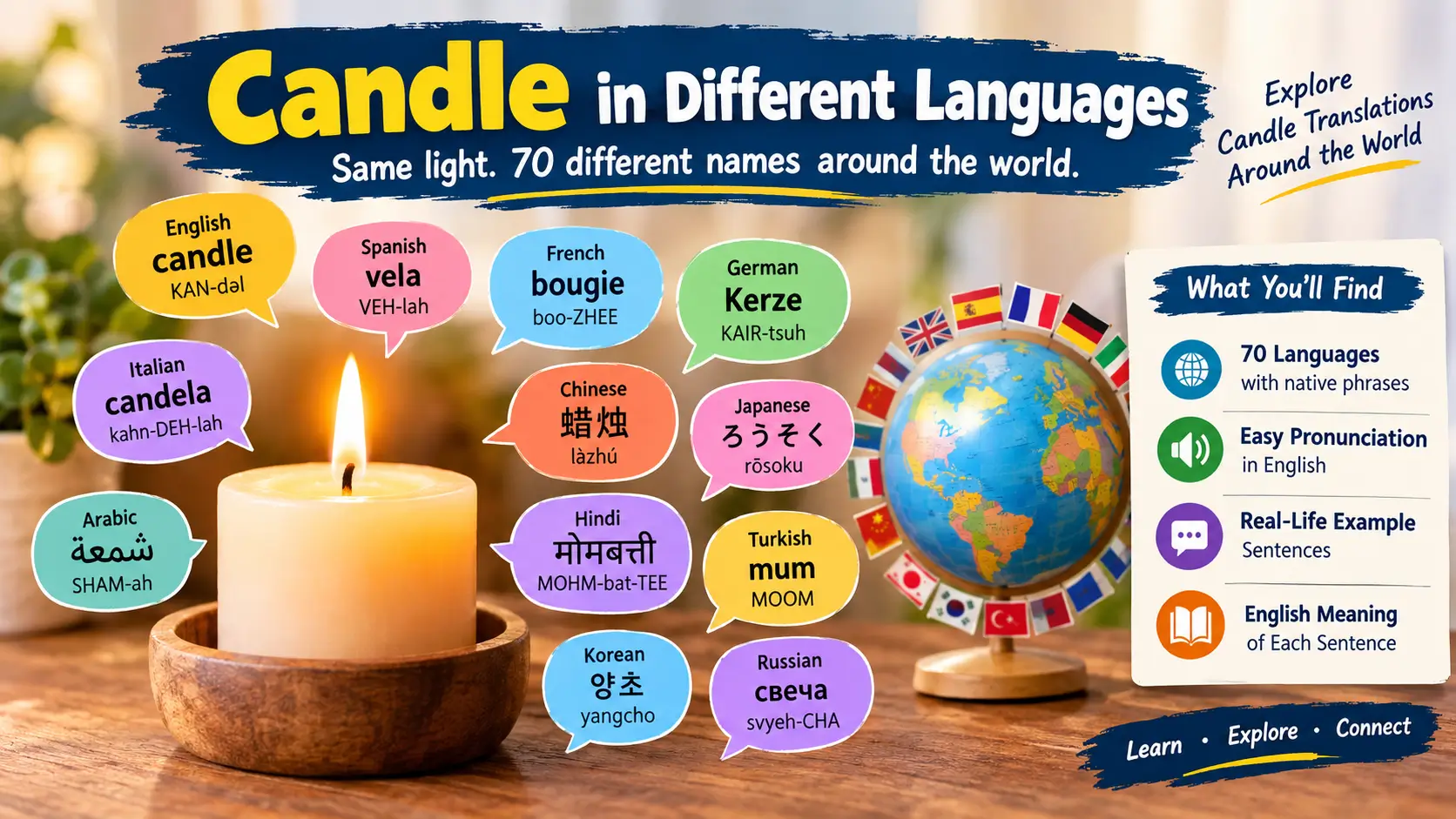
For example, Spanish uses vela, French uses bougie, German uses Kerze, Italian uses candela, and Turkish uses mum. These translations may look very different, but they all refer to the familiar object used for lighting, decoration, ceremonies, celebrations, and relaxation.
Asian languages also have distinctive terms. Mandarin Chinese uses 蜡烛, Japanese uses ろうそく, Korean uses 양초, and Hindi uses मोमबत्ती.
Candle Translations Around the World
The translations in this guide show how widely the word is used. Candles have practical and cultural meanings in many societies.
They can be used during power outages, birthday celebrations, religious ceremonies, memorials, weddings, romantic dinners, festivals, and home decoration. Because of these different uses, knowing the local word can be particularly useful when traveling or studying another language.
Common Uses of the Word Candle
The English word “candle” appears in many everyday expressions. Some common examples include:
- Light a candle — to set a candle burning.
- Blow out a candle — to extinguish a candle by blowing on it.
- Candle flame — the visible flame produced by a burning candle.
- Scented candle — a candle made with fragrance.
- Birthday candle — a small candle traditionally placed on a birthday cake.
- Candle holder — an object designed to hold a candle safely.
- Candlelight — light produced by candles.
Learning these related terms can help you use candle vocabulary more naturally in English and other languages.
Why Learn Candle in Different Languages?
Learning simple everyday words is an effective way to build practical vocabulary. “Candle” is especially useful because it appears in conversations about celebrations, home décor, traditions, religious practices, and everyday activities.
A multilingual list also makes it easier to recognize the word when reading menus, labels, travel information, language-learning materials, or cultural content.
Candle in All Languages: Quick Guide
Here are a few especially common translations at a glance:
- Spanish: vela
- French: bougie
- German: Kerze
- Italian: candela
- Portuguese: vela
- Arabic: شمعة
- Hindi: मोमबत्ती
- Urdu: موم بتی
- Chinese: 蜡烛
- Japanese: ろうそく
- Korean: 양초
- Turkish: mum
- Indonesian: lilin
- Filipino: kandila
- Swahili: mshumaa
Frequently Asked Questions
1. How do you say candle in different languages?
“Candle” has different translations depending on the language. For example, it is vela in Spanish, bougie in French, Kerze in German, candela in Italian, and 蜡烛 in Mandarin Chinese.
2. What is candle in Spanish?
The Spanish word for candle is vela. For example, “Encendí una vela” means “I lit a candle.”
3. What is candle in French?
The French word for candle is bougie. A common sentence is “J’allume une bougie,” meaning “I am lighting a candle.”
4. What is candle in Hindi and Urdu?
In Hindi, candle is मोमबत्ती (mombatti). In Urdu, it is موم بتی (mombatti). Both languages use closely related vocabulary for the everyday object.
5. What is candle in Japanese and Chinese?
In Japanese, candle is ろうそく (rōsoku). In Mandarin Chinese, it is 蜡烛 (làzhú). Both terms are commonly used for an ordinary candle.
Conclusion
Learning candle in different languages offers a simple way to explore vocabulary and cultural differences around the world. From vela in Spanish and bougie in French to 蜡烛 in Chinese and ろうそく in Japanese, the same familiar object has many fascinating names.
Use the 70-language table as a quick reference for language learning, translation practice, travel vocabulary, or discovering how everyday words change around the world.

I am Scarlett Wilson, a passionate language writer who loves exploring different languages, words, meanings, translations, and useful phrases. I enjoy making language learning simple, clear, and interesting for everyone.