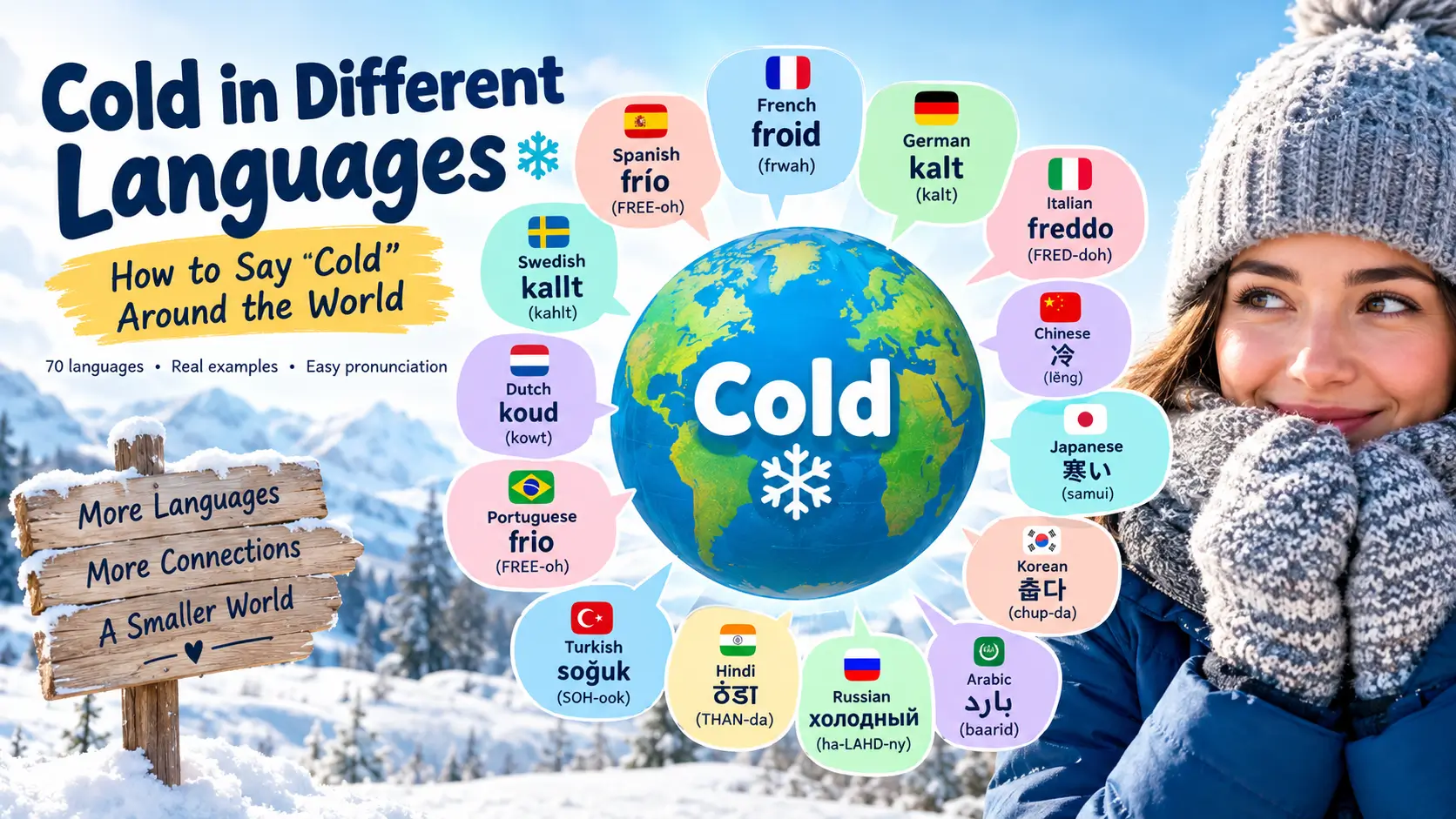
The word “cold” is useful in everyday conversations, especially when talking about weather, temperature, food, drinks, or how something feels. Learning how to say cold in different languages is a simple way to expand your vocabulary and communicate more naturally when traveling or speaking with people from other countries.
Below, you’ll find 70 cold translations from languages around the world. Each entry includes the native word or phrase, an easy English pronunciation, and a short real-life example sentence with its English meaning.
Cold in Different Languages
The exact translation of “cold” can change depending on context. In some languages, the adjective changes according to grammatical gender, number, or the noun being described. The examples below use common everyday forms.
| # | Language | Native Phrase | Easy English Pronunciation | Example Sentence | English Meaning |
|---|---|---|---|---|---|
| 1 | Spanish | frío | FREE-oh | Hace frío hoy. | It is cold today. |
| 2 | French | froid | frwah | Il fait froid. | It is cold. |
| 3 | German | kalt | kalt | Es ist kalt draußen. | It is cold outside. |
| 4 | Italian | freddo | FRED-doh | Fa freddo oggi. | It is cold today. |
| 5 | Portuguese | frio | FREE-oh | Está frio hoje. | It is cold today. |
| 6 | Dutch | koud | kowt | Het is koud buiten. | It is cold outside. |
| 7 | Swedish | kallt | kahlt | Det är kallt idag. | It is cold today. |
| 8 | Norwegian | kaldt | kahlt | Det er kaldt ute. | It is cold outside. |
| 9 | Danish | koldt | kohlt | Det er koldt i dag. | It is cold today. |
| 10 | Finnish | kylmä | KÜL-mah | Tänään on kylmä. | It is cold today. |
| 11 | Icelandic | kalt | kahlt | Það er kalt úti. | It is cold outside. |
| 12 | Irish | fuar | FOO-er | Tá sé fuar inni. | It is cold inside. |
| 13 | Welsh | oer | oyr | Mae hi’n oer. | It is cold. |
| 14 | Scottish Gaelic | fuar | foo-er | Tha e fuar. | It is cold. |
| 15 | Polish | zimny | ZIM-nih | Dzień jest zimny. | The day is cold. |
| 16 | Czech | studený | STOO-deh-nee | Je dnes studeno. | It is cold today. |
| 17 | Slovak | studený | STOO-deh-nee | Dnes je studeno. | It is cold today. |
| 18 | Slovenian | hladen | HLAH-den | Dan je hladen. | The day is cold. |
| 19 | Croatian | hladan | HLAH-dan | Dan je hladan. | The day is cold. |
| 20 | Serbian | хладан | HLAH-dan | Дан је хладан. | The day is cold. |
| 21 | Bosnian | hladan | HLAH-dan | Dan je hladan. | The day is cold. |
| 22 | Bulgarian | студен | STOO-den | Денят е студен. | The day is cold. |
| 23 | Macedonian | студено | STOO-deh-no | Денес е студено. | It is cold today. |
| 24 | Russian | холодный | ha-LAHD-ny | Сегодня холодно. | It is cold today. |
| 25 | Ukrainian | холодний | ho-LOHD-ny | Сьогодні холодно. | It is cold today. |
| 26 | Belarusian | халодны | ha-LOD-ny | Сёння холадна. | It is cold today. |
| 27 | Lithuanian | šaltas | SHAL-tas | Šiandien šalta. | It is cold today. |
| 28 | Latvian | auksts | OWKSTS | Šodien ir auksts. | It is cold today. |
| 29 | Estonian | külm | KÜLM | Täna on külm. | It is cold today. |
| 30 | Hungarian | hideg | HEE-deg | Ma hideg van. | It is cold today. |
| 31 | Romanian | rece | REH-cheh | Este rece afară. | It is cold outside. |
| 32 | Greek | κρύο | KREE-oh | Κάνει κρύο σήμερα. | It is cold today. |
| 33 | Albanian | ftohtë | ftoht | Është ftohtë sot. | It is cold today. |
| 34 | Turkish | soğuk | SOH-ook | Bugün hava soğuk. | The weather is cold today. |
| 35 | Azerbaijani | soyuq | soh-YOOK | Bu gün hava soyuqdur. | The weather is cold today. |
| 36 | Armenian | ցուրտ | tsoort | Այսօր ցուրտ է։ | It is cold today. |
| 37 | Georgian | ცივი | TSEE-vee | დღეს ცივა. | It is cold today. |
| 38 | Persian | سرد | sard | امروز هوا سرد است. | The weather is cold today. |
| 39 | Arabic | بارد | BAA-rid | الجو بارد اليوم. | The weather is cold today. |
| 40 | Hebrew | קר | kar | היום קר. | It is cold today. |
| 41 | Hindi | ठंडा | THAN-da | आज मौसम ठंडा है। | The weather is cold today. |
| 42 | Urdu | ٹھنڈا | THUN-da | آج موسم ٹھنڈا ہے۔ | The weather is cold today. |
| 43 | Bengali | ঠান্ডা | THAN-da | আজ আবহাওয়া ঠান্ডা। | The weather is cold today. |
| 44 | Punjabi | ਠੰਡਾ | THAN-da | ਅੱਜ ਮੌਸਮ ਠੰਡਾ ਹੈ। | The weather is cold today. |
| 45 | Gujarati | ઠંડું | THAN-doo | આજે હવામાન ઠંડું છે. | The weather is cold today. |
| 46 | Marathi | थंड | THUND | आज हवामान थंड आहे. | The weather is cold today. |
| 47 | Nepali | चिसो | CHEE-so | आज चिसो छ। | It is cold today. |
| 48 | Sinhala | සීතල | SEE-ta-la | අද සීතලයි. | It is cold today. |
| 49 | Tamil | குளிர் | KOO-leer | இன்று குளிராக இருக்கிறது. | It is cold today. |
| 50 | Telugu | చల్లగా | CHAL-la-ga | ఈ రోజు చల్లగా ఉంది. | It is cold today. |
| 51 | Kannada | ತಂಪು | TAM-poo | ಇಂದು ತಂಪಾಗಿದೆ. | It is cool/cold today. |
| 52 | Malayalam | തണുപ്പ് | tha-NU-pp | ഇന്ന് തണുപ്പാണ്. | It is cold today. |
| 53 | Chinese (Mandarin) | 冷 | lěng | 今天很冷。 | It is very cold today. |
| 54 | Japanese | 寒い | samui | 今日は寒いです。 | It is cold today. |
| 55 | Korean | 춥다 | chup-da | 오늘은 추워요. | It is cold today. |
| 56 | Vietnamese | lạnh | lahng | Hôm nay trời lạnh. | The weather is cold today. |
| 57 | Thai | หนาว | nǎao | วันนี้อากาศหนาว | The weather is cold today. |
| 58 | Indonesian | dingin | DEE-ngin | Hari ini dingin. | It is cold today. |
| 59 | Malay | sejuk | suh-jook | Hari ini sejuk. | It is cool/cold today. |
| 60 | Filipino | malamig | ma-LA-mig | Malamig ngayon. | It is cold now. |
| 61 | Burmese | အေး | aye | ဒီနေ့ အေးတယ်။ | It is cold today. |
| 62 | Khmer | ត្រជាក់ | trah-JAK | ថ្ងៃនេះត្រជាក់។ | It is cold today. |
| 63 | Mongolian | хүйтэн | KHOY-ten | Өнөөдөр хүйтэн байна. | It is cold today. |
| 64 | Swahili | baridi | ba-REE-dee | Leo kuna baridi. | It is cold today. |
| 65 | Afrikaans | koud | kowt | Dit is koud vandag. | It is cold today. |
| 66 | Amharic | ብርድ | BIRD | ዛሬ ብርድ ነው። | It is cold today. |
| 67 | Somali | qabow | qa-BOW | Maanta waa qabow. | It is cold today. |
| 68 | Yoruba | tutu | TOO-too | O tutu loni. | It is cold today. |
| 69 | Hausa | sanyi | SAN-yee | Yau akwai sanyi. | It is cold today. |
| 70 | Zulu | kubanda | koo-BAHN-da | Namuhla kuyabanda. | It is cold today. |
How to Say “Cold” in Different Languages
If you are searching for how to say cold in different languages, the table above gives a practical starting point. For example, cold is frío in Spanish, froid in French, kalt in German, 冷 in Mandarin Chinese, and 寒い in Japanese.
One important point is that direct translations do not always work in exactly the same way. Some languages use different forms depending on whether “cold” describes weather, an object, a person, or a physical sensation.
Cold Translations Around the World
The word “cold” can describe several related ideas:
- Cold weather: The temperature is low.
- A cold object: Something feels cold when touched.
- Cold food or drinks: A beverage or food has a low temperature.
- A cold person: In some contexts, “cold” can describe someone as emotionally distant.
- A cold illness: English also uses “a cold” to describe a common respiratory illness.
Because these meanings differ, the appropriate translation may also change from one language to another.
Cold in All Languages: Useful Vocabulary Tips
When learning cold in all languages, it helps to learn the word together with a complete sentence. This makes it easier to remember how native speakers actually use the expression.
For example, instead of memorizing only the English word “cold,” learn a phrase meaning “It is cold today.” This gives you useful vocabulary for conversations about weather and seasons.
Pronunciation can also vary considerably. English-style pronunciations in the table are approximate learning aids rather than replacements for native pronunciation.
Why Learn “Cold” in Different Languages?
Knowing basic temperature vocabulary can be especially useful when traveling. Weather is a common conversation topic, and words such as “cold,” “hot,” “rainy,” and “windy” are frequently used in everyday situations.
Learning these words can also help language students recognize familiar vocabulary when reading weather forecasts, travel information, menus, conversations, and social media posts.
Common Uses of the Word “Cold”
In English, cold can be used in several everyday ways:
Talking about weather:
“It is cold outside.”
Talking about objects:
“The water is cold.”
Talking about drinks:
“I would like a cold drink.”
Talking about food:
“The soup is cold.”
Talking about illness:
“I have a cold.”
The meaning becomes clear from the surrounding words and context.
Frequently Asked Questions
1. What is “cold” in Spanish?
“Cold” is frío in Spanish. For weather, a common sentence is “Hace frío,” meaning “It is cold.”
2. What is “cold” in French?
“Cold” is froid in French. A common weather expression is “Il fait froid,” meaning “It is cold.”
3. What is “cold” in German?
“Cold” is kalt in German. For example, “Es ist kalt draußen” means “It is cold outside.”
4. What is “cold” in Japanese?
“Cold” can be 寒い (samui) when describing cold weather or a cold environment. For example, “今日は寒いです” means “It is cold today.”
5. What is “cold” in Chinese?
In Mandarin Chinese, 冷 (lěng) commonly means “cold,” especially when talking about temperature or weather. “今天很冷” means “It is very cold today.”
Conclusion
Learning cold in different languages is a useful way to build practical vocabulary for travel, conversation, and language study. From frío in Spanish and froid in French to 冷 in Mandarin and 寒い in Japanese, the word appears in many different forms around the world.
Use the 70-language table as a quick reference, and remember each translation in a short sentence for easier recall and more natural communication.

I am Scarlett Wilson, a passionate language writer who loves exploring different languages, words, meanings, translations, and useful phrases. I enjoy making language learning simple, clear, and interesting for everyone.