Candy is a sweet treat enjoyed in almost every part of the world, but the word used for it changes from one language to another. Learning how to say candy in different languages is a fun way to explore vocabulary, food culture, and everyday expressions.
Whether you are learning a new language, traveling, writing multilingual content, or simply curious about candy translations, this guide gives you 70 useful translations in one easy-to-read table. Each entry includes the native word, a simple English pronunciation, and a practical example sentence.
Candy in Different Languages
The exact meaning of “candy” can vary slightly between languages. In some places, the word refers broadly to sweets or confectionery, while in others it may describe a particular type of sugary treat.
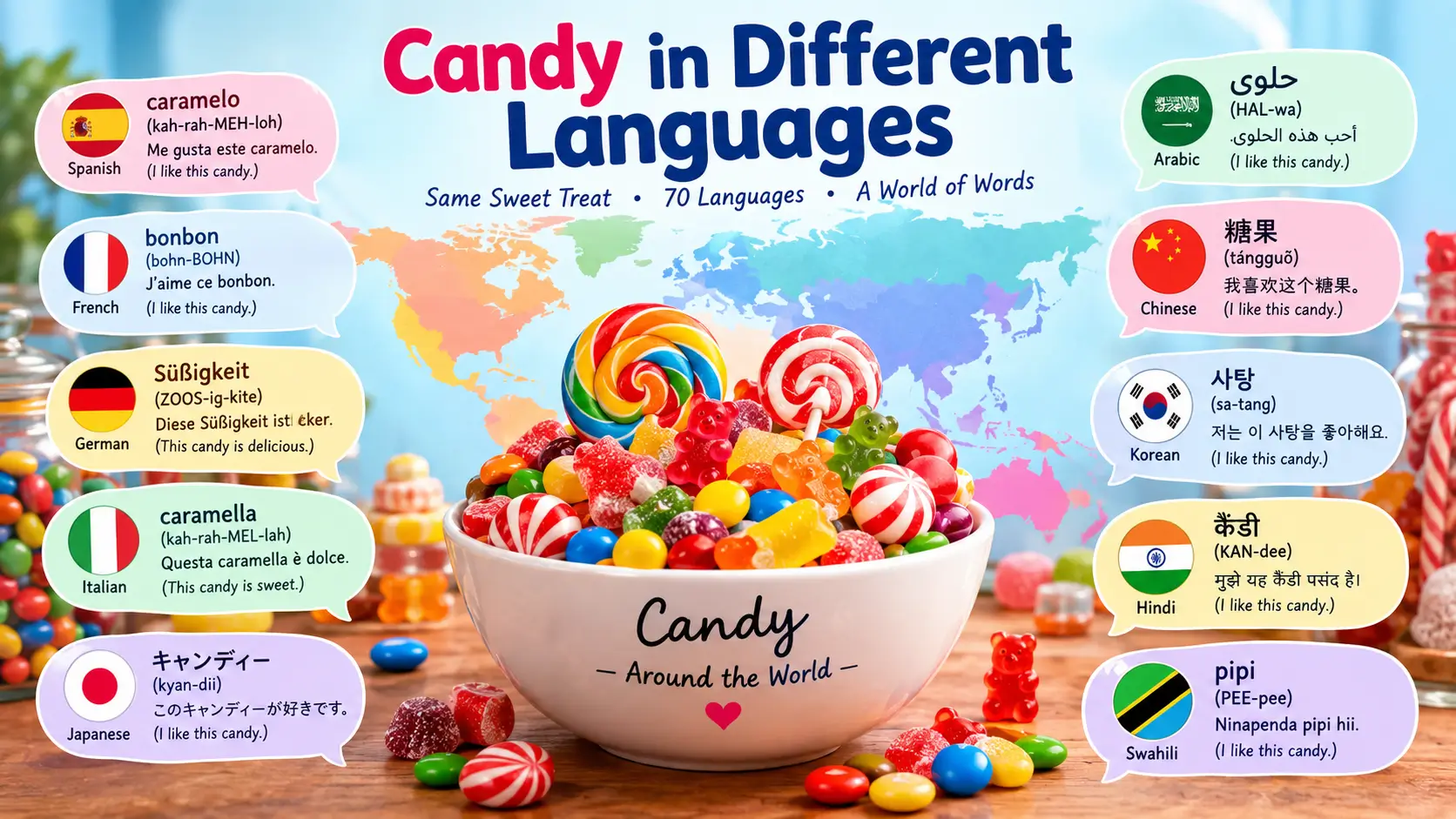
Here are 70 ways to say candy in different languages:
| # | Language | Native Phrase | Easy English Pronunciation | Example Sentence | English Meaning |
|---|---|---|---|---|---|
| 1 | Spanish | caramelo | kah-rah-MEH-loh | Me gusta este caramelo. | I like this candy. |
| 2 | French | bonbon | bohn-BOHN | J’aime ce bonbon. | I like this candy. |
| 3 | German | Süßigkeit | ZOOS-ig-kite | Diese Süßigkeit ist lecker. | This candy is delicious. |
| 4 | Italian | caramella | kah-rah-MEL-lah | Questa caramella è dolce. | This candy is sweet. |
| 5 | Portuguese | doce | DOH-see | Eu gosto deste doce. | I like this candy. |
| 6 | Dutch | snoep | snoop | Ik eet graag snoep. | I like eating candy. |
| 7 | Swedish | godis | GOO-dis | Jag gillar godis. | I like candy. |
| 8 | Norwegian | godteri | GOO-deh-ree | Jeg liker godteri. | I like candy. |
| 9 | Danish | slik | sleek | Jeg kan godt lide slik. | I like candy. |
| 10 | Finnish | karkki | KAR-kkee | Tykkään karkista. | I like candy. |
| 11 | Icelandic | nammi | NAH-mih | Mér finnst nammi gott. | I like candy. |
| 12 | Irish | milseán | MIL-shawn | Is maith liom milseán. | I like candy. |
| 13 | Welsh | melysion | meh-LUH-shon | Dw i’n hoffi melysion. | I like candy. |
| 14 | Polish | cukierek | tsoo-KYEH-rek | Lubię ten cukierek. | I like this candy. |
| 15 | Czech | bonbon | BON-bon | Mám rád tento bonbon. | I like this candy. |
| 16 | Slovak | cukrík | TSOO-kreek | Mám rád tento cukrík. | I like this candy. |
| 17 | Slovenian | bonbon | BON-bon | Rad imam ta bonbon. | I like this candy. |
| 18 | Croatian | bombon | BOM-bon | Volim ovaj bombon. | I like this candy. |
| 19 | Serbian | bombona | BOM-boh-nah | Volim ovu bombonu. | I like this candy. |
| 20 | Bulgarian | бонбон | bon-BON | Обичам този бонбон. | I like this candy. |
| 21 | Macedonian | бонбона | bom-BOH-nah | Ја сакам оваа бонбона. | I like this candy. |
| 22 | Romanian | bomboană | bom-BOAH-nuh | Îmi place această bomboană. | I like this candy. |
| 23 | Hungarian | cukorka | TSOO-kor-kah | Szeretem ezt a cukorkát. | I like this candy. |
| 24 | Greek | καραμέλα | kah-rah-MEH-lah | Μου αρέσει αυτή η καραμέλα. | I like this candy. |
| 25 | Albanian | karamele | kah-rah-MEH-leh | Më pëlqen kjo karamele. | I like this candy. |
| 26 | Lithuanian | saldainis | sal-DYE-nis | Man patinka šis saldainis. | I like this candy. |
| 27 | Latvian | konfekte | kon-FEK-teh | Man garšo šī konfekte. | I like this candy. |
| 28 | Estonian | komm | kohm | Mulle meeldib see komm. | I like this candy. |
| 29 | Russian | конфета | kon-FYEH-tah | Я люблю эту конфету. | I love this candy. |
| 30 | Ukrainian | цукерка | tsoo-KER-kah | Я люблю цю цукерку. | I love this candy. |
| 31 | Belarusian | цукерка | tsoo-KYER-kah | Я люблю гэтую цукерку. | I love this candy. |
| 32 | Armenian | կոնֆետ | kon-FET | Ես սիրում եմ այս կոնֆետը։ | I like this candy. |
| 33 | Georgian | კანფეტი | kan-FEH-tee | მე მიყვარს ეს კანფეტი. | I like this candy. |
| 34 | Turkish | şekerleme | sheh-kehr-LEH-meh | Bu şekerlemeyi seviyorum. | I like this candy. |
| 35 | Azerbaijani | konfet | kon-FET | Mən bu konfeti sevirəm. | I like this candy. |
| 36 | Persian | آبنبات | aab-na-BAAT | من این آبنبات را دوست دارم. | I like this candy. |
| 37 | Arabic | حلوى | HAL-wa | أحب هذه الحلوى. | I like this candy. |
| 38 | Hebrew | ממתק | mah-MAHK | אני אוהב את הממתק הזה. | I like this candy. |
| 39 | Hindi | कैंडी | KAN-dee | मुझे यह कैंडी पसंद है। | I like this candy. |
| 40 | Urdu | ٹافی | TAA-fee | مجھے یہ ٹافی پسند ہے۔ | I like this candy. |
| 41 | Bengali | ক্যান্ডি | KEN-dee | আমি এই ক্যান্ডি পছন্দ করি। | I like this candy. |
| 42 | Punjabi | ਟਾਫ਼ੀ | TAA-fee | ਮੈਨੂੰ ਇਹ ਟਾਫ਼ੀ ਪਸੰਦ ਹੈ। | I like this candy. |
| 43 | Gujarati | કેન્ડી | KEN-dee | મને આ કેન્ડી ગમે છે. | I like this candy. |
| 44 | Marathi | कँडी | KAN-dee | मला ही कँडी आवडते. | I like this candy. |
| 45 | Nepali | क्यान्डी | KYAN-dee | मलाई यो क्यान्डी मन पर्छ। | I like this candy. |
| 46 | Sinhala | කැන්ඩි | KEN-dee | මම මේ කැන්ඩි වලට කැමතියි. | I like this candy. |
| 47 | Tamil | மிட்டாய் | MIT-taai | எனக்கு இந்த மிட்டாய் பிடிக்கும். | I like this candy. |
| 48 | Telugu | మిఠాయి | mi-THAA-yi | నాకు ఈ మిఠాయి ఇష్టం. | I like this candy. |
| 49 | Kannada | ಮಿಠಾಯಿ | mi-THAA-yi | ನನಗೆ ಈ ಮಿಠಾಯಿ ಇಷ್ಟ. | I like this candy. |
| 50 | Malayalam | മിഠായി | mi-THAA-yi | എനിക്ക് ഈ മിഠായി ഇഷ്ടമാണ്. | I like this candy. |
| 51 | Chinese | 糖果 | tángguǒ | 我喜欢这个糖果。 | I like this candy. |
| 52 | Japanese | キャンディー | kyan-dii | このキャンディーが好きです。 | I like this candy. |
| 53 | Korean | 사탕 | sa-tang | 저는 이 사탕을 좋아해요. | I like this candy. |
| 54 | Vietnamese | kẹo | keh-oh | Tôi thích kẹo này. | I like this candy. |
| 55 | Thai | ลูกอม | look-om | ฉันชอบลูกอมนี้ | I like this candy. |
| 56 | Indonesian | permen | PER-men | Saya suka permen ini. | I like this candy. |
| 57 | Malay | gula-gula | GOO-lah GOO-lah | Saya suka gula-gula ini. | I like this candy. |
| 58 | Filipino | kendi | KEN-dee | Gusto ko ang kendi na ito. | I like this candy. |
| 59 | Burmese | သကြားလုံး | thuh-gyar-lone | ဒီသကြားလုံးကို ကြိုက်တယ်။ | I like this candy. |
| 60 | Khmer | ស្ករគ្រាប់ | skor-krap | ខ្ញុំចូលចិត្តស្ករគ្រាប់នេះ។ | I like this candy. |
| 61 | Lao | ເຂົ້າໜົມ | khao-nom | ຂ້ອຍມັກເຂົ້າໜົມນີ້. | I like this candy. |
| 62 | Mongolian | чихэр | CHEE-kher | Би энэ чихэрт дуртай. | I like this candy. |
| 63 | Kazakh | кәмпит | kem-PIT | Маған бұл кәмпит ұнайды. | I like this candy. |
| 64 | Uzbek | konfet | kon-FET | Men bu konfetni yaxshi ko‘raman. | I like this candy. |
| 65 | Swahili | pipi | PEE-pee | Ninapenda pipi hii. | I like this candy. |
| 66 | Zulu | uswidi | oo-SWEE-dee | Ngiyawuthanda lo swidi. | I like this candy. |
| 67 | Afrikaans | lekkergoed | LEK-er-khoot | Ek hou van hierdie lekkergoed. | I like this candy. |
| 68 | Amharic | ከረሜላ | ke-re-ME-la | ይህን ከረሜላ እወዳለሁ። | I like this candy. |
| 69 | Malagasy | vatomamy | va-too-MAH-mee | Tiako ity vatomamy ity. | I like this candy. |
| 70 | Haitian Creole | bonbon | bon-BON | Mwen renmen bonbon sa a. | I like this candy. |
How to Say Candy in Different Languages
The translations above show that there is no single universal word for candy. Some languages use words specifically associated with sweets, while others commonly use terms that can refer to particular kinds of candy.
For example, “candy” in Spanish is commonly expressed as caramelo, while French uses bonbon. In German, Süßigkeit is a broader word for a sweet or confection. In Japanese, the commonly used modern term キャンディー is borrowed from English.
This makes learning how to say candy in different languages especially interesting because everyday vocabulary often reflects local food traditions and language history.
Candy Translations Around the World
Candy vocabulary differs significantly across regions.
In many European languages, candy is represented by a traditional native word or a term related to sweets. In several Asian languages, the vocabulary can distinguish between hard candy, sweets, confectionery, and other sugary foods.
In South Asia, you may also encounter words that refer more broadly to sweets rather than only Western-style packaged candy. Context therefore matters when translating food-related vocabulary.
Candy in All Languages: What to Notice
When looking at candy in all languages, three patterns stand out:
- Some languages use a word specifically associated with candy or confectionery.
- Several languages have adopted or adapted international vocabulary.
- A number of languages use a broader term for sweets rather than a direct one-word equivalent.
Pronunciation can also vary depending on regional accents. The English pronunciations in the table are simple learner-friendly guides rather than formal phonetic transcriptions.
Why Learn Candy Translations?
Knowing simple food words can make language learning more practical. Candy is a familiar topic that can help beginners practice pronunciation, sentence structure, and everyday conversation.
For travelers, knowing the local word can also make shopping easier. You can recognize the word on packaging, understand basic conversations, and ask about sweets more naturally.
For multilingual writers and educators, these candy translations can also be useful when creating vocabulary lists, language-learning materials, and cultural content.
Common Uses of the Word “Candy”
The English word “candy” is generally used for sweet confectionery, especially in American English.
Examples include:
- Hard candy
- Chocolate candy
- Gummy candy
- Candy bars
- Lollipops
- Chewy candy
- Jelly candies
- Mint candy
British English often uses “sweets” where American English commonly uses “candy.” This is an important distinction for English learners.
Candy Around the World
Candy traditions vary widely around the world. Different cultures have their own favorite ingredients, preparation methods, shapes, and occasions for eating sweets.
Some sweets are associated with holidays, festivals, weddings, birthdays, or religious celebrations. Others are everyday treats sold in shops, markets, and supermarkets.
Learning the local word for candy can therefore introduce you to more than vocabulary. It can also open the door to understanding how different cultures enjoy sweet foods.
Frequently Asked Questions
1. How do you say candy in different languages?
There are many ways to say candy depending on the language. Examples include caramelo in Spanish, bonbon in French, Süßigkeit in German, caramella in Italian, snoep in Dutch, and pipi in Swahili.
2. What is candy called in Spanish?
Candy is commonly called caramelo in Spanish. Depending on the country and type of sweet, other terms may also be used.
3. What is candy called in French?
The common French word for candy is bonbon. It is widely used for small sweet confectionery.
4. What is the difference between candy and sweets?
Both words describe sweet confectionery, but usage differs by variety of English. Candy is especially common in American English, while sweets is commonly used in British English.
5. What is candy called in Japanese?
Candy can be expressed as キャンディー (kyandī) in Japanese. Other Japanese words may be used for particular types of sweets depending on the context.
Conclusion
Learning candy in different languages is a simple and enjoyable way to expand your vocabulary while discovering how languages describe familiar foods. From caramelo and bonbon to 사탕 and 糖果, these 70 translations demonstrate the fascinating variety of words used for candy around the world.
Whether you are studying languages, traveling, or exploring international vocabulary, these candy translations provide a useful starting point for understanding everyday speech.

I’m Jesse Crawford, a language enthusiast and writer passionate about exploring different languages. I create helpful content that makes words, meanings, translations, and language learning simple, useful, and enjoyable for everyone.