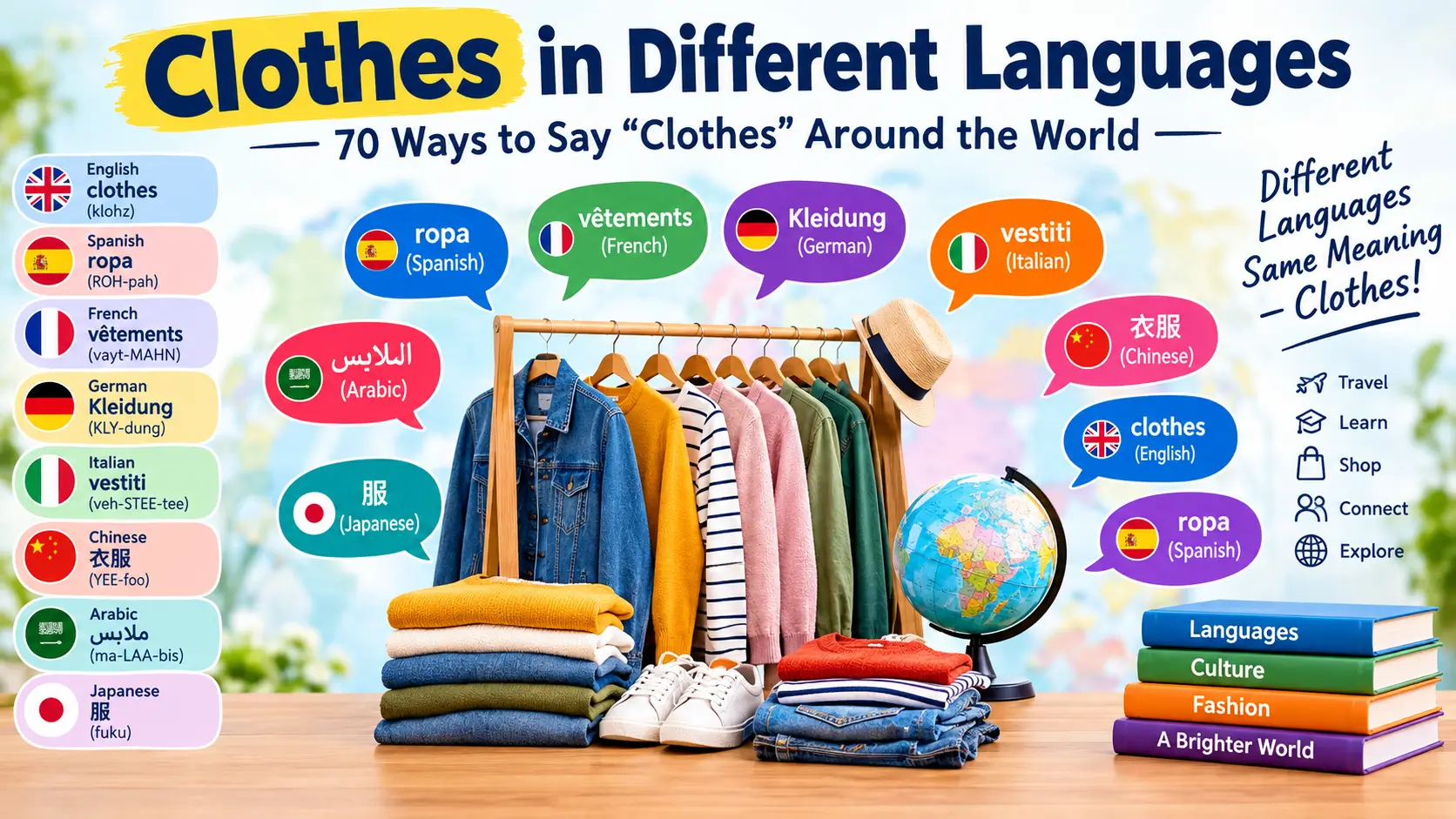
Clothes are a universal part of everyday life, but the word for “clothes” changes from one language to another. Learning how to say clothes in different languages can help with travel, shopping, language learning, cultural conversations, and understanding international fashion.
In this guide, you’ll discover clothes in all languages across Europe, Asia, Africa, the Middle East, and other regions. Each translation includes an easy English pronunciation and a practical example sentence so you can understand how the word is naturally used.
Whether you want to know how to say clothes in different languages, explore clothes translations, or discover how people talk about clothing around the world, this table gives you 70 useful examples in one place.
Clothes in Different Languages
| # | Language | Clothes | Easy English Pronunciation | Example Sentence | English Meaning |
|---|---|---|---|---|---|
| 1 | English | clothes | klohz | My clothes are clean. | My clothes are clean. |
| 2 | Spanish | ropa | ROH-pah | Mi ropa está limpia. | My clothes are clean. |
| 3 | French | vêtements | vayt-MAHN | Mes vêtements sont propres. | My clothes are clean. |
| 4 | German | Kleidung | KLY-dung | Meine Kleidung ist sauber. | My clothes are clean. |
| 5 | Italian | vestiti | veh-STEE-tee | I miei vestiti sono puliti. | My clothes are clean. |
| 6 | Portuguese | roupas | HOO-pahs | Minhas roupas estão limpas. | My clothes are clean. |
| 7 | Dutch | kleding | KLAY-ding | Mijn kleding is schoon. | My clothes are clean. |
| 8 | Swedish | kläder | KLAIR-der | Mina kläder är rena. | My clothes are clean. |
| 9 | Norwegian | klær | klair | Klærne mine er rene. | My clothes are clean. |
| 10 | Danish | tøj | toy | Mit tøj er rent. | My clothes are clean. |
| 11 | Finnish | vaatteet | VAHT-teht | Vaatteeni ovat puhtaat. | My clothes are clean. |
| 12 | Icelandic | föt | fuht | Fötin mín eru hrein. | My clothes are clean. |
| 13 | Irish | éadaí | AY-dee | Tá mo chuid éadaí glan. | My clothes are clean. |
| 14 | Welsh | dillad | DILL-ad | Mae fy nillad yn lân. | My clothes are clean. |
| 15 | Scottish Gaelic | aodach | EE-dach | Tha an t-aodach agam glan. | My clothes are clean. |
| 16 | Polish | ubrania | oo-BRAH-nya | Moje ubrania są czyste. | My clothes are clean. |
| 17 | Czech | oblečení | oh-BLEH-cheh-nee | Moje oblečení je čisté. | My clothes are clean. |
| 18 | Slovak | oblečenie | oh-BLEH-cheh-nee-eh | Moje oblečenie je čisté. | My clothes are clean. |
| 19 | Slovenian | oblačila | ob-LAH-chee-lah | Moja oblačila so čista. | My clothes are clean. |
| 20 | Croatian | odjeća | OD-yeh-cha | Moja odjeća je čista. | My clothes are clean. |
| 21 | Serbian | одећа | oh-DEH-cha | Моја одећа је чиста. | My clothes are clean. |
| 22 | Bosnian | odjeća | OD-yeh-cha | Moja odjeća je čista. | My clothes are clean. |
| 23 | Bulgarian | дрехи | DREH-khee | Дрехите ми са чисти. | My clothes are clean. |
| 24 | Macedonian | облека | oh-BLEH-kah | Мојата облека е чиста. | My clothes are clean. |
| 25 | Romanian | haine | HAH-neh | Hainele mele sunt curate. | My clothes are clean. |
| 26 | Hungarian | ruhák | ROO-hahk | A ruháim tiszták. | My clothes are clean. |
| 27 | Greek | ρούχα | ROO-khah | Τα ρούχα μου είναι καθαρά. | My clothes are clean. |
| 28 | Albanian | rroba | ROH-bah | Rrobat e mia janë të pastra. | My clothes are clean. |
| 29 | Lithuanian | drabužiai | drah-boo-ZHYE | Mano drabužiai švarūs. | My clothes are clean. |
| 30 | Latvian | drēbes | DRAY-bes | Manas drēbes ir tīras. | My clothes are clean. |
| 31 | Estonian | riided | REE-det | Minu riided on puhtad. | My clothes are clean. |
| 32 | Russian | одежда | ah-DYEZH-dah | Моя одежда чистая. | My clothes are clean. |
| 33 | Ukrainian | одяг | OH-dyah | Мій одяг чистий. | My clothes are clean. |
| 34 | Belarusian | адзенне | ah-DZEHN-neh | Маё адзенне чыстае. | My clothes are clean. |
| 35 | Armenian | հագուստ | hah-GOOST | Իմ հագուստը մաքուր է։ | My clothes are clean. |
| 36 | Georgian | ტანსაცმელი | tahn-tsahts-MEH-lee | ჩემი ტანსაცმელი სუფთაა. | My clothes are clean. |
| 37 | Turkish | giysiler | GYEE-see-ler | Giysilerim temiz. | My clothes are clean. |
| 38 | Azerbaijani | paltar | pahl-TAHR | Paltarlarım təmizdir. | My clothes are clean. |
| 39 | Persian | لباس | le-BAAS | لباسهایم تمیز هستند. | My clothes are clean. |
| 40 | Arabic | ملابس | ma-LAA-bis | ملابسي نظيفة. | My clothes are clean. |
| 41 | Hebrew | בגדים | beh-gah-DEEM | הבגדים שלי נקיים. | My clothes are clean. |
| 42 | Hindi | कपड़े | KAP-ray | मेरे कपड़े साफ़ हैं। | My clothes are clean. |
| 43 | Urdu | کپڑے | KAP-ray | میرے کپڑے صاف ہیں۔ | My clothes are clean. |
| 44 | Bengali | কাপড় | KAP-por | আমার কাপড় পরিষ্কার। | My clothes are clean. |
| 45 | Punjabi | ਕੱਪੜੇ | KAP-ray | ਮੇਰੇ ਕੱਪੜੇ ਸਾਫ਼ ਹਨ। | My clothes are clean. |
| 46 | Gujarati | કપડાં | KAP-daan | મારાં કપડાં સ્વચ્છ છે. | My clothes are clean. |
| 47 | Marathi | कपडे | KUP-day | माझे कपडे स्वच्छ आहेत. | My clothes are clean. |
| 48 | Nepali | लुगा | LOO-gah | मेरा लुगा सफा छ। | My clothes are clean. |
| 49 | Sinhala | ඇඳුම් | AN-doom | මගේ ඇඳුම් පිරිසිදුයි. | My clothes are clean. |
| 50 | Tamil | ஆடைகள் | AA-dai-gal | என் ஆடைகள் சுத்தமாக உள்ளன. | My clothes are clean. |
| 51 | Telugu | బట్టలు | BUT-ta-loo | నా బట్టలు శుభ్రంగా ఉన్నాయి. | My clothes are clean. |
| 52 | Kannada | ಬಟ್ಟೆಗಳು | BUT-teh-ga-loo | ನನ್ನ ಬಟ್ಟೆಗಳು ಸ್ವಚ್ಛವಾಗಿವೆ. | My clothes are clean. |
| 53 | Malayalam | വസ്ത്രങ്ങൾ | VAS-tran-gal | എന്റെ വസ്ത്രങ്ങൾ വൃത്തിയാണ്. | My clothes are clean. |
| 54 | Chinese | 衣服 | YEE-foo | 我的衣服很干净。 | My clothes are clean. |
| 55 | Japanese | 服 | fuku | 私の服はきれいです。 | My clothes are clean. |
| 56 | Korean | 옷 | ot | 제 옷은 깨끗해요. | My clothes are clean. |
| 57 | Vietnamese | quần áo | kwun ow | Quần áo của tôi sạch. | My clothes are clean. |
| 58 | Thai | เสื้อผ้า | seu-a phaa | เสื้อผ้าของฉันสะอาด | My clothes are clean. |
| 59 | Indonesian | pakaian | pah-KAI-yan | Pakaian saya bersih. | My clothes are clean. |
| 60 | Malay | pakaian | pah-KAI-yan | Pakaian saya bersih. | My clothes are clean. |
| 61 | Filipino | damit | DAH-mit | Malinis ang damit ko. | My clothes are clean. |
| 62 | Burmese | အဝတ်အစား | uh-WUT uh-SAAR | ကျွန်တော့်အဝတ်အစားတွေ သန့်ရှင်းတယ်။ | My clothes are clean. |
| 63 | Khmer | សម្លៀកបំពាក់ | som-lee-ak bom-PEAK | សម្លៀកបំពាក់របស់ខ្ញុំស្អាត។ | My clothes are clean. |
| 64 | Mongolian | хувцас | KHOOV-tsas | Миний хувцас цэвэрхэн байна. | My clothes are clean. |
| 65 | Swahili | nguo | NGOO-oh | Nguo zangu ni safi. | My clothes are clean. |
| 66 | Zulu | izingubo | ee-zeen-GOO-boh | Izingubo zami zihlanzekile. | My clothes are clean. |
| 67 | Xhosa | iimpahla | eem-PAH-lah | Iimpahla zam zicocekile. | My clothes are clean. |
| 68 | Afrikaans | klere | KLEE-reh | My klere is skoon. | My clothes are clean. |
| 69 | Amharic | ልብስ | libis | ልብሴ ንጹህ ነው። | My clothes are clean. |
| 70 | Malagasy | akanjo | ah-KAHN-dzoo | Madio ny akanjoko. | My clothes are clean. |
How to Say Clothes in Different Languages
The word “clothes” does not always work exactly the same way across languages. Some languages use a plural word, while others commonly use a collective or general noun for clothing.
For example, ropa in Spanish can refer to clothes or clothing in general, while Kleidung in German is generally a collective noun. In Japanese, 服 (fuku) can refer to clothes or clothing depending on context.
This is why direct word-for-word translation is not always enough. Understanding how a word is naturally used makes your language learning more practical.
Clothes Translations Around the World
The translations above show how widely clothing vocabulary varies around the world. European languages include forms such as ropa, vêtements, Kleidung, and vestiti, while South Asian languages use words such as कपड़े, کپڑے, and কাপড়.
East Asian languages also have distinct everyday terms. Chinese uses 衣服, Japanese uses 服, and Korean uses 옷. Across Africa, examples include nguo in Swahili, izingubo in Zulu, and iimpahla in Xhosa.
These differences make clothing vocabulary a useful starting point for exploring languages and cultures.
Clothes in All Languages: Useful Context
When learning clothes in all languages, it is helpful to remember that “clothes” can refer to many different things, including:
- Shirts and T-shirts
- Pants and trousers
- Dresses and skirts
- Jackets and coats
- Shoes and boots
- Traditional clothing
- Sportswear
- Sleepwear
- Workwear
- Accessories and fashion items
If you are traveling or shopping internationally, learning the general word for clothes is useful, but learning individual clothing items can make conversations much easier.
Clothes and Cultural Differences
Clothing vocabulary can also provide a small window into culture. Some languages distinguish clothing categories more specifically than English, while others use a broad word for clothing.
Traditional garments can also have their own names that should not always be translated simply as “clothes.” For example, cultural clothing terms may describe a particular garment, style, material, or occasion.
When learning a new language, pay attention to the context in which native speakers use the general word for clothes.
Why Learn Clothes in Different Languages?
Learning clothes in different languages can be useful for several practical reasons.
Travel: You may need clothing vocabulary when shopping, packing, or asking about sizes.
Language learning: Everyday nouns are among the most useful words to learn early.
Shopping: Knowing basic clothing vocabulary can make international shopping websites easier to understand.
Culture: Clothing words can introduce you to traditional garments and local fashion vocabulary.
Communication: A simple clothing word can help you describe what someone is wearing or what you need to buy.
Common Clothing Phrases to Learn Next
Once you know how to say clothes in different languages, you can expand your vocabulary with related phrases such as:
- What are you wearing?
- I need new clothes.
- Where can I buy clothes?
- These clothes are beautiful.
- What size do you need?
- I like this shirt.
- Where is the changing room?
- These clothes are too small.
- These clothes are too large.
- How much does this cost?
Learning these phrases together creates a more useful vocabulary set than memorizing the word “clothes” alone.
Frequently Asked Questions
1. What is “clothes” in Spanish?
“Clothes” in Spanish is ropa. It is commonly used when talking about clothing in general.
2. How do you say “clothes” in French?
“Clothes” in French is vêtements. The word is commonly used for clothing or garments.
3. What is the word for clothes in Hindi?
In Hindi, “clothes” is commonly expressed as कपड़े (kapṛe). It is an everyday word for clothes.
4. How do you say “clothes” in Japanese?
In Japanese, “clothes” is commonly 服 (fuku). It can refer to clothes or clothing depending on the sentence.
5. What is “clothes” in Arabic?
In Arabic, “clothes” is ملابس (malābis). It is a common term for clothing.
Conclusion
Learning clothes in different languages is a simple and practical way to build useful vocabulary. From ropa in Spanish and vêtements in French to 衣服 in Chinese and nguo in Swahili, the word takes many forms around the world.
Use the 70-language table as a quick reference, and combine these words with useful shopping, travel, and everyday phrases to make your language skills more practical.

I am Ricardo Hunter, Administrator at LingoBuz, passionate about languages, translations, and global communication. I help create useful, clear content that makes exploring different languages simple, enjoyable, and accessible.