Chicken is one of the most familiar food words across cultures. Whether you are traveling, reading an international menu, learning vocabulary, cooking a recipe, or simply exploring languages, knowing how to say chicken in different languages can be surprisingly useful.
The word can refer to the bird itself or to chicken meat, and some languages use different words depending on the context. For this list, the most common everyday term is used where possible.
Chicken in All Languages: 70 Translations
Here is a simple table showing chicken in 70 different languages, including the native word, an easy English pronunciation, a practical example, and its English meaning.
| # | Language | Native phrase | Easy English pronunciation | Real-life example | English meaning |
|---|---|---|---|---|---|
| 1 | English | Chicken | chik-en | I cooked chicken for dinner. | I cooked chicken for dinner. |
| 2 | Spanish | Pollo | POH-yoh | Me gusta el pollo. | I like chicken. |
| 3 | French | Poulet | poo-LAY | J’aime le poulet. | I like chicken. |
| 4 | German | Hähnchen | HEN-chen | Ich esse gern Hähnchen. | I like eating chicken. |
| 5 | Italian | Pollo | POL-loh | Mi piace il pollo. | I like chicken. |
| 6 | Portuguese | Frango | FRAN-goo | Eu gosto de frango. | I like chicken. |
| 7 | Dutch | Kip | kip | Ik hou van kip. | I like chicken. |
| 8 | Russian | Курица | koo-REE-tsa | Я люблю курицу. | I love chicken. |
| 9 | Ukrainian | Курка | KOOR-ka | Я люблю курку. | I love chicken. |
| 10 | Polish | Kurczak | KOOR-chak | Jem kurczaka na obiad. | I eat chicken for lunch. |
| 11 | Czech | Kuře | KOO-rzhe | Dnes jím kuře. | I am eating chicken today. |
| 12 | Slovak | Kurča | KOOR-cha | Varím kurča. | I am cooking chicken. |
| 13 | Hungarian | Csirke | CHEER-keh | Szeretem a csirkét. | I like chicken. |
| 14 | Romanian | Pui | POO-ee | Mănânc pui azi. | I am eating chicken today. |
| 15 | Greek | Κοτόπουλο | ko-TO-poo-lo | Μου αρέσει το κοτόπουλο. | I like chicken. |
| 16 | Turkish | Tavuk | ta-VOOK | Tavuk yiyorum. | I am eating chicken. |
| 17 | Arabic | دجاج | da-JAJ | أحب الدجاج. | I love chicken. |
| 18 | Hebrew | עוף | oof | אני אוהב עוף. | I like chicken. |
| 19 | Persian | مرغ | morgh | من مرغ دوست دارم. | I like chicken. |
| 20 | Hindi | चिकन | CHIK-en | मुझे चिकन पसंद है। | I like chicken. |
| 21 | Urdu | چکن | CHIK-en | مجھے چکن پسند ہے۔ | I like chicken. |
| 22 | Punjabi | ਮੁਰਗ਼ੀ | MOOR-ghee | ਮੈਨੂੰ ਮੁਰਗ਼ੀ ਪਸੰਦ ਹੈ। | I like chicken. |
| 23 | Bengali | মুরগি | MOOR-gee | আমি মুরগি পছন্দ করি। | I like chicken. |
| 24 | Gujarati | ચિકન | CHIK-en | મને ચિકન ગમે છે. | I like chicken. |
| 25 | Marathi | चिकन | CHIK-en | मला चिकन आवडते. | I like chicken. |
| 26 | Nepali | कुखुरा | koo-KHOO-ra | मलाई कुखुरा मन पर्छ। | I like chicken. |
| 27 | Sinhala | කුකුල් මස් | koo-kul mas | මම කුකුල් මස් කනවා. | I eat chicken. |
| 28 | Tamil | கோழி | KOH-zhi | எனக்கு கோழி பிடிக்கும். | I like chicken. |
| 29 | Telugu | కోడి | KOH-dee | నాకు కోడి ఇష్టం. | I like chicken. |
| 30 | Kannada | ಕೋಳಿ | KOH-lee | ನನಗೆ ಕೋಳಿ ಇಷ್ಟ. | I like chicken. |
| 31 | Malayalam | കോഴി | KOH-zhi | എനിക്ക് കോഴി ഇഷ്ടമാണ്. | I like chicken. |
| 32 | Chinese (Mandarin) | 鸡肉 | jee-ROH | 我喜欢鸡肉。 | I like chicken. |
| 33 | Japanese | 鶏肉 | toh-ree-nee-koo | 鶏肉が好きです。 | I like chicken. |
| 34 | Korean | 닭고기 | dalk-go-gi | 저는 닭고기를 좋아해요. | I like chicken. |
| 35 | Thai | ไก่ | guy | ฉันชอบไก่ | I like chicken. |
| 36 | Vietnamese | Gà | gah | Tôi thích gà. | I like chicken. |
| 37 | Indonesian | Ayam | AH-yam | Saya suka ayam. | I like chicken. |
| 38 | Malay | Ayam | AH-yam | Saya suka ayam. | I like chicken. |
| 39 | Filipino | Manok | MA-nok | Gusto ko ang manok. | I like chicken. |
| 40 | Mongolian | Тахиа | ta-KHEE-a | Би тахиа иддэг. | I eat chicken. |
| 41 | Swahili | Kuku | KOO-koo | Ninapenda kuku. | I like chicken. |
| 42 | Zulu | Inkukhu | in-KOO-koo | Ngithanda inkukhu. | I like chicken. |
| 43 | Xhosa | Inkukhu | in-KOO-koo | Ndiyayithanda inkukhu. | I like chicken. |
| 44 | Afrikaans | Hoender | HOON-der | Ek hou van hoender. | I like chicken. |
| 45 | Somali | Digaag | dee-GAAG | Waxaan jeclahay digaag. | I like chicken. |
| 46 | Amharic | ዶሮ | DOH-ro | ዶሮ እወዳለሁ። | I like chicken. |
| 47 | Yoruba | Adìẹ | ah-DEE-eh | Mo fẹ́ adìẹ. | I like chicken. |
| 48 | Igbo | Okuko | oh-KOO-koh | Ana m eri okuko. | I eat chicken. |
| 49 | Hausa | Kaza | KAH-zah | Ina cin kaza. | I am eating chicken. |
| 50 | Malagasy | Akoho | ah-KOH-ho | Mihinana akoho aho. | I eat chicken. |
| 51 | Maori | Heihei | HAY-hay | Ka kai au i te heihei. | I eat chicken. |
| 52 | Hawaiian | Moa | MO-ah | ʻAi au i ka moa. | I eat chicken. |
| 53 | Samoan | Moa | MO-ah | Ou te ʻai moa. | I eat chicken. |
| 54 | Fijian | Toa | TOH-ah | Au kania toa. | I eat chicken. |
| 55 | Finnish | Kana | KAH-nah | Syön kanaa. | I eat chicken. |
| 56 | Estonian | Kana | KAH-nah | Ma söön kana. | I eat chicken. |
| 57 | Latvian | Vista | VIS-tah | Es ēdu vistu. | I eat chicken. |
| 58 | Lithuanian | Vištiena | vish-TYEH-nah | Aš valgau vištieną. | I eat chicken. |
| 59 | Swedish | Kyckling | SHICK-ling | Jag äter kyckling. | I eat chicken. |
| 60 | Norwegian | Kylling | SHILL-ing | Jeg spiser kylling. | I eat chicken. |
| 61 | Danish | Kylling | KOO-ling | Jeg spiser kylling. | I eat chicken. |
| 62 | Icelandic | Kjúklingur | KYOO-kling-ur | Ég borða kjúkling. | I eat chicken. |
| 63 | Basque | Oilasko | oy-LAHS-koh | Oilaskoa jaten dut. | I eat chicken. |
| 64 | Catalan | Pollastre | poh-YAHS-treh | Menjo pollastre. | I eat chicken. |
| 65 | Galician | Polo | POH-loh | Como polo. | I eat chicken. |
| 66 | Irish | Sicín | shi-KEEN | Ithim sicín. | I eat chicken. |
| 67 | Welsh | Cyw iâr | KOO-yar | Rwy’n bwyta cyw iâr. | I eat chicken. |
| 68 | Scottish Gaelic | Cearc | KYARK | Ith mi cearc. | I eat chicken. |
| 69 | Albanian | Pulë | POO-leh | Ha pulë sot. | I eat chicken today. |
| 70 | Serbian | Piletina | pee-leh-TEE-nah | Jedem piletinu. | I eat chicken. |
The exact word can vary according to whether a speaker means the bird, a hen, a young chicken, or chicken meat. For example, English “chicken” covers several meanings, while some languages make more distinctions.
How to Say Chicken in Different Languages
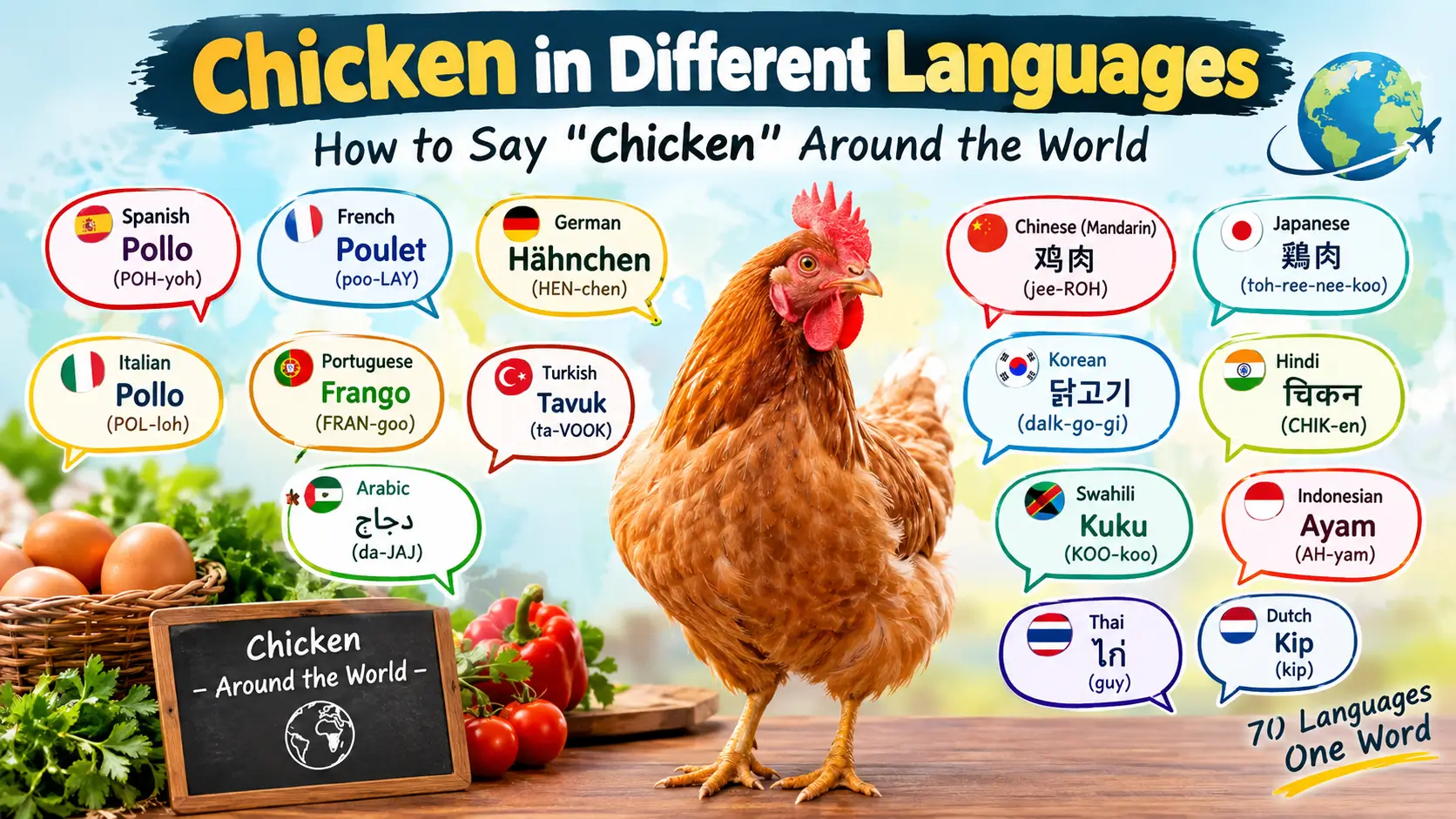
The table makes it easy to see how widely the word varies. Some translations are closely related because the languages share historical roots. Spanish pollo and Italian pollo, for example, look and sound similar.
Other languages have completely different-looking words. Indonesian and Malay use ayam, Swahili uses kuku, Turkish uses tavuk, and Arabic uses دجاج. These differences make language learning especially interesting.
Chicken Translations in European Languages
European languages offer many recognizable patterns. Romance languages commonly have forms such as pollo, poulet, frango, pui, and pollastre.
Germanic languages use very different forms, including German Hähnchen, Dutch kip, Swedish kyckling, Norwegian kylling, Danish kylling, and English chicken.
Slavic languages also show related vocabulary, including Russian курица, Ukrainian курка, Polish kurczak, Czech kuře, and Slovak kurča.
Chicken Around the World
Chicken vocabulary becomes even more diverse across Asia, Africa, Oceania, and the Americas.
In South Asia, you may encounter Hindi चिकन, Urdu چکن, Punjabi ਮੁਰਗ਼ੀ, Bengali মুরগি, Nepali कुखुरा, and Tamil கோழி.
Across East and Southeast Asia, common terms include Mandarin 鸡肉, Japanese 鶏肉, Korean 닭고기, Thai ไก่, Vietnamese gà, Indonesian ayam, Malay ayam, and Filipino manok.
African languages also have distinctive words, including Swahili kuku, Zulu inkukhu, Somali digaag, Amharic ዶሮ, Yoruba adìẹ, and Hausa kaza.
Chicken as Food vs. the Chicken Bird
One useful point when learning chicken translations is that the English word can have more than one meaning.
“Chicken” may describe the living bird, while “chicken” can also mean the meat served as food. Other languages may use separate vocabulary for these meanings.
For example, Mandarin commonly uses 鸡 for chicken as a bird and 鸡肉 for chicken meat. Similarly, English dictionaries distinguish the bird from its meat.
This distinction matters when ordering food, reading recipes, or creating accurate translations.
Useful Chicken Vocabulary for Travelers
Knowing just the word for chicken can be helpful when traveling, but a few related phrases can make communication easier.
You might want to learn phrases such as:
- chicken soup
- grilled chicken
- fried chicken
- chicken rice
- chicken sandwich
- chicken breast
- chicken wings
- I would like chicken
- I don’t eat chicken
- Is this chicken?
Learning these expressions together with the basic food vocabulary can make restaurant conversations much easier.
Why Learn “Chicken” in Different Languages?
There are several practical reasons to learn this simple word.
Travel: Knowing food vocabulary can help you understand menus and communicate basic preferences.
Language learning: Everyday nouns are useful building blocks for forming sentences.
Cooking: International recipes frequently use local names for ingredients.
Culture: Food vocabulary provides a simple way to discover similarities and differences between languages.
Communication: Even one familiar word can make an interaction more comfortable when you are speaking with someone in another language.
Frequently Asked Questions
1. How do you say chicken in different languages?
“Chicken” has many translations. Some common examples are pollo in Spanish and Italian, poulet in French, frango in Portuguese, kip in Dutch, tavuk in Turkish, ayam in Indonesian and Malay, kuku in Swahili, and manok in Filipino.
2. What is chicken in the most common languages?
Some widely used translations include pollo in Spanish, poulet in French, Hähnchen in German, pollo in Italian, frango in Portuguese, 鸡肉 in Mandarin, 鶏肉 in Japanese, 닭고기 in Korean, دجاج in Arabic, चिकन in Hindi, and چکن in Urdu.
3. How do you say chicken in Asian languages?
Examples include 鸡肉 in Mandarin, 鶏肉 in Japanese, 닭고기 in Korean, ไก่ in Thai, gà in Vietnamese, ayam in Indonesian and Malay, manok in Filipino, கோழி in Tamil, and को कुखुरा in Nepali.
4. How do you say chicken in European languages?
Examples include pollo in Spanish and Italian, poulet in French, Hähnchen in German, frango in Portuguese, kip in Dutch, kurczak in Polish, kuře in Czech, pui in Romanian, kylling in Norwegian and Danish, and kyckling in Swedish.
5. Why are chicken translations different from one language to another?
Languages developed independently across different regions and cultures, so the same animal or food can have very different names. Historical relationships between languages can explain some similarities, while borrowing, sound changes, and local vocabulary explain many differences.
Conclusion
Learning chicken in different languages is a simple way to expand your vocabulary and explore how people around the world talk about food. From pollo and poulet to ayam, kuku, tavuk, and manok, these 70 translations show the remarkable variety of everyday language.
Whether you are studying languages, traveling, reading international menus, or simply curious about chicken around the world, this list provides a convenient starting point for learning and comparison.

I am Ava Jones, a language enthusiast and author passionate about exploring different languages, sharing useful phrases, explaining meanings, and helping readers communicate confidently across cultures and countries.