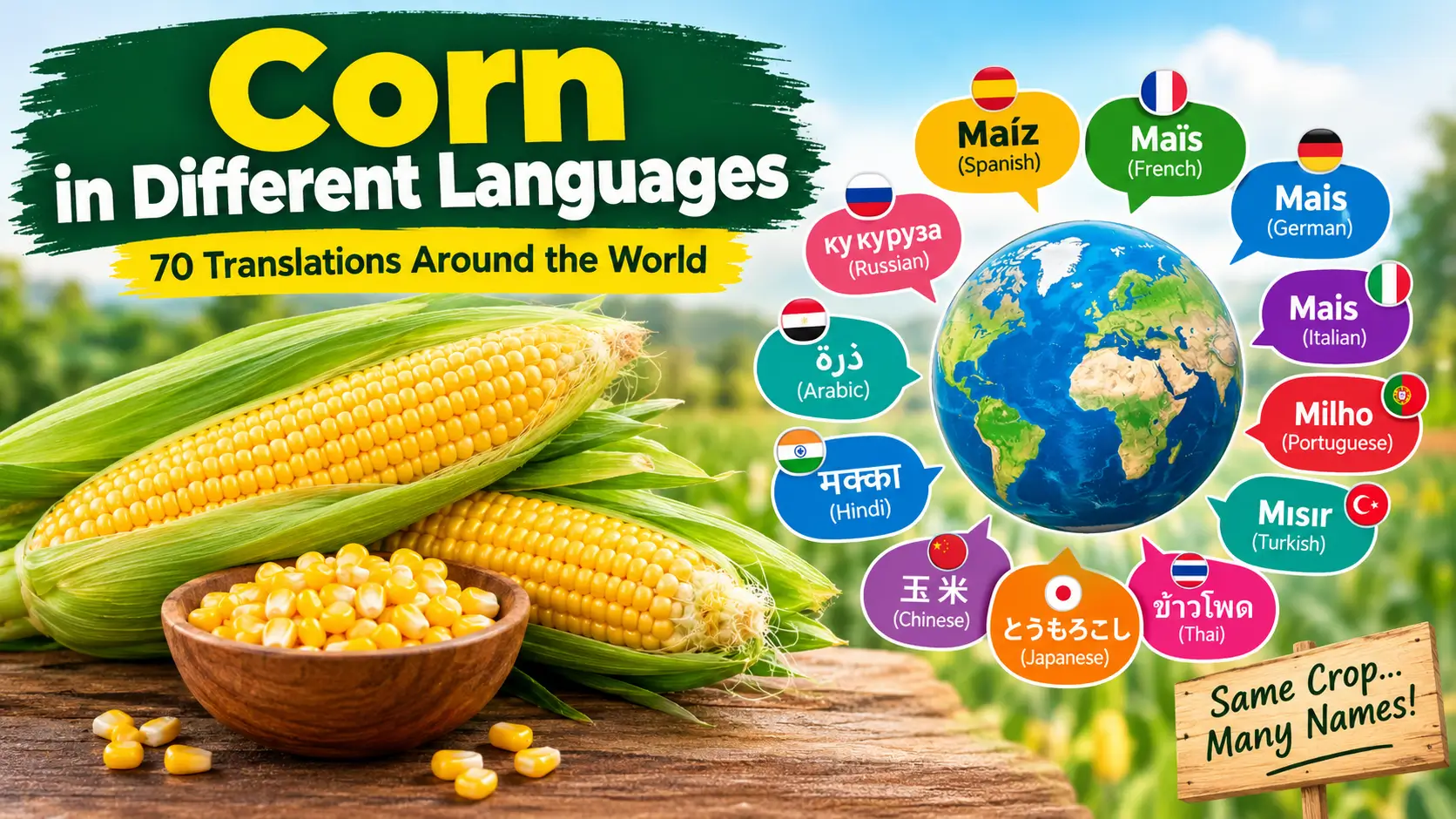
Corn is one of the world’s most widely grown and recognized crops. Whether you mean the golden kernels eaten as a vegetable, the crop grown for animal feed, or maize used in traditional foods, the word has fascinating equivalents across languages.
If you are searching for corn in different languages, this guide provides 70 useful translations with easy English pronunciations and short real-life examples. It is helpful for language learners, travelers, writers, students, and anyone interested in how everyday food words change around the world.
Corn in All Languages
The English word corn can refer to maize in many parts of the world. In some languages, the exact word may vary depending on whether the speaker means maize as a crop, corn on the cob, or sweet corn.
Here is a practical list of corn translations in 70 languages.
| # | Language | Native word for corn | Easy English pronunciation | Example sentence | English meaning |
|---|---|---|---|---|---|
| 1 | Spanish | maíz | mah-EES | El maíz crece rápidamente. | The corn grows quickly. |
| 2 | French | maïs | mah-EES | Le maïs est prêt à être récolté. | The corn is ready to be harvested. |
| 3 | German | Mais | myce | Der Mais wächst auf diesem Feld. | The corn grows in this field. |
| 4 | Italian | mais | mice | Il mais cresce bene qui. | The corn grows well here. |
| 5 | Portuguese | milho | MEEL-yoo | O milho está fresco. | The corn is fresh. |
| 6 | Dutch | maïs | mice | De maïs groeit goed. | The corn is growing well. |
| 7 | Afrikaans | mielies | MEE-leece | Die mielies is vars. | The corn is fresh. |
| 8 | Swedish | majs | mice | Majsen växer snabbt. | The corn grows quickly. |
| 9 | Norwegian | mais | myce | Maisen vokser godt. | The corn grows well. |
| 10 | Danish | majs | mice | Majsen er klar. | The corn is ready. |
| 11 | Icelandic | maís | MICE | Maísinn vex vel. | The corn grows well. |
| 12 | Finnish | maissi | MYE-see | Maissi kasvaa hyvin. | The corn grows well. |
| 13 | Estonian | mais | mice | Mais kasvab siin hästi. | Corn grows well here. |
| 14 | Latvian | kukurūza | koo-koo-ROO-zah | Kukurūza aug laukā. | Corn grows in the field. |
| 15 | Lithuanian | kukurūzai | koo-koo-ROO-zai | Kukurūzai auga greitai. | Corn grows quickly. |
| 16 | Polish | kukurydza | koo-koo-RID-zah | Kukurydza rośnie wysoko. | The corn grows tall. |
| 17 | Czech | kukuřice | KOO-koo-rzhit-seh | Kukuřice roste rychle. | The corn grows quickly. |
| 18 | Slovak | kukurica | KOO-koo-rit-sah | Kukurica rastie dobre. | The corn grows well. |
| 19 | Slovenian | koruza | koh-ROO-zah | Koruza hitro raste. | The corn grows quickly. |
| 20 | Croatian | kukuruz | KOO-koo-rooz | Kukuruz je zreo. | The corn is ripe. |
| 21 | Serbian | кукуруз | KOO-koo-rooz | Kukuruz je svež. | The corn is fresh. |
| 22 | Bosnian | kukuruz | KOO-koo-rooz | Kukuruz je spreman. | The corn is ready. |
| 23 | Bulgarian | царевица | tsah-REH-vee-tsah | Царевицата расте бързо. | The corn grows quickly. |
| 24 | Macedonian | пченка | PCHEN-kah | Пченката е свежа. | The corn is fresh. |
| 25 | Romanian | porumb | poh-ROOMB | Porumbul este copt. | The corn is ripe. |
| 26 | Hungarian | kukorica | KOO-koh-ree-tsah | A kukorica gyorsan nő. | The corn grows quickly. |
| 27 | Greek | καλαμπόκι | kah-lahm-BOH-kee | Το καλαμπόκι είναι φρέσκο. | The corn is fresh. |
| 28 | Albanian | misër | MEE-suhr | Misri është i freskët. | The corn is fresh. |
| 29 | Russian | кукуруза | koo-koo-ROO-zah | Кукуруза растет быстро. | The corn grows quickly. |
| 30 | Ukrainian | кукурудза | koo-koo-ROOD-zah | Кукурудза росте швидко. | The corn grows quickly. |
| 31 | Belarusian | кукуруза | koo-koo-ROO-zah | Кукуруза добра расце. | The corn grows well. |
| 32 | Armenian | եգիպտացորեն | yeh-gip-tah-tso-REN | Եգիպտացորենը հասել է։ | The corn is ripe. |
| 33 | Georgian | სიმინდი | see-MEEN-dee | სიმინდი კარგად იზრდება. | The corn grows well. |
| 34 | Turkish | mısır | muh-SUHR | Mısır tarlada büyüyor. | The corn is growing in the field. |
| 35 | Azerbaijani | qarğıdalı | gahr-guh-dah-LUH | Qarğıdalı tez böyüyür. | The corn grows quickly. |
| 36 | Persian | ذرت | zor-RET | ذرت تازه است. | The corn is fresh. |
| 37 | Arabic | ذرة | DHUR-rah | الذرة طازجة. | The corn is fresh. |
| 38 | Hebrew | תירס | tee-RESS | התירס טרי. | The corn is fresh. |
| 39 | Hindi | मक्का | MAK-kah | मक्का खेत में उगता है। | Corn grows in the field. |
| 40 | Urdu | مکئی | muh-KAI | مکئی کھیت میں اگتی ہے۔ | Corn grows in the field. |
| 41 | Bengali | ভুট্টা | BHOOT-tah | ভুট্টা খুব ভালো হয়েছে। | The corn has grown very well. |
| 42 | Punjabi | ਮੱਕੀ | MAK-kee | ਮੱਕੀ ਖੇਤ ਵਿੱਚ ਉੱਗਦੀ ਹੈ। | Corn grows in the field. |
| 43 | Gujarati | મકાઈ | muh-KAI | મકાઈ ખેતરમાં ઉગે છે. | Corn grows in the field. |
| 44 | Marathi | मका | muh-KAH | मका शेतात वाढतो. | Corn grows in the field. |
| 45 | Nepali | मकै | muh-KAI | मकै खेतमा उम्रन्छ। | Corn grows in the field. |
| 46 | Sinhala | බඩ ඉරිඟු | bahd ee-RIN-goo | බඩ ඉරිඟු නැවුම් ය. | The corn is fresh. |
| 47 | Tamil | சோளம் | SOH-lum | சோளம் வயலில் வளர்கிறது. | Corn grows in the field. |
| 48 | Telugu | మొక్కజొన్న | mok-kuh-JON-nah | మొక్కజొన్న పొలంలో పెరుగుతుంది. | Corn grows in the field. |
| 49 | Kannada | ಜೋಳ | JOH-lah | ಜೋಳ ಹೊಲದಲ್ಲಿ ಬೆಳೆಯುತ್ತದೆ. | Corn grows in the field. |
| 50 | Malayalam | ചോളം | CHOH-lum | ചോളം വയലിൽ വളരുന്നു. | Corn grows in the field. |
| 51 | Odia | ମକା | muh-KAH | ମକା କ୍ଷେତରେ ବଢ଼େ। | Corn grows in the field. |
| 52 | Assamese | মাকৈ | mah-KAI | মাকৈ খেতিত গজে। | Corn grows in the field. |
| 53 | Thai | ข้าวโพด | kâao-phôht | ข้าวโพดสดมาก | The corn is very fresh. |
| 54 | Lao | ເຂົ້າໂພດ | khao-phot | ເຂົ້າໂພດສົດຫຼາຍ | The corn is very fresh. |
| 55 | Khmer | ពោត | poht | ពោតស្រស់ណាស់។ | The corn is very fresh. |
| 56 | Vietnamese | ngô | ngoh | Ngô rất tươi. | The corn is very fresh. |
| 57 | Indonesian | jagung | jah-GOONG | Jagung ini segar. | This corn is fresh. |
| 58 | Malay | jagung | jah-goong | Jagung ini manis. | This corn is sweet. |
| 59 | Filipino | mais | mah-EES | Ang mais ay sariwa. | The corn is fresh. |
| 60 | Javanese | jagung | jah-GOONG | Jagung iki seger. | This corn is fresh. |
| 61 | Chinese (Mandarin) | 玉米 | yùmǐ | 玉米很新鲜。 | The corn is very fresh. |
| 62 | Japanese | とうもろこし | tōmorokoshi | とうもろこしは新鮮です。 | The corn is fresh. |
| 63 | Korean | 옥수수 | oksusu | 옥수수가 신선해요. | The corn is fresh. |
| 64 | Mongolian | эрдэнэ шиш | erdene shish | Эрдэнэ шиш шинэхэн байна. | The corn is fresh. |
| 65 | Swahili | mahindi | mah-HIN-dee | Mahindi haya ni mabichi. | This corn is fresh. |
| 66 | Zulu | ummbila | oom-BEE-lah | Umbila usha. | The corn is fresh. |
| 67 | Xhosa | umbona | oom-BOH-nah | Umbona mtsha. | The corn is fresh. |
| 68 | Yoruba | agbado | ahg-BAH-doh | Agbado náà jẹ́ tuntun. | The corn is fresh. |
| 69 | Igbo | ọka | AW-kah | Ọka a dị ọhụrụ. | This corn is fresh. |
| 70 | Hawaiian | kulina | koo-LEE-nah | He hou ka kulina. | The corn is fresh. |
How to Say Corn in Different Languages
The most common translations of corn vary considerably between language families. For example, Spanish and French use forms derived from maíz, while German, Italian, Dutch, Norwegian, and Danish use forms related to Mais.
In South and Southeast Asia, several languages use completely different native terms. Hindi uses मक्का, Urdu uses مکئی, Bengali uses ভুট্টা, Thai uses ข้าวโพด, and Indonesian uses jagung.
East Asian languages also have distinctive words. Mandarin Chinese uses 玉米, Japanese uses とうもろこし, and Korean uses 옥수수.
These differences make food vocabulary particularly interesting for language learners because a familiar crop can have very different names depending on the region.
Corn Translations in European Languages
European languages show several interesting patterns.
Spanish and French use maíz and maïs, respectively. Portuguese uses milho, while Italian commonly uses mais. German uses Mais, as do several Scandinavian languages with closely related forms.
In Central and Eastern Europe, words such as kukurydza, kukuřice, kukurica, and kukurica-related forms are common. Romanian uses porumb, while Greek uses καλαμπόκι.
This variety demonstrates that there is no single universal word for corn, even among neighboring countries.
Corn Around the World
Corn is deeply connected with food, farming, trade, and traditional cuisine around the world.
In North and South America, maize has an especially important historical and cultural role. It is used in foods such as tortillas, tamales, cornbread, arepas, and many regional dishes.
Across Africa, corn is also an important staple. It can be ground into flour, cooked into porridge, or served as part of traditional meals.
In Asia, corn appears in soups, snacks, desserts, street foods, and fresh dishes. Sweet corn is especially popular in many modern cuisines.
Because corn is used in so many different ways, knowing its name in another language can be useful when shopping, traveling, reading recipes, or communicating about food.
Corn, Maize, and Sweet Corn: What Is the Difference?
The words corn and maize can sometimes cause confusion.
In international English, maize generally refers specifically to the crop known scientifically as Zea mays. In American English, corn is the everyday word most commonly used for maize.
The word corn can also have different meanings historically. In older British usage, it could refer more broadly to a major cereal crop. Today, when people discuss the crop commonly associated with yellow kernels, corn usually means maize.
Sweet corn is a particular type of corn harvested while the kernels are still tender and sweet. It is commonly eaten fresh, canned, or frozen.
Why Learn Corn in Different Languages?
Learning food vocabulary is one of the easiest ways to expand practical language skills.
Knowing how to say corn in different languages can help you:
- Understand food labels while traveling.
- Communicate when shopping at local markets.
- Read international recipes.
- Learn agricultural vocabulary.
- Improve everyday conversation.
- Understand cultural differences in food.
- Build a stronger multilingual vocabulary.
For students, food terms are also useful because they appear frequently in everyday conversations and written material.
Common Uses of the Word Corn
The word corn can describe several everyday situations.
You might talk about fresh corn, sweet corn, corn on the cob, corn flour, cornmeal, or a corn field.
For example, a traveler might ask about corn at a local market. A chef might look for corn while preparing a recipe. A farmer may discuss corn production or harvesting.
The exact translation can therefore depend on the context and the variety of corn being discussed.
Tips for Learning Corn Translations
A simple way to remember food vocabulary is to connect each word with an image or real-life situation.
For example, associate the Spanish maíz with a corn field, the Hindi मक्का with a traditional food market, or the Japanese とうもろこし with corn sold at a summer festival.
Writing short sentences is another effective method. Instead of memorizing only the word, practice a phrase such as “The corn is fresh” or “I bought corn today.”
This approach helps you remember both vocabulary and sentence structure.
Frequently Asked Questions About Corn in Different Languages
1. What is corn called in Spanish?
Corn is called maíz in Spanish. It is a common word used for maize and appears frequently in discussions about food, farming, and traditional dishes.
2. What is corn called in French?
Corn is called maïs in French. The word is used when referring to maize, including the crop and its uses as food.
3. What is corn called in Hindi?
Corn is commonly called मक्का (makkā) in Hindi. The term is widely used for maize and corn as an agricultural and food product.
4. What is corn called in Chinese?
In Mandarin Chinese, corn is 玉米 (yùmǐ). This is the standard everyday term for maize or corn.
5. What is corn called in Japanese?
Corn is called とうもろこし (tōmorokoshi) in Japanese. It is commonly used for the familiar edible corn sold fresh or prepared in dishes.
Conclusion
Learning corn in different languages is a simple way to explore how languages, food, farming, and culture connect. From maíz in Spanish to 玉米 in Mandarin and とうもろこし in Japanese, the same familiar crop has many different names around the world.
Whether you are learning a language, preparing for travel, studying food vocabulary, or simply exploring corn around the world, these 70 translations provide a useful starting point for understanding this globally important food and crop.

I am Ricardo Hunter, Administrator at LingoBuz, passionate about languages, translations, and global communication. I help create useful, clear content that makes exploring different languages simple, enjoyable, and accessible.