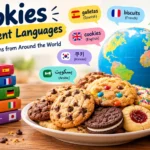
Cookies are one of the most popular sweet treats around the world, but the word used for them changes from language to language. If you are learning a new language, traveling, creating multilingual content, or simply curious about global vocabulary, knowing how to say “cookies” in different languages can be surprisingly useful.
In some languages, cookies have a word that directly refers to a baked biscuit or sweet snack. In others, the everyday term may be borrowed from another language or vary depending on the type of cookie.
Below, you will find cookies in all languages in one easy-to-read table. Each translation includes the native word, an easy English pronunciation, a practical example sentence, and the English meaning of that sentence.
Cookies in Different Languages
The following table shows 70 cookies translations from languages spoken across Europe, Asia, Africa, the Middle East, and the Americas.
| # | Language | Native phrase | Easy English pronunciation | Example sentence | English meaning |
|---|---|---|---|---|---|
| 1 | Spanish | galletas | gah-YEH-tahs | Me gustan las galletas. | I like cookies. |
| 2 | French | biscuits | bee-SKEE | J’aime les biscuits. | I like cookies. |
| 3 | German | Kekse | KEK-suh | Ich mag Kekse. | I like cookies. |
| 4 | Italian | biscotti | bee-SKOT-tee | Mi piacciono i biscotti. | I like cookies. |
| 5 | Portuguese | biscoitos | bees-KOY-tohs | Eu gosto de biscoitos. | I like cookies. |
| 6 | Dutch | koekjes | KOOK-yuhs | Ik hou van koekjes. | I love cookies. |
| 7 | Swedish | kakor | KAH-kor | Jag gillar kakor. | I like cookies. |
| 8 | Norwegian | kjeks | CHEKS | Jeg liker kjeks. | I like cookies. |
| 9 | Danish | småkager | SMOH-kay-er | Jeg kan lide småkager. | I like cookies. |
| 10 | Finnish | keksit | KEK-sit | Pidän kekseistä. | I like cookies. |
| 11 | Icelandic | smákökur | SMAU-kur | Mér finnst smákökur góðar. | I think cookies are good. |
| 12 | Estonian | küpsised | KURP-see-sed | Mulle meeldivad küpsised. | I like cookies. |
| 13 | Latvian | cepumi | TSEH-poo-mee | Man garšo cepumi. | I like cookies. |
| 14 | Lithuanian | sausainiai | sow-SAI-nye | Man patinka sausainiai. | I like cookies. |
| 15 | Polish | ciasteczka | chas-TECH-kah | Lubię ciasteczka. | I like cookies. |
| 16 | Czech | sušenky | SOO-shen-kee | Mám rád sušenky. | I like cookies. |
| 17 | Slovak | sušienky | SOO-shyen-kee | Mám rád sušienky. | I like cookies. |
| 18 | Slovenian | piškoti | PISH-koh-tee | Rad imam piškote. | I like cookies. |
| 19 | Croatian | keksi | KEK-see | Volim kekse. | I like cookies. |
| 20 | Serbian | кекси | KEK-see | Волим кексе. | I like cookies. |
| 21 | Bulgarian | бисквити | bees-KVEE-tee | Обичам бисквити. | I love cookies. |
| 22 | Macedonian | колачиња | koh-LAH-chee-nyah | Сакам колачиња. | I like cookies. |
| 23 | Romanian | biscuiți | bees-KWITS | Îmi plac biscuiții. | I like cookies. |
| 24 | Hungarian | sütemények | SHOO-teh-may-nyek | Szeretem a süteményeket. | I like pastries and cookies. |
| 25 | Greek | μπισκότα | bee-SKOH-tah | Μου αρέσουν τα μπισκότα. | I like cookies. |
| 26 | Albanian | biskota | bees-KOH-tah | Më pëlqejnë biskotat. | I like cookies. |
| 27 | Russian | печенье | peh-CHEH-nyuh | Я люблю печенье. | I love cookies. |
| 28 | Ukrainian | печиво | peh-CHY-voh | Я люблю печиво. | I love cookies. |
| 29 | Belarusian | печыва | peh-CHY-vah | Я люблю печыва. | I love cookies. |
| 30 | Armenian | թխվածքաբլիթներ | tukh-vats-kah-BLEET-ner | Ես սիրում եմ թխվածքաբլիթներ։ | I love cookies. |
| 31 | Georgian | ორცხობილა | orts-khee-BEE-lah | მე მიყვარს ორცხობილა. | I love cookies. |
| 32 | Turkish | kurabiyeler | koo-rah-bee-yeh-LER | Kurabiyeleri seviyorum. | I like cookies. |
| 33 | Azerbaijani | peçenyelər | peh-chen-yeh-LER | Mən peçenyeləri sevirəm. | I like cookies. |
| 34 | Persian | کلوچهها | keh-loo-CHEH-hah | من کلوچهها را دوست دارم. | I like cookies. |
| 35 | Arabic | بسكويت | bas-KWEE-t | أحب البسكويت. | I love cookies. |
| 36 | Hebrew | עוגיות | oo-gee-YOT | אני אוהב עוגיות. | I love cookies. |
| 37 | Hindi | कुकीज़ | koo-keez | मुझे कुकीज़ पसंद हैं। | I like cookies. |
| 38 | Urdu | کوکیز | KOH-keez | مجھے کوکیز پسند ہیں۔ | I like cookies. |
| 39 | Bengali | কুকিজ | KOO-kij | আমি কুকিজ পছন্দ করি। | I like cookies. |
| 40 | Punjabi | ਕੂਕੀਜ਼ | KOO-keez | ਮੈਨੂੰ ਕੂਕੀਜ਼ ਪਸੰਦ ਹਨ। | I like cookies. |
| 41 | Gujarati | કૂકીઝ | KOO-keez | મને કૂકીઝ ગમે છે. | I like cookies. |
| 42 | Marathi | कुकीज | KOO-keez | मला कुकीज आवडतात. | I like cookies. |
| 43 | Nepali | कुकीहरू | KOO-kee-har-oo | मलाई कुकीहरू मन पर्छ। | I like cookies. |
| 44 | Sinhala | කුකීස් | KOO-kees | මම කුකීස් වලට කැමතියි. | I like cookies. |
| 45 | Tamil | குக்கீகள் | KOO-kee-gal | எனக்கு குக்கீகள் பிடிக்கும். | I like cookies. |
| 46 | Telugu | కుకీలు | KOO-kee-loo | నాకు కుకీలు ఇష్టం. | I like cookies. |
| 47 | Kannada | ಕುಕೀಸ್ | KOO-kees | ನನಗೆ ಕುಕೀಸ್ ಇಷ್ಟ. | I like cookies. |
| 48 | Malayalam | കുക്കികൾ | KOO-kee-kal | എനിക്ക് കുക്കികൾ ഇഷ്ടമാണ്. | I like cookies. |
| 49 | Thai | คุกกี้ | kook-GEE | ฉันชอบคุกกี้ | I like cookies. |
| 50 | Vietnamese | bánh quy | ban kwee | Tôi thích bánh quy. | I like cookies. |
| 51 | Indonesian | kue kering | KOO-eh kuh-RING | Saya suka kue kering. | I like cookies. |
| 52 | Malay | biskut | BIS-koot | Saya suka biskut. | I like cookies. |
| 53 | Filipino | cookies | KOO-keez | Gusto ko ang cookies. | I like cookies. |
| 54 | Chinese | 饼干 | bing-gahn | 我喜欢饼干。 | I like cookies. |
| 55 | Japanese | クッキー | KUK-kee | 私はクッキーが好きです。 | I like cookies. |
| 56 | Korean | 쿠키 | KOO-kee | 저는 쿠키를 좋아해요. | I like cookies. |
| 57 | Mongolian | жигнэмэг | JIG-neh-meg | Би жигнэмэгт дуртай. | I like cookies. |
| 58 | Swahili | biskuti | bee-SKOO-tee | Ninapenda biskuti. | I like cookies. |
| 59 | Afrikaans | koekies | KOO-kees | Ek hou van koekies. | I love cookies. |
| 60 | Zulu | amakhukhi | ah-mah-KOO-khee | Ngiyawathanda amakhukhi. | I like cookies. |
| 61 | Xhosa | amaqebengwana | ah-mah-keh-beng-GWAH-nah | Ndiyawathanda amaqebengwana. | I like cookies. |
| 62 | Somali | buskud | BOOS-kood | Waxaan jeclahay buskud. | I like cookies. |
| 63 | Hausa | biskit | BIS-kit | Ina son biskit. | I like cookies. |
| 64 | Yoruba | bísíkítì | bee-SEE-kee-tee | Mo fẹ́ràn bísíkítì. | I like cookies. |
| 65 | Igbo | bisiki | bee-SEE-kee | A na m ahụ bisiki n’anya. | I like cookies. |
| 66 | Amharic | ኩኪዎች | koo-kee-woch | ኩኪዎችን እወዳለሁ። | I love cookies. |
| 67 | Haitian Creole | bonbon | bon-BON | Mwen renmen bonbon. | I like cookies. |
| 68 | Esperanto | kuketoj | koo-KEH-toy | Mi ŝatas kuketojn. | I like cookies. |
| 69 | Latin | crustula | kroos-too-lah | Crustula amo. | I love cookies. |
| 70 | Irish | fianáin | FEE-ah-nawn | Is maith liom fianáin. | I like cookies. |
How to Say Cookies in Different Languages
The easiest way to learn how to say cookies in different languages is to notice patterns. Many European languages use words related to biscuits, baked goods, or small cakes.
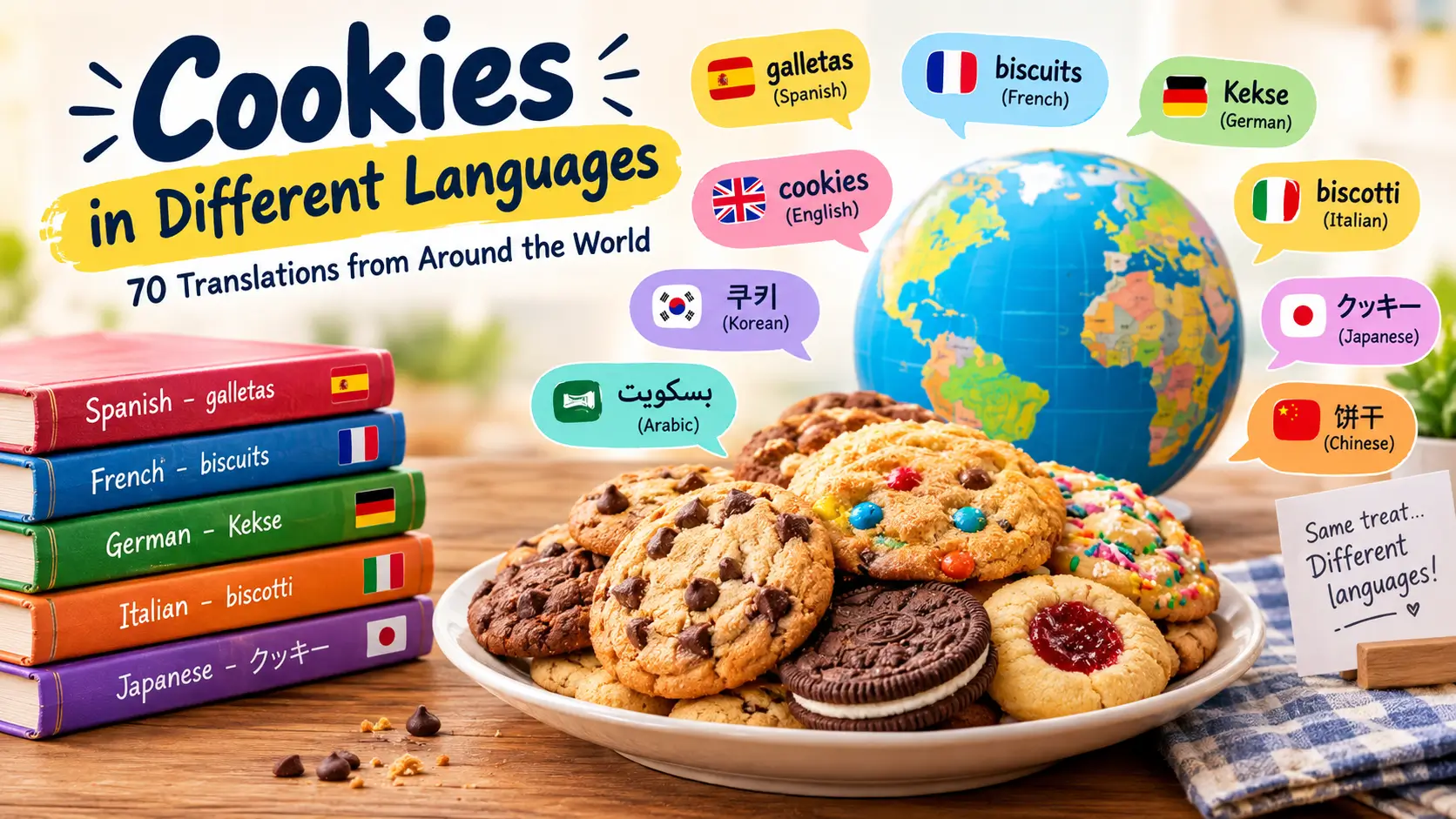
For example, Spanish uses galletas, French commonly uses biscuits, German uses Kekse, Italian uses biscotti, and Polish uses ciasteczka.
In several Asian languages, the modern word for cookies is influenced by international vocabulary. Japanese uses クッキー, Korean uses 쿠키, and Hindi commonly uses कुकीज़.
The exact word can sometimes depend on the type of cookie, regional usage, or whether you mean a homemade cookie, a packaged biscuit, or another baked snack.
Cookies Around the World
Cookies are enjoyed in many different forms around the world. The ingredients and preparation methods may change, but common ingredients include flour, sugar, butter or other fats, eggs, chocolate, nuts, spices, and dried fruit.
Some cultures prefer crisp cookies, while others have soft, chewy, filled, or cake-like varieties. Local traditions can also influence the vocabulary used to describe them.
This is why cookies around the world can have many different names even when the basic idea is familiar.
Cookies vs. Biscuits in Different Languages
One important translation detail is the difference between “cookie” and “biscuit.”
In American English, a cookie is generally a sweet baked snack. In British English, the word “biscuit” is commonly used for many foods that Americans would call cookies.
Other languages do not always make exactly the same distinction. A single local word may cover several types of sweet baked goods.
Therefore, when learning cookies translations, context is important. A dictionary translation may be correct, but the everyday word used by native speakers can vary according to the food being discussed.
Why Learn Cookies in All Languages?
Learning the word for cookies in multiple languages can be useful for several reasons.
Travel
If you visit another country, knowing basic food vocabulary can make shopping, ordering, and reading menus easier.
Language Learning
Food words are practical vocabulary because they appear frequently in everyday conversations, recipes, grocery stores, and restaurants.
Cultural Understanding
Different names for cookies can reveal how languages describe food and how culinary traditions develop.
Multilingual Content
Bloggers, educators, translators, and businesses can use multilingual food vocabulary when creating content for international audiences.
Common Cookie Vocabulary
When learning how to say cookies in another language, it can also help to learn related words such as:
- cookie
- biscuit
- chocolate chip cookie
- homemade cookies
- sweet
- dessert
- bakery
- recipe
- flour
- sugar
- chocolate
- snack
Knowing related vocabulary makes it easier to create natural sentences instead of memorizing one isolated translation.
How to Use Cookie Translations Naturally
A translation is most useful when you know how to use it in a sentence.
For example, instead of only memorizing the word for cookies, learn a simple expression such as “I like cookies,” “These cookies are delicious,” or “I made cookies today.”
This approach helps you understand grammar, pronunciation, and everyday usage at the same time.
Remember that plural forms can change according to the grammar of each language. Some languages also use different forms depending on gender, case, number, or sentence structure.
Frequently Asked Questions
1. How do you say “cookies” in different languages?
“Cookies” has different translations depending on the language. Examples include galletas in Spanish, biscuits in French, Kekse in German, biscotti in Italian, クッキー in Japanese, 쿠키 in Korean, and 饼干 in Chinese.
2. What is the most common word for cookies around the world?
There is no single word that is used universally. Many languages have their own traditional terms, while others use words influenced by international vocabulary. The appropriate translation depends on the language and regional context.
3. Are cookies and biscuits the same thing?
They can refer to similar foods, but the distinction depends on the variety of English and the local language. American English generally uses “cookie” for many sweet baked snacks, while British English commonly uses “biscuit.”
4. How can I learn cookie vocabulary in another language?
Start by memorizing the native word and then practice it in a short everyday sentence. Learning related food words and listening to native speakers can also help you use the vocabulary naturally.
5. Why are cookie translations different across languages?
Languages develop their own words based on local food traditions, historical influences, borrowing from other languages, and regional usage. As a result, the same type of food can have completely different names in different parts of the world.
Conclusion
Learning cookies in different languages is a simple way to expand practical vocabulary while discovering how cultures describe familiar foods. From Spanish galletas and French biscuits to Japanese クッキー and Chinese 饼干, each language offers its own way to express the idea.
Whether you are studying languages, traveling, writing multilingual content, or simply exploring cookies in all languages, this 70-language list provides a useful starting point for everyday communication.

I am Scarlett Wilson, a passionate language writer who loves exploring different languages, words, meanings, translations, and useful phrases. I enjoy making language learning simple, clear, and interesting for everyone.